


Publications
Publications
Category
Year
Newsletter (Gender In Focus)
Gender in Focus
- March , 2021
- IWWAGE
IWWAGE has partnered with the University of Bath on WorkFREE to test how unconditional cash transfers affect workers in exploitative jobs like waste picking, supported through research over the next 2.5 years. It has also expanded work on gender budgeting and policy solutions—covering gender-responsive financing, urban employment guarantees, post-COVID childcare, and women’s collective responses—while scaling gender resource centres in Madhya Pradesh with Anandi and the State Rural Livelihoods Mission.
IWWAGE has partnered with the University of Bath on WorkFREE to test how unconditional cash transfers affect workers in exploitative jobs like waste picking, supported through research over the next 2.5 years. It has also expanded work on gender budgeting and policy solutions—covering gender-responsive financing, urban employment guarantees, post-COVID childcare, and women’s collective responses—while scaling gender resource centres in Madhya Pradesh with Anandi and the State Rural Livelihoods Mission.
Learning note
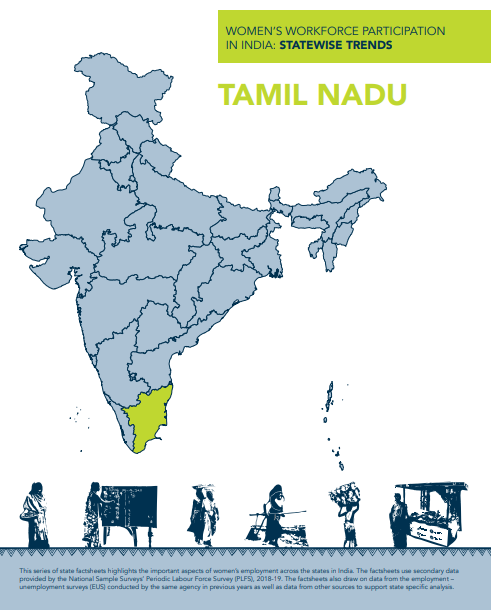
Women’s Workforce Participation in India: Statewise Trends
- March , 2021
- Nidhi Gyan Pandey
Tamil Nadu, the second-largest economy in India with a GSDP of Rs 18,45,853 crores, is known for combining rapid economic growth with high social development. The state boasts strong public services, ranking third in human development and literacy (96.8%) among all states. Tamil Nadu’s female labour force participation rates (FLFPR) are significantly higher than the national average, with rural FLFPR at 35.1% and urban FLFPR at 23.6%. The state also excels in gender indicators, with a low maternal mortality rate of 66 and the third lowest crime rate against women in the country.
Tamil Nadu, the second-largest economy in India with a GSDP of Rs 18,45,853 crores, is known for combining rapid economic growth with high social development. The state boasts strong public services, ranking third in human development and literacy (96.8%) among all states. Tamil Nadu’s female labour force participation rates (FLFPR) are significantly higher than the national average, with rural FLFPR at 35.1% and urban FLFPR at 23.6%. The state also excels in gender indicators, with a low maternal mortality rate of 66 and the third lowest crime rate against women in the country.
IWWAGE-ISST-BRIEFS
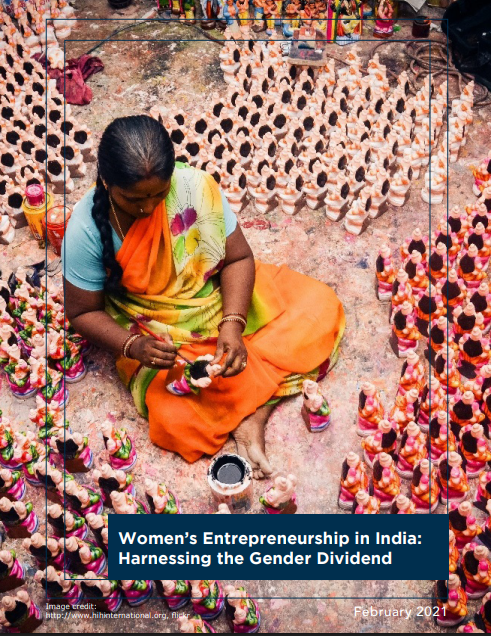
Women’s Entrepreneurship in India: Harnessing the Gender Dividend
- March , 2021
- Sanjana Vijay , Mridulya Narasimhan
India’s economic growth has largely bypassed its smallest enterprises-particularly those led by women. Despite an increase in the number of micro, small, and medium enterprises (MSMEs), only 21.5% were owned by women as of 2018-19. Even more concerning is the stagnation in growth: between 2010 and 2015, the share of women-led enterprises and their gross value added (GVA) remained static, while the share of workers in these enterprises declined. Women entrepreneurs face layered barriers-from deep-rooted social norms and gender biases to unequal access to education, credit, and networks. For many women, entrepreneurship is not a path to scale but a survivalist response to limited employment opportunities, wage inequality, and inflexible work conditions. India ranked 49th out of 57 countries in the 2020 Mastercard Index of Women Entrepreneurs-a stark reflection of the odds stacked against women in the entrepreneurial landscape. To enable women to thrive as entrepreneurs, we must address structural and cultural challenges. Key recommendations include: – Challenging restrictive gender norms and stereotypes; – Ensuring better access to education and digital literacy; – Expanding affordable and inclusive financing mechanisms; – Creating women-friendly business networks and incubators; – Leveraging technology to connect women to markets, mentorship, and information. Enabling women to realise their entrepreneurial ambitions is not only a matter of equity-it is essential for India’s inclusive and sustainable economic growth.
India’s economic growth has largely bypassed its smallest enterprises-particularly those led by women. Despite an increase in the number of micro, small, and medium enterprises (MSMEs), only 21.5% were owned by women as of 2018-19. Even more concerning is the stagnation in growth: between 2010 and 2015, the share of women-led enterprises and their gross value added (GVA) remained static, while the share of workers in these enterprises declined. Women entrepreneurs face layered barriers-from deep-rooted social norms and gender biases to unequal access to education, credit, and networks. For many women, entrepreneurship is not a path to scale but a survivalist response to limited employment opportunities, wage inequality, and inflexible work conditions. India ranked 49th out of 57 countries in the 2020 Mastercard Index of Women Entrepreneurs-a stark reflection of the odds stacked against women in the entrepreneurial landscape. To enable women to thrive as entrepreneurs, we must address structural and cultural challenges. Key recommendations include: – Challenging restrictive gender norms and stereotypes; – Ensuring better access to education and digital literacy; – Expanding affordable and inclusive financing mechanisms; – Creating women-friendly business networks and incubators; – Leveraging technology to connect women to markets, mentorship, and information. Enabling women to realise their entrepreneurial ambitions is not only a matter of equity-it is essential for India’s inclusive and sustainable economic growth.

IWWAGE-ISST-BRIEFS
Women and Unpaid Work
- March , 2021
- Monika Banerjee , Ahana Chakrabarti
Women’s workforce participation in India has been consistently low-and steadily declining over the last 15 years, as recorded by official surveys like those conducted by the National Sample Survey Office (NSSO) and the Periodic Labour Force Survey (PLFS). However, these numbers fail to capture the full extent of women’s economic contributions, largely because they exclude unpaid work-domestic chores, caregiving, and community roles-that women perform on a daily basis. Feminist scholars have long advocated for the recognition, reduction, and redistribution of unpaid work as essential steps toward achieving gender equality. If the definition of work is expanded to include these invisible activities, it becomes evident that many more women are contributing to the economy than current statistics suggest. The COVID-19 pandemic further exacerbated these inequalities. As homes transformed into sites of both work and survival, women’s unpaid workload increased significantly. A Rapid Assessment Survey conducted by the Institute of Social Studies Trust (ISST) in Delhi found that women in urban informal sectors-such as domestic work, waste picking, street vending, and construction-reported a significant rise in unpaid responsibilities, including childcare, eldercare, and food provisioning. Despite other family members being at home, women continued to shoulder the majority of domestic work, often with little or no help. To build a more inclusive and equitable economy, it is critical to recognise and value unpaid labour and ensure that data and policy frameworks reflect the full spectrum of women’s work.
Women’s workforce participation in India has been consistently low-and steadily declining over the last 15 years, as recorded by official surveys like those conducted by the National Sample Survey Office (NSSO) and the Periodic Labour Force Survey (PLFS). However, these numbers fail to capture the full extent of women’s economic contributions, largely because they exclude unpaid work-domestic chores, caregiving, and community roles-that women perform on a daily basis. Feminist scholars have long advocated for the recognition, reduction, and redistribution of unpaid work as essential steps toward achieving gender equality. If the definition of work is expanded to include these invisible activities, it becomes evident that many more women are contributing to the economy than current statistics suggest. The COVID-19 pandemic further exacerbated these inequalities. As homes transformed into sites of both work and survival, women’s unpaid workload increased significantly. A Rapid Assessment Survey conducted by the Institute of Social Studies Trust (ISST) in Delhi found that women in urban informal sectors-such as domestic work, waste picking, street vending, and construction-reported a significant rise in unpaid responsibilities, including childcare, eldercare, and food provisioning. Despite other family members being at home, women continued to shoulder the majority of domestic work, often with little or no help. To build a more inclusive and equitable economy, it is critical to recognise and value unpaid labour and ensure that data and policy frameworks reflect the full spectrum of women’s work.
Working Paper
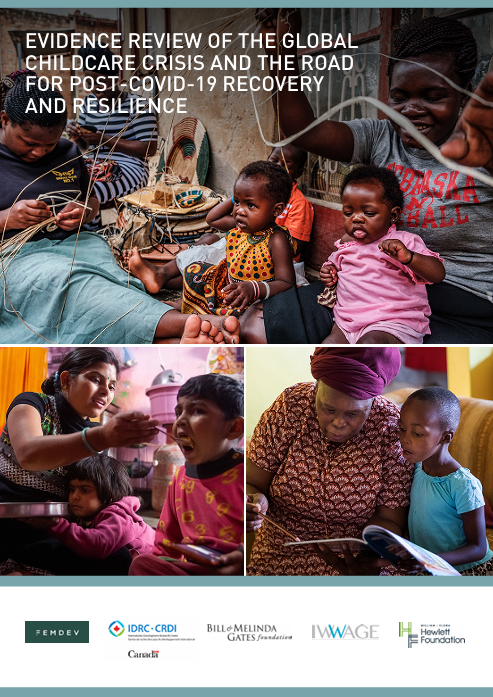
Evidence Review of the Global Childcare Crisis and the Road for post COVID- 19 Recovery and Resilience
- March , 2021
- Kate Grantham, Leva Rouhani and Neelanjana Gupta
A year into the pandemic, COVID-19 has severely reversed progress on women’s livelihoods by intensifying unpaid care work and triggering a global childcare crisis. With widespread school closures and limited childcare services, women—especially those in low-income, informal, rural, or marginalized groups—have faced rising time burdens, job losses, and reduced labour force participation. Female-dominated childcare services have also been hit hard, reducing both access to care and employment opportunities. Despite its central role in supporting households and economic growth, childcare remains undervalued and underfunded. Urgent public, private, and donor action is needed to address unpaid care, rebuild childcare services, and integrate childcare into inclusive COVID-19 recovery efforts.
A year into the pandemic, COVID-19 has severely reversed progress on women’s livelihoods by intensifying unpaid care work and triggering a global childcare crisis. With widespread school closures and limited childcare services, women—especially those in low-income, informal, rural, or marginalized groups—have faced rising time burdens, job losses, and reduced labour force participation. Female-dominated childcare services have also been hit hard, reducing both access to care and employment opportunities. Despite its central role in supporting households and economic growth, childcare remains undervalued and underfunded. Urgent public, private, and donor action is needed to address unpaid care, rebuild childcare services, and integrate childcare into inclusive COVID-19 recovery efforts.
Learning note
IWWAGE- ISST Briefs
- February , 2021
- Ayushi Gupta, Hiya Singh Rajput, Monika Banerjee, Mridulya Narasimhan, Sanjana Vijay, Shiney Chakraborty, Steven Walker
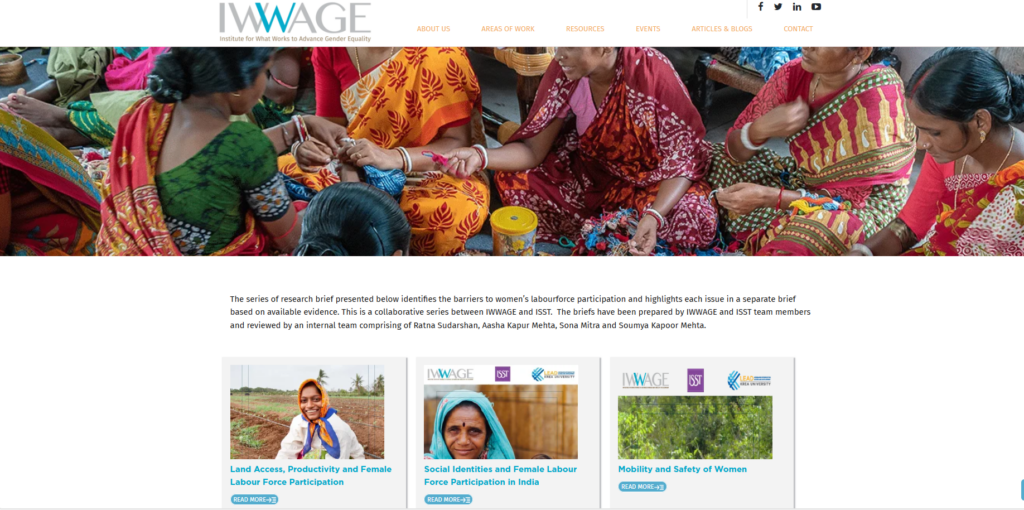
The series of research brief presented below identifies the barriers to women’s labourforce participation and highlights each issue in a separate brief based on available evidence. This is a collaborative series between IWWAGE and ISST. The briefs have been prepared by IWWAGE and ISST team members and reviewed by an internal team comprising of Ratna Sudarshan, Aasha Kapur Mehta, Sona Mitra and Soumya Kapoor Mehta. Mobility and Safety of Women: Interlinkages with Labour Force Participation One of the major factors limiting the participation of women in the labour force is concern for their safety. These include fear of sexual violence in streets, in and around public transportation, schools, workplaces and other public and private spaces. This reality decreases women’s and girls freedom of mobility by impacting their ability to participate in school, work and public life; access to essential services; and enjoyment of cultural and recreational opportunities. In particular, ensuring a safe city and a safe workplace by investing in safe and affordable modes of public transportation, infrastructural additions to make cities more accessible for women, and inclusive legal provisions for safety at work can be important enablers of female LFPR. This policy brief attempts to describe the issues underpinning women’s safety as a barrier to their participation in the labour force; and shares recommendations to ensure that safety does not act as a barrier to mobility and the ability to access services that might improve life prospects and opportunities for women and girls. Women’s Entrepreneurship in India: Harnessing the Gender Dividend. India’s economic growth story has eluded a large section of the micro, small and medium enterprises (MSMEs) in fact the smallest of the enterprises led by women. This is evident in the fact that, despite the growing number of MSMEs in India, as of 2018-19, only one in every five enterprises was owned by women (21.5 per cent). Not only is women’s representation across sectors low, the growth of existing enterprises also seems to have stagnated over time. This brief seeks to highlight the key challenges to women’s entrepreneurship in India, including social norms and biases, lack of education, unequal opportunities for affordable financing, and limited networking opportunities which prevent them from exploring their full entrepreneurial potential. It also seeks to document some of the key recommendations to address these social, economic and technological constraints. Financial Inclusion and Female Labour Force Participation The rapid growth in India over the past decade has been coupled with a steady decline in female labour force participation. Despite rising GDPs, improvements in higher education attainment as well as fall in fertility rates, India’s female labour force participation rate (LFPR) has continued to drop. This has been further aggravated by job stagnation and high unemployment rates in recent years which have impacted women disproportionately and may worsen due to the ongoing pandemic. In India, existing societal norms, low literacy levels as well as lack of access to fixed assets further excludes women from the formal financial structure, thereby hampering their socio-economic growth. The brief analyses the barriers faced by women while accessing financial services and products, the lack of gender- specific policies, discrimination towards women entrepreneurs and geographic distance to financial institutions. Attempt is also made to look at policy interventions, and schemes designed to address some of the supply side barriers. Barriers for Women in Public Employment Despite high economic growth and improved health and economic outcomes since the 1990s, female labour force participation (FLFP) has stagnated or declined in India, falling to 17.5 per cent in 2017-18 according to the Periodic Labour Force Survey (PLFS). For working women, the public sector is the largest provider of formal or regular salaried jobs in the Indian economy. Given stagnating FLFP according to official data, the severe impacts of COVID-19 on unemployment, and the necessity to boost economic growth and recovery, removing barriers to women’s opportunities in public employment is more important than ever. The brief looks at the role of women’s public employment prospects in not only creating needed jobs, but delivering indirect benefits such as improved public service delivery, greater social protection for women, and boosts to consumption from increased household incomes. Addressing them will help guarantee the right to safe working conditions, adequate compensation, and deserved social protections that will benefit women workers and the economy at large. Women in the Indian Informal Economy Globally, two billion of population aged 15 years and above works in the informal economy, representing 61.2 per cent of world employment. Informal employment is a greater source of employment for men (63 per cent) than women (58.1 per cent). In India, although the absolute numbers are lower, a slightly higher percentage of women workers are in informal employment as compared to men. In India, women are almost always involved in some kind of productive and/or reproductive activity, but much of their work is invisible, and they are largely employed in low skilled, low paid informal work with little or no social security, with a consolidation of caste or religion-based disadvantages, even within a larger context of women’s marginalisation. Within this informal workforce with its persistent gender-based occupational segregation, the COVID-19 pandemic is intensifying pre-existing inequalities, exposing vulnerabilities across every sphere, from health to the economy, security to social protection. The brief analyses gender dimension of informality, its implications and captures the gendered experiences of informal workers during the lockdown and the post-lockdown period. Women and Unpaid Work Women’s workforce participation rates (WPR) in India, as measured by the National Sample Survey Organisation (NSSO), have been low and consistently declining over the last 15 years or so. An important part of the reason for this is women’s unpaid and unaccounted work. Time is spent on activities which remain excluded from the radar of large sample surveys on employment. Feminist scholars have been arguing for recognition, reduction and redistribution of unpaid activities to be able to move towards gender equality. With the transformation of the household into the site of work and livelihood due to the COVID- 19 pandemic, power relations are seen manifesting both within and outside the household, forcing women to spend hours in backbreaking work, often not even recognised as work in surveys or discourses. The brief assesses the impact of the pandemic and the consequent lockdown on women workers in informal sectors and shares recommendations to recognise and redistribute unpaid work.
The series of research brief presented below identifies the barriers to women’s labourforce participation and highlights each issue in a separate brief based on available evidence. This is a collaborative series between IWWAGE and ISST. The briefs have been prepared by IWWAGE and ISST team members and reviewed by an internal team comprising of Ratna Sudarshan, Aasha Kapur Mehta, Sona Mitra and Soumya Kapoor Mehta. Mobility and Safety of Women: Interlinkages with Labour Force Participation One of the major factors limiting the participation of women in the labour force is concern for their safety. These include fear of sexual violence in streets, in and around public transportation, schools, workplaces and other public and private spaces. This reality decreases women’s and girls freedom of mobility by impacting their ability to participate in school, work and public life; access to essential services; and enjoyment of cultural and recreational opportunities. In particular, ensuring a safe city and a safe workplace by investing in safe and affordable modes of public transportation, infrastructural additions to make cities more accessible for women, and inclusive legal provisions for safety at work can be important enablers of female LFPR. This policy brief attempts to describe the issues underpinning women’s safety as a barrier to their participation in the labour force; and shares recommendations to ensure that safety does not act as a barrier to mobility and the ability to access services that might improve life prospects and opportunities for women and girls. Women’s Entrepreneurship in India: Harnessing the Gender Dividend. India’s economic growth story has eluded a large section of the micro, small and medium enterprises (MSMEs) in fact the smallest of the enterprises led by women. This is evident in the fact that, despite the growing number of MSMEs in India, as of 2018-19, only one in every five enterprises was owned by women (21.5 per cent). Not only is women’s representation across sectors low, the growth of existing enterprises also seems to have stagnated over time. This brief seeks to highlight the key challenges to women’s entrepreneurship in India, including social norms and biases, lack of education, unequal opportunities for affordable financing, and limited networking opportunities which prevent them from exploring their full entrepreneurial potential. It also seeks to document some of the key recommendations to address these social, economic and technological constraints. Financial Inclusion and Female Labour Force Participation The rapid growth in India over the past decade has been coupled with a steady decline in female labour force participation. Despite rising GDPs, improvements in higher education attainment as well as fall in fertility rates, India’s female labour force participation rate (LFPR) has continued to drop. This has been further aggravated by job stagnation and high unemployment rates in recent years which have impacted women disproportionately and may worsen due to the ongoing pandemic. In India, existing societal norms, low literacy levels as well as lack of access to fixed assets further excludes women from the formal financial structure, thereby hampering their socio-economic growth. The brief analyses the barriers faced by women while accessing financial services and products, the lack of gender- specific policies, discrimination towards women entrepreneurs and geographic distance to financial institutions. Attempt is also made to look at policy interventions, and schemes designed to address some of the supply side barriers. Barriers for Women in Public Employment Despite high economic growth and improved health and economic outcomes since the 1990s, female labour force participation (FLFP) has stagnated or declined in India, falling to 17.5 per cent in 2017-18 according to the Periodic Labour Force Survey (PLFS). For working women, the public sector is the largest provider of formal or regular salaried jobs in the Indian economy. Given stagnating FLFP according to official data, the severe impacts of COVID-19 on unemployment, and the necessity to boost economic growth and recovery, removing barriers to women’s opportunities in public employment is more important than ever. The brief looks at the role of women’s public employment prospects in not only creating needed jobs, but delivering indirect benefits such as improved public service delivery, greater social protection for women, and boosts to consumption from increased household incomes. Addressing them will help guarantee the right to safe working conditions, adequate compensation, and deserved social protections that will benefit women workers and the economy at large. Women in the Indian Informal Economy Globally, two billion of population aged 15 years and above works in the informal economy, representing 61.2 per cent of world employment. Informal employment is a greater source of employment for men (63 per cent) than women (58.1 per cent). In India, although the absolute numbers are lower, a slightly higher percentage of women workers are in informal employment as compared to men. In India, women are almost always involved in some kind of productive and/or reproductive activity, but much of their work is invisible, and they are largely employed in low skilled, low paid informal work with little or no social security, with a consolidation of caste or religion-based disadvantages, even within a larger context of women’s marginalisation. Within this informal workforce with its persistent gender-based occupational segregation, the COVID-19 pandemic is intensifying pre-existing inequalities, exposing vulnerabilities across every sphere, from health to the economy, security to social protection. The brief analyses gender dimension of informality, its implications and captures the gendered experiences of informal workers during the lockdown and the post-lockdown period. Women and Unpaid Work Women’s workforce participation rates (WPR) in India, as measured by the National Sample Survey Organisation (NSSO), have been low and consistently declining over the last 15 years or so. An important part of the reason for this is women’s unpaid and unaccounted work. Time is spent on activities which remain excluded from the radar of large sample surveys on employment. Feminist scholars have been arguing for recognition, reduction and redistribution of unpaid activities to be able to move towards gender equality. With the transformation of the household into the site of work and livelihood due to the COVID- 19 pandemic, power relations are seen manifesting both within and outside the household, forcing women to spend hours in backbreaking work, often not even recognised as work in surveys or discourses. The brief assesses the impact of the pandemic and the consequent lockdown on women workers in informal sectors and shares recommendations to recognise and redistribute unpaid work.
IWWAGE-ISST-BRIEFS
Women in the Indian Informal Economy
- March , 2021
- Shiney Chakraborty
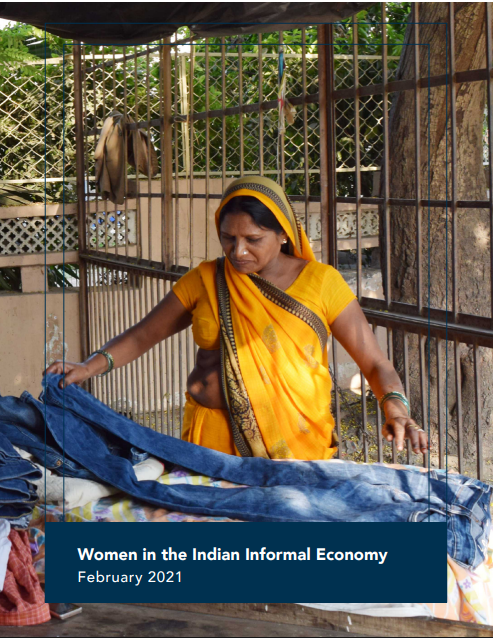
Globally, the informal economy employs over two billion people aged 15 and above-accounting for 61.2 per cent of total employment. In India, a slightly higher proportion of women than men are engaged in informal employment, despite the absolute numbers being lower. Informality often reflects a lack of socio-economic development and education, with workers possessing limited or no formal qualifications being more vulnerable to informal work. In India, women are extensively engaged in productive and reproductive activities, yet much of this labour remains invisible. They are concentrated in low-skilled, low-paid informal jobs with minimal or no social protection-working as domestic workers, self-employed home-based workers, or in other precarious roles. These challenges are further compounded by caste- and religion-based discrimination, revealing the layered nature of women’s marginalisation. The COVID-19 pandemic exacerbated existing gender inequalities within the informal sector. With the collapse of livelihoods during the lockdown, women bore a disproportionate burden of job losses and increased household responsibilities. The economic shock reinforced pre-existing gaps in employment, wages, and access to social security. To address these inequities, the following policy recommendations are key: – Expand employment opportunities through direct public investment and job generation, including reservation for women in these initiatives. – Improve working conditions in the informal sector by recognising all types of work (including home-based), enforcing minimum wages, and reducing gender wage gaps. – Strengthen access to social protection, especially old-age pensions and healthcare, including occupational health services for women in often-overlooked sectors. – Invest in gender-sensitive infrastructure, such as safe public transport, crèche facilities, and accessible toilets. – Support collective organising among informal women workers to strengthen their bargaining power and representation. Addressing informality through a gendered lens is crucial for building an inclusive and equitable economy.
Globally, the informal economy employs over two billion people aged 15 and above-accounting for 61.2 per cent of total employment. In India, a slightly higher proportion of women than men are engaged in informal employment, despite the absolute numbers being lower. Informality often reflects a lack of socio-economic development and education, with workers possessing limited or no formal qualifications being more vulnerable to informal work. In India, women are extensively engaged in productive and reproductive activities, yet much of this labour remains invisible. They are concentrated in low-skilled, low-paid informal jobs with minimal or no social protection-working as domestic workers, self-employed home-based workers, or in other precarious roles. These challenges are further compounded by caste- and religion-based discrimination, revealing the layered nature of women’s marginalisation. The COVID-19 pandemic exacerbated existing gender inequalities within the informal sector. With the collapse of livelihoods during the lockdown, women bore a disproportionate burden of job losses and increased household responsibilities. The economic shock reinforced pre-existing gaps in employment, wages, and access to social security. To address these inequities, the following policy recommendations are key: – Expand employment opportunities through direct public investment and job generation, including reservation for women in these initiatives. – Improve working conditions in the informal sector by recognising all types of work (including home-based), enforcing minimum wages, and reducing gender wage gaps. – Strengthen access to social protection, especially old-age pensions and healthcare, including occupational health services for women in often-overlooked sectors. – Invest in gender-sensitive infrastructure, such as safe public transport, crèche facilities, and accessible toilets. – Support collective organising among informal women workers to strengthen their bargaining power and representation. Addressing informality through a gendered lens is crucial for building an inclusive and equitable economy.
IWWAGE-ISI-BRIEFS
Women and Unpaid Work
- February , 2021
- Monika Bannerjee
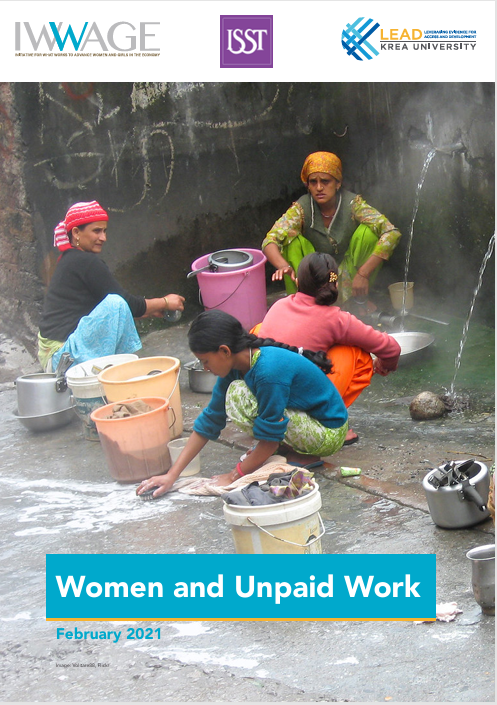
Women’s workforce participation in India, as captured by NSSO surveys, has been low and declining for around 15 years, largely because a major share of women’s labour is **unpaid and not counted**. Much of women’s time goes into activities that employment surveys (earlier NSSO, now PLFS) often exclude, which leads to systematic underestimation of women’s work. Feminist scholars argue for **recognition, reduction, and redistribution** of unpaid work to advance gender equality. If “work” were defined more broadly to include these activities, far more women would be seen as working yet current data continues to **invisibilise** their multiple economic contributions.
Women’s workforce participation in India, as captured by NSSO surveys, has been low and declining for around 15 years, largely because a major share of women’s labour is **unpaid and not counted**. Much of women’s time goes into activities that employment surveys (earlier NSSO, now PLFS) often exclude, which leads to systematic underestimation of women’s work. Feminist scholars argue for **recognition, reduction, and redistribution** of unpaid work to advance gender equality. If “work” were defined more broadly to include these activities, far more women would be seen as working yet current data continues to **invisibilise** their multiple economic contributions.
IWWAGE-ISI-BRIEFS
Women’s Entrepreneurship in India: Harnessing the Gender Dividend
- February , 2021
- Sanjana Vijay
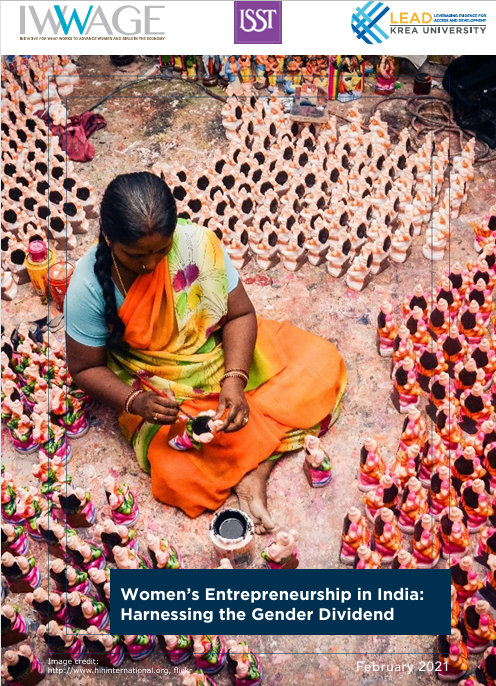
Women-led micro and small enterprises have benefited the least from India’s growth. Despite a rising number of MSMEs, **only 21.5%** were women-owned in **2018–19**. Growth has also stagnated: **NSS 2015** estimates show that between **2010 and 2015**, the share of women-led enterprises and their **GVA** did not rise, and their share of workers fell from **18% to 16%**. India also ranked **49th out of 57** in the **2020 Mastercard Index of Women Entrepreneurs**, reflecting persistent barriers in the ecosystem. Limited opportunities due to inflexible work, wage gaps, and constrained job options push many women toward subsistence, “survivalist” entrepreneurship. The brief outlines key constraints—**social norms and bias, low education, limited access to affordable finance, and weak networks**—and compiles recommendations to address these social, economic, and technological barriers.
Women-led micro and small enterprises have benefited the least from India’s growth. Despite a rising number of MSMEs, **only 21.5%** were women-owned in **2018–19**. Growth has also stagnated: **NSS 2015** estimates show that between **2010 and 2015**, the share of women-led enterprises and their **GVA** did not rise, and their share of workers fell from **18% to 16%**. India also ranked **49th out of 57** in the **2020 Mastercard Index of Women Entrepreneurs**, reflecting persistent barriers in the ecosystem. Limited opportunities due to inflexible work, wage gaps, and constrained job options push many women toward subsistence, “survivalist” entrepreneurship. The brief outlines key constraints—**social norms and bias, low education, limited access to affordable finance, and weak networks**—and compiles recommendations to address these social, economic, and technological barriers.
IWWAGE-ISI-BRIEFS
Financial Inclusion and FLFP
- February , 2021
- Ayushi Gupta
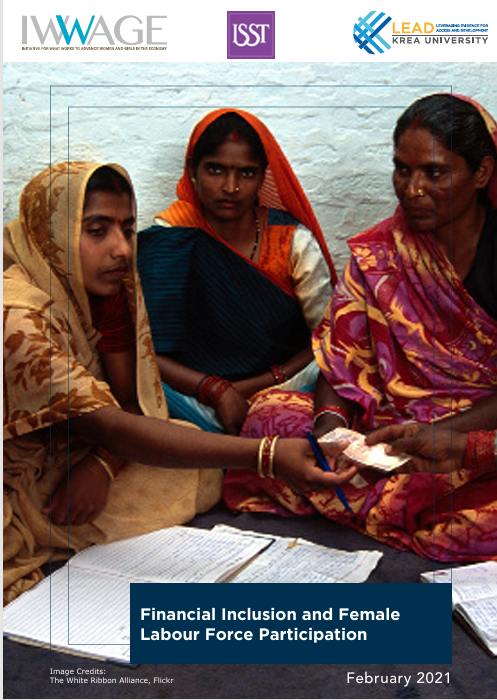
India’s rapid economic growth has coincided with a steady decline in women’s labour force participation, despite higher education gains and falling fertility. Recent job stagnation and high unemployment have hit women harder and may worsen with the pandemic. The decline varies by state, with rural areas seeing a sharper fall than urban—though urban women have also become vulnerable during the pandemic because many work in informal, low-wage jobs with limited social protection. While this “growth but falling LFPR” paradox is well-studied, a less explored angle is financial inclusion: despite expansion of formal financial services, women still face a large access gap versus men, especially in South Asia. In India, social norms, low literacy, and limited asset ownership further restrict women’s access to formal finance, limiting their economic and social mobility.
India’s rapid economic growth has coincided with a steady decline in women’s labour force participation, despite higher education gains and falling fertility. Recent job stagnation and high unemployment have hit women harder and may worsen with the pandemic. The decline varies by state, with rural areas seeing a sharper fall than urban—though urban women have also become vulnerable during the pandemic because many work in informal, low-wage jobs with limited social protection. While this “growth but falling LFPR” paradox is well-studied, a less explored angle is financial inclusion: despite expansion of formal financial services, women still face a large access gap versus men, especially in South Asia. In India, social norms, low literacy, and limited asset ownership further restrict women’s access to formal finance, limiting their economic and social mobility.
Factsheet
Trends in Female Labour Force Participation in Chhattisgarh
- November , 2026
- Nabankur Huda, Bidisha Mondal
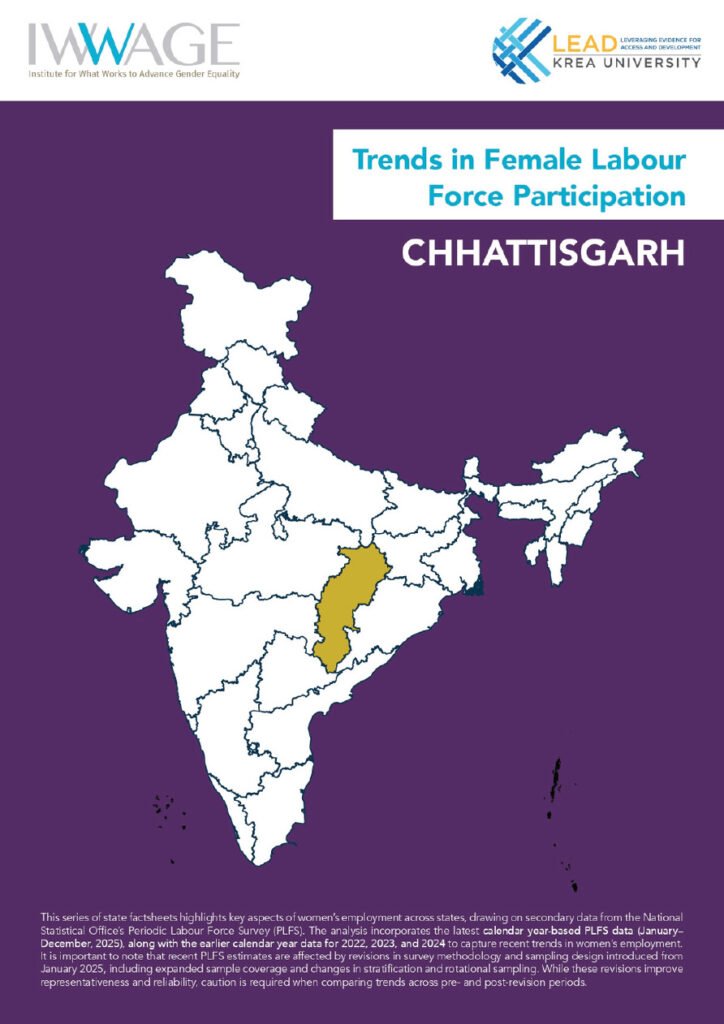
Chhattisgarh is a state that stands out nationally for its high female labour force participation, especially in rural areas, where women’s work is concentrated in family cultivation, much of it is informal or unpaid. The factsheet examines trends in women’s labour force participation and employment in Chhattisgarh between 2022 and 2025, highlighting the state’s high rural participation alongside declining urban participation.
Chhattisgarh is a state that stands out nationally for its high female labour force participation, especially in rural areas, where women’s work is concentrated in family cultivation, much of it is informal or unpaid. The factsheet examines trends in women’s labour force participation and employment in Chhattisgarh between 2022 and 2025, highlighting the state’s high rural participation alongside declining urban participation.

SWAYAM
The National Gender Campaign – Nayi Chetna 4.0
- November , 2026
- Arpita Paul, Chandan Sharma
The National Gender Campaign – Nayi Chetna 4.0, implemented under the Deendayal Antyodaya Yojana–National Rural Livelihood Mission (DAY-NRLM), represents effort to institutionalise gender equality and address gender-based violence (GBV) through a community-driven, convergent approach. This report records the perspective of women on the identified barriers to achieving women’s empowerment such as access to and control over assets, safe mobility and safety, non-recognition of women as economic contributors and unrecognised unpaid care work, along with the activities organised at different levels and the reach of the campaign in terms of participation during the campaign period.
The National Gender Campaign – Nayi Chetna 4.0, implemented under the Deendayal Antyodaya Yojana–National Rural Livelihood Mission (DAY-NRLM), represents effort to institutionalise gender equality and address gender-based violence (GBV) through a community-driven, convergent approach. This report records the perspective of women on the identified barriers to achieving women’s empowerment such as access to and control over assets, safe mobility and safety, non-recognition of women as economic contributors and unrecognised unpaid care work, along with the activities organised at different levels and the reach of the campaign in terms of participation during the campaign period.
Factsheet
Trends in Female Labour Force Participation in Gujarat
- November , 2026
- Nabankur Huda, Bidisha Mondal
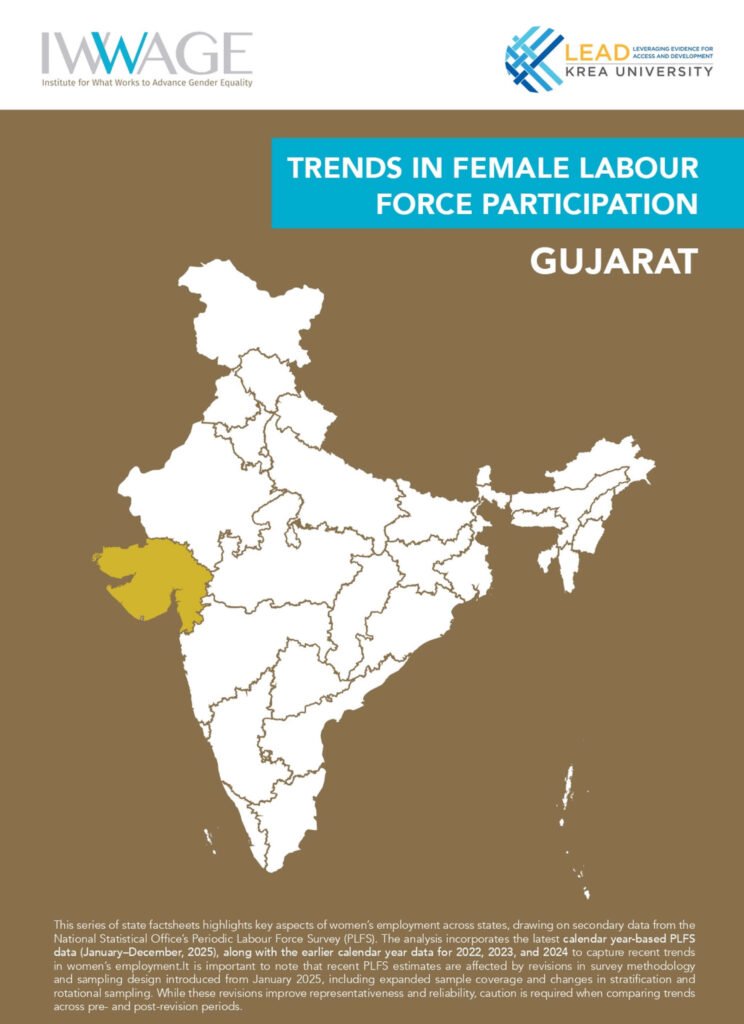
Gujarat is one of India’s most industrialised and urbanised states, generating a large share of national manufacturing output and exports.This factsheet analyses patterns of female labour force participation in Gujarat from 2022 to 2025 using PLFS calendar year data. It highlights trends in participation rates, sectoral distribution and occupational distribution, quality of work, employment types, and barriers to women’s workforce entry.
Gujarat is one of India’s most industrialised and urbanised states, generating a large share of national manufacturing output and exports.This factsheet analyses patterns of female labour force participation in Gujarat from 2022 to 2025 using PLFS calendar year data. It highlights trends in participation rates, sectoral distribution and occupational distribution, quality of work, employment types, and barriers to women’s workforce entry.
Factsheet
Trends in Female Labour Force Participation in West Bengal
- October , 2026
- Arpita Paul, Bidisha Mondal
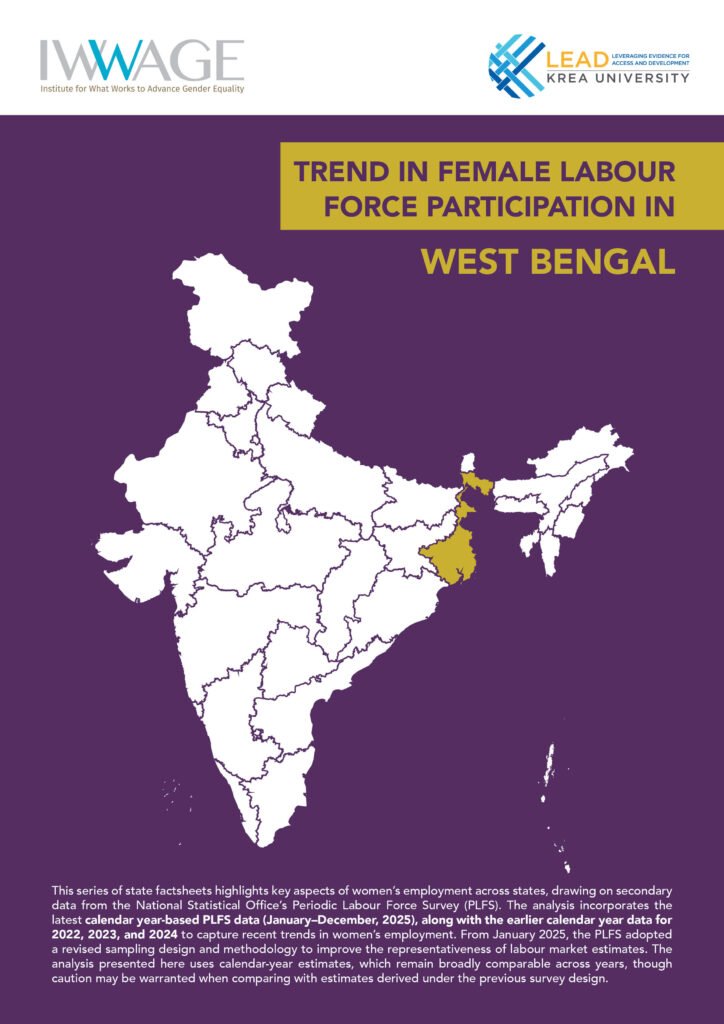
West Bengal, located in eastern India, is one of the most densely populated states with a diverse economic ranging from agriculture, manufacturing (jute, textiles, chemicals), trade, services,forest and fisheries, and construction sector. This factsheet analyses patterns of female labour force participation in West Bengal from 2022 to 2025 using PLFS calendar year data. It highlights trends in participation rates, sectoral distribution, occupational composition, employment types, and barriers to women’s workforce entry.
West Bengal, located in eastern India, is one of the most densely populated states with a diverse economic ranging from agriculture, manufacturing (jute, textiles, chemicals), trade, services,forest and fisheries, and construction sector. This factsheet analyses patterns of female labour force participation in West Bengal from 2022 to 2025 using PLFS calendar year data. It highlights trends in participation rates, sectoral distribution, occupational composition, employment types, and barriers to women’s workforce entry.
Factsheet
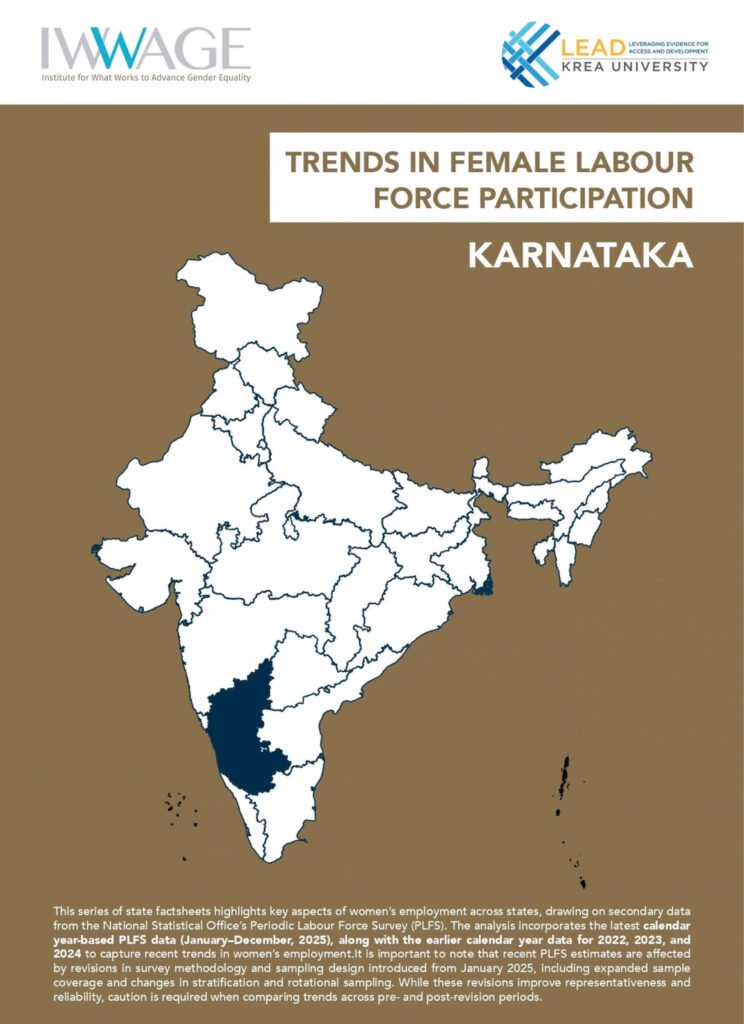
Trends in Female Labour Force Participation in Karnataka
- October , 2026
- Vidhi, Bidisha Mondal
Karnataka occupies a distinctive position in India’s economic landscape, driven by rapid growth in services, technology, and manufacturing sectors.This factsheet examines key trends in women’s labour force participation in Karnataka using PLFS data, with a focus on employment composition, sectoral and occupational distribution, quality of work, and barriers to women’s participation in the labour market.
Karnataka occupies a distinctive position in India’s economic landscape, driven by rapid growth in services, technology, and manufacturing sectors.This factsheet examines key trends in women’s labour force participation in Karnataka using PLFS data, with a focus on employment composition, sectoral and occupational distribution, quality of work, and barriers to women’s participation in the labour market.
Brief
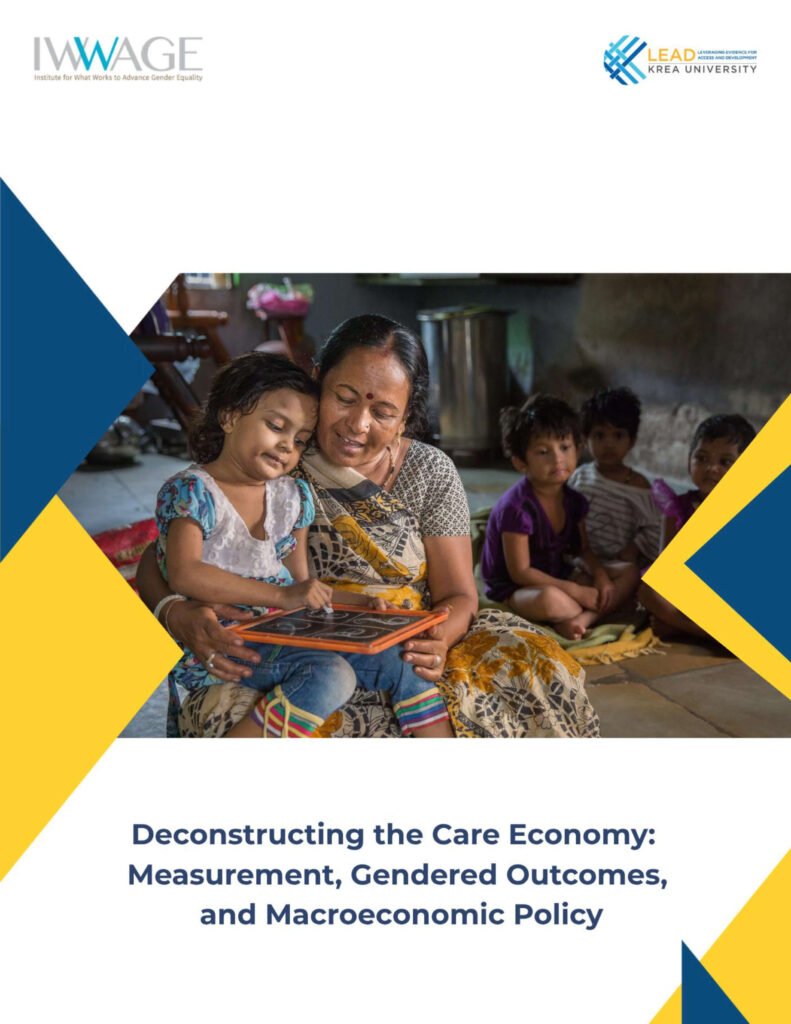
Deconstructing the Care Economy: Measurement, Gendered Outcomes, and Macroeconomic Policy
- September , 2026
The policy brief examines how unpaid care and domestic work largely undertaken by women remains invisible in conventional economic and labour statistics, while significantly shaping women’s participation and outcomes in the labour market. It highlights how care responsibilities contribute to women’s underemployment, lower-paid and precarious work, and inequalities in platform and hybrid work.
The policy brief examines how unpaid care and domestic work largely undertaken by women remains invisible in conventional economic and labour statistics, while significantly shaping women’s participation and outcomes in the labour market. It highlights how care responsibilities contribute to women’s underemployment, lower-paid and precarious work, and inequalities in platform and hybrid work.