


Publications
Publications
Category
Year

Report
Strengthening Socio-Economic Rights of Women in the Informal Economy: The SEWA Approach in West Bengal and Jharkhand
- December , 2020
- Ayushi Gupta , Kanika Jha Kingra
Women working in India’s informal sector face several vulnerabilities and are often denied decent working conditions and wages. This further exacerbates inequities and pushes them towards high risk poverty. The situation is worse for women belonging to socially disadvantaged castes and communities. Evidence from India and other contexts shows that the working poor in the informal economy, particularly women, need to organise themselves to overcome the structural disadvantages they face. Organisation gives these otherwise marginalised workers the power of solidarity and a platform to be seen and heard by decision makers with the power to affect their lives. Since 1972, the Self-Employed Women’s Association (SEWA) is working as an organisation of poor women workers and a movement to create better alternatives. SEWA is currently operative in many states across the country and has a membership base of nearly 2 million women workers in the informal economy, comprising domestic workers, street vendors, agricultural workers, construction labourers, salt workers, beedi and papad rollers and such other vulnerable categories. SEWA’s programme in Jharkhand and West Bengal aims to increase the collective bargaining strength of women, particularly those working as agricultural workers, domestic workers and construction labourers (in the former state) and female beedi rollers in West Bengal. The programme aims to improve women’s access to and understanding of basic services, such as health and sanitation, and also increase their ability to demand local accountability through nurturing of grassroots leadership. The study tries to understand the impact that various components of its programme have had on informal women workers in Jharkhand and West Bengal. The women included in the study were predominantly engaged in beedi rolling, domestic work, construction work, agriculture and street vending.
Women working in India’s informal sector face several vulnerabilities and are often denied decent working conditions and wages. This further exacerbates inequities and pushes them towards high risk poverty. The situation is worse for women belonging to socially disadvantaged castes and communities. Evidence from India and other contexts shows that the working poor in the informal economy, particularly women, need to organise themselves to overcome the structural disadvantages they face. Organisation gives these otherwise marginalised workers the power of solidarity and a platform to be seen and heard by decision makers with the power to affect their lives. Since 1972, the Self-Employed Women’s Association (SEWA) is working as an organisation of poor women workers and a movement to create better alternatives. SEWA is currently operative in many states across the country and has a membership base of nearly 2 million women workers in the informal economy, comprising domestic workers, street vendors, agricultural workers, construction labourers, salt workers, beedi and papad rollers and such other vulnerable categories. SEWA’s programme in Jharkhand and West Bengal aims to increase the collective bargaining strength of women, particularly those working as agricultural workers, domestic workers and construction labourers (in the former state) and female beedi rollers in West Bengal. The programme aims to improve women’s access to and understanding of basic services, such as health and sanitation, and also increase their ability to demand local accountability through nurturing of grassroots leadership. The study tries to understand the impact that various components of its programme have had on informal women workers in Jharkhand and West Bengal. The women included in the study were predominantly engaged in beedi rolling, domestic work, construction work, agriculture and street vending.

Learning note
Making a Gender Responsive Urban Employment Guarantee Scheme
- December , 2020
- Soumya Kapoor Mehta | Aparajita Bharti | Deepro Guha
The COVID-19 pandemic severely impacted urban livelihoods in India, with over 21 million salaried jobs lost between April and August 2020. Women, particularly those in the informal sector, faced disproportionate job losses, further compounding their already low participation in the labour force. Sectors employing large numbers of women-such as domestic work, construction, and beauty services-were among the hardest hit. Even in the formal economy, women in temporary or part-time roles were more vulnerable to layoffs and lacked access to social security. The crisis has highlighted the urgent need for an urban employment guarantee programme, akin to MGNREGA, which has shown positive outcomes for women in rural areas. Several states have already taken the lead in pilotig such schemes. These efforts present a crucial opportunity to design gender-responsive urban employment programmes that support women’s livelihoods, build resilience, and boost overall economic recovery.
The COVID-19 pandemic severely impacted urban livelihoods in India, with over 21 million salaried jobs lost between April and August 2020. Women, particularly those in the informal sector, faced disproportionate job losses, further compounding their already low participation in the labour force. Sectors employing large numbers of women-such as domestic work, construction, and beauty services-were among the hardest hit. Even in the formal economy, women in temporary or part-time roles were more vulnerable to layoffs and lacked access to social security. The crisis has highlighted the urgent need for an urban employment guarantee programme, akin to MGNREGA, which has shown positive outcomes for women in rural areas. Several states have already taken the lead in pilotig such schemes. These efforts present a crucial opportunity to design gender-responsive urban employment programmes that support women’s livelihoods, build resilience, and boost overall economic recovery.

Brief
Digital Solutions for SHGs in Chhattisgarh – The COVID-19 Pandemic: Project Modifications and Learnings
- December , 2020
Women’s collectives like self-help groups (SHGs) have long played a transformative role in empowering women across India. Building on this potential, IWWAGE an initiative of LEAD at Krea University is partnering with the State Rural Livelihoods Mission (SRLM) Chhattisgarh and Haqdarshak Empowerment Solutions (HESPL) to train SHG members on using the **Haqdarshak** mobile application. This innovative tool helps citizens access information on over 200 central and state government welfare schemes. Trained SHG women, known as *Haqdarshikas*, earn a livelihood by offering doorstep services to their communities, enabling access to welfare entitlements for a small fee. The project adopts a sustainable, entrepreneurial model while enhancing digital literacy and economic participation among rural women. Alongside implementation, IWWAGE and LEAD are conducting an impact and process evaluation of the Haqdarshak model. This includes assessing adaptations made during the COVID-19 pandemic, changes in program delivery for different training cohorts, and evolving evaluation methods. This learning note captures early implementation insights and outlines how the model is evolving to remain effective in changing contexts.
Women’s collectives like self-help groups (SHGs) have long played a transformative role in empowering women across India. Building on this potential, IWWAGE an initiative of LEAD at Krea University is partnering with the State Rural Livelihoods Mission (SRLM) Chhattisgarh and Haqdarshak Empowerment Solutions (HESPL) to train SHG members on using the **Haqdarshak** mobile application. This innovative tool helps citizens access information on over 200 central and state government welfare schemes. Trained SHG women, known as *Haqdarshikas*, earn a livelihood by offering doorstep services to their communities, enabling access to welfare entitlements for a small fee. The project adopts a sustainable, entrepreneurial model while enhancing digital literacy and economic participation among rural women. Alongside implementation, IWWAGE and LEAD are conducting an impact and process evaluation of the Haqdarshak model. This includes assessing adaptations made during the COVID-19 pandemic, changes in program delivery for different training cohorts, and evolving evaluation methods. This learning note captures early implementation insights and outlines how the model is evolving to remain effective in changing contexts.

IWWAGE-ISI-BRIEFS
Women in Agriculture
- December , 2020
Over the past two decades, India has seen a dramatic rise in agricultural mechanisation, particularly through the widespread adoption of tractors. While this technological progress has improved productivity, it has also led to a significant decline in rural farm employment-most notably among women. This study investigates how mechanisation, especially in tilling, has contributed to the fall in female agricultural labour. The analysis finds that a 1 percentage point increase in the mechanisation of tilling operations reduces female labour per hectare by 0.7 per cent. This decline stems largely from a reduction in the need for weeding-an activity traditionally undertaken by women-as tilling quality improves. Between 1999 and 2011, a 32 percentage point rise in mechanisation explains around 22 per cent of the 30 per cent drop in women’s employment in agriculture during the same period. The research underscores that when the production process is sequential and tasks are gendered-as in Indian agriculture-technological change can disproportionately affect women’s livelihoods. Since men have historically undertaken the more power-intensive tasks like deep tilling, they are better positioned to benefit from mechanisation. Meanwhile, women, who perform precision-based tasks such as weeding and sowing, are often displaced. Soil composition also plays a role: regions with loamy soils, which require deeper tilling, are more likely to adopt mechanised tools. These structural dynamics-both technological and environmental-compound the challenges rural women face in maintaining agricultural employment. The findings highlight the need for gender-sensitive policy design that anticipates and mitigates the unintended consequences of agricultural modernisation.
Over the past two decades, India has seen a dramatic rise in agricultural mechanisation, particularly through the widespread adoption of tractors. While this technological progress has improved productivity, it has also led to a significant decline in rural farm employment-most notably among women. This study investigates how mechanisation, especially in tilling, has contributed to the fall in female agricultural labour. The analysis finds that a 1 percentage point increase in the mechanisation of tilling operations reduces female labour per hectare by 0.7 per cent. This decline stems largely from a reduction in the need for weeding-an activity traditionally undertaken by women-as tilling quality improves. Between 1999 and 2011, a 32 percentage point rise in mechanisation explains around 22 per cent of the 30 per cent drop in women’s employment in agriculture during the same period. The research underscores that when the production process is sequential and tasks are gendered-as in Indian agriculture-technological change can disproportionately affect women’s livelihoods. Since men have historically undertaken the more power-intensive tasks like deep tilling, they are better positioned to benefit from mechanisation. Meanwhile, women, who perform precision-based tasks such as weeding and sowing, are often displaced. Soil composition also plays a role: regions with loamy soils, which require deeper tilling, are more likely to adopt mechanised tools. These structural dynamics-both technological and environmental-compound the challenges rural women face in maintaining agricultural employment. The findings highlight the need for gender-sensitive policy design that anticipates and mitigates the unintended consequences of agricultural modernisation.
Report
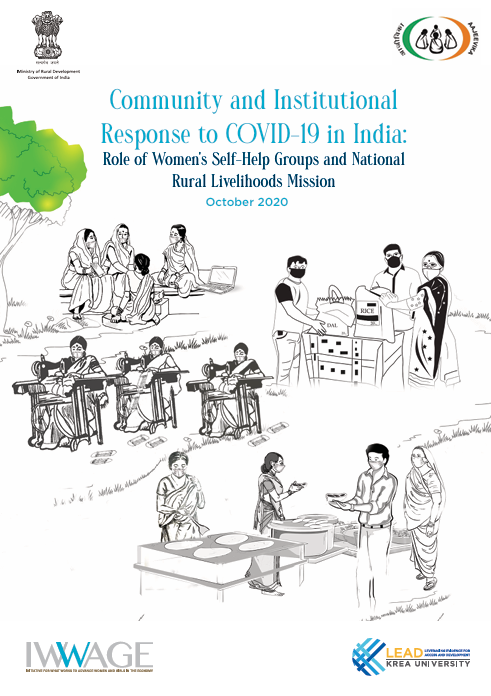
Community and Institutional Response to COVID-19 in India: Role of Women’s SHG and NRLM
- December , 2020
- Rukmini Tankha
This publication was developed with support from the Bill & Melinda Gates Foundation. The findings and conclusions in this publication are those of the authors and do not necessarily represent the views of the Bill & Melinda Gates Foundation
This publication was developed with support from the Bill & Melinda Gates Foundation. The findings and conclusions in this publication are those of the authors and do not necessarily represent the views of the Bill & Melinda Gates Foundation
IWWAGE-ISI-BRIEFS
Nudging Households to increase the usage of Clean Fuel
- December , 2020
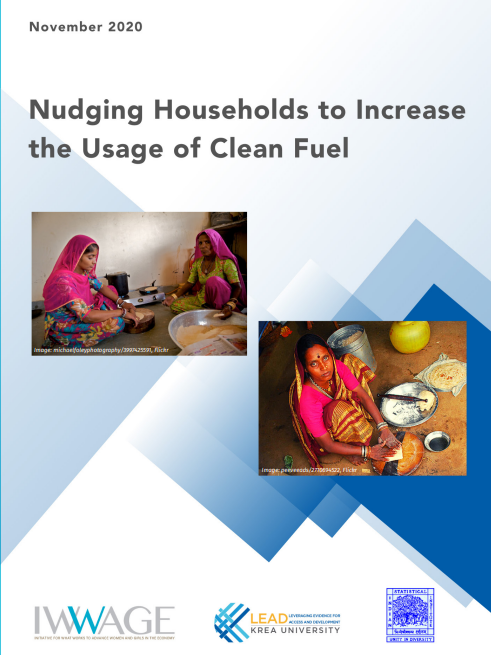
Indoor air pollution, particularly from cooking with solid fuels, poses a severe public health risk, with women disproportionately bearing the burden. This project, based in rural Madhya Pradesh, investigates how targeted health communication and information on LPG subsidies can influence a shift towards cleaner cooking practices. Villages were randomly assigned to receive different interventions: health awareness alone, health awareness with information on the LPG subsidy programme, or no intervention (control). The combined campaign resulted in a 6% annual increase in LPG refill purchases, a 14% rise in monthly consumption, and a 320% boost in self-reported induction stove usage. While the ‘health only’ group did not show an increase in LPG use, there was improved adoption of safety measures such as smoke outlets or separate kitchens. These findings suggest that both awareness and financial accessibility are critical in enabling consistent clean fuel usage. Despite the significant expansion of LPG access under the Government of India’s Ujjwala Yojana scheme, sustained use remains limited due to low awareness about subsidy benefits and the health risks of solid fuels. This study underscores the importance of integrated communication and policy design in advancing cleaner, safer household energy use.
Indoor air pollution, particularly from cooking with solid fuels, poses a severe public health risk, with women disproportionately bearing the burden. This project, based in rural Madhya Pradesh, investigates how targeted health communication and information on LPG subsidies can influence a shift towards cleaner cooking practices. Villages were randomly assigned to receive different interventions: health awareness alone, health awareness with information on the LPG subsidy programme, or no intervention (control). The combined campaign resulted in a 6% annual increase in LPG refill purchases, a 14% rise in monthly consumption, and a 320% boost in self-reported induction stove usage. While the ‘health only’ group did not show an increase in LPG use, there was improved adoption of safety measures such as smoke outlets or separate kitchens. These findings suggest that both awareness and financial accessibility are critical in enabling consistent clean fuel usage. Despite the significant expansion of LPG access under the Government of India’s Ujjwala Yojana scheme, sustained use remains limited due to low awareness about subsidy benefits and the health risks of solid fuels. This study underscores the importance of integrated communication and policy design in advancing cleaner, safer household energy use.

Learning note
Digital Solutions for SHGs in Chhattisgarh
- November , 2020
Government entitlements are often the primary source of social protection for poor households. With the aim of increasing information about and uptake of government entitlements, and with the support of the State Rural Livelihoods Mission (SRLM) in the state of Chhattisgarh, IWWAGE – an initiative of LEAD at Krea University and Haqdarshak Empowerment Solutions Private Limited (HESPL),is implementing a project on promoting government entitlements through women self-help group (SHG) members as agents. Within this project, self-help group (SHG) members are trained on a digital application called Haqdarshak. The digital tool, Haqdarshak, is an innovative mobile application developed by HESPL. The application provides a ready reference of more than 200 central and state government welfare schemes and programmes, their benefits, eligibility criteria, documents required, and the application process for each scheme. These SHG women members, known as Haqdarshikas, in turn go door to door to households within their communities to provide information and enable households to apply for these government programmes, for a small fee. The research team at IWWAGE – an initiative of LEAD at Krea University, conducted a survey of 411 Haqdarshikas in September and October 2020 to understand factors that influence retention and drop-out from the programme. This cohort of Haqdarshikas received training between August 2019 to February 2020. The survey also delved into the impact of COVID-19 on the work of the Haqdarshikas.
Government entitlements are often the primary source of social protection for poor households. With the aim of increasing information about and uptake of government entitlements, and with the support of the State Rural Livelihoods Mission (SRLM) in the state of Chhattisgarh, IWWAGE – an initiative of LEAD at Krea University and Haqdarshak Empowerment Solutions Private Limited (HESPL),is implementing a project on promoting government entitlements through women self-help group (SHG) members as agents. Within this project, self-help group (SHG) members are trained on a digital application called Haqdarshak. The digital tool, Haqdarshak, is an innovative mobile application developed by HESPL. The application provides a ready reference of more than 200 central and state government welfare schemes and programmes, their benefits, eligibility criteria, documents required, and the application process for each scheme. These SHG women members, known as Haqdarshikas, in turn go door to door to households within their communities to provide information and enable households to apply for these government programmes, for a small fee. The research team at IWWAGE – an initiative of LEAD at Krea University, conducted a survey of 411 Haqdarshikas in September and October 2020 to understand factors that influence retention and drop-out from the programme. This cohort of Haqdarshikas received training between August 2019 to February 2020. The survey also delved into the impact of COVID-19 on the work of the Haqdarshikas.

Brief
IWWAGE-ISI Briefs: Analysing the constraints to women’s economic participation in the context of pandemic
- November , 2020
As a part of the project undertaken by Indian Statistical Institute (ISI) and IWWAGE, a set of four briefs have been developed to understand the challenges faced by women while engaging in remunerative economic activities. The briefs also evaluate the existing programmes with gender lens, that aim at unleashing women’s economic potential fully in India, and offers policy recommendations. As the pandemic and subsequent lockdowns have impacted women adversely, these briefs also assess the gendered experience of the crisis, on the lives and livelihoods of women, including their physical and emotional well-being. Home production, technology and women’s time allocation The gender gap in time use, especially related to cooking and fuel collection, constrains women’s participation in remunerative activities, while also disproportionately having higher adverse health impacts for women. More efficient technology for home production in the form of LPG (liquefied petroleum gas) usage for cooking may enable women to invest the time and effort saved in more productive activities and thus increase their wellbeing. This aims inducing households to switch to LPG for cooking, through information campaigns on the health benefits of clean fuels and the existing LPG subsidy. It builds on the Pradhan Mantri Ujjwala Yojana, which seeks to expand access to clean fuel among rural households. Impact of COVID-19 on urban poor in industrial clusters: a gender lens As work opportunities in agriculture shrink, the future lies in improving women’s access to jobs in manufacturing and services. It is therefore, important to understand the demand and supply factors that determine their participation in these sectors. The project seeks to examine the profile and background of women workers in contemporary industrial and urban landscapes types of opportunities available, barriers to participation, and aspirations and expectations from industrial employment. It further aims to situate the findings within the context of existing policy and regulatory frameworks, and the implications they hold for women’s industrial employment, while also assessing the impact of the pandemic on the lives and livelihoods of women. Nudging households to increase the usage of clean fuel Air pollution is a grave public health concern and cooking with solid fuels is a major contributor, which also has a disproportionately adverse impact on women. In this project, based in Madhya Pradesh, villages were randomly assigned to a campaign by public health workers to either raise awareness about health effects of solid fuels and mitigation measures, or health awareness on the LPG subsidy programme, or a control group in which no information is provided. In the health only intervention, households become more likely to have a smoke outlet or a separate cooking room, indicating that financial constraints and design of public subsidy schemes are salient in inducing regular usage of clean fuel. Women in agriculture: gendered impact of mechanisation on labour demand The trend of mechanisation in agriculture, which increased exponentially since the 1990s, has had an adverse impact of farm employment, especially that of women. When the production process is sequential and the division of labour across complementary tasks is gendered as is the case in agriculture technological change can have a differential impact on women’s and men’s labour. By constructing a comprehensive database of multiple secondary data sources on farm employment, agricultural inputs, climate and socio-economic characteristics at the district level in India, this study explores various aspects of the gendered effects of technological change in agricultural production.
As a part of the project undertaken by Indian Statistical Institute (ISI) and IWWAGE, a set of four briefs have been developed to understand the challenges faced by women while engaging in remunerative economic activities. The briefs also evaluate the existing programmes with gender lens, that aim at unleashing women’s economic potential fully in India, and offers policy recommendations. As the pandemic and subsequent lockdowns have impacted women adversely, these briefs also assess the gendered experience of the crisis, on the lives and livelihoods of women, including their physical and emotional well-being. Home production, technology and women’s time allocation The gender gap in time use, especially related to cooking and fuel collection, constrains women’s participation in remunerative activities, while also disproportionately having higher adverse health impacts for women. More efficient technology for home production in the form of LPG (liquefied petroleum gas) usage for cooking may enable women to invest the time and effort saved in more productive activities and thus increase their wellbeing. This aims inducing households to switch to LPG for cooking, through information campaigns on the health benefits of clean fuels and the existing LPG subsidy. It builds on the Pradhan Mantri Ujjwala Yojana, which seeks to expand access to clean fuel among rural households. Impact of COVID-19 on urban poor in industrial clusters: a gender lens As work opportunities in agriculture shrink, the future lies in improving women’s access to jobs in manufacturing and services. It is therefore, important to understand the demand and supply factors that determine their participation in these sectors. The project seeks to examine the profile and background of women workers in contemporary industrial and urban landscapes types of opportunities available, barriers to participation, and aspirations and expectations from industrial employment. It further aims to situate the findings within the context of existing policy and regulatory frameworks, and the implications they hold for women’s industrial employment, while also assessing the impact of the pandemic on the lives and livelihoods of women. Nudging households to increase the usage of clean fuel Air pollution is a grave public health concern and cooking with solid fuels is a major contributor, which also has a disproportionately adverse impact on women. In this project, based in Madhya Pradesh, villages were randomly assigned to a campaign by public health workers to either raise awareness about health effects of solid fuels and mitigation measures, or health awareness on the LPG subsidy programme, or a control group in which no information is provided. In the health only intervention, households become more likely to have a smoke outlet or a separate cooking room, indicating that financial constraints and design of public subsidy schemes are salient in inducing regular usage of clean fuel. Women in agriculture: gendered impact of mechanisation on labour demand The trend of mechanisation in agriculture, which increased exponentially since the 1990s, has had an adverse impact of farm employment, especially that of women. When the production process is sequential and the division of labour across complementary tasks is gendered as is the case in agriculture technological change can have a differential impact on women’s and men’s labour. By constructing a comprehensive database of multiple secondary data sources on farm employment, agricultural inputs, climate and socio-economic characteristics at the district level in India, this study explores various aspects of the gendered effects of technological change in agricultural production.
Learning note
Women’s Workforce Participation In India: Statewise Trends
- November , 2020
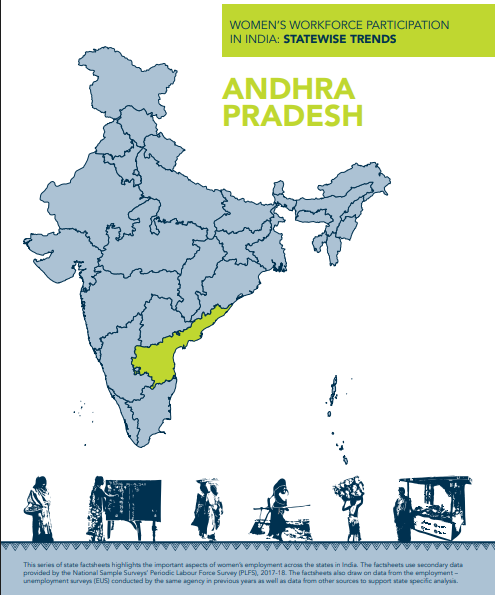
In Andhra Pradesh, the rise in urban women’s work participation rates are exceptional. The state shows high incidence of self-employment among women in both rural and urban areas. However, almost 66 percent of such women in rural areas work as unpaid helpers in household enterprises. In the urban areas, the incidence of women’s entrepreneurship in self-employment is visible. Among wage workers, MGNREGA has been an attractive option apart from other construction, manufacturing and service employment. The urban areas show some diversity in women’s engagement, while in rural areas women work in agriculture, construction and low productive manufacturing sectors
In Andhra Pradesh, the rise in urban women’s work participation rates are exceptional. The state shows high incidence of self-employment among women in both rural and urban areas. However, almost 66 percent of such women in rural areas work as unpaid helpers in household enterprises. In the urban areas, the incidence of women’s entrepreneurship in self-employment is visible. Among wage workers, MGNREGA has been an attractive option apart from other construction, manufacturing and service employment. The urban areas show some diversity in women’s engagement, while in rural areas women work in agriculture, construction and low productive manufacturing sectors
Learning note
Women’s Workforce Participation In India: Statewise Trends
- November , 2020
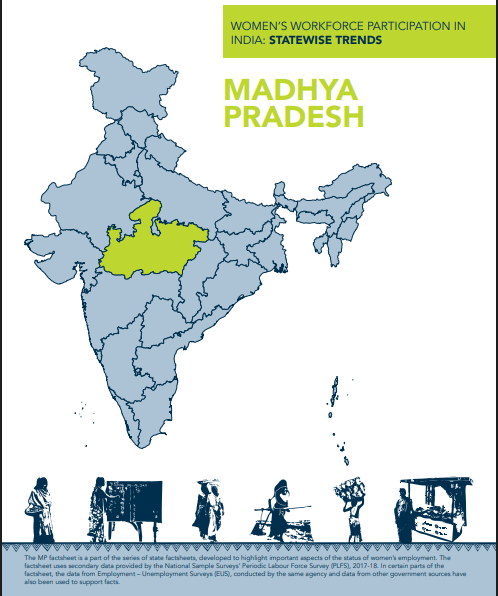
Madhya Pradesh (MP) is the only state in India to have witnessed a rise in workforce participation rates (WPRs) of women in both rural and urban areas between 2011-12 and 2017-18. The increase in women’s WPR in MP was driven largely by increase in self-employment in the rural areas and regular employment in the urban areas. According to the Periodic Labourforce Survey in 2017-18, more than half of the female workforce in the state is self-employed, with a higher incidence of self-employment in rural areas. While approximately 88 percent of the rural self-employed women in MP are engaged in unpaid work, the share of women in own account enterprises is substantially high in urban MP. The distribution of casual women workers suggests very few women engaged under MGNREGA and other public works as 96 percent women in casual employment were engaged in non-public works, with very little security or guarantee of payment
Madhya Pradesh (MP) is the only state in India to have witnessed a rise in workforce participation rates (WPRs) of women in both rural and urban areas between 2011-12 and 2017-18. The increase in women’s WPR in MP was driven largely by increase in self-employment in the rural areas and regular employment in the urban areas. According to the Periodic Labourforce Survey in 2017-18, more than half of the female workforce in the state is self-employed, with a higher incidence of self-employment in rural areas. While approximately 88 percent of the rural self-employed women in MP are engaged in unpaid work, the share of women in own account enterprises is substantially high in urban MP. The distribution of casual women workers suggests very few women engaged under MGNREGA and other public works as 96 percent women in casual employment were engaged in non-public works, with very little security or guarantee of payment
Factsheet
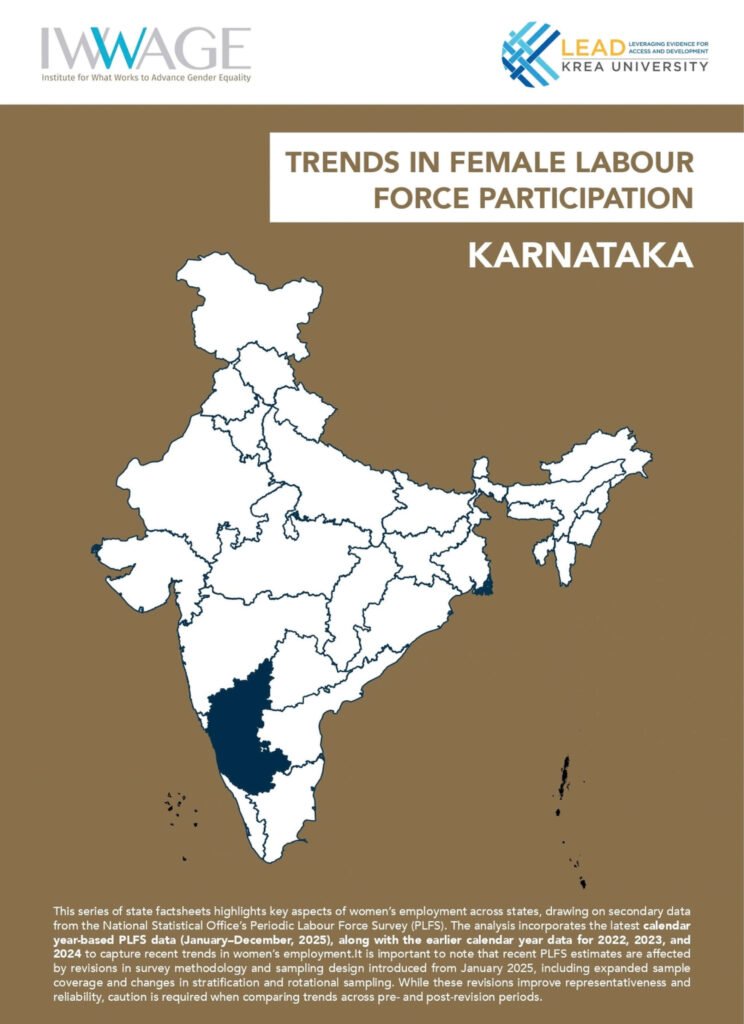
Trends in Female Labour Force Participation in Karnataka
- October , 2026
- Vidhi, Bidisha Mondal
Karnataka occupies a distinctive position in India’s economic landscape, driven by rapid growth in services, technology, and manufacturing sectors.This factsheet examines key trends in women’s labour force participation in Karnataka using PLFS data, with a focus on employment composition, sectoral and occupational distribution, quality of work, and barriers to women’s participation in the labour market.
Karnataka occupies a distinctive position in India’s economic landscape, driven by rapid growth in services, technology, and manufacturing sectors.This factsheet examines key trends in women’s labour force participation in Karnataka using PLFS data, with a focus on employment composition, sectoral and occupational distribution, quality of work, and barriers to women’s participation in the labour market.
Brief
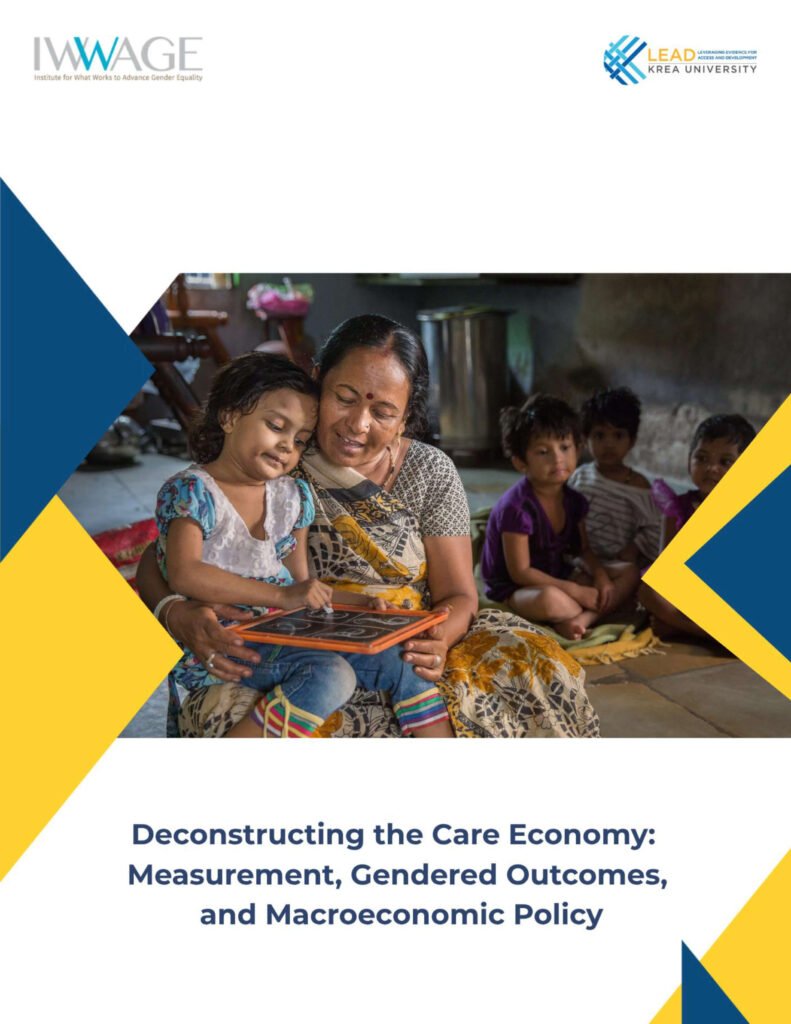
Deconstructing the Care Economy: Measurement, Gendered Outcomes, and Macroeconomic Policy
- September , 2026
The policy brief examines how unpaid care and domestic work largely undertaken by women remains invisible in conventional economic and labour statistics, while significantly shaping women’s participation and outcomes in the labour market. It highlights how care responsibilities contribute to women’s underemployment, lower-paid and precarious work, and inequalities in platform and hybrid work.
The policy brief examines how unpaid care and domestic work largely undertaken by women remains invisible in conventional economic and labour statistics, while significantly shaping women’s participation and outcomes in the labour market. It highlights how care responsibilities contribute to women’s underemployment, lower-paid and precarious work, and inequalities in platform and hybrid work.
Factsheet
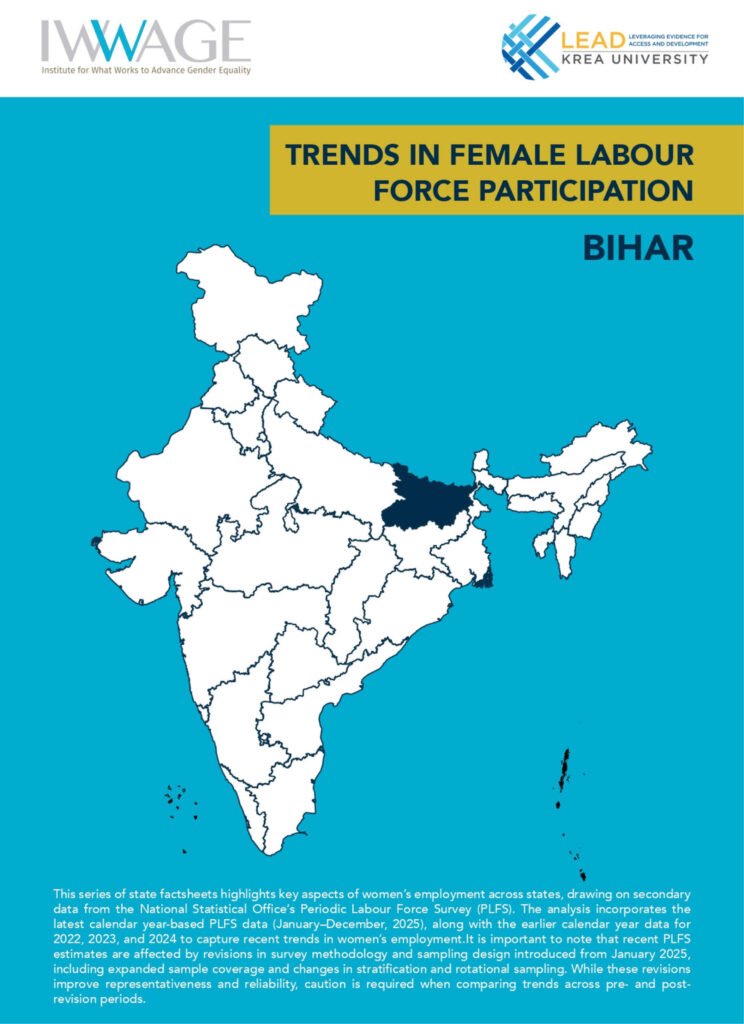
Trends in Female Labour Force Participation in Bihar
- September , 2026
- Vidhi, Bidisha Mondal
Despite economic growth, Bihar continues to face low female labour force participation, reflecting persistent supply-side constraints and limited access to suitable employment opportunities. Young women, in particular, experience low labour force participation amid high youth unemployment, while employment remains concentrated in agriculture and informal work. Sociocultural norms, limited access to education and skills, mobility constraints, inadequate transport, and care responsibilities further restrict women’s access to employment. Against this backdrop, this factsheet examines trends in female labour force participation, workforce composition, sectoral distribution, and working conditions in Bihar.
Despite economic growth, Bihar continues to face low female labour force participation, reflecting persistent supply-side constraints and limited access to suitable employment opportunities. Young women, in particular, experience low labour force participation amid high youth unemployment, while employment remains concentrated in agriculture and informal work. Sociocultural norms, limited access to education and skills, mobility constraints, inadequate transport, and care responsibilities further restrict women’s access to employment. Against this backdrop, this factsheet examines trends in female labour force participation, workforce composition, sectoral distribution, and working conditions in Bihar.
Report
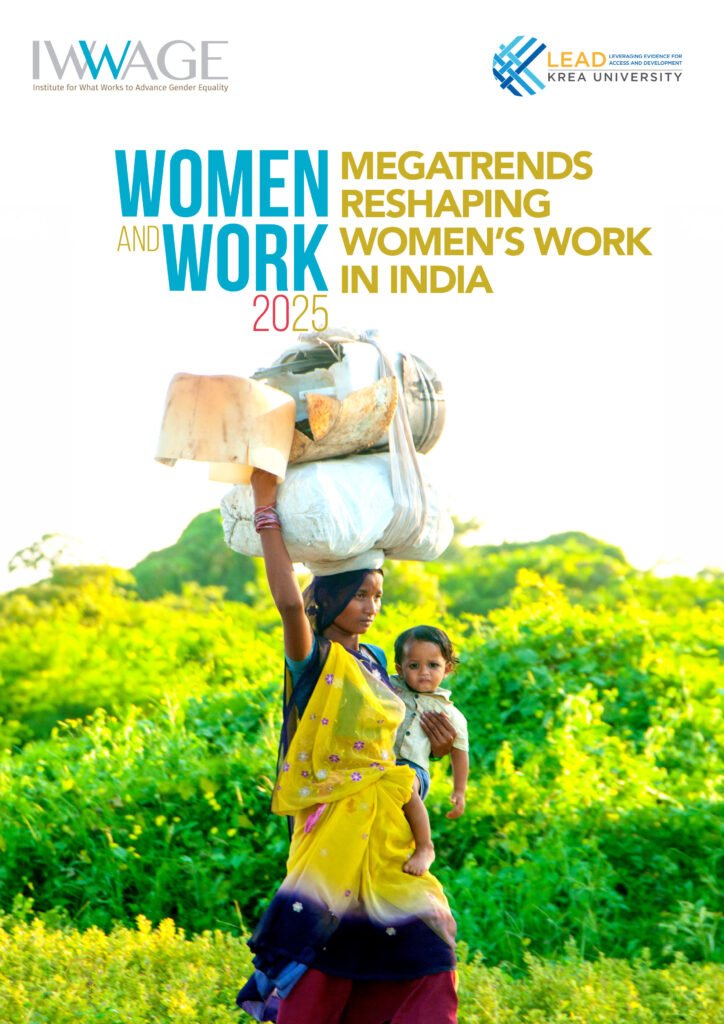
Women and Work 2025: Megatrends Reshaping Women’s Work in India
- September , 2026
- Divya Singh, Prakriti Sharma, Vidhi Singh, Sharati Roy
IWWAGE’s flagship report examines the changing landscape of women’s work in India and the forces shaping its future. Women’s labour force participation has risen significantly in recent years. Yet, the headline numbers tell only part of the story. The nature and experience of women’s work continue to be shaped by the quality and security of employment, unpaid care work, digitalisation, artificial intelligence, climate change, and women’s health at work. The report brings together evidence and emerging policy developments across these interconnected forces to examine where women’s work is headed—and what it will take to translate greater participation into greater economic agency, decent work, and protection.
IWWAGE’s flagship report examines the changing landscape of women’s work in India and the forces shaping its future. Women’s labour force participation has risen significantly in recent years. Yet, the headline numbers tell only part of the story. The nature and experience of women’s work continue to be shaped by the quality and security of employment, unpaid care work, digitalisation, artificial intelligence, climate change, and women’s health at work. The report brings together evidence and emerging policy developments across these interconnected forces to examine where women’s work is headed—and what it will take to translate greater participation into greater economic agency, decent work, and protection.
Factsheet
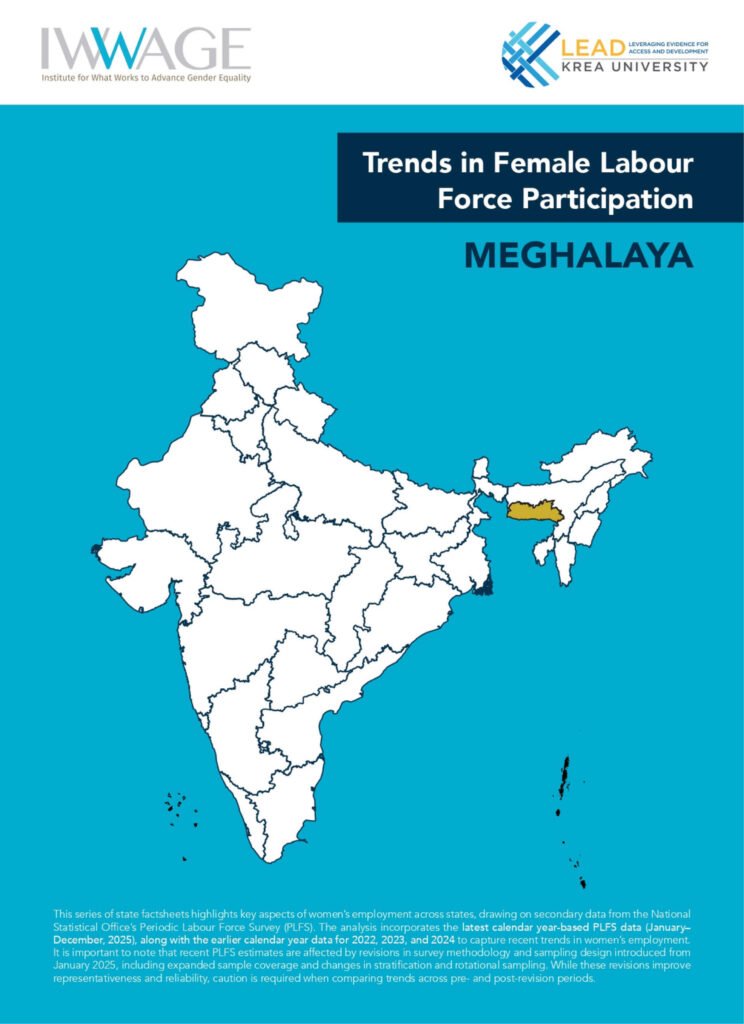
Trends in Female Labour Force Participation in Meghalaya
- August , 2026
- Nabankur Huda, Bidisha Mondal
Meghalaya is a small, hilly state in north-east India with a predominantly rural, agrarian economy and one of the country’s most distinctive social structures. The factsheet explores the trends, opportunities and challenges shaping women’s participation in Meghalaya’s labour market, with a focus on how the state’s social structure and economic transformation influence the nature and quality of women’s work.
Meghalaya is a small, hilly state in north-east India with a predominantly rural, agrarian economy and one of the country’s most distinctive social structures. The factsheet explores the trends, opportunities and challenges shaping women’s participation in Meghalaya’s labour market, with a focus on how the state’s social structure and economic transformation influence the nature and quality of women’s work.
Newsletter (Gender In Focus)
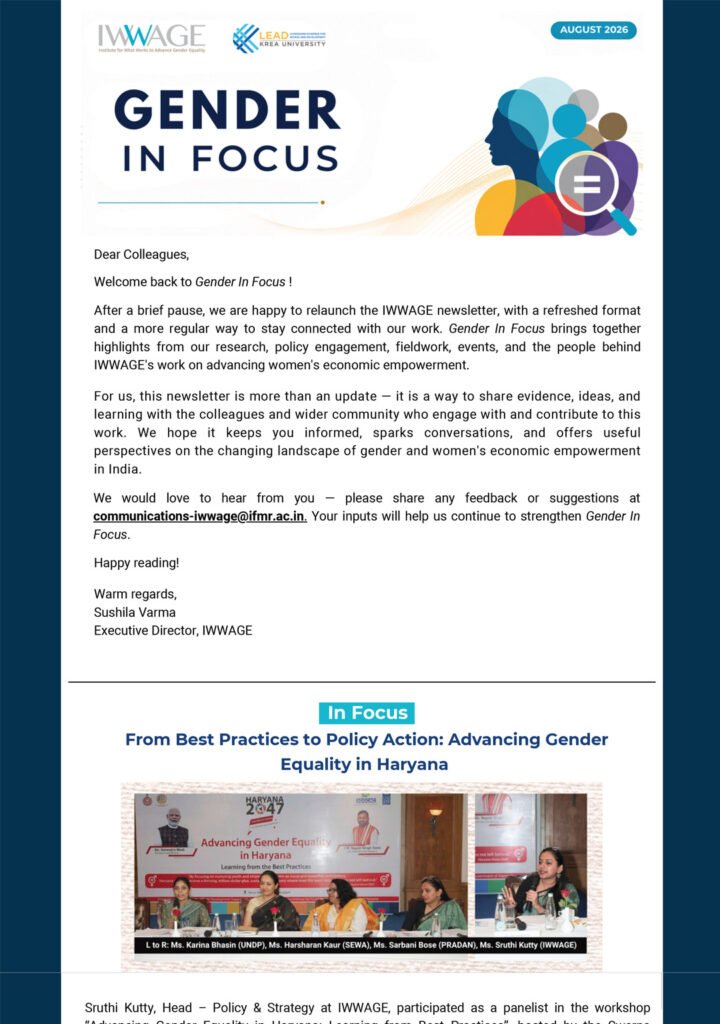
Gender in Focus
- August , 2026
The August 2026 edition features highlights from IWWAGE’s research, policy engagements, fieldwork and knowledge initiatives. It also offers a closer look at emerging trends shaping women’s work and economic participation in India.
The August 2026 edition features highlights from IWWAGE’s research, policy engagements, fieldwork and knowledge initiatives. It also offers a closer look at emerging trends shaping women’s work and economic participation in India.