


This factsheet explores Madhya Pradesh’s economy, contributing 4% to the national GDP with a GSDP of Rs. 8.1 lakh crores. Despite its natural resources, the state ranks among the bottom ten in per capita GSDP. With nearly 20% of the population being Scheduled Tribes, districts like Barwani, Damoh, and Guna experience higher poverty rates, highlighting the challenges faced by MP’s large tribal population.
Women's Economic
Empowerment
Women's Economic
Empowerment
IWWAGE’s work on women’s economic empowerment focuses on understanding and addressing the structural barriers that shape women’s participation in India’s labour market. At the centre of this agenda is the persistently low Female Labour Force Participation Rate (FLFPR), which reflects deep-rooted challenges related to access to decent work, social norms, and labour market institutions.
IWWAGE’s work in this area focuses on:
Evidence generation for policy action
Analysing national and state-level data to understand women’s employment patterns, sectoral and occupational distribution, and barriers to labour market entry and continuity.
Improving measurement and visibility of women’s work
Improved definitions and measurement of work, with a strong emphasis on recognising unpaid, home-based, and care work that remains undercounted in conventional labour statistics.
Shaping the future of women’s work
Examining women’s participation in a rapidly digitising economy, including platform and hybrid work models, to assess emerging opportunities, risks, and forms of precarity.
Strengthening agency and protection
Exploring women’s access to digital skills, agency, bargaining power, and social protection within evolving labour market arrangements.
Together, this body of work highlights that meaningful women’s economic empowerment requires better data, recognition of all forms of work, and the proactive shaping of labour market institutions so that women’s work is visible, valued, and protected.
Factsheet
Women’s Workforce Participation in India: Statewise Trends
- November , 2020
- Sona Mitra, Hiya Singh Rajput
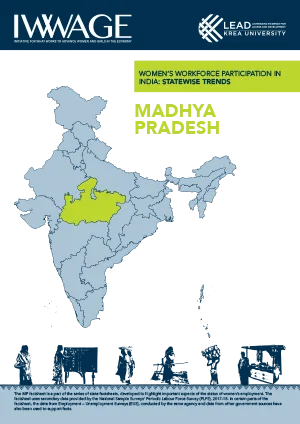
In urban areas of Madhya Pradesh, while the rise of women in regular wage work appears to be a positive trend, more in-depth analyses is required on the nature of employment contracts for women. On the positive side, the share of women in own account enterprises is substantially high in MP, more so in urban parts of the state
In urban areas of Madhya Pradesh, while the rise of women in regular wage work appears to be a positive trend, more in-depth analyses is required on the nature of employment contracts for women. On the positive side, the share of women in own account enterprises is substantially high in MP, more so in urban parts of the state
Learning note
Women’s Workforce Participation in India: Statewise Trends
- November , 2020
- Sona Mitra , Hiya Singh Rajput
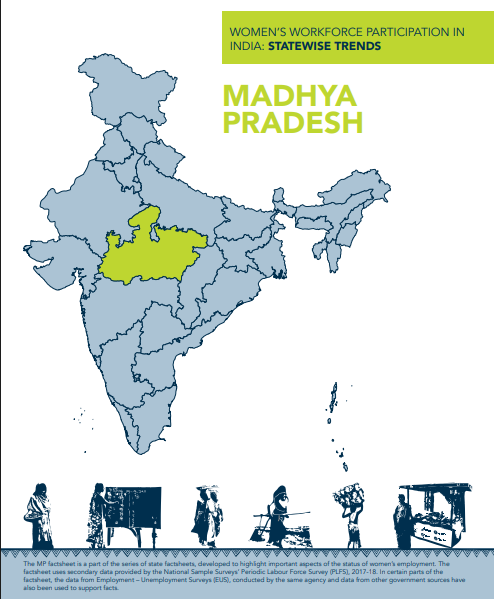
Madhya Pradesh, known as the heart of India, is the second-largest state by area and rich in natural resources. With a Gross State Domestic Product (GSDP) of Rs. 8.1 lakh crores, MP contributes around 4% to the national GDP. However, the state faces significant challenges, ranking among the bottom ten states in per capita GSDP. Nearly 20% of MP’s population comprises Scheduled Tribes (STs), and districts like Barwani, Damoh, and Guna are among the poorest in the country, reflecting higher poverty rates among the state’s large tribal population.
Madhya Pradesh, known as the heart of India, is the second-largest state by area and rich in natural resources. With a Gross State Domestic Product (GSDP) of Rs. 8.1 lakh crores, MP contributes around 4% to the national GDP. However, the state faces significant challenges, ranking among the bottom ten states in per capita GSDP. Nearly 20% of MP’s population comprises Scheduled Tribes (STs), and districts like Barwani, Damoh, and Guna are among the poorest in the country, reflecting higher poverty rates among the state’s large tribal population.
Learning note
Women’s Workforce Participation in India: Statewise Trends
- November , 2020
- Nidhi Gyan Pandey , Sona Mitra
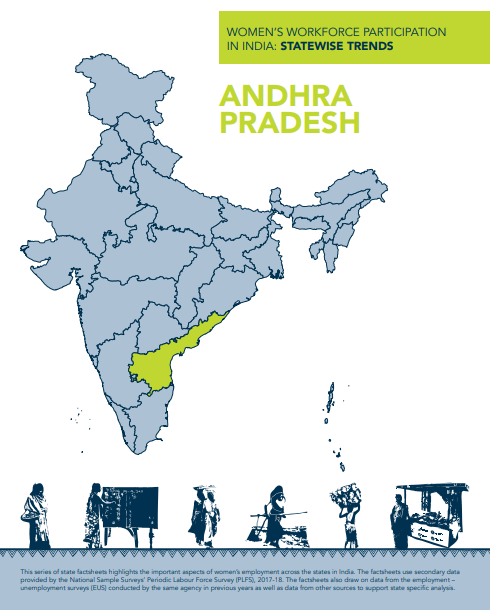
Located on the southeastern coast of India, Andhra Pradesh is the eighth largest state by area, with 23.5% forest cover and 50.5% land under cultivation. While agriculture employs 60% of the population, it contributes only 32% to the state’s GSDP. Andhra Pradesh is a middle-income state with a high growth rate of 11% in 2018-19. The state’s female labour force participation rate (FLFPR) is significantly higher than the national average, with rural FLFPR at 39% and urban FLFPR at 25.1%. The high rural FLFPR is partly attributed to women’s participation in the MGNREGA programme.
Located on the southeastern coast of India, Andhra Pradesh is the eighth largest state by area, with 23.5% forest cover and 50.5% land under cultivation. While agriculture employs 60% of the population, it contributes only 32% to the state’s GSDP. Andhra Pradesh is a middle-income state with a high growth rate of 11% in 2018-19. The state’s female labour force participation rate (FLFPR) is significantly higher than the national average, with rural FLFPR at 39% and urban FLFPR at 25.1%. The high rural FLFPR is partly attributed to women’s participation in the MGNREGA programme.
Learning note
Women’s Workforce Participation in India: Statewise Trends
- November , 2020
- Sona Mitra , Hiya Singh Rajput
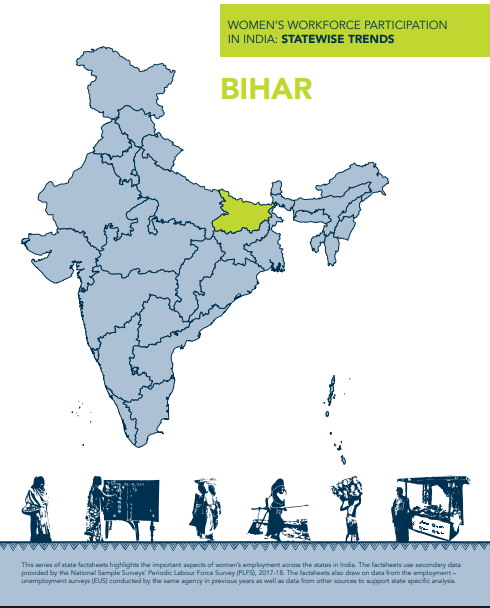
Bihar, one of India’s poorest states, faces significant challenges in development across key areas such as education, health, and nutrition, while also lagging in gender development. With the lowest female workforce participation rate (WPR) in the country at just 2.8%, Bihar’s economic empowerment of women is a critical concern. This factsheet highlights the stark disparities in women’s employment in the state and calls for urgent policy action to address these issues, offering a comparison with national averages.
Bihar, one of India’s poorest states, faces significant challenges in development across key areas such as education, health, and nutrition, while also lagging in gender development. With the lowest female workforce participation rate (WPR) in the country at just 2.8%, Bihar’s economic empowerment of women is a critical concern. This factsheet highlights the stark disparities in women’s employment in the state and calls for urgent policy action to address these issues, offering a comparison with national averages.
Learning note
Women’s Workforce Participation in India: Statewise Trends
- November , 2020
- Nidhi Gyan Pandey , Sona Mitra
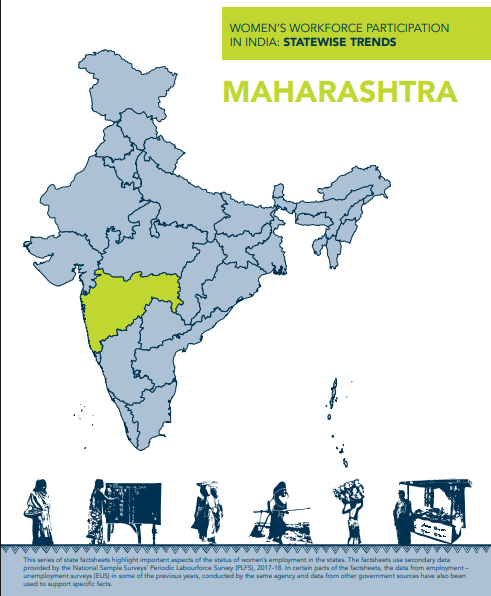
Maharashtra, one of India’s most prosperous and industrially advanced states, has the highest Gross State Domestic Product (GSDP) among all states, amounting to Rs. 19,400 billion in 2017-18. Despite its economic strength, Maharashtra ranks lower on gender indicators, with a sex ratio of 958 females per 1,000 males and a child sex ratio of 894. Female labour force participation (FLFPR) in Maharashtra is significantly higher than the national average at 31%, driven by rural participation. However, urban FLFPR remains low at 16.8%, highlighting gender disparities in urban employment. This factsheet explores key socio-economic and gender trends in the state.
Maharashtra, one of India’s most prosperous and industrially advanced states, has the highest Gross State Domestic Product (GSDP) among all states, amounting to Rs. 19,400 billion in 2017-18. Despite its economic strength, Maharashtra ranks lower on gender indicators, with a sex ratio of 958 females per 1,000 males and a child sex ratio of 894. Female labour force participation (FLFPR) in Maharashtra is significantly higher than the national average at 31%, driven by rural participation. However, urban FLFPR remains low at 16.8%, highlighting gender disparities in urban employment. This factsheet explores key socio-economic and gender trends in the state.
Factsheet
Women’s Workforce Participation in India: Statewise Trends
- October , 2020
- Nidhi Gyan Pandey
This factsheet highlights Odisha’s economy, which is largely agro-based, with agriculture, forestry, and fishing providing 50% of employment. Despite natural disasters, the state’s service, industrial, and mining sectors contribute significantly to its GSDP. Tribal women play a vital role in forest produce collection and handicrafts, yet female labor force participation remains low, with rural and urban FLFPRs at 15.2% and 13.4%, respectively.
While the share of women workers in regular wage work has been increasing all across India, Odisha has shown exceptional growth in this regard, particularly in urban areas. But as in other states, this has not translated into improved working conditions for women.
While the share of women workers in regular wage work has been increasing all across India, Odisha has shown exceptional growth in this regard, particularly in urban areas. But as in other states, this has not translated into improved working conditions for women.