Women's Economic
Empowerment

Women's Economic
Empowerment

IWWAGE’s work on women’s economic empowerment focuses on understanding and addressing the structural barriers that shape women’s participation in India’s labour market. At the centre of this agenda is the persistently low Female Labour Force Participation Rate (FLFPR), which reflects deep-rooted challenges related to access to decent work, social norms, and labour market institutions.

IWWAGE’s work in this area focuses on:

Evidence generation for policy action

Analysing national and state-level data to understand women’s employment patterns, sectoral and occupational distribution, and barriers to labour market entry and continuity.

Improving measurement and visibility of women’s work

Improved definitions and measurement of work, with a strong emphasis on recognising unpaid, home-based, and care work that remains undercounted in conventional labour statistics.

Shaping the future of women’s work

Examining women’s participation in a rapidly digitising economy, including platform and hybrid work models, to assess emerging opportunities, risks, and forms of precarity.

Strengthening agency and protection

Exploring women’s access to digital skills, agency, bargaining power, and social protection within evolving labour market arrangements.

Together, this body of work highlights that meaningful women’s economic empowerment requires better data, recognition of all forms of work, and the proactive shaping of labour market institutions so that women’s work is visible, valued, and protected.
Learning note

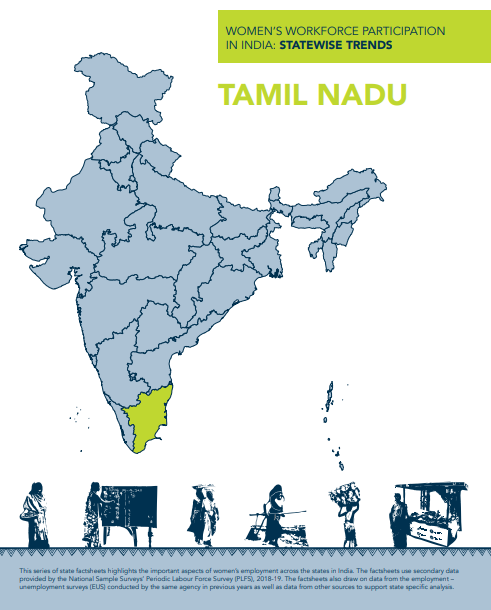
Women’s Workforce Participation in India: Statewise Trends

Tamil Nadu, the second-largest economy in India with a GSDP of Rs 18,45,853 crores, is known for combining rapid economic growth with high social development. The state boasts strong public services, ranking third in human development and literacy (96.8%) among all states. Tamil Nadu’s female labour force participation rates (FLFPR) are significantly higher than the national average, with rural FLFPR at 35.1% and urban FLFPR at 23.6%. The state also excels in gender indicators, with a low maternal mortality rate of 66 and the third lowest crime rate against women in the country.
Learning note

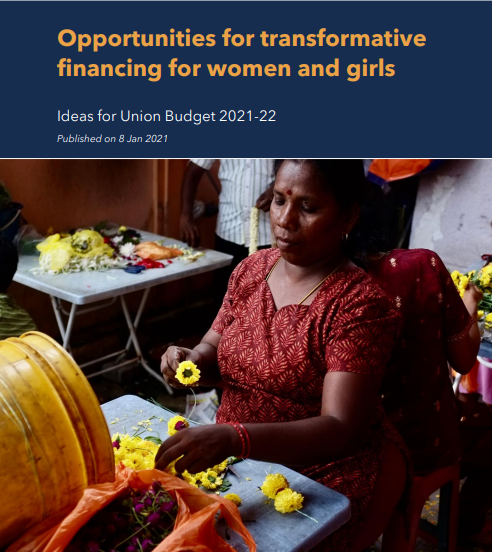
Opportunities for Transformative Financing for Women and Girls

This paper draws on a pre-budget consultation hosted by IWWAGE and The Quantum Hub (TQH) on 1 October 2020, ‘Transformative financing for Gender Equality in a COVID-19 context’ to inform the Union Budget 2021-22. The aim of the consultation was to identify and amplify the needs of millions of women and girls whose lives have been disrupted and severely affected because of the pandemic, but also account for the disadvantages and inequities that existed even before COVID-19. IWWAGE invited experts1 from academia, civil society, NGOs, and donor bodies, who have been actively advocating for transformative financing for gender equality in India. These experts shared their insights from current and past experiences to shape an actionable agenda to improve the lives of women and girls in the current context. IWWAGE, like some of the experts invited for the consultation, is part of the Broad-Based Committee on Gender Budgeting and Analysis that has been set up by the Ministry for Women and Child Development (MWCD). We used this opportunity to provide suggestions to support the gender responsive budgeting efforts of MWCD and that of other relevant ministries, and also shared these with the Ministry of Finance in response to their request for ideas for Union Budget 2021-22. We also aim to share insights from this consultation among key decision makers, relevant line ministries and departments, and to a wider audience engaged in shaping the agenda on advancing gender equality and women’s economic empowerment in India. This paper has been jointly developed by The Quantum Hub (TQH) and IWWAGE.
Report

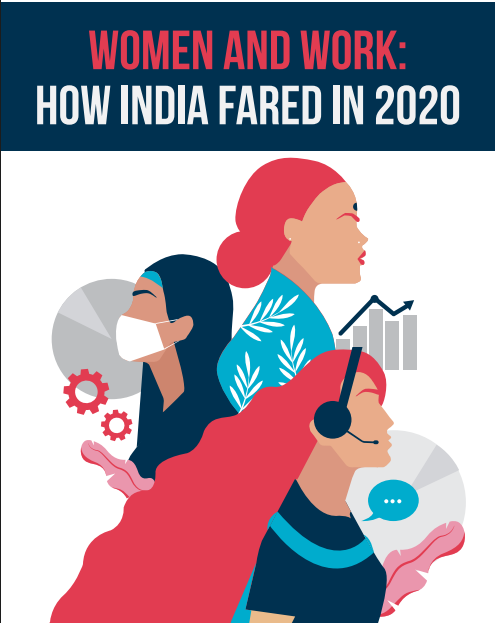
Women and Work: How India fared in 2020

Women and girls across the world have been disproportionately affected in the year of the pandemic, not in terms of impact of the virus, but more so socially and economically. While India was rapidly responding to the health crisis, millions of Indians were grappling with the unintended impacts of lockdown measures on the economy and their livelihoods. Even before the onset of COVID-19, India’s female workforce was largely invisible, underpaid, under-protected and constituted largest segment of the informal workforce, which is among the worst-hit this year. But several opportunities exist in 2021 to ensure that India’s women are not left behind in its recovery plans. Against this backdrop, IWWAGE and The Quantum Hub (TQH) authored a report that draws from various studies, data sources and nationally-representative data sets to look at the key trends and policy developments that came to shape and define the lives of women across India in 2020. This report captures key data on economic and social indicators (like female labour force participation, barriers to work and livelihoods, financial inclusion, digital access, skilling, education and violence against women) that played a central role in determining women’s role in the Indian economy this year.
Report

Strengthening Socio-Economic Rights of Women in the Informal Economy: The SEWA Approach in West Bengal and Jharkhand

Women working in India’s informal sector face several vulnerabilities and are often denied decent working conditions and wages. This further exacerbates inequities and pushes them towards high risk poverty. The situation is worse for women belonging to socially disadvantaged castes and communities. Evidence from India and other contexts shows that the working poor in the informal economy, particularly women, need to organise themselves to overcome the structural disadvantages they face. Organisation gives these otherwise marginalised workers the power of solidarity and a platform to be seen and heard by decision makers with the power to affect their lives. Since 1972, the Self-Employed Women’s Association (SEWA) is working as an organisation of poor women workers and a movement to create better alternatives. SEWA is currently operative in many states across the country and has a membership base of nearly 2 million women workers in the informal economy, comprising domestic workers, street vendors, agricultural workers, construction labourers, salt workers, beedi and papad rollers and such other vulnerable categories. SEWA’s programme in Jharkhand and West Bengal aims to increase the collective bargaining strength of women, particularly those working as agricultural workers, domestic workers and construction labourers (in the former state) and female beedi rollers in West Bengal. The programme aims to improve women’s access to and understanding of basic services, such as health and sanitation, and also increase their ability to demand local accountability through nurturing of grassroots leadership. The study tries to understand the impact that various components of its programme have had on informal women workers in Jharkhand and West Bengal. The women included in the study were predominantly engaged in beedi rolling, domestic work, construction work, agriculture and street vending.
IWWAGE-ISI-BRIEFS

Women in Agriculture

Over the past two decades, India has seen a dramatic rise in agricultural mechanisation, particularly through the widespread adoption of tractors. While this technological progress has improved productivity, it has also led to a significant decline in rural farm employment-most notably among women. This study investigates how mechanisation, especially in tilling, has contributed to the fall in female agricultural labour. The analysis finds that a 1 percentage point increase in the mechanisation of tilling operations reduces female labour per hectare by 0.7 per cent. This decline stems largely from a reduction in the need for weeding-an activity traditionally undertaken by women-as tilling quality improves. Between 1999 and 2011, a 32 percentage point rise in mechanisation explains around 22 per cent of the 30 per cent drop in women’s employment in agriculture during the same period. The research underscores that when the production process is sequential and tasks are gendered-as in Indian agriculture-technological change can disproportionately affect women’s livelihoods. Since men have historically undertaken the more power-intensive tasks like deep tilling, they are better positioned to benefit from mechanisation. Meanwhile, women, who perform precision-based tasks such as weeding and sowing, are often displaced. Soil composition also plays a role: regions with loamy soils, which require deeper tilling, are more likely to adopt mechanised tools. These structural dynamics-both technological and environmental-compound the challenges rural women face in maintaining agricultural employment. The findings highlight the need for gender-sensitive policy design that anticipates and mitigates the unintended consequences of agricultural modernisation.
Brief

Digital Solutions for SHGs in Chhattisgarh – The COVID-19 Pandemic: Project Modifications and Learnings

Women’s collectives like self-help groups (SHGs) have long played a transformative role in empowering women across India. Building on this potential, IWWAGE an initiative of LEAD at Krea University is partnering with the State Rural Livelihoods Mission (SRLM) Chhattisgarh and Haqdarshak Empowerment Solutions (HESPL) to train SHG members on using the **Haqdarshak** mobile application. This innovative tool helps citizens access information on over 200 central and state government welfare schemes. Trained SHG women, known as *Haqdarshikas*, earn a livelihood by offering doorstep services to their communities, enabling access to welfare entitlements for a small fee. The project adopts a sustainable, entrepreneurial model while enhancing digital literacy and economic participation among rural women. Alongside implementation, IWWAGE and LEAD are conducting an impact and process evaluation of the Haqdarshak model. This includes assessing adaptations made during the COVID-19 pandemic, changes in program delivery for different training cohorts, and evolving evaluation methods. This learning note captures early implementation insights and outlines how the model is evolving to remain effective in changing contexts.
Scroll to Top