


Explore our annual collection of factsheets for state-wise analysis of women’s workforce participation in India. Using data from the Periodic Labour Force Survey (PLFS), these factsheets highlight trends in female labor force participation, employment types, and earnings gaps. They provide valuable insights for researchers, policymakers, and the public on the evolving landscape of women’s work in India.
Women's Economic
Empowerment
Women's Economic
Empowerment
IWWAGE’s work on women’s economic empowerment focuses on understanding and addressing the structural barriers that shape women’s participation in India’s labour market. At the centre of this agenda is the persistently low Female Labour Force Participation Rate (FLFPR), which reflects deep-rooted challenges related to access to decent work, social norms, and labour market institutions.
IWWAGE’s work in this area focuses on:
Evidence generation for policy action
Analysing national and state-level data to understand women’s employment patterns, sectoral and occupational distribution, and barriers to labour market entry and continuity.
Improving measurement and visibility of women’s work
Improved definitions and measurement of work, with a strong emphasis on recognising unpaid, home-based, and care work that remains undercounted in conventional labour statistics.
Shaping the future of women’s work
Examining women’s participation in a rapidly digitising economy, including platform and hybrid work models, to assess emerging opportunities, risks, and forms of precarity.
Strengthening agency and protection
Exploring women’s access to digital skills, agency, bargaining power, and social protection within evolving labour market arrangements.
Together, this body of work highlights that meaningful women’s economic empowerment requires better data, recognition of all forms of work, and the proactive shaping of labour market institutions so that women’s work is visible, valued, and protected.

Factsheet
Female Labour Force Participation Rate and Earnings Gap in India
- July , 2020
- Anjana Thampi, Sona Mitra
Explore our annual collection of factsheets for state-wise analysis of women’s workforce participation in India. Using data from the Periodic Labour Force Survey (PLFS), these factsheets highlight trends in female labor force participation, employment types, and earnings gaps. They provide valuable insights for researchers, policymakers, and the public on the evolving landscape of women’s work in India.
Explore our annual collection of factsheets for state-wise analysis of women’s workforce participation in India. Using data from the Periodic Labour Force Survey (PLFS), these factsheets highlight trends in female labor force participation, employment types, and earnings gaps. They provide valuable insights for researchers, policymakers, and the public on the evolving landscape of women’s work in India.
Learning note
Policies and Programmes For Women and Girls
- July , 2020
- Nidhi Gyan Pandey
Bihar faces significant challenges in health, education, and gender development. With low female literacy and the country’s lowest female workforce participation, the state has launched initiatives like the ‘Mukhyamantri Balika Cycle Yojana,’ improving school attendance and reducing dropout rates. The ‘Saat Nischay’ programme focuses on empowering women through schemes targeting health, education, and infrastructure. While these efforts show promise, more evaluations are needed to assess their impact on women’s development and social protection.
Bihar faces significant challenges in health, education, and gender development. With low female literacy and the country’s lowest female workforce participation, the state has launched initiatives like the ‘Mukhyamantri Balika Cycle Yojana,’ improving school attendance and reducing dropout rates. The ‘Saat Nischay’ programme focuses on empowering women through schemes targeting health, education, and infrastructure. While these efforts show promise, more evaluations are needed to assess their impact on women’s development and social protection.
Learning note
Female Labour Force Participation Rate and Earnings Gap in India
- July , 2020
- Anjana Thampi | Sona Mitra
Welcome to our annual repository of factsheets, where we present a detailed analysis of women’s workforce participation across India. Each year, we gather state-wise data from surveys such as the Periodic Labour Force Survey (PLFS) to explore trends in female labour force participation, employment types, and earnings gaps. These factsheets provide a snapshot of the economic and social factors affecting women’s employment, offering valuable insights for researchers, policymakers, and the general public. Dive into the data and discover the evolving landscape of women’s work in India
Welcome to our annual repository of factsheets, where we present a detailed analysis of women’s workforce participation across India. Each year, we gather state-wise data from surveys such as the Periodic Labour Force Survey (PLFS) to explore trends in female labour force participation, employment types, and earnings gaps. These factsheets provide a snapshot of the economic and social factors affecting women’s employment, offering valuable insights for researchers, policymakers, and the general public. Dive into the data and discover the evolving landscape of women’s work in India

Factsheet
Trends in Female Labour and Workforce Participation – Karnataka
- April , 2020
- Aneek Choudhary , Bidisha Mondal
Karnataka, despite being India’s IT hub, has a lower female labour force participation rate (FLFPR) than the national average. While women’s literacy exceeds 68%, many are engaged in unpaid household work or casual labour. Recent developments, like the ‘Shakti’ scheme, have positively impacted FLFPR by providing safe and affordable transportation, leading to increased workforce participation. However, disparities remain, as highlighted by the PLFS 2023-24 survey. This factsheet explores the trends, challenges, and policy implications affecting women’s participation in Karnataka’s labour market.
Karnataka, despite being India’s IT hub, has a lower female labour force participation rate (FLFPR) than the national average. While women’s literacy exceeds 68%, many are engaged in unpaid household work or casual labour. Recent developments, like the ‘Shakti’ scheme, have positively impacted FLFPR by providing safe and affordable transportation, leading to increased workforce participation. However, disparities remain, as highlighted by the PLFS 2023-24 survey. This factsheet explores the trends, challenges, and policy implications affecting women’s participation in Karnataka’s labour market.
Report
Generating Female Employment through Public Employment: A Scoping Paper
- February , 2020
- Dipa Sinha, Jayati Ghosh, Mohini Gupta, Varsha Gupta
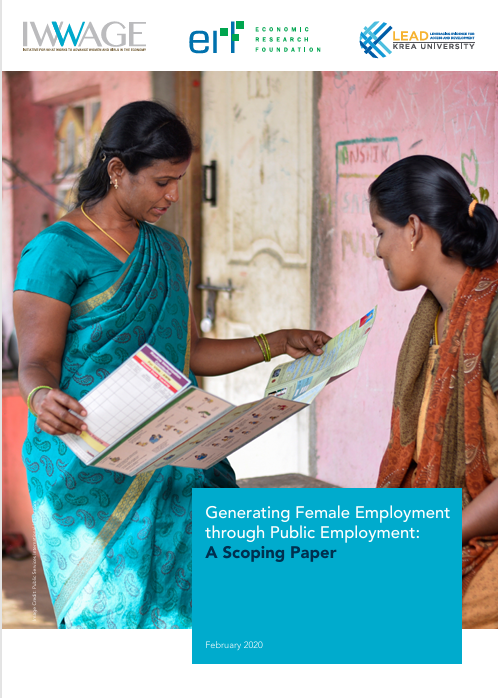
The employment generating potential of growth in India has been on the decline with unemployment and the lack of new job opportunities at their peak. According to the data put together by the State of Working India 2018, the relationship between growth and employment generation in India has weakened over time. A related puzzle is that of declining female workforce participation rates in the country, despite increasing education levels as well as economic growth. A major concern for the direction and pace of economic growth is how work and labour force participation rates of women can be improved. Employment in the government, especially in public services delivery, is a potential area where jobs can be created. An emphasis on creating work opportunities for women in public administration and frontline public services can serve the dual purpose of providing universal access to quality public services and reviving demand in the economy. IWWAGE study, Generating Female Employment through Public Employment aims to estimate the impact of creating and regularising jobs for women within the system of public administration, especially in frontline public services delivery. It considers questions on the activities and working conditions of women workers in frontline public services, assesses the number of such workers, and compares them with international estimates. The study also evaluates whether there is gender stereotyping in certain public sector jobs. Additionally, the study captures women’s perceptions of the benefits and constraints of being employed in such jobs. This scoping paper presents the current status of women employed in various levels by the government, based on data from the National Sample Survey (NSS), analysis of government reports, publications, and responses to queries raised using the Right to Information (RTI).
The employment generating potential of growth in India has been on the decline with unemployment and the lack of new job opportunities at their peak. According to the data put together by the State of Working India 2018, the relationship between growth and employment generation in India has weakened over time. A related puzzle is that of declining female workforce participation rates in the country, despite increasing education levels as well as economic growth. A major concern for the direction and pace of economic growth is how work and labour force participation rates of women can be improved. Employment in the government, especially in public services delivery, is a potential area where jobs can be created. An emphasis on creating work opportunities for women in public administration and frontline public services can serve the dual purpose of providing universal access to quality public services and reviving demand in the economy. IWWAGE study, Generating Female Employment through Public Employment aims to estimate the impact of creating and regularising jobs for women within the system of public administration, especially in frontline public services delivery. It considers questions on the activities and working conditions of women workers in frontline public services, assesses the number of such workers, and compares them with international estimates. The study also evaluates whether there is gender stereotyping in certain public sector jobs. Additionally, the study captures women’s perceptions of the benefits and constraints of being employed in such jobs. This scoping paper presents the current status of women employed in various levels by the government, based on data from the National Sample Survey (NSS), analysis of government reports, publications, and responses to queries raised using the Right to Information (RTI).
Brief
Learnings from Scoping Visit
- February , 2020
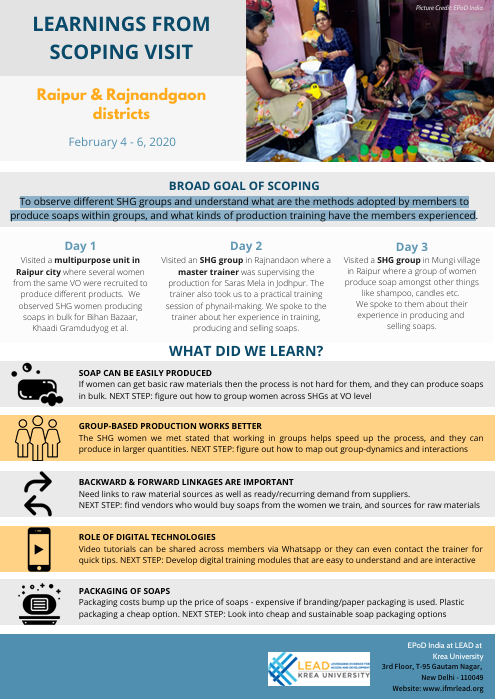
To observe different SHG groups and understand what are the methods adopted by members to produce soaps within groups, and what kinds of production training have the members experienced
To observe different SHG groups and understand what are the methods adopted by members to produce soaps within groups, and what kinds of production training have the members experienced