


This rapid assessment explores how hybrid work models are reshaping opportunities for women in India post-pandemic. It examines the benefits and challenges of hybrid work, with data from 400 working women across various sectors. Featuring a case study of a rural BPO in Uttarakhand, the study highlights the potential of hybrid work for women in both urban and rural areas, offering insights into its impact on productivity, autonomy, and work-life balance.
Publications
Publications
Category
Year

Factsheet
Women’s Workforce Participation in India: Statewise Trends
- April , 2023
- Suchika Gupta, Sona Mitra
Uttar Pradesh, with a population of nearly 200 million, is India’s most populous state and the fourth largest by area.This factsheet explores key socio-economic and employment trends in the state
Uttar Pradesh, with a population of nearly 200 million, is India’s most populous state and the fourth largest by area.This factsheet explores key socio-economic and employment trends in the state

Brief
Hybrid Work and its Effect on Women’s Labour Force Participation
- April , 2023
- Areen Deshmukh, Mitali Nikore
COVID-19 and related lockdowns disrupted the global economy and reshaped the concept of the workplace. Organisations worldwide are increasingly adopting hybrid work models that combine remote and in-office work, a trend also evident in India, where 73% of firms plan to shift to hybrid work (CBRE). Women are more vulnerable to such economic shocks due to structural inequities and their disproportionate burden of unpaid care work, which intensified during the pandemic as care institutions shut down. As a result, women’s employment in India was severely affected, with 13.4 million women (26.6%) exiting the labour force between March–April 2020. Hybrid work offers potential to support women’s labour force participation by providing flexibility for those facing caregiving responsibilities, safety concerns, or mobility constraints. This policy review analyses existing government and private-sector hybrid work policies and identifies global best practices. The study draws on a literature review of policy and legal frameworks across 60 countries, along with consultations with key stakeholders.
COVID-19 and related lockdowns disrupted the global economy and reshaped the concept of the workplace. Organisations worldwide are increasingly adopting hybrid work models that combine remote and in-office work, a trend also evident in India, where 73% of firms plan to shift to hybrid work (CBRE). Women are more vulnerable to such economic shocks due to structural inequities and their disproportionate burden of unpaid care work, which intensified during the pandemic as care institutions shut down. As a result, women’s employment in India was severely affected, with 13.4 million women (26.6%) exiting the labour force between March–April 2020. Hybrid work offers potential to support women’s labour force participation by providing flexibility for those facing caregiving responsibilities, safety concerns, or mobility constraints. This policy review analyses existing government and private-sector hybrid work policies and identifies global best practices. The study draws on a literature review of policy and legal frameworks across 60 countries, along with consultations with key stakeholders.
Working Paper
Understanding the barriers to womens career advancement in manufacturing sector
- March , 2023
- Aishwarya Joshi , Kaavyayani Pal , Mahima Chaki
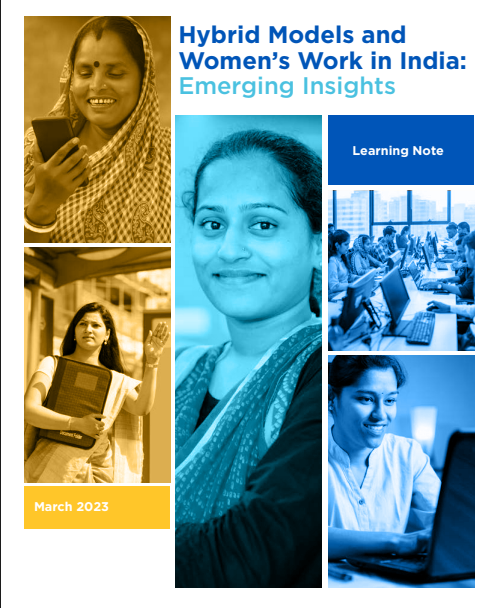
The COVID-19 pandemic catalysed a shift in how we work, bringing hybrid work models into the spotlight especially for women. These flexible arrangements offer greater autonomy over time, often leading to improved work-life balance, reduced costs, and higher productivity. However, the benefits and challenges of hybrid work are not experienced equally its effects are often gendered. While most existing research on hybrid work focuses on ICT-intensive sectors, there’s limited data on how women across different industries and regions are engaging with this model. With the government’s push for a digitally empowered society under the Digital India Programme, and a growing emphasis on enterprise development in peri-urban and rural areas, hybrid work holds promise for expanding economic opportunities for women. This rapid assessment captures insights from 400 working women, including 150 currently in hybrid roles, across sectors such as technology, social services, and healthcare. With an average respondent age of 27 years and nearly half residing outside metropolitan areas, the study highlights both the opportunities and gaps in hybrid work adoption. A case study from a rural BPO in Uttarakhand further explores how hybrid work could transform women’s employment in non-urban settings.
The COVID-19 pandemic catalysed a shift in how we work, bringing hybrid work models into the spotlight especially for women. These flexible arrangements offer greater autonomy over time, often leading to improved work-life balance, reduced costs, and higher productivity. However, the benefits and challenges of hybrid work are not experienced equally its effects are often gendered. While most existing research on hybrid work focuses on ICT-intensive sectors, there’s limited data on how women across different industries and regions are engaging with this model. With the government’s push for a digitally empowered society under the Digital India Programme, and a growing emphasis on enterprise development in peri-urban and rural areas, hybrid work holds promise for expanding economic opportunities for women. This rapid assessment captures insights from 400 working women, including 150 currently in hybrid roles, across sectors such as technology, social services, and healthcare. With an average respondent age of 27 years and nearly half residing outside metropolitan areas, the study highlights both the opportunities and gaps in hybrid work adoption. A case study from a rural BPO in Uttarakhand further explores how hybrid work could transform women’s employment in non-urban settings.

Brief
Emerging Priorities in the Care Sector: Opportunities for India’s G20 Presidency
- March , 2023
- Sona Mitra and Sruthi Kutty
Care work has emerged as a critical issue in shaping the women-led development agenda at the G20. This brief highlights priority concerns for India’s G20 presidency. Care work—both paid and unpaid—is essential to the functioning of economies and societies, yet it is disproportionately shouldered by women due to entrenched gender norms and the gendered division of labour. This unequal burden remains a major barrier to women’s participation in labour markets. Evidence shows that care responsibilities significantly limit women’s income-earning capacity and economic agency, with women globally spending two to ten times more time on unpaid care work than men.
Care work has emerged as a critical issue in shaping the women-led development agenda at the G20. This brief highlights priority concerns for India’s G20 presidency. Care work—both paid and unpaid—is essential to the functioning of economies and societies, yet it is disproportionately shouldered by women due to entrenched gender norms and the gendered division of labour. This unequal burden remains a major barrier to women’s participation in labour markets. Evidence shows that care responsibilities significantly limit women’s income-earning capacity and economic agency, with women globally spending two to ten times more time on unpaid care work than men.
Learning note
Gender Responsive Budgeting: Good Practices from Select States
- March , 2023
- Sona Mitra | Sruthi Kutty
Mainstreaming gender into development financing has gained global momentum, with the Addis Ababa Action Agenda reinforcing the need for gender-sensitive approaches in financial, economic, and social policies. In India, the journey towards Gender Responsive Budgeting (GRB) began with efforts in the Sixth Five Year Plan and was institutionalised at the central level in 2004-05. GRB aims to integrate gender considerations across development planning, programme formulation, and budgeting processes. India’s GRB mechanism functions through Gender Budget Cells and the Gender Budget Statement (GBS), covering 57 ministries as of 2022. While the framework provides an avenue for monitoring fund allocations and their impact on gender equality, significant gaps remain in its implementation. State governments, such as Odisha and Kerala, have shown greater success in embedding gender concerns into policy-making, with Odisha allocating over 40% of its budget towards gender priorities. However, at the national level, gender budgeting remains low, accounting for less than 5% of the Union Budget. This brief highlights the divrse approaches to GRB across states like Odisha, Karnataka, Kerala, and Andhra Pradesh, showcasing experiences, lessons learnt, and good practices in advancing gender equality through fiscal policy.
Mainstreaming gender into development financing has gained global momentum, with the Addis Ababa Action Agenda reinforcing the need for gender-sensitive approaches in financial, economic, and social policies. In India, the journey towards Gender Responsive Budgeting (GRB) began with efforts in the Sixth Five Year Plan and was institutionalised at the central level in 2004-05. GRB aims to integrate gender considerations across development planning, programme formulation, and budgeting processes. India’s GRB mechanism functions through Gender Budget Cells and the Gender Budget Statement (GBS), covering 57 ministries as of 2022. While the framework provides an avenue for monitoring fund allocations and their impact on gender equality, significant gaps remain in its implementation. State governments, such as Odisha and Kerala, have shown greater success in embedding gender concerns into policy-making, with Odisha allocating over 40% of its budget towards gender priorities. However, at the national level, gender budgeting remains low, accounting for less than 5% of the Union Budget. This brief highlights the divrse approaches to GRB across states like Odisha, Karnataka, Kerala, and Andhra Pradesh, showcasing experiences, lessons learnt, and good practices in advancing gender equality through fiscal policy.

Brief
Creating Flexible and Gender-responsive Workplaces
- March , 2023
- Shreya Ghosh | Suhani Pandey | Sonakshi Chaudhary
The COVID-19 pandemic triggered a significant shift in the ‘future of work,’ with remote work rapidly becoming a global norm. In India, this shift was accompanied by a gendered impact-women faced higher job losses and slower recovery rates than men, particularly among the highly educated. Despite challenges such as lack of infrastructure and fear of career setbacks, there is a growing demand among women for flexible work arrangements. Studies show that 8 in 10 women in India now prefer greater workplace flexibility, underscoring the need for gender-responsive remote work policies. Recognising these trends, the Government of India, along with several state governments, has initiated efforts to create remote work ecosystems, including ‘Work Near Home’ centres and co-working spaces. These initiatives, especially in the services sector like IT/ITES-which employs over 4.7 million people with 35% female representation-offer a unique opportunity to boost women’s labour force participation. However, for such models to be inclusive and scalable, they must incorporate thoughtful design principles that address sector-specific challenges and prioritise women’s needs for safety, infrastructure, and digital access.
The COVID-19 pandemic triggered a significant shift in the ‘future of work,’ with remote work rapidly becoming a global norm. In India, this shift was accompanied by a gendered impact-women faced higher job losses and slower recovery rates than men, particularly among the highly educated. Despite challenges such as lack of infrastructure and fear of career setbacks, there is a growing demand among women for flexible work arrangements. Studies show that 8 in 10 women in India now prefer greater workplace flexibility, underscoring the need for gender-responsive remote work policies. Recognising these trends, the Government of India, along with several state governments, has initiated efforts to create remote work ecosystems, including ‘Work Near Home’ centres and co-working spaces. These initiatives, especially in the services sector like IT/ITES-which employs over 4.7 million people with 35% female representation-offer a unique opportunity to boost women’s labour force participation. However, for such models to be inclusive and scalable, they must incorporate thoughtful design principles that address sector-specific challenges and prioritise women’s needs for safety, infrastructure, and digital access.
Report
Hybrid Models and Women’s Work in India, Emerging Insights
- March , 2023
- Sona Mitra, Aishwarya Joshi, Mahima Chaki
Learning note
Women’s Workforce Participation in India: Statewise Trends
- March , 2023
- Trisha Chandra , Sona Mitra , Bidisha Mondal
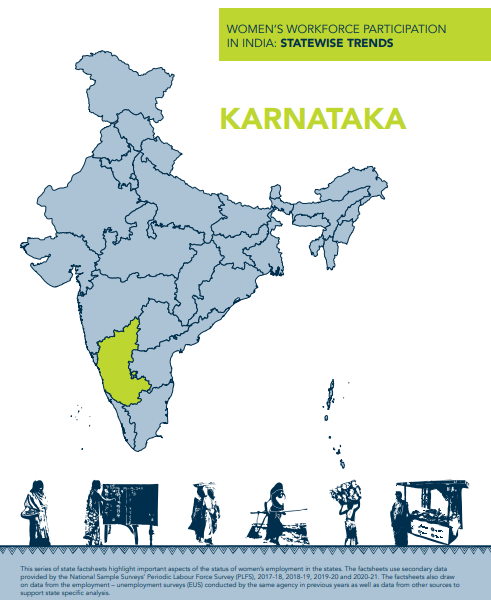
Karnataka, the sixth largest state in India, covers an area of 191,791 square kilometres and has a Gross State Domestic Product (GSDP) of INR 18.85 trillion. Known as India’s leading Information Technology hub, with Bengaluru as the tech capital, Karnataka also has a diverse economy with a strong agricultural base. While over 41% of the workforce depends on agriculture, the services sector contributes 66% to the state’s GSDP. Karnataka boasts one of the highest female labour force participation rates in India, with a Work Participation Rate (WPR) of 31.5% as per the 2021-22 PLFS. Women workers are primarily engaged in agriculture in rural areas and in manufacturing and services in urban regions. This factsheet provides an overview of Karnataka’s socio-economic landscape and workforce trends.
Karnataka, the sixth largest state in India, covers an area of 191,791 square kilometres and has a Gross State Domestic Product (GSDP) of INR 18.85 trillion. Known as India’s leading Information Technology hub, with Bengaluru as the tech capital, Karnataka also has a diverse economy with a strong agricultural base. While over 41% of the workforce depends on agriculture, the services sector contributes 66% to the state’s GSDP. Karnataka boasts one of the highest female labour force participation rates in India, with a Work Participation Rate (WPR) of 31.5% as per the 2021-22 PLFS. Women workers are primarily engaged in agriculture in rural areas and in manufacturing and services in urban regions. This factsheet provides an overview of Karnataka’s socio-economic landscape and workforce trends.
Learning note
Women’s Workforce Participation in India: Statewise Trends
- March , 2023
- Trisha Chandra , Sona Mitra , Bidisha Mondal
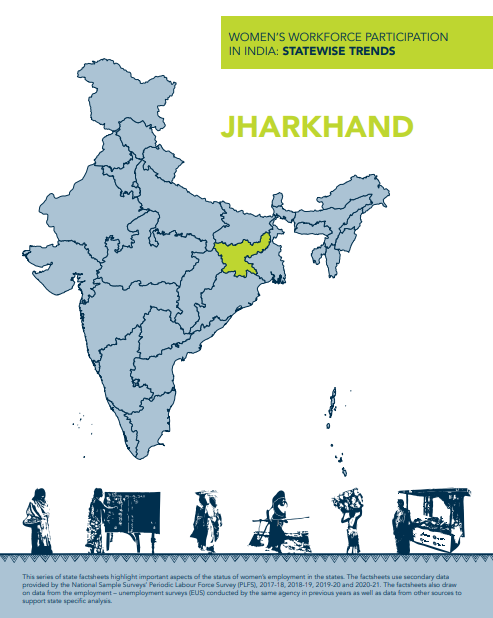
Formed in 2000, Jharkhand is rich in natural resources, covering nearly 80,000 square kilometers with 23,605 sq. km of forest land. The state contributes 40% of India’s total mineral resources, housing major industrial towns like Jamshedpur and Bokaro. While mining and industrial activities are significant, agriculture remains the mainstay for 50.4% of the population. Jharkhand’s female Work Participation Rate (WPR) was 35.2% in 2021-22, driven largely by the state’s tribal population. This factsheet explores Jharkhand’s economy, employment trends, and the role of women in its workforce.
Formed in 2000, Jharkhand is rich in natural resources, covering nearly 80,000 square kilometers with 23,605 sq. km of forest land. The state contributes 40% of India’s total mineral resources, housing major industrial towns like Jamshedpur and Bokaro. While mining and industrial activities are significant, agriculture remains the mainstay for 50.4% of the population. Jharkhand’s female Work Participation Rate (WPR) was 35.2% in 2021-22, driven largely by the state’s tribal population. This factsheet explores Jharkhand’s economy, employment trends, and the role of women in its workforce.

Report
Evidence Review of the Global Childcare Crisis
- March , 2023
- Kate Grantham , Leva Rouhani, Neelanjana Gupta
The COVID-19 pandemic reversed gains in women’s equality by intensifying unpaid care work and triggering a global childcare crisis. School and childcare closures sharply increased care demands, disproportionately affecting women—especially those in low-paid, informal, and vulnerable jobs—leading to job losses, income insecurity, and limited social protection. Despite its economic importance, childcare remains underfunded and unpaid care work undervalued. Expanding access to affordable, quality childcare is essential to support women’s employment, reduce poverty, create jobs, and enable an inclusive and sustainable post-COVID recovery.
The COVID-19 pandemic reversed gains in women’s equality by intensifying unpaid care work and triggering a global childcare crisis. School and childcare closures sharply increased care demands, disproportionately affecting women—especially those in low-paid, informal, and vulnerable jobs—leading to job losses, income insecurity, and limited social protection. Despite its economic importance, childcare remains underfunded and unpaid care work undervalued. Expanding access to affordable, quality childcare is essential to support women’s employment, reduce poverty, create jobs, and enable an inclusive and sustainable post-COVID recovery.
Brief
Care and Climate Change
- January , 2026
The brief focuses on bridging feminist economics and climate policy, highlighting gendered care burdens, structural undervaluation of reproductive labour, and the need for transformative interventions like care-responsive adaptation and finance.
The brief focuses on bridging feminist economics and climate policy, highlighting gendered care burdens, structural undervaluation of reproductive labour, and the need for transformative interventions like care-responsive adaptation and finance.
Brief
Measuring Women’s Work: Innovations and Obstacles in the Global South
- January , 2026
The brief examined challenges and innovations in capturing women’s paid and unpaid work in labour statistics. Drawing on experiences from India, South Africa, Latin America, and global systems, panelists highlighted how survey design, classifications, and institutional limits determine what is counted, and what remains invisible
The brief examined challenges and innovations in capturing women’s paid and unpaid work in labour statistics. Drawing on experiences from India, South Africa, Latin America, and global systems, panelists highlighted how survey design, classifications, and institutional limits determine what is counted, and what remains invisible

Report Snapshot
The Changing World of Women’s Work
- December , 2025
- Bidisha Mondal, Prakriti Sharma, Aneek Chowdhury, Anjali S
This study examines women’s participation in India’s platform economy using a mixed-methods approach, combining a survey of 598 platform workers (440 women) across care, domestic, beauty, ride-sharing, and delivery services with qualitative interviews. While platform work offers new entry points and flexibility, it often mirrors and deepens the precarity of informal work, limiting its potential for women’s empowerment. Persistent challenges include income instability, high entry and platform costs, limited social protection, unsafe conditions, and reinforced gender inequalities. Meaningful progress requires coordinated action by policymakers, platforms, and worker collectives to ensure fair earnings, social security, gender-sensitive systems, and effective grievance redressal
This study examines women’s participation in India’s platform economy using a mixed-methods approach, combining a survey of 598 platform workers (440 women) across care, domestic, beauty, ride-sharing, and delivery services with qualitative interviews. While platform work offers new entry points and flexibility, it often mirrors and deepens the precarity of informal work, limiting its potential for women’s empowerment. Persistent challenges include income instability, high entry and platform costs, limited social protection, unsafe conditions, and reinforced gender inequalities. Meaningful progress requires coordinated action by policymakers, platforms, and worker collectives to ensure fair earnings, social security, gender-sensitive systems, and effective grievance redressal

Brief
Women’s Work and AI-Unlocking Potential, Bridging the Divide
- December , 2025
- Sharati Roy, Dr. Mahima Taneja
AI is not neutral in how it’s designed or deployed. It is reshaping labour markets, with the biggest gains when it complements human skills rather than replaces them (ILO, 2025). While AI can improve efficiency and decision-making in sectors like healthcare, finance, and education, it also risks job losses and deeper inequalities. Outcomes will depend on whether AI drives automation or augmentation. In India—where Digital Public Infrastructure, data expansion, and the gig economy are growing rapidly—this brief explores women’s opportunities in AI/data value-chain work and AI-augmented livelihoods to support economic empowerment.
AI is not neutral in how it’s designed or deployed. It is reshaping labour markets, with the biggest gains when it complements human skills rather than replaces them (ILO, 2025). While AI can improve efficiency and decision-making in sectors like healthcare, finance, and education, it also risks job losses and deeper inequalities. Outcomes will depend on whether AI drives automation or augmentation. In India—where Digital Public Infrastructure, data expansion, and the gig economy are growing rapidly—this brief explores women’s opportunities in AI/data value-chain work and AI-augmented livelihoods to support economic empowerment.
Report
The Changing World of Women’s Work
- December , 2025
- Bidisha Mondal, Prakriti Sharma, Aneek Chowdhury, Anjali S
This study examines women’s participation in India’s platform economy using a mixed-methods approach, combining a survey of 598 platform workers (440 women) across care, domestic, beauty, ride-sharing, and delivery services with qualitative interviews. While platform work offers new entry points and flexibility, it often mirrors and deepens the precarity of informal work, limiting its potential for women’s empowerment. Persistent challenges include income instability, high entry and platform costs, limited social protection, unsafe conditions, and reinforced gender inequalities. Meaningful progress requires coordinated action by policymakers, platforms, and worker collectives to ensure fair earnings, social security, gender-sensitive systems, and effective grievance redressal
This study examines women’s participation in India’s platform economy using a mixed-methods approach, combining a survey of 598 platform workers (440 women) across care, domestic, beauty, ride-sharing, and delivery services with qualitative interviews. While platform work offers new entry points and flexibility, it often mirrors and deepens the precarity of informal work, limiting its potential for women’s empowerment. Persistent challenges include income instability, high entry and platform costs, limited social protection, unsafe conditions, and reinforced gender inequalities. Meaningful progress requires coordinated action by policymakers, platforms, and worker collectives to ensure fair earnings, social security, gender-sensitive systems, and effective grievance redressal

Brief
Impact of Social Norms on Women’s Economic Empowerment in India
- November , 2025
- Mridusmita Bordoloi, Surabhi Awasthi, Sharati Roy
Women’s Economic Empowerment (WEE) refers to women’s access to economic opportunities, resources, decent work, and the ability to make independent economic choices. It is both a process and an outcome that strengthens individual agency and supports inclusive growth. In countries like India, WEE is constrained not only by structural gaps—such as inadequate care infrastructure, poor connectivity, and limited skills access—but also by deeply rooted gender norms that shape women’s roles in society.
Women’s Economic Empowerment (WEE) refers to women’s access to economic opportunities, resources, decent work, and the ability to make independent economic choices. It is both a process and an outcome that strengthens individual agency and supports inclusive growth. In countries like India, WEE is constrained not only by structural gaps—such as inadequate care infrastructure, poor connectivity, and limited skills access—but also by deeply rooted gender norms that shape women’s roles in society.