


Publications
Publications
Category
Year

Learning note
Strengthening the Skilling Ecosystem: Leveraging the Potential of the Private Sector in India
- August , 2023
- Prakriti Sharma
India faces a unique challenge with one of the world’s lowest female labour force participation rates and a large informal workforce. As nearly 50 million young women remain neither in education nor employment, it is crucial to bridge the gap between available jobs and the skills required by the market. While the government has led the charge in skilling efforts, the private sector holds immense potential to play a pivotal role in this ecosystem. Despite efforts through initiatives like the National Skill Development Corporation (NSDC), only 36% of companies in India currently conduct in-house training. Barriers such as societal norms, mobility restrictions, and lack of awareness particularly hinder women’s participation in vocational training. To address these gaps, there is a need for stronger private sector engagement in skill development and workforce placement. By mobilising Corporate Social Responsibility (CSR) funds, creating local infrastructure, and offering financial and non-financial support for entrepreneurship, the private sector can foster inclusive growth. Additionally, businesses can leverage their networks to connect disadvantaged groups with market opportunities, offering targeted placement support to enhance women’s participation in the workforce. Unlocking India’s latent talent through collaboration between government and private enterprises will help build a more skilled, diverse, and employable workforce, ensuring sustainable economic growth and increased female labour force participation.
India faces a unique challenge with one of the world’s lowest female labour force participation rates and a large informal workforce. As nearly 50 million young women remain neither in education nor employment, it is crucial to bridge the gap between available jobs and the skills required by the market. While the government has led the charge in skilling efforts, the private sector holds immense potential to play a pivotal role in this ecosystem. Despite efforts through initiatives like the National Skill Development Corporation (NSDC), only 36% of companies in India currently conduct in-house training. Barriers such as societal norms, mobility restrictions, and lack of awareness particularly hinder women’s participation in vocational training. To address these gaps, there is a need for stronger private sector engagement in skill development and workforce placement. By mobilising Corporate Social Responsibility (CSR) funds, creating local infrastructure, and offering financial and non-financial support for entrepreneurship, the private sector can foster inclusive growth. Additionally, businesses can leverage their networks to connect disadvantaged groups with market opportunities, offering targeted placement support to enhance women’s participation in the workforce. Unlocking India’s latent talent through collaboration between government and private enterprises will help build a more skilled, diverse, and employable workforce, ensuring sustainable economic growth and increased female labour force participation.

Working Paper
Needs Assessment of Childcare Facilities
- July , 2023
- Sona Mitra , Neelanjana Gupta ,Trisha Chandra
This report, conducted by IWWAGE in collaboration with SEWA, explores the critical need for childcare in remote tribal areas of India, covering districts in Gujarat, Odisha, Kerala, and Meghalaya. The study focuses on how the lack of quality childcare services impacts mothers’ ability to engage in paid employment, particularly following the disruptions caused by the Covid-19 pandemic. It highlights the “double burden” that women face managing domestic responsibilities while striving to earn a livelihood. Findings reveal significant gaps in childcare facilities, with many women relying on informal, unpaid care arrangements. The report stresses the urgent need for improved, accessible Early Childhood Development (ECD) services that not only support mother’s workforce participation but also ensure the well-being and cognitive development of children. This study provides valuable insights into the barriers women in rural and tribal areas face and calls for targeted policy interventions to close the gap in childcare services.
This report, conducted by IWWAGE in collaboration with SEWA, explores the critical need for childcare in remote tribal areas of India, covering districts in Gujarat, Odisha, Kerala, and Meghalaya. The study focuses on how the lack of quality childcare services impacts mothers’ ability to engage in paid employment, particularly following the disruptions caused by the Covid-19 pandemic. It highlights the “double burden” that women face managing domestic responsibilities while striving to earn a livelihood. Findings reveal significant gaps in childcare facilities, with many women relying on informal, unpaid care arrangements. The report stresses the urgent need for improved, accessible Early Childhood Development (ECD) services that not only support mother’s workforce participation but also ensure the well-being and cognitive development of children. This study provides valuable insights into the barriers women in rural and tribal areas face and calls for targeted policy interventions to close the gap in childcare services.
Report
SWAYAM Process Evaluation
- July , 2023
- Valentina Brailovskaya , Bhavya Khare , Debendra Nag
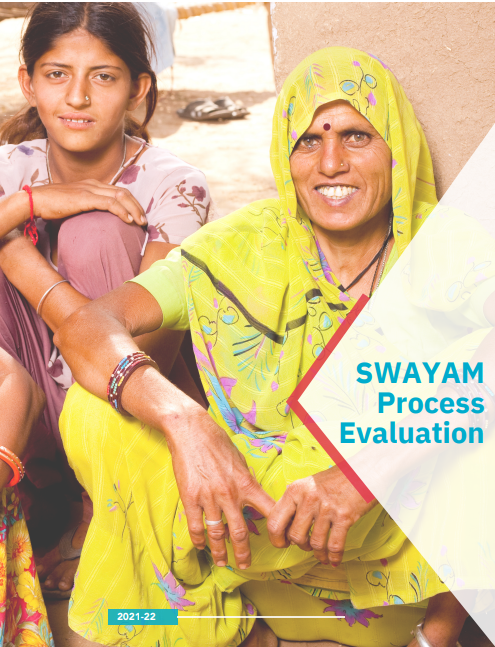
The Strengthening Women’s Institutions for Agency and Empowerment (SWAYAM) programme is being implemented in Chhattisgarh, Jharkhand, Madhya Pradesh, and Odisha, aimed at empowering women by strengthening collectives. IWWAGE, an initiative of LEAD at Krea University, provides technical assistance to the Deendayal Antyodaya Yojana-National Rural Livelihoods Mission (DAY-NRLM), with IDinsight conducting the evaluation. This report presents IDinsight’s final evaluation findings, offering insights and recommendations for future rollout. The evaluation assessed whether SWAYAM’s activities were implemented as intended based on the Theory of Change (TOC). Two rounds of phone surveys (2021 and 2022) measured key indicators related to women’s empowerment, with the second round including qualitative surveys with stakeholders to understand the role of Gender Resource Centres (GRCs). Key activities in Round 2 included updating the TOC, defining indicators, and revising survey instruments. Topics covered included SWAYAM training, gender-based violence, and economic and political empowerment. This report provides insights to improve SWAYAM’s implementation and increase its impact on women’s empowerment.
The Strengthening Women’s Institutions for Agency and Empowerment (SWAYAM) programme is being implemented in Chhattisgarh, Jharkhand, Madhya Pradesh, and Odisha, aimed at empowering women by strengthening collectives. IWWAGE, an initiative of LEAD at Krea University, provides technical assistance to the Deendayal Antyodaya Yojana-National Rural Livelihoods Mission (DAY-NRLM), with IDinsight conducting the evaluation. This report presents IDinsight’s final evaluation findings, offering insights and recommendations for future rollout. The evaluation assessed whether SWAYAM’s activities were implemented as intended based on the Theory of Change (TOC). Two rounds of phone surveys (2021 and 2022) measured key indicators related to women’s empowerment, with the second round including qualitative surveys with stakeholders to understand the role of Gender Resource Centres (GRCs). Key activities in Round 2 included updating the TOC, defining indicators, and revising survey instruments. Topics covered included SWAYAM training, gender-based violence, and economic and political empowerment. This report provides insights to improve SWAYAM’s implementation and increase its impact on women’s empowerment.

Learning note
Hybrid Work and its Effect on Womens Labour Force Participation
- June , 2023
- Sona Mitra | Preethi Rao | Aishwarya Joshi
The COVID-19 pandemic redefined workspaces globally, with many organisations adopting hybrid work models that offer employees flexibility between working from home and in the office. In India, this shift holds potential to increase women’s participation in the workforce, as hybrid work can help women balance care responsibilities, safety concerns, and mobility challenges. However, it also presents unique challenges for women, including increased stress, burnout, and a heavier burden of unpaid care work. This policy review highlights the need for gender-inclusive hybrid work policies, drawing on global best practices and insights from 60 countries. It reveals that while hybrid models are becoming the norm, there is a lack of specific provisions addressing women’s unique needs. In India, the absence of comprehensive remote work policies and gender-responsive guidelines further complicates the situation, despite some initiatives like the Maternity Benefit Act and the Sexual Harassment at Workplace Act extending protection to remote work. This publication calls for concerted efforts by both government and private sectors to develop gender-responsive hybrid work policies. Recommendations include transparent compensation policies, clear communication channels, flexible evaluation systems, childcare support, and training for managers to ensure a gender-inclusive work environment. By adopting these measures, organisations can minimise attrition, maximise retention, and create a more equitable hybrid workplace for women.
The COVID-19 pandemic redefined workspaces globally, with many organisations adopting hybrid work models that offer employees flexibility between working from home and in the office. In India, this shift holds potential to increase women’s participation in the workforce, as hybrid work can help women balance care responsibilities, safety concerns, and mobility challenges. However, it also presents unique challenges for women, including increased stress, burnout, and a heavier burden of unpaid care work. This policy review highlights the need for gender-inclusive hybrid work policies, drawing on global best practices and insights from 60 countries. It reveals that while hybrid models are becoming the norm, there is a lack of specific provisions addressing women’s unique needs. In India, the absence of comprehensive remote work policies and gender-responsive guidelines further complicates the situation, despite some initiatives like the Maternity Benefit Act and the Sexual Harassment at Workplace Act extending protection to remote work. This publication calls for concerted efforts by both government and private sectors to develop gender-responsive hybrid work policies. Recommendations include transparent compensation policies, clear communication channels, flexible evaluation systems, childcare support, and training for managers to ensure a gender-inclusive work environment. By adopting these measures, organisations can minimise attrition, maximise retention, and create a more equitable hybrid workplace for women.

Learning note
Emerging Priorities in the Care Sector: Opportunities for Indias G20 Presidency
- June , 2023
- Sruthi Kutty | Sona Mitra
Care work-both paid and unpaid-plays a vital role in supporting economies and societies. However, it is predominantly shouldered by women, which limits their ability to participate in the formal workforce. As India assumes the G20 presidency, there is an opportunity to spotlight the care sector as a driver of gender-responsive development. This brief explores the potential of the care economy, highlighting the need for investments in care infrastructure and care workers. By recognising care as a critical sector, and investing in childcare, elder care, and support for persons with disabilities, India can unlock new economic opportunities for women. Adequate investments in infrastructure and trained care workers can reduce the burden on women, enabling them to access employment and contribute to the economy. The brief also calls for public and private sector collaboration to enhance social security, fair wages, and decent working conditions for care workers. Addressing the invisibility of unpaid care work through better measurement tools is key to acknowledging women’s contributions and integrating care work into economic policies.
Care work-both paid and unpaid-plays a vital role in supporting economies and societies. However, it is predominantly shouldered by women, which limits their ability to participate in the formal workforce. As India assumes the G20 presidency, there is an opportunity to spotlight the care sector as a driver of gender-responsive development. This brief explores the potential of the care economy, highlighting the need for investments in care infrastructure and care workers. By recognising care as a critical sector, and investing in childcare, elder care, and support for persons with disabilities, India can unlock new economic opportunities for women. Adequate investments in infrastructure and trained care workers can reduce the burden on women, enabling them to access employment and contribute to the economy. The brief also calls for public and private sector collaboration to enhance social security, fair wages, and decent working conditions for care workers. Addressing the invisibility of unpaid care work through better measurement tools is key to acknowledging women’s contributions and integrating care work into economic policies.
Newsletter (Gender In Focus)
Gender in Focus
- June , 2023
- IWWAGE
In this issue, we have included the insights from ‘Together We Can’, a compilation of case studies of how women’s collectives from different Indian states address the issue of gender-based violence that could serve as an example for others.
In this issue, we have included the insights from ‘Together We Can’, a compilation of case studies of how women’s collectives from different Indian states address the issue of gender-based violence that could serve as an example for others.
Learning note
Women’s Workforce Participation in India: Statewise Trends
- April , 2023
- Suchika Gupta , Sona Mitra , Bidisha Mondal
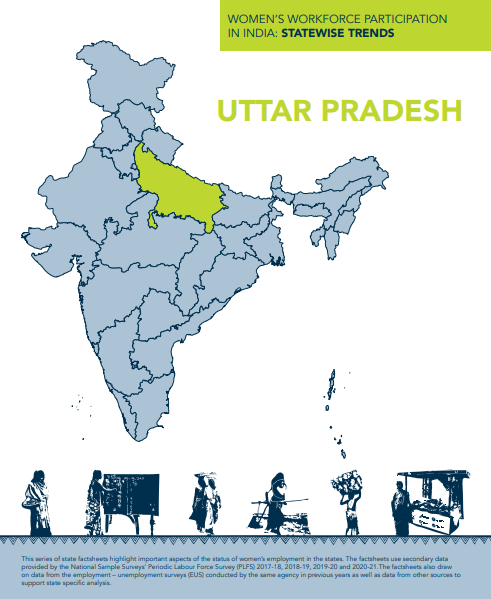
Uttar Pradesh, with a population of nearly 200 million, is India’s most populous state and the fourth largest by area. Despite a literacy rate of 57.1% for women in 2011 and a female unemployment rate of 13.1% in urban areas in 2020-21, UP remains an economic powerhouse. It is the largest producer of food grains and accounts for 90% of India’s carpet production. With a Gross State Domestic Product (GSDP) of INR 17.49 trillion in 2021-22, UP’s economy is driven by its thriving agricultural, textile, and tertiary sectors. This factsheet explores key socio-economic and employment trends in the state.
Uttar Pradesh, with a population of nearly 200 million, is India’s most populous state and the fourth largest by area. Despite a literacy rate of 57.1% for women in 2011 and a female unemployment rate of 13.1% in urban areas in 2020-21, UP remains an economic powerhouse. It is the largest producer of food grains and accounts for 90% of India’s carpet production. With a Gross State Domestic Product (GSDP) of INR 17.49 trillion in 2021-22, UP’s economy is driven by its thriving agricultural, textile, and tertiary sectors. This factsheet explores key socio-economic and employment trends in the state.

Learning note
Women’s Workforce Participation in India: Statewise Trends
- April , 2023
- Suchika Gupta , Sona Mitra , Bidisha Mondal
Assam, the second-largest state in the northeast by population and area, had a population of 3.12 crore in 2011. With a Gross State Domestic Product (GSDP) of INR 3,73,872 crores in 2020-21, the state’s Female Labour Force Participation (FLFP) rate stands at 18.9% in rural areas and 16% in urban areas, lower than the national average. Assam’s gender ratio in 2020-21 was 958 females per 1,000 males, and the literacy rate was 72.2%, with a gender disparity in literacy-77.85% for men and 66.27% for women. This factsheet examines Assam’s key socio-economic indicators.
Assam, the second-largest state in the northeast by population and area, had a population of 3.12 crore in 2011. With a Gross State Domestic Product (GSDP) of INR 3,73,872 crores in 2020-21, the state’s Female Labour Force Participation (FLFP) rate stands at 18.9% in rural areas and 16% in urban areas, lower than the national average. Assam’s gender ratio in 2020-21 was 958 females per 1,000 males, and the literacy rate was 72.2%, with a gender disparity in literacy-77.85% for men and 66.27% for women. This factsheet examines Assam’s key socio-economic indicators.

Factsheet
Women’s Workforce Participation in India: Statewise Trends
- April , 2023
- Suchika Gupta, Sona Mitra, Bidisha Mondal
This factsheet highlights Assam’s key socio-economic indicators, including a Female Labour Force Participation (FLFP) rate of 18.9% in rural areas and 16% in urban areas, both below the national average. With a literacy rate of 72.2%, the state shows notable gender disparity in education. Explore Assam’s economic landscape, gender ratios, and workforce trends.
This factsheet highlights Assam’s key socio-economic indicators, including a Female Labour Force Participation (FLFP) rate of 18.9% in rural areas and 16% in urban areas, both below the national average. With a literacy rate of 72.2%, the state shows notable gender disparity in education. Explore Assam’s economic landscape, gender ratios, and workforce trends.

Factsheet
Women’s Workforce Participation in India: Statewise Trends
- April , 2023
- Nidhi Gyan Pandey
West Bengal (WB) is located on the eastern coast of the Indian peninsula and is part of the fertile Indo-Gangetic Plain. It is the fourth most populous state in the country, with a population of about 99 million.This factsheet examines West Bengal’s key socio-economic indicators.
West Bengal (WB) is located on the eastern coast of the Indian peninsula and is part of the fertile Indo-Gangetic Plain. It is the fourth most populous state in the country, with a population of about 99 million.This factsheet examines West Bengal’s key socio-economic indicators.
Factsheet
Trends in Female Labour Force Participation in Karnataka
- October , 2026
- Vidhi, Bidisha Mondal
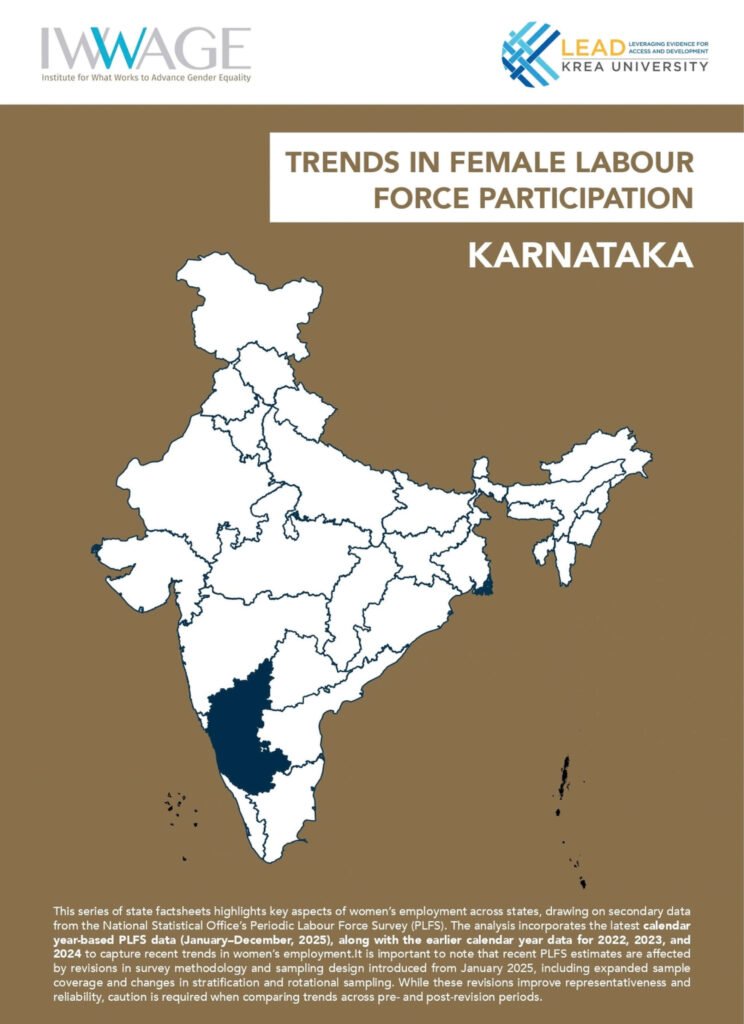
Karnataka occupies a distinctive position in India’s economic landscape, driven by rapid growth in services, technology, and manufacturing sectors.This factsheet examines key trends in women’s labour force participation in Karnataka using PLFS data, with a focus on employment composition, sectoral and occupational distribution, quality of work, and barriers to women’s participation in the labour market.
Karnataka occupies a distinctive position in India’s economic landscape, driven by rapid growth in services, technology, and manufacturing sectors.This factsheet examines key trends in women’s labour force participation in Karnataka using PLFS data, with a focus on employment composition, sectoral and occupational distribution, quality of work, and barriers to women’s participation in the labour market.
Brief
Deconstructing the Care Economy: Measurement, Gendered Outcomes, and Macroeconomic Policy
- September , 2026
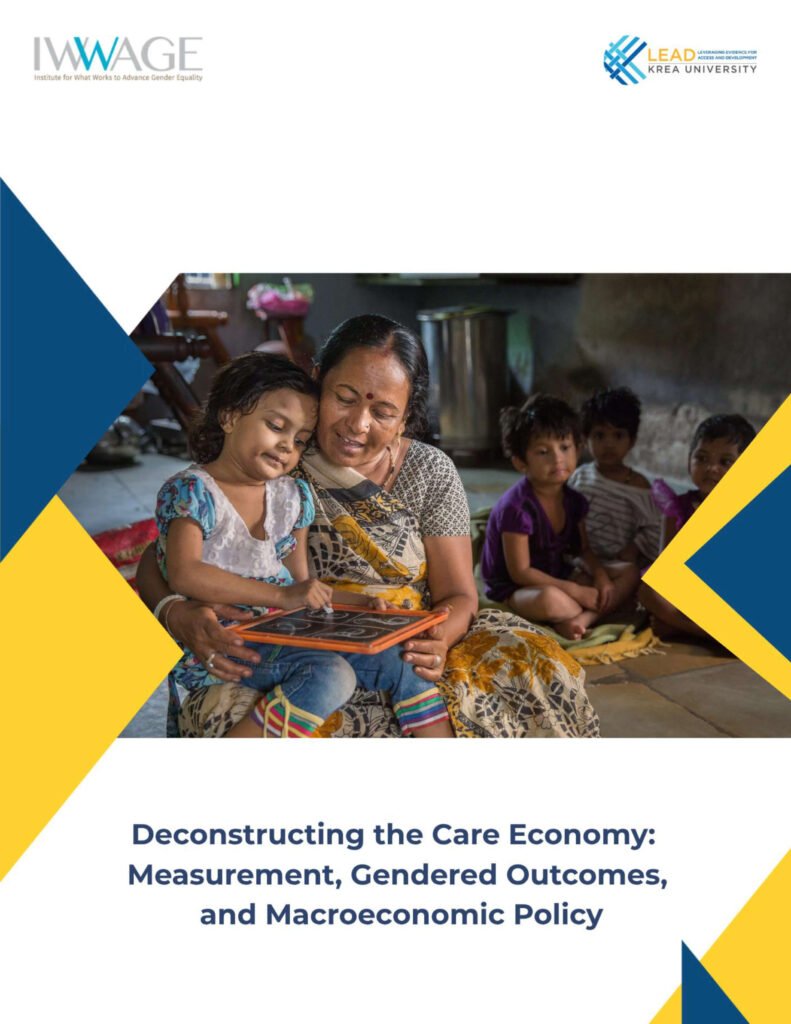
The policy brief examines how unpaid care and domestic work largely undertaken by women remains invisible in conventional economic and labour statistics, while significantly shaping women’s participation and outcomes in the labour market. It highlights how care responsibilities contribute to women’s underemployment, lower-paid and precarious work, and inequalities in platform and hybrid work.
The policy brief examines how unpaid care and domestic work largely undertaken by women remains invisible in conventional economic and labour statistics, while significantly shaping women’s participation and outcomes in the labour market. It highlights how care responsibilities contribute to women’s underemployment, lower-paid and precarious work, and inequalities in platform and hybrid work.
Factsheet
Trends in Female Labour Force Participation in Bihar
- September , 2026
- Vidhi, Bidisha Mondal
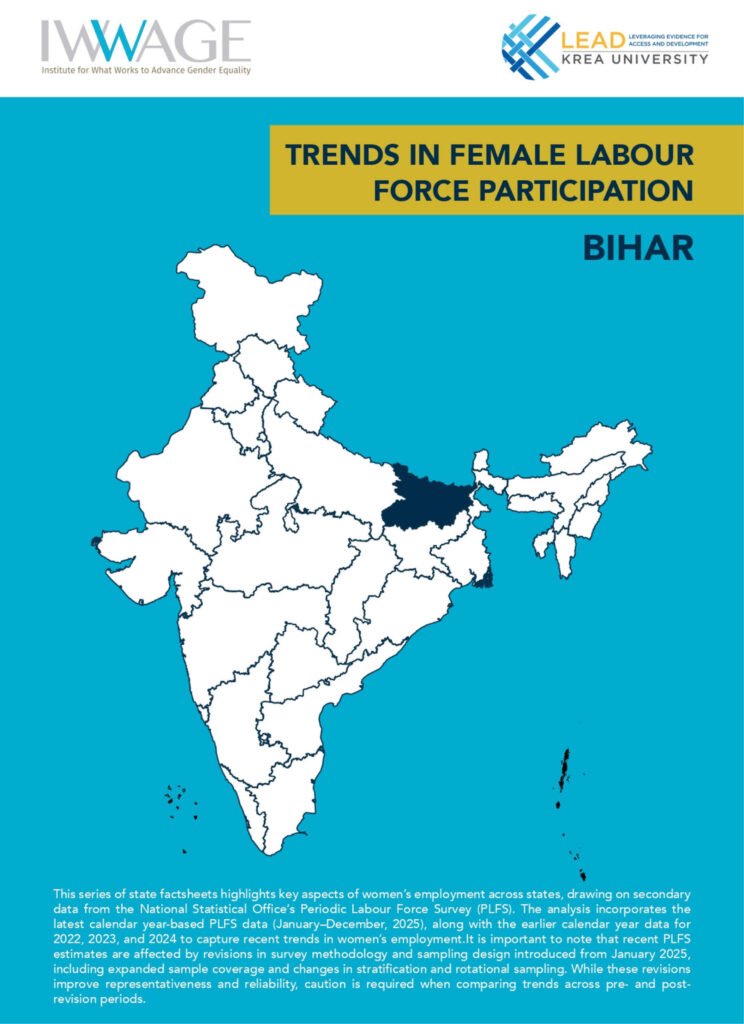
Despite economic growth, Bihar continues to face low female labour force participation, reflecting persistent supply-side constraints and limited access to suitable employment opportunities. Young women, in particular, experience low labour force participation amid high youth unemployment, while employment remains concentrated in agriculture and informal work. Sociocultural norms, limited access to education and skills, mobility constraints, inadequate transport, and care responsibilities further restrict women’s access to employment. Against this backdrop, this factsheet examines trends in female labour force participation, workforce composition, sectoral distribution, and working conditions in Bihar.
Despite economic growth, Bihar continues to face low female labour force participation, reflecting persistent supply-side constraints and limited access to suitable employment opportunities. Young women, in particular, experience low labour force participation amid high youth unemployment, while employment remains concentrated in agriculture and informal work. Sociocultural norms, limited access to education and skills, mobility constraints, inadequate transport, and care responsibilities further restrict women’s access to employment. Against this backdrop, this factsheet examines trends in female labour force participation, workforce composition, sectoral distribution, and working conditions in Bihar.
Report
Women and Work 2025: Megatrends Reshaping Women’s Work in India
- September , 2026
- Divya Singh, Prakriti Sharma, Vidhi Singh, Sharati Roy
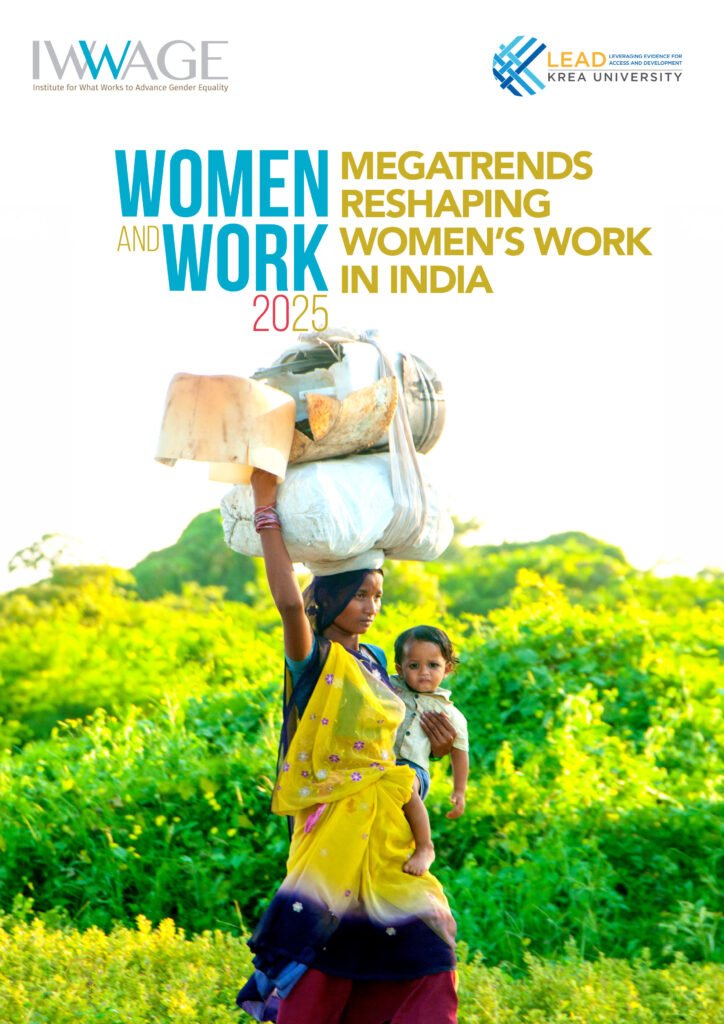
IWWAGE’s flagship report examines the changing landscape of women’s work in India and the forces shaping its future. Women’s labour force participation has risen significantly in recent years. Yet, the headline numbers tell only part of the story. The nature and experience of women’s work continue to be shaped by the quality and security of employment, unpaid care work, digitalisation, artificial intelligence, climate change, and women’s health at work. The report brings together evidence and emerging policy developments across these interconnected forces to examine where women’s work is headed—and what it will take to translate greater participation into greater economic agency, decent work, and protection.
IWWAGE’s flagship report examines the changing landscape of women’s work in India and the forces shaping its future. Women’s labour force participation has risen significantly in recent years. Yet, the headline numbers tell only part of the story. The nature and experience of women’s work continue to be shaped by the quality and security of employment, unpaid care work, digitalisation, artificial intelligence, climate change, and women’s health at work. The report brings together evidence and emerging policy developments across these interconnected forces to examine where women’s work is headed—and what it will take to translate greater participation into greater economic agency, decent work, and protection.
Factsheet
Trends in Female Labour Force Participation in Meghalaya
- August , 2026
- Nabankur Huda, Bidisha Mondal
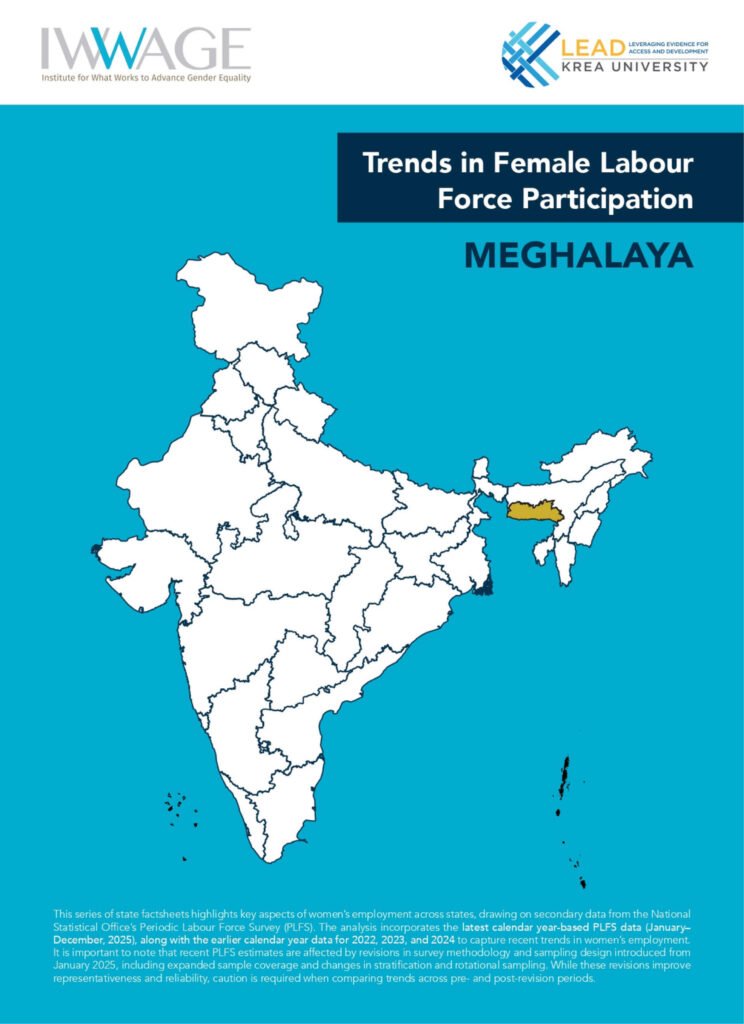
Meghalaya is a small, hilly state in north-east India with a predominantly rural, agrarian economy and one of the country’s most distinctive social structures. The factsheet explores the trends, opportunities and challenges shaping women’s participation in Meghalaya’s labour market, with a focus on how the state’s social structure and economic transformation influence the nature and quality of women’s work.
Meghalaya is a small, hilly state in north-east India with a predominantly rural, agrarian economy and one of the country’s most distinctive social structures. The factsheet explores the trends, opportunities and challenges shaping women’s participation in Meghalaya’s labour market, with a focus on how the state’s social structure and economic transformation influence the nature and quality of women’s work.
Newsletter (Gender In Focus)
Gender in Focus
- August , 2026
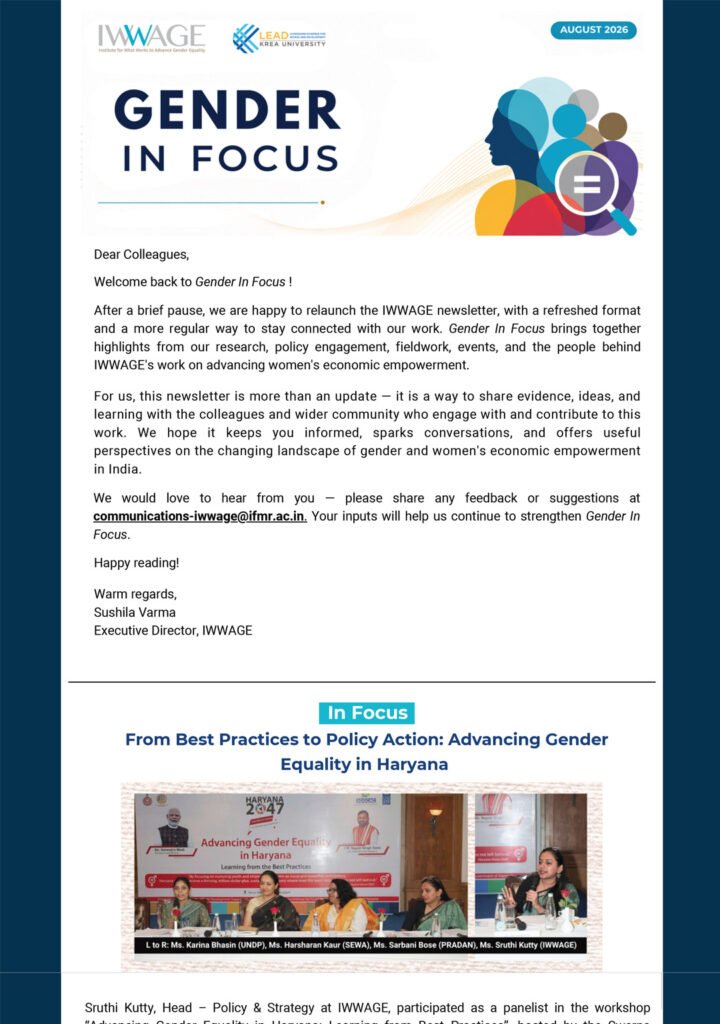
The August 2026 edition features highlights from IWWAGE’s research, policy engagements, fieldwork and knowledge initiatives. It also offers a closer look at emerging trends shaping women’s work and economic participation in India.
The August 2026 edition features highlights from IWWAGE’s research, policy engagements, fieldwork and knowledge initiatives. It also offers a closer look at emerging trends shaping women’s work and economic participation in India.