


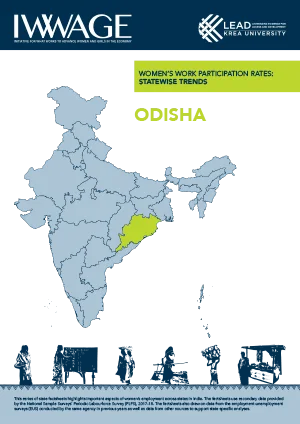
This factsheet highlights Odisha’s economy, which is largely agro-based, with agriculture, forestry, and fishing providing 50% of employment. Despite natural disasters, the state’s service, industrial, and mining sectors contribute significantly to its GSDP. Tribal women play a vital role in forest produce collection and handicrafts, yet female labor force participation remains low, with rural and urban FLFPRs at 15.2% and 13.4%, respectively.
Publications
Publications
Category
Year
SWAYAM
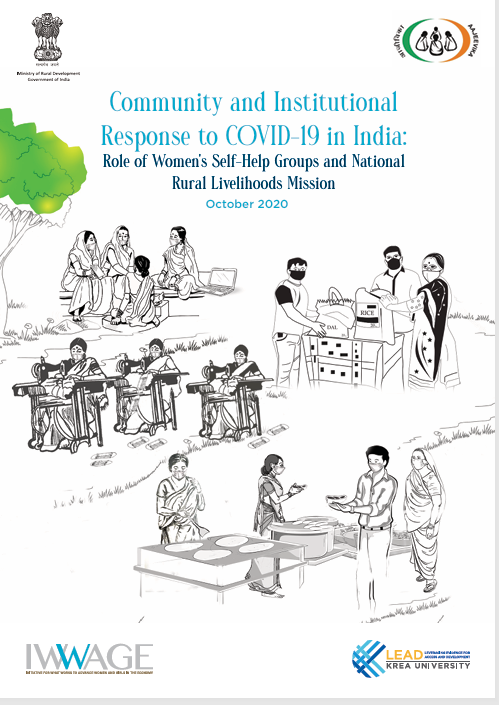
Community and Institutional Response to COVID-19 in India: Role of Women’s SHG and DAY-NRLM
- October , 2020
- Soumya Kapoor Mehta | Rukmini Tankha
The women’s Self-Help Group (SHG) network promoted under the Deendayal Antyodaya Yojana – National Rural Livelihoods Mission (DAY-NRLM) assumed particular significance during COVID-19 given its tremendous outreach in rural areas, and the trust, social capital and networks enjoyed by women’s institutional platforms of the poor. Women’s SHGs of DAY-NRLM emerged as pivotal actors, leading from the front in crisis response. The COVID-19 pandemic has served as a trigger mobilising SHG women to come together to transcend their group identity and contribute through collective action towards crisis management, including helping those in need – thus demonstrating the transformational potential of women’s collectives. As the pandemic and its impacts continue unabated, this juncture can provide the women’s SHG movement in India the unique opportunity to define agendas and priorities that are most relevant to them during the recovery phase. DAY-NRLM can act as a critically important facilitation agency in ensuring this objective in the challenging times ahead. With the objective of recognising the work undertaken by women’s SHGs, and highlighting their indispensable economic and social contribution, the report summarises good practices, strategies and innovations that were spearheaded by SHGs in collaboration with State Rural Livelihoods Missions during the pandemic. This report highlights that economic and social action unleashed by women’s SHGs coupled with existing institutional investments, mechanisms and collaborations forged by DAY-NRLM and SRLMs can help in developing decentralised, participatory and context-specific local solutions amid any crisis.
The women’s Self-Help Group (SHG) network promoted under the Deendayal Antyodaya Yojana – National Rural Livelihoods Mission (DAY-NRLM) assumed particular significance during COVID-19 given its tremendous outreach in rural areas, and the trust, social capital and networks enjoyed by women’s institutional platforms of the poor. Women’s SHGs of DAY-NRLM emerged as pivotal actors, leading from the front in crisis response. The COVID-19 pandemic has served as a trigger mobilising SHG women to come together to transcend their group identity and contribute through collective action towards crisis management, including helping those in need – thus demonstrating the transformational potential of women’s collectives. As the pandemic and its impacts continue unabated, this juncture can provide the women’s SHG movement in India the unique opportunity to define agendas and priorities that are most relevant to them during the recovery phase. DAY-NRLM can act as a critically important facilitation agency in ensuring this objective in the challenging times ahead. With the objective of recognising the work undertaken by women’s SHGs, and highlighting their indispensable economic and social contribution, the report summarises good practices, strategies and innovations that were spearheaded by SHGs in collaboration with State Rural Livelihoods Missions during the pandemic. This report highlights that economic and social action unleashed by women’s SHGs coupled with existing institutional investments, mechanisms and collaborations forged by DAY-NRLM and SRLMs can help in developing decentralised, participatory and context-specific local solutions amid any crisis.
Learning note
Women’s Workforce Participation In India: Statewise Trends
- October , 2020
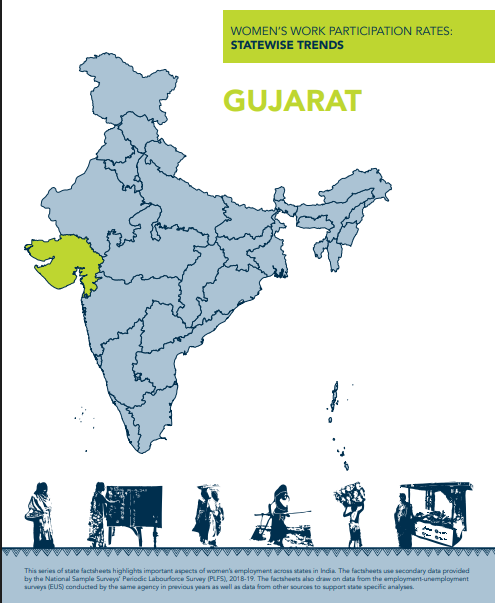
Madhya Pradesh (MP) is the only state in India to have witnessed a rise in workforce participation rates (WPRs) of women in both rural and urban areas between 2011-12 and 2017-18. The increase in women’s WPR in MP was driven largely by increase in self-employment in the rural areas and regular employment in the urban areas. According to the Periodic Labourforce Survey in 2017-18, more than half of the female workforce in the state is self-employed, with a higher incidence of self-employment in rural areas. While approximately 88 percent of the rural self-employed women in MP are engaged in unpaid work, the share of women in own account enterprises is substantially high in urban MP. The distribution of casual women workers suggests very few women engaged under MGNREGA and other public works as 96 percent women in casual employment were engaged in non-public works, with very little security or guarantee of payment
Madhya Pradesh (MP) is the only state in India to have witnessed a rise in workforce participation rates (WPRs) of women in both rural and urban areas between 2011-12 and 2017-18. The increase in women’s WPR in MP was driven largely by increase in self-employment in the rural areas and regular employment in the urban areas. According to the Periodic Labourforce Survey in 2017-18, more than half of the female workforce in the state is self-employed, with a higher incidence of self-employment in rural areas. While approximately 88 percent of the rural self-employed women in MP are engaged in unpaid work, the share of women in own account enterprises is substantially high in urban MP. The distribution of casual women workers suggests very few women engaged under MGNREGA and other public works as 96 percent women in casual employment were engaged in non-public works, with very little security or guarantee of payment
Learning note
Women’s Workforce Participation in India: Statewise Trends
- October , 2020
- Nidhi Gyan Pandey
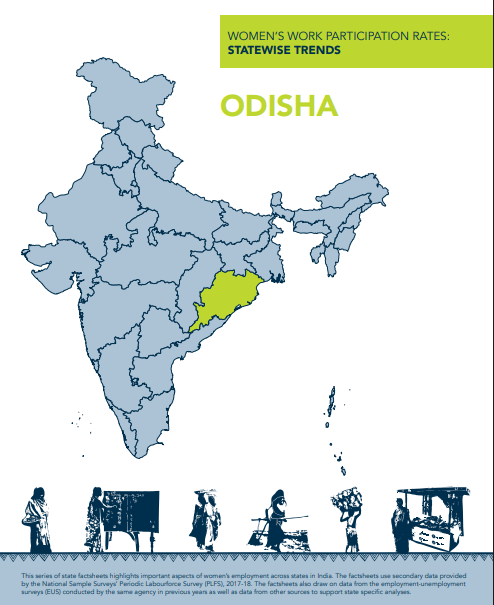
Odisha, located on India’s eastern coastline, is rich in natural resources with forests covering 33.2% of its area. The state’s economy is largely agro-based, with agriculture, forestry, and fishing sectors providing around 50% of employment. Despite frequent cyclones and floods that impact livelihoods, Odisha’s service, industrial, and mining sectors contribute significantly to its GSDP. With a large tribal population, tribal women play a key role in forest produce collection and handicraft industries. Female labour force participation in Odisha remains low, with rural and urban FLFPRs below the national average at 15.2% and 13.4%, respectively.
Odisha, located on India’s eastern coastline, is rich in natural resources with forests covering 33.2% of its area. The state’s economy is largely agro-based, with agriculture, forestry, and fishing sectors providing around 50% of employment. Despite frequent cyclones and floods that impact livelihoods, Odisha’s service, industrial, and mining sectors contribute significantly to its GSDP. With a large tribal population, tribal women play a key role in forest produce collection and handicraft industries. Female labour force participation in Odisha remains low, with rural and urban FLFPRs below the national average at 15.2% and 13.4%, respectively.
Learning note
Women’s Workforce Participation in India: Statewise Trends
- October , 2020
- Nidhi Gyan Pandey , Sona Mitra
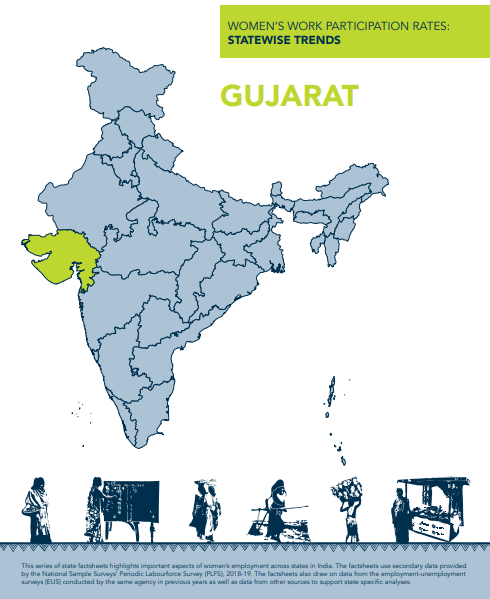
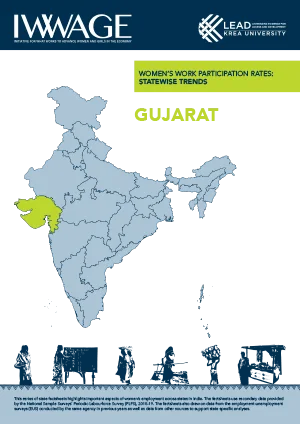
Gujarat, one of India’s most industrially advanced states, is a hub for textile manufacturing and diamond trade with a high GSDP per capita of Rs 1,65,414. Despite its economic strengths, Gujarat faces significant challenges in social development. The state has a low sex ratio (866 females per 1,000 males) and high rates of under-nutrition, with 55% of women aged 15-49 being anaemic. Education indicators also lag behind national averages, and gender inequality in the labour market is prevalent. The female labour force participation rate (FLFPR) stands at 16.9%, below the national average, with large gender disparities in both rural and urban areas. This factsheet explores key economic and social indicators for Gujarat in 2020.
Gujarat, one of India’s most industrially advanced states, is a hub for textile manufacturing and diamond trade with a high GSDP per capita of Rs 1,65,414. Despite its economic strengths, Gujarat faces significant challenges in social development. The state has a low sex ratio (866 females per 1,000 males) and high rates of under-nutrition, with 55% of women aged 15-49 being anaemic. Education indicators also lag behind national averages, and gender inequality in the labour market is prevalent. The female labour force participation rate (FLFPR) stands at 16.9%, below the national average, with large gender disparities in both rural and urban areas. This factsheet explores key economic and social indicators for Gujarat in 2020.
Factsheet
Women’s Workforce Participation in India: Statewise Trends
- October , 2020
- Nidhi Gyan Pandey
While the share of women workers in regular wage work has been increasing all across India, Odisha has shown exceptional growth in this regard, particularly in urban areas. But as in other states, this has not translated into improved working conditions for women.
While the share of women workers in regular wage work has been increasing all across India, Odisha has shown exceptional growth in this regard, particularly in urban areas. But as in other states, this has not translated into improved working conditions for women.
Factsheet
Women’s Workforce Participation in India: Statewise Trends
- October , 2020
- Nidhi Gyan Pandey, Sona Mitra
This factsheet provides insights into Gujarat’s economic and social landscape in 2020. Despite its industrial strengths, the state faces challenges in gender inequality, with a low sex ratio (866 females per 1,000 males) and an FLFPR of 16.9%, below the national average. High anaemia rates among women and lagging education indicators further highlight the need for improved social development.
Despite being an industrial state, women’s participation in regular wage employment in Gujarat, particularly in its manufacturing sector, has been poor. This is regardless of the improvements in FWPRs witnessed by the state in recent times.
Despite being an industrial state, women’s participation in regular wage employment in Gujarat, particularly in its manufacturing sector, has been poor. This is regardless of the improvements in FWPRs witnessed by the state in recent times.
Learning note
Advancing gender equality in a post COVID context: Mitigating the impacts of COVID-19 on India’s women and girls through emergency cash transfers
- August , 2020
- Kanika Jha Kingra
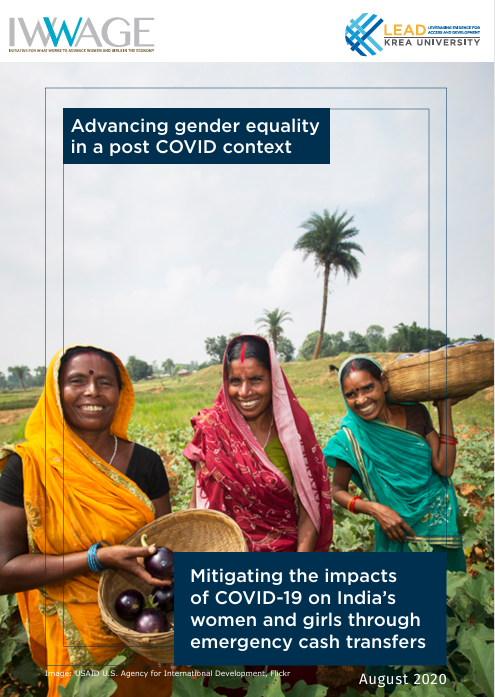
COVID-19 is no longer a health crisis. The pandemic and the subsequent lockdown have led to dire socio-economic challenges for India. Loss of livelihoods, food insecurity, wage cuts and financial insecurity are among the few challenges that the majority of Indians are grappling with, especially the poor. The lockdown and the halt of economic activities led to the reverse migration of millions of migrants. According to the Census of 2011, there are 139 million interstate migrants who are now among the worst hit by the pandemic and the lockdown. Little to no data exists on women migrant workers, mostly employed in construction and domestic work, who continue to be invisible in recent policy discourse and in the design of relief packages. The return of male migrant workers too can have unintended effects on women: fewer jobs being available to them in rural areas, thereby impacting overall levels of household income. All these uncertainties have led to the re-emergence of a demand for basic income in India. Convergence of existing schemes, fewer leakages and less corruption, as well as reduction in administrative costs, are some of the arguments in favour of a basic income, which were also cited in India’s Economic Survey (2017-18). An emergency basic income has the potential to mitigate the adverse impacts on the most vulnerable, including women and girls.
COVID-19 is no longer a health crisis. The pandemic and the subsequent lockdown have led to dire socio-economic challenges for India. Loss of livelihoods, food insecurity, wage cuts and financial insecurity are among the few challenges that the majority of Indians are grappling with, especially the poor. The lockdown and the halt of economic activities led to the reverse migration of millions of migrants. According to the Census of 2011, there are 139 million interstate migrants who are now among the worst hit by the pandemic and the lockdown. Little to no data exists on women migrant workers, mostly employed in construction and domestic work, who continue to be invisible in recent policy discourse and in the design of relief packages. The return of male migrant workers too can have unintended effects on women: fewer jobs being available to them in rural areas, thereby impacting overall levels of household income. All these uncertainties have led to the re-emergence of a demand for basic income in India. Convergence of existing schemes, fewer leakages and less corruption, as well as reduction in administrative costs, are some of the arguments in favour of a basic income, which were also cited in India’s Economic Survey (2017-18). An emergency basic income has the potential to mitigate the adverse impacts on the most vulnerable, including women and girls.

Learning note
Advancing gender equality in a post COVID context: Gender sensitive policies to enhance food security and expand wage employment
- August , 2020
The COVID-19 pandemic has affected all Indians, particularly vulnerable groups, including women and girls. If evidence from previous disasters and health crises is any indication, women will be disproportionately affected during this pandemic. Within homes, women and girls who already do more than six times unpaid work than men, now shoulder added responsibilities of feeding and caring for children who are not going to schools as well as care work for the elderly, sick or disabled family members. Outside their homes, shrinking employment opportunities and the resultant loss in bargaining power has compounded the problems faced by women. The decline in decent work opportunities and loss of income can, among other things, lead to a loss of independence, agency, and undo several years of progress achieved through gender-responsive policies. The disproportionate impact on women and girls calls for more gender-responsive interventions and relief measures. It is becoming increasingly important to expand opportunities for wage employment and enhance food security and nutrition. Evidence shows a clear co-relation between food and nutrition insecurity and gender inequalities, with mothers and daughters usually eating last as well as the least nutritious food in Indian households. Therefore, expanding social security benefits, improving access to and availability of employment and decent work opportunities, particularly for women, can help address nutritional and food security challenges during the pandemic.
The COVID-19 pandemic has affected all Indians, particularly vulnerable groups, including women and girls. If evidence from previous disasters and health crises is any indication, women will be disproportionately affected during this pandemic. Within homes, women and girls who already do more than six times unpaid work than men, now shoulder added responsibilities of feeding and caring for children who are not going to schools as well as care work for the elderly, sick or disabled family members. Outside their homes, shrinking employment opportunities and the resultant loss in bargaining power has compounded the problems faced by women. The decline in decent work opportunities and loss of income can, among other things, lead to a loss of independence, agency, and undo several years of progress achieved through gender-responsive policies. The disproportionate impact on women and girls calls for more gender-responsive interventions and relief measures. It is becoming increasingly important to expand opportunities for wage employment and enhance food security and nutrition. Evidence shows a clear co-relation between food and nutrition insecurity and gender inequalities, with mothers and daughters usually eating last as well as the least nutritious food in Indian households. Therefore, expanding social security benefits, improving access to and availability of employment and decent work opportunities, particularly for women, can help address nutritional and food security challenges during the pandemic.

Learning note
Business Readiness Scorecard for Women
- August , 2020
- Rigzom Wangchuk | Ria Dutta | M P Karthick
Women dominate India’s informal economy, especially in the handloom and handicrafts sectors, where they often operate as home-based entrepreneurs. Yet, they remain underrepresented in the formal business space. To better support these women-led enterprises, IWWAGE developed the Women’s Business Readiness Scorecard for Handloom and Handicrafts Sector (WBRS-HHS). This data-driven diagnostic tool was developed through surveys with 800 women entrepreneurs across Rajasthan and Tamil Nadu’s two states with distinct public and private sector dynamics. The scorecard evaluates business readiness across four dimensions: 1.Agency (decision-making, financial control, risk-taking) 2. Market Readiness (product portfolio, advance orders) 3. Production Readiness (worksite, inventory, personnel) 4. Legal and Regulatory Readiness (registration, scheme awareness) By measuring these indicators, the WBRS-HHS helps identify strengths, gaps, and policy opportunities to scale and sustain women’s enterprises. The tool also offers a replicable framework for stakeholders to design targeted interventions across sectors.
Women dominate India’s informal economy, especially in the handloom and handicrafts sectors, where they often operate as home-based entrepreneurs. Yet, they remain underrepresented in the formal business space. To better support these women-led enterprises, IWWAGE developed the Women’s Business Readiness Scorecard for Handloom and Handicrafts Sector (WBRS-HHS). This data-driven diagnostic tool was developed through surveys with 800 women entrepreneurs across Rajasthan and Tamil Nadu’s two states with distinct public and private sector dynamics. The scorecard evaluates business readiness across four dimensions: 1.Agency (decision-making, financial control, risk-taking) 2. Market Readiness (product portfolio, advance orders) 3. Production Readiness (worksite, inventory, personnel) 4. Legal and Regulatory Readiness (registration, scheme awareness) By measuring these indicators, the WBRS-HHS helps identify strengths, gaps, and policy opportunities to scale and sustain women’s enterprises. The tool also offers a replicable framework for stakeholders to design targeted interventions across sectors.
Report
The Future of Work for Women Workers
- August , 2020
- Ruchika Chaudhary , Sona Mitra , Soumya Kapoor Mehta
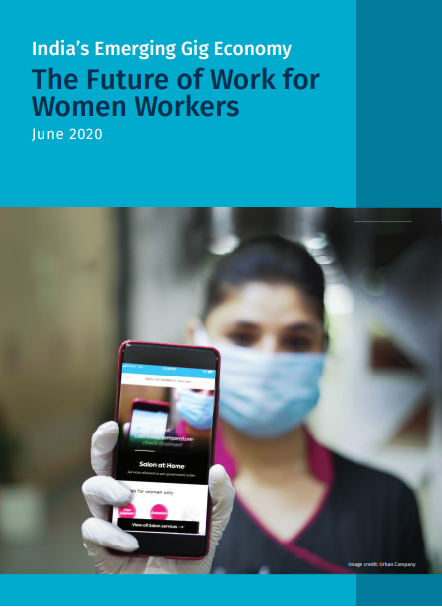
World over, the technology-driven gig economy has been expanding rapidly over the past decade, in which digital platforms connect workers with requesters to facilitate on demand work. While the gig economy has also become a buzzword in India, particularly in the last couple of years, and is attracting millennials by offering alternative employment opportunities. However, literature is scanty when it comes to measuring its impacts on the gendered experiences of gig work or on gig workers. This report aims to provide a comprehensive analytical overview of women’s engagement in platform work, and presents findings from an in-depth study of women’s work in one of India’s leading platform companies. It aims to understand the emerging forms of labour practices and the impact of platform engagement on workers experiences, challenges, and impact on women’s empowerment and agency. The findings are based on interviews with workers, platform managers, and other key informants, and comprehensive literature review. The study presents an in-depth and specialised analysis of the gig economy to explain some of the unique features of the labour practices and consequences of such practices on the overall labour relations. The study also makes specific recommendations and argue that policy makers and platforms have a key role in ensuring access to decent work and social protection for these workers.
World over, the technology-driven gig economy has been expanding rapidly over the past decade, in which digital platforms connect workers with requesters to facilitate on demand work. While the gig economy has also become a buzzword in India, particularly in the last couple of years, and is attracting millennials by offering alternative employment opportunities. However, literature is scanty when it comes to measuring its impacts on the gendered experiences of gig work or on gig workers. This report aims to provide a comprehensive analytical overview of women’s engagement in platform work, and presents findings from an in-depth study of women’s work in one of India’s leading platform companies. It aims to understand the emerging forms of labour practices and the impact of platform engagement on workers experiences, challenges, and impact on women’s empowerment and agency. The findings are based on interviews with workers, platform managers, and other key informants, and comprehensive literature review. The study presents an in-depth and specialised analysis of the gig economy to explain some of the unique features of the labour practices and consequences of such practices on the overall labour relations. The study also makes specific recommendations and argue that policy makers and platforms have a key role in ensuring access to decent work and social protection for these workers.
Brief
Care and Climate Change
- January , 2026
The brief focuses on bridging feminist economics and climate policy, highlighting gendered care burdens, structural undervaluation of reproductive labour, and the need for transformative interventions like care-responsive adaptation and finance.
The brief focuses on bridging feminist economics and climate policy, highlighting gendered care burdens, structural undervaluation of reproductive labour, and the need for transformative interventions like care-responsive adaptation and finance.
Brief
Measuring Women’s Work: Innovations and Obstacles in the Global South
- January , 2026
The brief examined challenges and innovations in capturing women’s paid and unpaid work in labour statistics. Drawing on experiences from India, South Africa, Latin America, and global systems, panelists highlighted how survey design, classifications, and institutional limits determine what is counted, and what remains invisible
The brief examined challenges and innovations in capturing women’s paid and unpaid work in labour statistics. Drawing on experiences from India, South Africa, Latin America, and global systems, panelists highlighted how survey design, classifications, and institutional limits determine what is counted, and what remains invisible

Report Snapshot
The Changing World of Women’s Work
- December , 2025
- Bidisha Mondal, Prakriti Sharma, Aneek Chowdhury, Anjali S
This study examines women’s participation in India’s platform economy using a mixed-methods approach, combining a survey of 598 platform workers (440 women) across care, domestic, beauty, ride-sharing, and delivery services with qualitative interviews. While platform work offers new entry points and flexibility, it often mirrors and deepens the precarity of informal work, limiting its potential for women’s empowerment. Persistent challenges include income instability, high entry and platform costs, limited social protection, unsafe conditions, and reinforced gender inequalities. Meaningful progress requires coordinated action by policymakers, platforms, and worker collectives to ensure fair earnings, social security, gender-sensitive systems, and effective grievance redressal
This study examines women’s participation in India’s platform economy using a mixed-methods approach, combining a survey of 598 platform workers (440 women) across care, domestic, beauty, ride-sharing, and delivery services with qualitative interviews. While platform work offers new entry points and flexibility, it often mirrors and deepens the precarity of informal work, limiting its potential for women’s empowerment. Persistent challenges include income instability, high entry and platform costs, limited social protection, unsafe conditions, and reinforced gender inequalities. Meaningful progress requires coordinated action by policymakers, platforms, and worker collectives to ensure fair earnings, social security, gender-sensitive systems, and effective grievance redressal

Brief
Women’s Work and AI-Unlocking Potential, Bridging the Divide
- December , 2025
- Sharati Roy, Dr. Mahima Taneja
AI is not neutral in how it’s designed or deployed. It is reshaping labour markets, with the biggest gains when it complements human skills rather than replaces them (ILO, 2025). While AI can improve efficiency and decision-making in sectors like healthcare, finance, and education, it also risks job losses and deeper inequalities. Outcomes will depend on whether AI drives automation or augmentation. In India—where Digital Public Infrastructure, data expansion, and the gig economy are growing rapidly—this brief explores women’s opportunities in AI/data value-chain work and AI-augmented livelihoods to support economic empowerment.
AI is not neutral in how it’s designed or deployed. It is reshaping labour markets, with the biggest gains when it complements human skills rather than replaces them (ILO, 2025). While AI can improve efficiency and decision-making in sectors like healthcare, finance, and education, it also risks job losses and deeper inequalities. Outcomes will depend on whether AI drives automation or augmentation. In India—where Digital Public Infrastructure, data expansion, and the gig economy are growing rapidly—this brief explores women’s opportunities in AI/data value-chain work and AI-augmented livelihoods to support economic empowerment.
Report
The Changing World of Women’s Work
- December , 2025
- Bidisha Mondal, Prakriti Sharma, Aneek Chowdhury, Anjali S
This study examines women’s participation in India’s platform economy using a mixed-methods approach, combining a survey of 598 platform workers (440 women) across care, domestic, beauty, ride-sharing, and delivery services with qualitative interviews. While platform work offers new entry points and flexibility, it often mirrors and deepens the precarity of informal work, limiting its potential for women’s empowerment. Persistent challenges include income instability, high entry and platform costs, limited social protection, unsafe conditions, and reinforced gender inequalities. Meaningful progress requires coordinated action by policymakers, platforms, and worker collectives to ensure fair earnings, social security, gender-sensitive systems, and effective grievance redressal
This study examines women’s participation in India’s platform economy using a mixed-methods approach, combining a survey of 598 platform workers (440 women) across care, domestic, beauty, ride-sharing, and delivery services with qualitative interviews. While platform work offers new entry points and flexibility, it often mirrors and deepens the precarity of informal work, limiting its potential for women’s empowerment. Persistent challenges include income instability, high entry and platform costs, limited social protection, unsafe conditions, and reinforced gender inequalities. Meaningful progress requires coordinated action by policymakers, platforms, and worker collectives to ensure fair earnings, social security, gender-sensitive systems, and effective grievance redressal

Brief
Impact of Social Norms on Women’s Economic Empowerment in India
- November , 2025
- Mridusmita Bordoloi, Surabhi Awasthi, Sharati Roy
Women’s Economic Empowerment (WEE) refers to women’s access to economic opportunities, resources, decent work, and the ability to make independent economic choices. It is both a process and an outcome that strengthens individual agency and supports inclusive growth. In countries like India, WEE is constrained not only by structural gaps—such as inadequate care infrastructure, poor connectivity, and limited skills access—but also by deeply rooted gender norms that shape women’s roles in society.
Women’s Economic Empowerment (WEE) refers to women’s access to economic opportunities, resources, decent work, and the ability to make independent economic choices. It is both a process and an outcome that strengthens individual agency and supports inclusive growth. In countries like India, WEE is constrained not only by structural gaps—such as inadequate care infrastructure, poor connectivity, and limited skills access—but also by deeply rooted gender norms that shape women’s roles in society.