


This factsheet provides insights into Chhattisgarh’s socio-economic trends, highlighting its strong Female Work Participation Rate (FWPR), which is 17 percentage points above the national average. Known as the ‘rice bowl of India,’ with 70% of its workforce in agriculture, Chhattisgarh has also made progress in reducing multi-dimensional poverty. Explore key data on women’s employment and the agricultural sector in the state.
Publications
Publications
Category
Year
Factsheet
Women’s Workforce Participation in India: Statewise Trends
- January , 2023
- Suchika Gupta, Sona Mitra
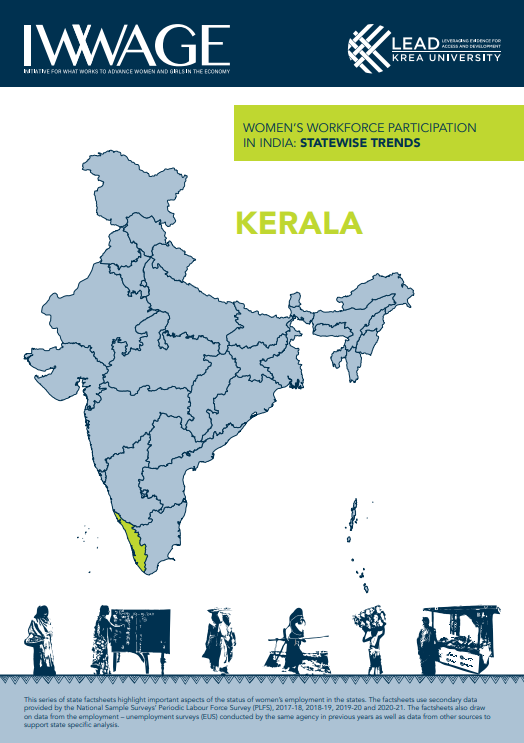
This factsheet highlights Kerala’s strong socio-economic indicators, including high literacy rates and a favorable sex ratio. Despite these achievements, the state’s Female Labour Force Participation Rate (FLFPR) remains low, with 29.5% in rural areas and 25.2% in urban areas. Explore key data on Kerala’s economy, gender wage gap, and human development in this comprehensive overview.
This factsheet highlights Kerala’s strong socio-economic indicators, including high literacy rates and a favorable sex ratio. Despite these achievements, the state’s Female Labour Force Participation Rate (FLFPR) remains low, with 29.5% in rural areas and 25.2% in urban areas. Explore key data on Kerala’s economy, gender wage gap, and human development in this comprehensive overview.
Factsheet
Women’s Workforce Participation in India: Statewise Trends
- January , 2023
- Prakriti Sharma, Sona Mitra
The majority of the primarily rural population of Chhattisgarh is involved in agriculture and allied services. There has been a significant rise in the labour force participation rate of rural women in the state; they are significantly involved in self-employment and work mainly as unpaid family enterprise workers in the agriculture sector.
The majority of the primarily rural population of Chhattisgarh is involved in agriculture and allied services. There has been a significant rise in the labour force participation rate of rural women in the state; they are significantly involved in self-employment and work mainly as unpaid family enterprise workers in the agriculture sector.

Report
Women’s Work in Select States in India: Opportunities and Challenges
- December , 2022
- Sona Mitra
Women comprise nearly half of the world’s working population and therefore potentially half of its labour force. Female labour force participation (FLFP) represent a women decision to be the part of labour force or part of economically inactive population. At present in nearly every country female labor force participation is lower than that of male labour force participation. Female labour force participation in South Asia is among the lowest of any developing region in the world. As per PLFS, FLFPR in rural and urban area are 27.7% and 18.6% respectively. India’s low female labour force participation excludes almost half of the potential working age population, leading to gross underutilisation of women’s talents and capabilities and remains a roadblock in reaping and distributing its demographic advantage. Women participation in labour force varies across different region. The variation is determined by an array of economic and social factors including income growth, educational attainment, marital status and other prevailing local social norms.
Women comprise nearly half of the world’s working population and therefore potentially half of its labour force. Female labour force participation (FLFP) represent a women decision to be the part of labour force or part of economically inactive population. At present in nearly every country female labor force participation is lower than that of male labour force participation. Female labour force participation in South Asia is among the lowest of any developing region in the world. As per PLFS, FLFPR in rural and urban area are 27.7% and 18.6% respectively. India’s low female labour force participation excludes almost half of the potential working age population, leading to gross underutilisation of women’s talents and capabilities and remains a roadblock in reaping and distributing its demographic advantage. Women participation in labour force varies across different region. The variation is determined by an array of economic and social factors including income growth, educational attainment, marital status and other prevailing local social norms.
Report Snapshot
Women’s Work in Select States in India: Opportunities and Challenges
- December , 2022
- Sona Mitra
Women comprise nearly half of the world’s working population and therefore potentially half of its labour force. Female labour force participation (FLFP) represent a women decision to be the part of labour force or part of economically inactive population. At present in nearly every country female labor force participation is lower than that of male labour force participation. Female labour force participation in South Asia is among the lowest of any developing region in the world. As per PLFS, FLFPR in rural and urban area are 27.7% and 18.6% respectively. India’s low female labour force participation excludes almost half of the potential working age population, leading to gross underutilisation of women’s talents and capabilities and remains a roadblock in reaping and distributing its demographic advantage. Women participation in labour force varies across different region. The variation is determined by an array of economic and social factors including income growth, educational attainment, marital status and other prevailing local social norms.
Women comprise nearly half of the world’s working population and therefore potentially half of its labour force. Female labour force participation (FLFP) represent a women decision to be the part of labour force or part of economically inactive population. At present in nearly every country female labor force participation is lower than that of male labour force participation. Female labour force participation in South Asia is among the lowest of any developing region in the world. As per PLFS, FLFPR in rural and urban area are 27.7% and 18.6% respectively. India’s low female labour force participation excludes almost half of the potential working age population, leading to gross underutilisation of women’s talents and capabilities and remains a roadblock in reaping and distributing its demographic advantage. Women participation in labour force varies across different region. The variation is determined by an array of economic and social factors including income growth, educational attainment, marital status and other prevailing local social norms.
SWAYAM
Compiled Case stories
- November , 2022
- Shreya Ghosh | Soya Thomas | Preethi Rao
Gender-based violence (GBV) is a pervasive issue across India, disproportionately affecting women and girls due to entrenched social norms. Women and girls face physical, sexual, and emotional abuse at alarming rates, and these challenges are further exacerbated in marginalised and rural communities. However, through Deendayal Antoyadaya Yojana- National Rural Livelihoods Mission’s (DAY-NRLM) engendered strategy, women’s collectives are becoming a powerful force for change, providing solidarity, information, and access to formal redressal mechanisms. This compendium presents ten inspiring stories from six states across India, demonstrating how these collectives, along with institutional mechanisms at the village, block, and district levels, are helping women confront and overcome the complexities of GBV. Each story in this compendium sheds light on the distinct challenges faced by women in various regions of India, from domestic violence and trafficking to wage parity and witch-hunting. Despite the diversity of these experiences, a common thread runs through them women drawing strength from their collectives and community resources to fight back against violence and injustice. It is a testament to the power of women’s collectives in transforming lives and communities.
Gender-based violence (GBV) is a pervasive issue across India, disproportionately affecting women and girls due to entrenched social norms. Women and girls face physical, sexual, and emotional abuse at alarming rates, and these challenges are further exacerbated in marginalised and rural communities. However, through Deendayal Antoyadaya Yojana- National Rural Livelihoods Mission’s (DAY-NRLM) engendered strategy, women’s collectives are becoming a powerful force for change, providing solidarity, information, and access to formal redressal mechanisms. This compendium presents ten inspiring stories from six states across India, demonstrating how these collectives, along with institutional mechanisms at the village, block, and district levels, are helping women confront and overcome the complexities of GBV. Each story in this compendium sheds light on the distinct challenges faced by women in various regions of India, from domestic violence and trafficking to wage parity and witch-hunting. Despite the diversity of these experiences, a common thread runs through them women drawing strength from their collectives and community resources to fight back against violence and injustice. It is a testament to the power of women’s collectives in transforming lives and communities.
Report
Stepping Out of Vulnerability
- November , 2022
- Alpaxee Kashyap
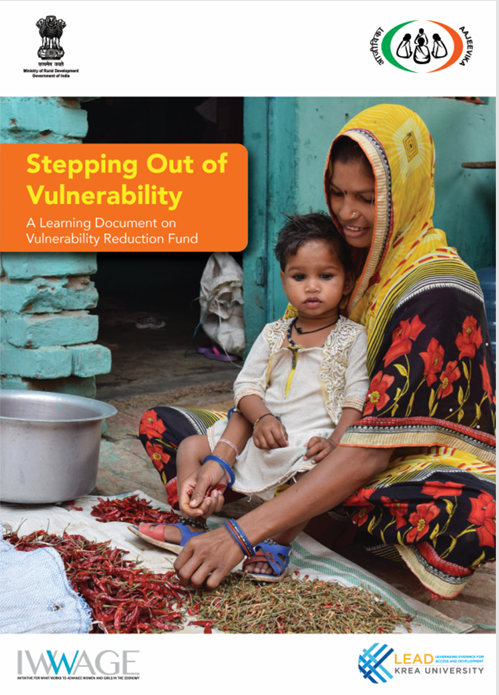
This learning practice document examines how Bihar, Jharkhand, Meghalaya, Odisha, and Tripura have utilised VRFs to support vulnerable households. The case studies highlight diverse applications, including Odisha’s use of VRFs to develop nutrition gardens (Mo Upakari Bagicha), supported by trained women Krishi Mitras who provide agricultural guidance and handholding. The case of Soni illustrates how VRF-supported nutrition gardens helped women sustain livelihoods and earn income during the COVID-19 lockdown.
This learning practice document examines how Bihar, Jharkhand, Meghalaya, Odisha, and Tripura have utilised VRFs to support vulnerable households. The case studies highlight diverse applications, including Odisha’s use of VRFs to develop nutrition gardens (Mo Upakari Bagicha), supported by trained women Krishi Mitras who provide agricultural guidance and handholding. The case of Soni illustrates how VRF-supported nutrition gardens helped women sustain livelihoods and earn income during the COVID-19 lockdown.

Factsheet
National Family Health Survey
- October , 2022
- Aparna G | Bidisha Mondal
Discover comprehensive data on women’s socio-economic conditions through our annual factsheets. These factsheets, drawn from the National Family Health Survey (NFHS), provide insights into critical areas such as education, health, work participation, decision-making, and access to resources. By analysing trends across various indicators, these factsheets offer a valuable snapshot of women’s lives in India, highlighting progress and ongoing challenges. Explore the factsheets for the latest data and understand the evolving landscape of gender equality and women’s empowerment.
Discover comprehensive data on women’s socio-economic conditions through our annual factsheets. These factsheets, drawn from the National Family Health Survey (NFHS), provide insights into critical areas such as education, health, work participation, decision-making, and access to resources. By analysing trends across various indicators, these factsheets offer a valuable snapshot of women’s lives in India, highlighting progress and ongoing challenges. Explore the factsheets for the latest data and understand the evolving landscape of gender equality and women’s empowerment.
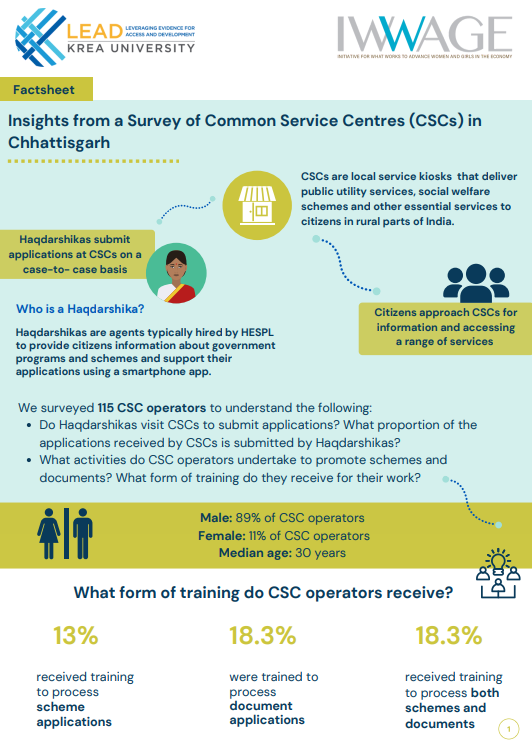
Learning note
Insights from a Survey of Common Service Centres (CSCs) in Chhattisgarh
- August , 2022
The CSC survey was conducted as part of an impact evaluation of the Haqdarshak program in Chhattisgarh.Haqdarshikas seem to play an important role in generating demand for less popular schemes especially state-specific schemes, which, nevertheless, bring important benefits to families across all major welfare dimensions, including education, health, shelter, and livelihoods.
The CSC survey was conducted as part of an impact evaluation of the Haqdarshak program in Chhattisgarh.Haqdarshikas seem to play an important role in generating demand for less popular schemes especially state-specific schemes, which, nevertheless, bring important benefits to families across all major welfare dimensions, including education, health, shelter, and livelihoods.
Newsletter (Gender In Focus)
Gender in Focus
- April , 2022
- IWWAGE
This issue of **Gender in Focus** offers a snapshot of IWWAGE’s ongoing work to address key challenges and document best practices. It features insights from a field study on information flows and the role of technology within Self-Help Groups in Chhattisgarh, along with excerpts from research on barriers to women’s career advancement in manufacturing. The issue also highlights a February 2022 report—developed with The Quantum Hub—summarising major trends in women’s work and livelihoods observed in 2021 and the pandemic’s impact on women’s lives. In addition, it includes webinar highlights on COVID-19’s effects across domains, along with updates and recent media coverage.
This issue of **Gender in Focus** offers a snapshot of IWWAGE’s ongoing work to address key challenges and document best practices. It features insights from a field study on information flows and the role of technology within Self-Help Groups in Chhattisgarh, along with excerpts from research on barriers to women’s career advancement in manufacturing. The issue also highlights a February 2022 report—developed with The Quantum Hub—summarising major trends in women’s work and livelihoods observed in 2021 and the pandemic’s impact on women’s lives. In addition, it includes webinar highlights on COVID-19’s effects across domains, along with updates and recent media coverage.
ICRW-GJP-IWWAGE Research Process Documentation
- April , 2020
- Radhika Uppal, Nilanjana Sengupta, Sunandita Banerjee, Somjita Laha
Brief
Care and Climate Change
- January , 2026
The brief focuses on bridging feminist economics and climate policy, highlighting gendered care burdens, structural undervaluation of reproductive labour, and the need for transformative interventions like care-responsive adaptation and finance.
The brief focuses on bridging feminist economics and climate policy, highlighting gendered care burdens, structural undervaluation of reproductive labour, and the need for transformative interventions like care-responsive adaptation and finance.
Brief
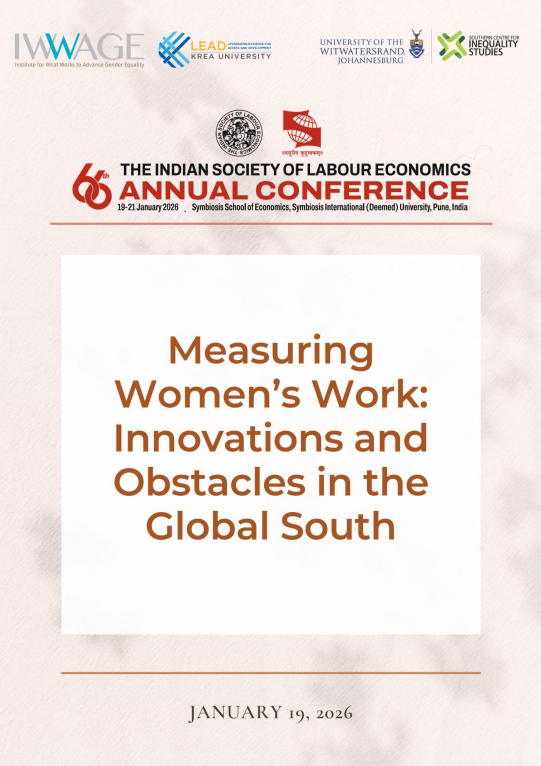
Measuring Women’s Work: Innovations and Obstacles in the Global South
- January , 2026
The brief examined challenges and innovations in capturing women’s paid and unpaid work in labour statistics. Drawing on experiences from India, South Africa, Latin America, and global systems, panelists highlighted how survey design, classifications, and institutional limits determine what is counted, and what remains invisible
The brief examined challenges and innovations in capturing women’s paid and unpaid work in labour statistics. Drawing on experiences from India, South Africa, Latin America, and global systems, panelists highlighted how survey design, classifications, and institutional limits determine what is counted, and what remains invisible

Report Snapshot
The Changing World of Women’s Work
- December , 2025
- Bidisha Mondal, Prakriti Sharma, Aneek Chowdhury, Anjali S
This study examines women’s participation in India’s platform economy using a mixed-methods approach, combining a survey of 598 platform workers (440 women) across care, domestic, beauty, ride-sharing, and delivery services with qualitative interviews. While platform work offers new entry points and flexibility, it often mirrors and deepens the precarity of informal work, limiting its potential for women’s empowerment. Persistent challenges include income instability, high entry and platform costs, limited social protection, unsafe conditions, and reinforced gender inequalities. Meaningful progress requires coordinated action by policymakers, platforms, and worker collectives to ensure fair earnings, social security, gender-sensitive systems, and effective grievance redressal
This study examines women’s participation in India’s platform economy using a mixed-methods approach, combining a survey of 598 platform workers (440 women) across care, domestic, beauty, ride-sharing, and delivery services with qualitative interviews. While platform work offers new entry points and flexibility, it often mirrors and deepens the precarity of informal work, limiting its potential for women’s empowerment. Persistent challenges include income instability, high entry and platform costs, limited social protection, unsafe conditions, and reinforced gender inequalities. Meaningful progress requires coordinated action by policymakers, platforms, and worker collectives to ensure fair earnings, social security, gender-sensitive systems, and effective grievance redressal

Brief
Women’s Work and AI-Unlocking Potential, Bridging the Divide
- December , 2025
- Sharati Roy, Dr. Mahima Taneja
AI is not neutral in how it’s designed or deployed. It is reshaping labour markets, with the biggest gains when it complements human skills rather than replaces them (ILO, 2025). While AI can improve efficiency and decision-making in sectors like healthcare, finance, and education, it also risks job losses and deeper inequalities. Outcomes will depend on whether AI drives automation or augmentation. In India—where Digital Public Infrastructure, data expansion, and the gig economy are growing rapidly—this brief explores women’s opportunities in AI/data value-chain work and AI-augmented livelihoods to support economic empowerment.
AI is not neutral in how it’s designed or deployed. It is reshaping labour markets, with the biggest gains when it complements human skills rather than replaces them (ILO, 2025). While AI can improve efficiency and decision-making in sectors like healthcare, finance, and education, it also risks job losses and deeper inequalities. Outcomes will depend on whether AI drives automation or augmentation. In India—where Digital Public Infrastructure, data expansion, and the gig economy are growing rapidly—this brief explores women’s opportunities in AI/data value-chain work and AI-augmented livelihoods to support economic empowerment.
Report
The Changing World of Women’s Work
- December , 2025
- Bidisha Mondal, Prakriti Sharma, Aneek Chowdhury, Anjali S
This study examines women’s participation in India’s platform economy using a mixed-methods approach, combining a survey of 598 platform workers (440 women) across care, domestic, beauty, ride-sharing, and delivery services with qualitative interviews. While platform work offers new entry points and flexibility, it often mirrors and deepens the precarity of informal work, limiting its potential for women’s empowerment. Persistent challenges include income instability, high entry and platform costs, limited social protection, unsafe conditions, and reinforced gender inequalities. Meaningful progress requires coordinated action by policymakers, platforms, and worker collectives to ensure fair earnings, social security, gender-sensitive systems, and effective grievance redressal
This study examines women’s participation in India’s platform economy using a mixed-methods approach, combining a survey of 598 platform workers (440 women) across care, domestic, beauty, ride-sharing, and delivery services with qualitative interviews. While platform work offers new entry points and flexibility, it often mirrors and deepens the precarity of informal work, limiting its potential for women’s empowerment. Persistent challenges include income instability, high entry and platform costs, limited social protection, unsafe conditions, and reinforced gender inequalities. Meaningful progress requires coordinated action by policymakers, platforms, and worker collectives to ensure fair earnings, social security, gender-sensitive systems, and effective grievance redressal

Brief
Impact of Social Norms on Women’s Economic Empowerment in India
- November , 2025
- Mridusmita Bordoloi, Surabhi Awasthi, Sharati Roy
Women’s Economic Empowerment (WEE) refers to women’s access to economic opportunities, resources, decent work, and the ability to make independent economic choices. It is both a process and an outcome that strengthens individual agency and supports inclusive growth. In countries like India, WEE is constrained not only by structural gaps—such as inadequate care infrastructure, poor connectivity, and limited skills access—but also by deeply rooted gender norms that shape women’s roles in society.
Women’s Economic Empowerment (WEE) refers to women’s access to economic opportunities, resources, decent work, and the ability to make independent economic choices. It is both a process and an outcome that strengthens individual agency and supports inclusive growth. In countries like India, WEE is constrained not only by structural gaps—such as inadequate care infrastructure, poor connectivity, and limited skills access—but also by deeply rooted gender norms that shape women’s roles in society.