


This factsheet highlights Tamil Nadu’s strong female labor force participation, surpassing the national average, supported by key initiatives like Pudhumai Penn and the Thozhi hostel programme. It explores how these schemes have boosted women’s employment in both urban manufacturing and rural agriculture, drawing insights from the Periodic Labour Force Survey (PLFS).
Publications
Publications
Category
Year

Factsheet
Trends in Female Labour and Workforce Participation – Tamil Nadu
- March , 2025
- Aneek Choudhary, Bidisha Mondal
This factsheet highlights Tamil Nadu’s strong female labor force participation, surpassing the national average, supported by key initiatives like Pudhumai Penn and the Thozhi hostel programme. It explores how these schemes have boosted women’s employment in both urban manufacturing and rural agriculture, drawing insights from the Periodic Labour Force Survey (PLFS).
This factsheet highlights Tamil Nadu’s strong female labor force participation, surpassing the national average, supported by key initiatives like Pudhumai Penn and the Thozhi hostel programme. It explores how these schemes have boosted women’s employment in both urban manufacturing and rural agriculture, drawing insights from the Periodic Labour Force Survey (PLFS).
Newsletter (Gender In Focus)
Gender in Focus
- January , 2025
- IWWAGE
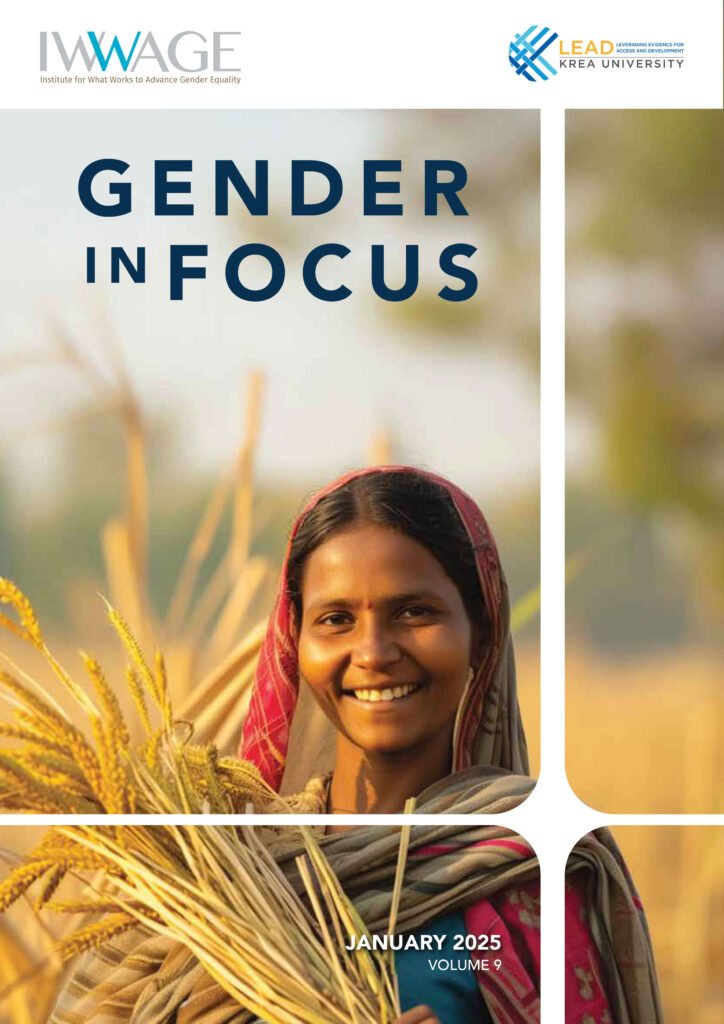
This issue offers a preview of IWWAGE’s work during the pandemic—field voices from discussions with civil society partners in four states, reflections on how physical distancing may affect SHG functioning, and analysis on how recovery strategies must account for women’s employment and labour participation. It also captures highlights from webinars, and introduces a new series of policy notes with timely recommendations to support a more resilient and gender-responsive post-COVID world.
This issue offers a preview of IWWAGE’s work during the pandemic—field voices from discussions with civil society partners in four states, reflections on how physical distancing may affect SHG functioning, and analysis on how recovery strategies must account for women’s employment and labour participation. It also captures highlights from webinars, and introduces a new series of policy notes with timely recommendations to support a more resilient and gender-responsive post-COVID world.

Brief
Understanding the Needs of Self-Employed Women in India
- January , 2025
- Prakriti Sharma, Vidhi
Insights from the IWWAGE and Institute for Human Development’s panel at the 65th ISLE Conference
Women’s entrepreneurship faces distinct gendered challenges, as unpaid work and domestic responsibilities significantly constrain their ability to scale up and expand their economic activities. This also tends to contribute to a persistent gender gap in the quality and outcomes of work, as most women are relegated to the periphery of entrepreneurship, earning little to no income from their contributions to household enterprises. Hence, since most of these activities are carried out from home and intertwined with household responsibilities, they must be understood not only in terms of economic contribution but within the broader framework of social reproduction.
Women’s entrepreneurship faces distinct gendered challenges, as unpaid work and domestic responsibilities significantly constrain their ability to scale up and expand their economic activities. This also tends to contribute to a persistent gender gap in the quality and outcomes of work, as most women are relegated to the periphery of entrepreneurship, earning little to no income from their contributions to household enterprises. Hence, since most of these activities are carried out from home and intertwined with household responsibilities, they must be understood not only in terms of economic contribution but within the broader framework of social reproduction.

Report
Implementation research study to understand DAY-NRLM’s institutional mechanisms and interventions to address Gender Based Violence
- January , 2025
- Kaliat Ammu Sanyal
The Strengthening Women’s Institutions for Agency and Empowerment (SWAYAM) programme is being piloted in Chhattisgarh, Jharkhand, Madhya Pradesh, and Odisha, in partnership with IWWAGE and DAY-NRLM. While DAY-NRLM is the largest government initiative working with rural women in India, the need remains to shift from solely engaging with women to adopting a gender equality and rights-based approach. This shift, through gender mainstreaming, aims to embed gender sensitivity across frameworks, institutions, and processes to achieve sustainable social, economic, and political goals. Under SWAYAM, gender-responsive training has been provided to cadres and institutions, focusing on gender issues, legal rights, and entitlements. A key feature of the programme is the establishment of Gender Justice Centres (GRCs) at the block level, aimed at improving women’s access to rights and services, and addressing grievances related to violence. IWWAGE, an initiative of LEAD at Krea University, conducted a qualitative study on the SWAYAM programme in these pilot states, focusing on its role in addressing Violence Against Women (VAW). The study aimed to understand women’s experiences with accessing services at GRCs and to explore how social norms and gender training impacted the community’s response to violence. The research included interviews with 102 participants across four states, involving SHG women trained and untrained in gender, women who sought support from GRCs, Gender Champions, and men related to SHG members. The study provides insights into the effectiveness of the SWAYAM programme in transforming attitudes towards violence and fostering community intervention in VAW cases.
The Strengthening Women’s Institutions for Agency and Empowerment (SWAYAM) programme is being piloted in Chhattisgarh, Jharkhand, Madhya Pradesh, and Odisha, in partnership with IWWAGE and DAY-NRLM. While DAY-NRLM is the largest government initiative working with rural women in India, the need remains to shift from solely engaging with women to adopting a gender equality and rights-based approach. This shift, through gender mainstreaming, aims to embed gender sensitivity across frameworks, institutions, and processes to achieve sustainable social, economic, and political goals. Under SWAYAM, gender-responsive training has been provided to cadres and institutions, focusing on gender issues, legal rights, and entitlements. A key feature of the programme is the establishment of Gender Justice Centres (GRCs) at the block level, aimed at improving women’s access to rights and services, and addressing grievances related to violence. IWWAGE, an initiative of LEAD at Krea University, conducted a qualitative study on the SWAYAM programme in these pilot states, focusing on its role in addressing Violence Against Women (VAW). The study aimed to understand women’s experiences with accessing services at GRCs and to explore how social norms and gender training impacted the community’s response to violence. The research included interviews with 102 participants across four states, involving SHG women trained and untrained in gender, women who sought support from GRCs, Gender Champions, and men related to SHG members. The study provides insights into the effectiveness of the SWAYAM programme in transforming attitudes towards violence and fostering community intervention in VAW cases.

Newsletter (Gender In Focus)
Gender in Focus- Hindi
- January , 2025
- IWWAGE
This issue offers a preview of IWWAGE’s work during the pandemic—field voices from discussions with civil society partners in four states, reflections on how physical distancing may affect SHG functioning, and analysis on how recovery strategies must account for women’s employment and labour participation. It also captures highlights from webinars, and introduces a new series of policy notes with timely recommendations to support a more resilient and gender-responsive post-COVID world.
This issue offers a preview of IWWAGE’s work during the pandemic—field voices from discussions with civil society partners in four states, reflections on how physical distancing may affect SHG functioning, and analysis on how recovery strategies must account for women’s employment and labour participation. It also captures highlights from webinars, and introduces a new series of policy notes with timely recommendations to support a more resilient and gender-responsive post-COVID world.

Report
Capturing Women’s Work to Measure Better
- September , 2024
- Sona Mitra | Bidisha Mondal | Prakriti Sharma | Aneek Choudhary
Women’s work is often underestimated in labour force surveys due to its complex nature, which includes economic, non-economic, and unpaid work such as domestic tasks and caregiving. Additionally, biases in respondents and enumerators, along with survey designs lacking gender sensitivity, contribute to data gaps and the undercounting of women’s contributions, keeping them invisible in statistics and policy discussions. Research highlights how oversimplified methodologies in mainstream surveys lead to the misclassification of economically active women as inactive. This study aims to address these gaps by testing innovative survey techniques that provide more accurate estimates of women’s participation in the workforce. It also examines perception bias in proxy-reporting. The study was conducted in Karnataka and Jharkhand, surveying 4,000 women and 800 men. Findings show that these innovations were effective in capturing more women in employment compared to conventional surveys, offering deeper insights into their time-use patterns and highlighting the impact of perception bias in proxy reporting.
Women’s work is often underestimated in labour force surveys due to its complex nature, which includes economic, non-economic, and unpaid work such as domestic tasks and caregiving. Additionally, biases in respondents and enumerators, along with survey designs lacking gender sensitivity, contribute to data gaps and the undercounting of women’s contributions, keeping them invisible in statistics and policy discussions. Research highlights how oversimplified methodologies in mainstream surveys lead to the misclassification of economically active women as inactive. This study aims to address these gaps by testing innovative survey techniques that provide more accurate estimates of women’s participation in the workforce. It also examines perception bias in proxy-reporting. The study was conducted in Karnataka and Jharkhand, surveying 4,000 women and 800 men. Findings show that these innovations were effective in capturing more women in employment compared to conventional surveys, offering deeper insights into their time-use patterns and highlighting the impact of perception bias in proxy reporting.

Learning note
Trend In Female Labour Force Participation In India
- December , 2024
- Aneek Choudhary , Bidisha Mondal
Despite significant economic growth since the 1990s, India’s female labour force participation rate (FLFPR) remains low at 28.2%, lagging behind countries like Bangladesh, Bhutan, and Sri Lanka.This factsheet explores these barriers and their impact on women’s workforce participation in India.
Despite significant economic growth since the 1990s, India’s female labour force participation rate (FLFPR) remains low at 28.2%, lagging behind countries like Bangladesh, Bhutan, and Sri Lanka.This factsheet explores these barriers and their impact on women’s workforce participation in India.
Report
Exploring Strategies, Processes, and Utility of the Vulnerability Reduction Fund (VRF) During COVID-19
- December , 2024
- Surabhi Awasthi | Sharmishtha Nanda | Arpita Paul
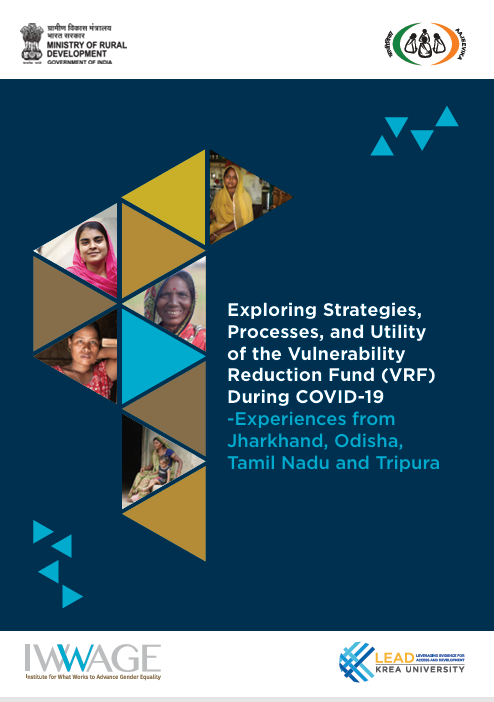
The Deendayal Antyodaya Yojana – National Rural Livelihoods Mission (DAY-NRLM) is a Government of India scheme aimed at reducing poverty by empowering women through Self-Help Groups (SHGs), Village Organisations (VOs), and Cluster-Level Federations (CLFs). These platforms provide access to rights, financial services, and livelihood opportunities, promoting collective action and leadership among women. To address vulnerability, the Vulnerability Reduction Fund (VRF) was introduced in 2016 as part of DAY-NRLM’s social inclusion strategy. The VRF focuses on reducing risk and supporting vulnerable communities, especially during crises like the COVID-19 pandemic. In 2022, IWWAGE conducted a study in Jharkhand, Odisha, Tamil Nadu, and Tripura to assess the implementation and impact of the VRF during COVID-19. The research involved interviews with beneficiaries and officials and focused on the allocation, disbursement, and effectiveness of the fund in reaching vulnerable households. The study highlights the VRF’s role in building resilience and aiding marginalised communities.
The Deendayal Antyodaya Yojana – National Rural Livelihoods Mission (DAY-NRLM) is a Government of India scheme aimed at reducing poverty by empowering women through Self-Help Groups (SHGs), Village Organisations (VOs), and Cluster-Level Federations (CLFs). These platforms provide access to rights, financial services, and livelihood opportunities, promoting collective action and leadership among women. To address vulnerability, the Vulnerability Reduction Fund (VRF) was introduced in 2016 as part of DAY-NRLM’s social inclusion strategy. The VRF focuses on reducing risk and supporting vulnerable communities, especially during crises like the COVID-19 pandemic. In 2022, IWWAGE conducted a study in Jharkhand, Odisha, Tamil Nadu, and Tripura to assess the implementation and impact of the VRF during COVID-19. The research involved interviews with beneficiaries and officials and focused on the allocation, disbursement, and effectiveness of the fund in reaching vulnerable households. The study highlights the VRF’s role in building resilience and aiding marginalised communities.

Learning note
Climate Change and the Future of Women’s Work
- December , 2024
- Sayak Sinha | Divya Singh | Devika Oberai
Climate change is a pressing global challenge that exacerbates existing inequalities, disproportionately affecting women, girls, and marginalised communities. Due to persistent gender inequalities, women face unique challenges in adapting to climate-induced disasters, often lacking access to resources, financial services, and decision-making platforms needed to rebuild livelihoods. As a result, they are often slower to recover compared to men. International frameworks, such as the United Nations Framework Convention on Climate Change (UNFCCC) and the Lima Work Program on Gender, stress the importance of integrating gender perspectives into climate policies. However, there is a lack of sex-disaggregated data to fully understand the impact of climate change on women’s workforce participation. This highlights the urgent need for research on how climate change affects women’s livelihoods and the importance of advocating for policies that protect their participation in existing sectors while empowering them to enter emerging industries. By addressing these gendered impacts, we can create more equitable and sustainable solutions to climate change, ensuring that women play a key role in building climate-resilient communities.
Climate change is a pressing global challenge that exacerbates existing inequalities, disproportionately affecting women, girls, and marginalised communities. Due to persistent gender inequalities, women face unique challenges in adapting to climate-induced disasters, often lacking access to resources, financial services, and decision-making platforms needed to rebuild livelihoods. As a result, they are often slower to recover compared to men. International frameworks, such as the United Nations Framework Convention on Climate Change (UNFCCC) and the Lima Work Program on Gender, stress the importance of integrating gender perspectives into climate policies. However, there is a lack of sex-disaggregated data to fully understand the impact of climate change on women’s workforce participation. This highlights the urgent need for research on how climate change affects women’s livelihoods and the importance of advocating for policies that protect their participation in existing sectors while empowering them to enter emerging industries. By addressing these gendered impacts, we can create more equitable and sustainable solutions to climate change, ensuring that women play a key role in building climate-resilient communities.
Brief
Care and Climate Change
- January , 2026
The brief focuses on bridging feminist economics and climate policy, highlighting gendered care burdens, structural undervaluation of reproductive labour, and the need for transformative interventions like care-responsive adaptation and finance.
The brief focuses on bridging feminist economics and climate policy, highlighting gendered care burdens, structural undervaluation of reproductive labour, and the need for transformative interventions like care-responsive adaptation and finance.
Brief
Measuring Women’s Work: Innovations and Obstacles in the Global South
- January , 2026
The brief examined challenges and innovations in capturing women’s paid and unpaid work in labour statistics. Drawing on experiences from India, South Africa, Latin America, and global systems, panelists highlighted how survey design, classifications, and institutional limits determine what is counted, and what remains invisible
The brief examined challenges and innovations in capturing women’s paid and unpaid work in labour statistics. Drawing on experiences from India, South Africa, Latin America, and global systems, panelists highlighted how survey design, classifications, and institutional limits determine what is counted, and what remains invisible

Report Snapshot
The Changing World of Women’s Work
- December , 2025
- Bidisha Mondal, Prakriti Sharma, Aneek Chowdhury, Anjali S
This study examines women’s participation in India’s platform economy using a mixed-methods approach, combining a survey of 598 platform workers (440 women) across care, domestic, beauty, ride-sharing, and delivery services with qualitative interviews. While platform work offers new entry points and flexibility, it often mirrors and deepens the precarity of informal work, limiting its potential for women’s empowerment. Persistent challenges include income instability, high entry and platform costs, limited social protection, unsafe conditions, and reinforced gender inequalities. Meaningful progress requires coordinated action by policymakers, platforms, and worker collectives to ensure fair earnings, social security, gender-sensitive systems, and effective grievance redressal
This study examines women’s participation in India’s platform economy using a mixed-methods approach, combining a survey of 598 platform workers (440 women) across care, domestic, beauty, ride-sharing, and delivery services with qualitative interviews. While platform work offers new entry points and flexibility, it often mirrors and deepens the precarity of informal work, limiting its potential for women’s empowerment. Persistent challenges include income instability, high entry and platform costs, limited social protection, unsafe conditions, and reinforced gender inequalities. Meaningful progress requires coordinated action by policymakers, platforms, and worker collectives to ensure fair earnings, social security, gender-sensitive systems, and effective grievance redressal

Brief
Women’s Work and AI-Unlocking Potential, Bridging the Divide
- December , 2025
- Sharati Roy, Dr. Mahima Taneja
AI is not neutral in how it’s designed or deployed. It is reshaping labour markets, with the biggest gains when it complements human skills rather than replaces them (ILO, 2025). While AI can improve efficiency and decision-making in sectors like healthcare, finance, and education, it also risks job losses and deeper inequalities. Outcomes will depend on whether AI drives automation or augmentation. In India—where Digital Public Infrastructure, data expansion, and the gig economy are growing rapidly—this brief explores women’s opportunities in AI/data value-chain work and AI-augmented livelihoods to support economic empowerment.
AI is not neutral in how it’s designed or deployed. It is reshaping labour markets, with the biggest gains when it complements human skills rather than replaces them (ILO, 2025). While AI can improve efficiency and decision-making in sectors like healthcare, finance, and education, it also risks job losses and deeper inequalities. Outcomes will depend on whether AI drives automation or augmentation. In India—where Digital Public Infrastructure, data expansion, and the gig economy are growing rapidly—this brief explores women’s opportunities in AI/data value-chain work and AI-augmented livelihoods to support economic empowerment.
Report
The Changing World of Women’s Work
- December , 2025
- Bidisha Mondal, Prakriti Sharma, Aneek Chowdhury, Anjali S
This study examines women’s participation in India’s platform economy using a mixed-methods approach, combining a survey of 598 platform workers (440 women) across care, domestic, beauty, ride-sharing, and delivery services with qualitative interviews. While platform work offers new entry points and flexibility, it often mirrors and deepens the precarity of informal work, limiting its potential for women’s empowerment. Persistent challenges include income instability, high entry and platform costs, limited social protection, unsafe conditions, and reinforced gender inequalities. Meaningful progress requires coordinated action by policymakers, platforms, and worker collectives to ensure fair earnings, social security, gender-sensitive systems, and effective grievance redressal
This study examines women’s participation in India’s platform economy using a mixed-methods approach, combining a survey of 598 platform workers (440 women) across care, domestic, beauty, ride-sharing, and delivery services with qualitative interviews. While platform work offers new entry points and flexibility, it often mirrors and deepens the precarity of informal work, limiting its potential for women’s empowerment. Persistent challenges include income instability, high entry and platform costs, limited social protection, unsafe conditions, and reinforced gender inequalities. Meaningful progress requires coordinated action by policymakers, platforms, and worker collectives to ensure fair earnings, social security, gender-sensitive systems, and effective grievance redressal

Brief
Impact of Social Norms on Women’s Economic Empowerment in India
- November , 2025
- Mridusmita Bordoloi, Surabhi Awasthi, Sharati Roy
Women’s Economic Empowerment (WEE) refers to women’s access to economic opportunities, resources, decent work, and the ability to make independent economic choices. It is both a process and an outcome that strengthens individual agency and supports inclusive growth. In countries like India, WEE is constrained not only by structural gaps—such as inadequate care infrastructure, poor connectivity, and limited skills access—but also by deeply rooted gender norms that shape women’s roles in society.
Women’s Economic Empowerment (WEE) refers to women’s access to economic opportunities, resources, decent work, and the ability to make independent economic choices. It is both a process and an outcome that strengthens individual agency and supports inclusive growth. In countries like India, WEE is constrained not only by structural gaps—such as inadequate care infrastructure, poor connectivity, and limited skills access—but also by deeply rooted gender norms that shape women’s roles in society.