


Haryana has transitioned from an agrarian to a more industrial economy, characterized by strong agricultural output and growing sectors such as automotive and IT. Despite economic growth, unemployment remains high, particularly among youth and women, due to limited formal job opportunities and structural challenges. This factsheet analyses female labour force participation in Haryana from 2017–18 to 2023–24, highlighting sectoral trends, occupational segregation, and barriers to workforce entry.
Publications
Publications
Category
Year

Report
Swayam Process Evaluation: A Year-Long Ethnography Study, Madhya Pradesh & Odisha
- June , 2025
- Surabhi Awasthi, Moumita Sarkar and Gayathri Sreedharan
This study assesses the impact of training programmes on community change and empowerment among leaders of Self-Help Groups (SHGs), Village Organisations (VOs), and Cluster-Level Federations (CLFs). It also includes interviews with district- and block-level officials from MPSRLM and OLM to examine how line departments collaborate with community institutions to address and resolve complaints.
This study assesses the impact of training programmes on community change and empowerment among leaders of Self-Help Groups (SHGs), Village Organisations (VOs), and Cluster-Level Federations (CLFs). It also includes interviews with district- and block-level officials from MPSRLM and OLM to examine how line departments collaborate with community institutions to address and resolve complaints.

Factsheet
Trends in Female Labour and Workforce Participation-Bihar
- April , 2025
- Aneek Choudhary and Bidisha Mondal
Bihar, despite being one of India’s fastest-growing states, has the lowest female labour force participation rate, alongside a widening gender gap. Policy focus on girls’ education, skills, entrepreneurship, and social support through schemes such as the Balika Cycle Yojana, Akshar Anchal Yojana, and Kanya Suraksha Yojana have contributed to recent improvements in female participation. Using PLFS data, this factsheet examines trends and key characteristics of women’s employment in Bihar.
Bihar, despite being one of India’s fastest-growing states, has the lowest female labour force participation rate, alongside a widening gender gap. Policy focus on girls’ education, skills, entrepreneurship, and social support through schemes such as the Balika Cycle Yojana, Akshar Anchal Yojana, and Kanya Suraksha Yojana have contributed to recent improvements in female participation. Using PLFS data, this factsheet examines trends and key characteristics of women’s employment in Bihar.

Factsheet
Trends in Female Labour Force Participation in Uttar Pradesh
- April , 2025
- Aneek Choudhary and Bidisha Mondal
Uttar Pradesh, India’s most populous state, has a large working-age female population but a female labor force participation rate that is well below the national average. Regional disparities, weak infrastructure in eastern UP, restrictive socio-cultural norms, and limited economic opportunities contribute to low participation. Female workforce participation has improved since 2017–18, supported by schemes such as the Mudra Yojana and Deendayal Antyodaya Yojana, which have expanded women’s access to credit, strengthened self-help groups, and promoted women’s economic empowerment across the state.
Uttar Pradesh, India’s most populous state, has a large working-age female population but a female labor force participation rate that is well below the national average. Regional disparities, weak infrastructure in eastern UP, restrictive socio-cultural norms, and limited economic opportunities contribute to low participation. Female workforce participation has improved since 2017–18, supported by schemes such as the Mudra Yojana and Deendayal Antyodaya Yojana, which have expanded women’s access to credit, strengthened self-help groups, and promoted women’s economic empowerment across the state.

Factsheet
Trends in Female Labour Force and Workforce Participation- Haryana
- April , 2025
- Vidhi, Aneek Choudhary and Bidisha Mondal
Haryana has transitioned from an agrarian to a more industrial economy, characterized by strong agricultural output and growing sectors such as automotive and IT. Despite economic growth, unemployment remains high, particularly among youth and women, due to limited formal job opportunities and structural challenges. This factsheet analyses female labour force participation in Haryana from 2017–18 to 2023–24, highlighting sectoral trends, occupational segregation, and barriers to workforce entry.
Haryana has transitioned from an agrarian to a more industrial economy, characterized by strong agricultural output and growing sectors such as automotive and IT. Despite economic growth, unemployment remains high, particularly among youth and women, due to limited formal job opportunities and structural challenges. This factsheet analyses female labour force participation in Haryana from 2017–18 to 2023–24, highlighting sectoral trends, occupational segregation, and barriers to workforce entry.

Factsheet
Trends in Female Labour Force Participation in Gujrat
- April , 2025
- Aneek Choudhary and Bidisha Mondal
Gujarat records a female labour force participation rate above the national average, supported by government policies promoting women’s economic empowerment. Schemes such as Mukhyamantri Mahila Utkars Yojana and Mahila Swavalamban Scheme strengthen financial inclusion, self-help groups, and access to credit for women, especially those below the poverty line. The state also promotes women’s entrepreneurship through targeted training and awareness programmes. Using PLFS 2023–24 data, this factsheet examines women’s employment in Gujarat, focusing on job types, sectoral distribution, and key indicators shaping female workforce participation.
Gujarat records a female labour force participation rate above the national average, supported by government policies promoting women’s economic empowerment. Schemes such as Mukhyamantri Mahila Utkars Yojana and Mahila Swavalamban Scheme strengthen financial inclusion, self-help groups, and access to credit for women, especially those below the poverty line. The state also promotes women’s entrepreneurship through targeted training and awareness programmes. Using PLFS 2023–24 data, this factsheet examines women’s employment in Gujarat, focusing on job types, sectoral distribution, and key indicators shaping female workforce participation.
Gujarat records a female labour force participation rate above the national average, supported by government policies promoting women’s economic empowerment. Schemes such as Mukhyamantri Mahila Utkars Yojana and Mahila Swavalamban Scheme strengthen financial inclusion, self-help groups, and access to credit for women, especially those below the poverty line. The state also promotes women’s entrepreneurship through targeted training and awareness programmes. Using PLFS 2023–24 data, this factsheet examines women’s employment in Gujarat, focusing on job types, sectoral distribution, and key indicators shaping female workforce participation.

Factsheet
Trend in Female Labour Force Participation in Chhattisgarh
- April , 2025
- Aneek Choudhary and Bidisha Mondal
Chhattisgarh records a significantly higher female labour force participation rate than the national average, particularly in rural areas, with rising women’s participation evident since before 2016. Tribal women participate in the labour market at much higher rates than non-tribal women, but most are engaged in self-employment, with a large share working as unpaid family workers. While schemes such as Mahila Kosh and the National Rural Livelihoods Mission aim to promote women’s financial independence, the dominance of unpaid work highlights the need for a deeper examination of labour market conditions and opportunities for women in the state.
Chhattisgarh records a significantly higher female labour force participation rate than the national average, particularly in rural areas, with rising women’s participation evident since before 2016. Tribal women participate in the labour market at much higher rates than non-tribal women, but most are engaged in self-employment, with a large share working as unpaid family workers. While schemes such as Mahila Kosh and the National Rural Livelihoods Mission aim to promote women’s financial independence, the dominance of unpaid work highlights the need for a deeper examination of labour market conditions and opportunities for women in the state.
Chhattisgarh records a significantly higher female labour force participation rate than the national average, particularly in rural areas, with rising women’s participation evident since before 2016. Tribal women participate in the labour market at much higher rates than non-tribal women, but most are engaged in self-employment, with a large share working as unpaid family workers. While schemes such as Mahila Kosh and the National Rural Livelihoods Mission aim to promote women’s financial independence, the dominance of unpaid work highlights the need for a deeper examination of labour market conditions and opportunities for women in the state.

Factsheet
Trends in Female Labour Force Participation in Assam
- April , 2025
- Aneek Choudhary, Vidhi and Bidisha Mondal
Assam has seen a notable rise in female labour force participation since 2021–22, exceeding the national average. However, data for 2022–23 shows an unusually wide gender gap and the lowest recorded female participation, largely due to an NSSO enumeration error that led to underreporting. In recent years, the state has introduced several pro-women initiatives focused on self-employment, skill development, and access to credit, which are expected to support higher female participation. Updated PLFS data will provide a clearer picture of emerging trends in women’s employment in Assam.
Assam has seen a notable rise in female labour force participation since 2021–22, exceeding the national average. However, data for 2022–23 shows an unusually wide gender gap and the lowest recorded female participation, largely due to an NSSO enumeration error that led to underreporting. In recent years, the state has introduced several pro-women initiatives focused on self-employment, skill development, and access to credit, which are expected to support higher female participation. Updated PLFS data will provide a clearer picture of emerging trends in women’s employment in Assam.
Assam has seen a notable rise in female labour force participation since 2021–22, exceeding the national average. However, data for 2022–23 shows an unusually wide gender gap and the lowest recorded female participation, largely due to an NSSO enumeration error that led to underreporting. In recent years, the state has introduced several pro-women initiatives focused on self-employment, skill development, and access to credit, which are expected to support higher female participation. Updated PLFS data will provide a clearer picture of emerging trends in women’s employment in Assam.

Factsheet
Trend In Female Labour Force and Workforce Participation- Telangana
- April , 2025
- Vidhi and Bidisha Mondal
Telangana has emerged as a major industrial and services-led economy, with GSDP growing nearly 197% between 2014–15 and 2023–24. Services contribute about two-thirds of GSVA, while industry has achieved near gender parity in employment due to targeted policy interventions. Agriculture remains a key employer, engaging 45.8% of the population but contributing a smaller share to GSDP. Women are largely concentrated in agriculture, while men dominate services. This factsheet examines trends in female labour force participation in Telangana from 2017–18 to 2023–24, focusing on sectoral distribution, occupational segregation, and workforce barriers.
Telangana has emerged as a major industrial and services-led economy, with GSDP growing nearly 197% between 2014–15 and 2023–24. Services contribute about two-thirds of GSVA, while industry has achieved near gender parity in employment due to targeted policy interventions. Agriculture remains a key employer, engaging 45.8% of the population but contributing a smaller share to GSDP. Women are largely concentrated in agriculture, while men dominate services. This factsheet examines trends in female labour force participation in Telangana from 2017–18 to 2023–24, focusing on sectoral distribution, occupational segregation, and workforce barriers.
Telangana has emerged as a major industrial and services-led economy, with GSDP growing nearly 197% between 2014–15 and 2023–24. Services contribute about two-thirds of GSVA, while industry has achieved near gender parity in employment due to targeted policy interventions. Agriculture remains a key employer, engaging 45.8% of the population but contributing a smaller share to GSDP. Women are largely concentrated in agriculture, while men dominate services. This factsheet examines trends in female labour force participation in Telangana from 2017–18 to 2023–24, focusing on sectoral distribution, occupational segregation, and workforce barriers.

Factsheet
Trends in Female Labour and Workforce Participation- Meghalaya
- April , 2025
- Aneek Chowdhury, Bidisha Mondal
Meghalaya’s FLFPR is significantly higher than the average for India and many other states. Although the proportion of self-employed women has risen in both rural and urban areas, the overwhelming majority (over 75 per cent) are own-account workers. The report highlights the Female Labour Force Participation Rate (FLFPR) in Meghalaya compared to other states in the country and delve into the specific data and factors influencing this FLFPR.
Meghalaya’s FLFPR is significantly higher than the average for India and many other states. Although the proportion of self-employed women has risen in both rural and urban areas, the overwhelming majority (over 75 per cent) are own-account workers. The report highlights the Female Labour Force Participation Rate (FLFPR) in Meghalaya compared to other states in the country and delve into the specific data and factors influencing this FLFPR.

Factsheet
Trends in Female Labour and Workforce Participation – Chhattisgarh
- April , 2025
- Aneek Choudhary
Chhattisgarh records significantly higher female labour force participation than the national average (60% vs 42% in PLFS 2023–24), driven mainly by increased involvement of women in agriculture and allied activities since 2016. However, much of this work remains informal, with high shares of self-employment and unpaid family labour (91% in PLFS 2023–24). While schemes like the Mahila Cash and National Rural Livelihoods Mission have expanded women’s self-help groups, these patterns point to the need for deeper analysis of job quality, labour conditions, and meaningful economic opportunities for women in the state.
Chhattisgarh records significantly higher female labour force participation than the national average (60% vs 42% in PLFS 2023–24), driven mainly by increased involvement of women in agriculture and allied activities since 2016. However, much of this work remains informal, with high shares of self-employment and unpaid family labour (91% in PLFS 2023–24). While schemes like the Mahila Cash and National Rural Livelihoods Mission have expanded women’s self-help groups, these patterns point to the need for deeper analysis of job quality, labour conditions, and meaningful economic opportunities for women in the state.
Chhattisgarh records significantly higher female labour force participation than the national average (60% vs 42% in PLFS 2023–24), driven mainly by increased involvement of women in agriculture and allied activities since 2016. However, much of this work remains informal, with high shares of self-employment and unpaid family labour (91% in PLFS 2023–24). While schemes like the Mahila Cash and National Rural Livelihoods Mission have expanded women’s self-help groups, these patterns point to the need for deeper analysis of job quality, labour conditions, and meaningful economic opportunities for women in the state.
Factsheet
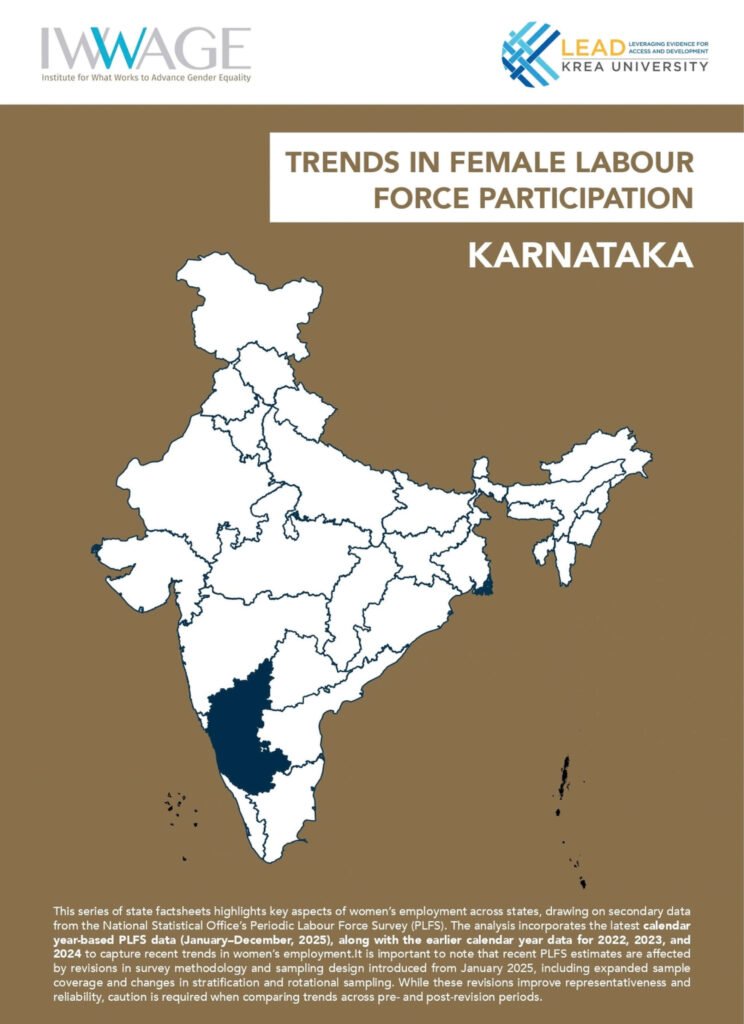
Trends in Female Labour Force Participation in Karnataka
- October , 2026
- Vidhi, Bidisha Mondal
Karnataka occupies a distinctive position in India’s economic landscape, driven by rapid growth in services, technology, and manufacturing sectors.This factsheet examines key trends in women’s labour force participation in Karnataka using PLFS data, with a focus on employment composition, sectoral and occupational distribution, quality of work, and barriers to women’s participation in the labour market.
Karnataka occupies a distinctive position in India’s economic landscape, driven by rapid growth in services, technology, and manufacturing sectors.This factsheet examines key trends in women’s labour force participation in Karnataka using PLFS data, with a focus on employment composition, sectoral and occupational distribution, quality of work, and barriers to women’s participation in the labour market.
Brief
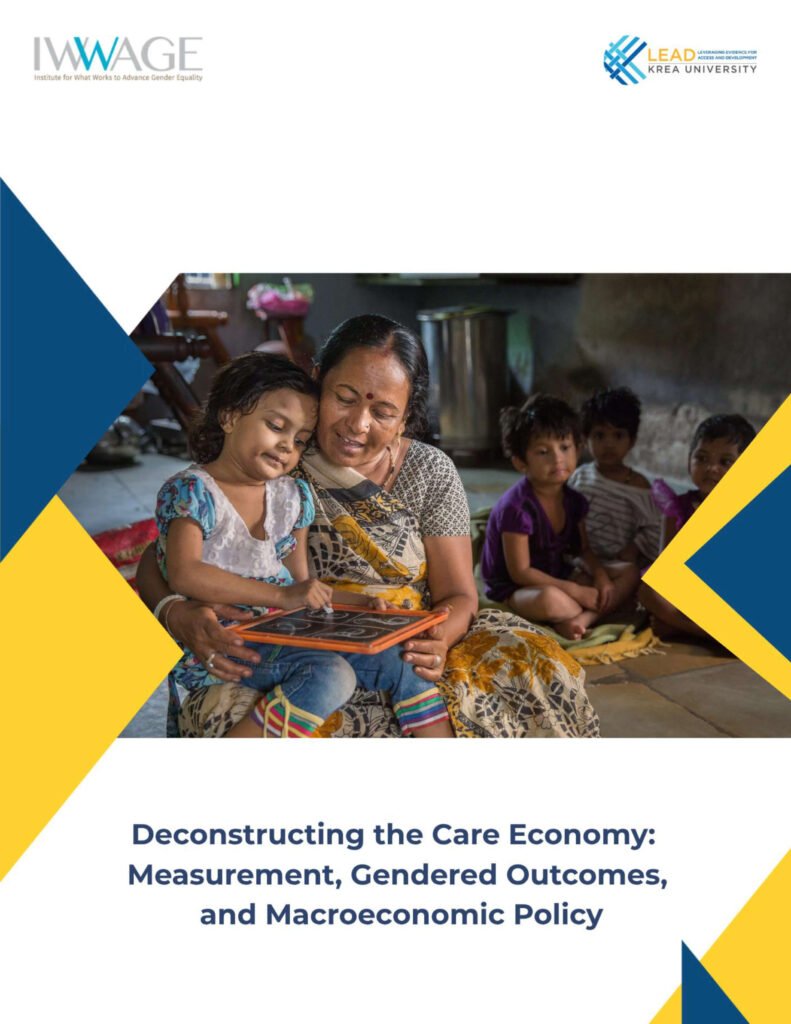
Deconstructing the Care Economy: Measurement, Gendered Outcomes, and Macroeconomic Policy
- September , 2026
The policy brief examines how unpaid care and domestic work largely undertaken by women remains invisible in conventional economic and labour statistics, while significantly shaping women’s participation and outcomes in the labour market. It highlights how care responsibilities contribute to women’s underemployment, lower-paid and precarious work, and inequalities in platform and hybrid work.
The policy brief examines how unpaid care and domestic work largely undertaken by women remains invisible in conventional economic and labour statistics, while significantly shaping women’s participation and outcomes in the labour market. It highlights how care responsibilities contribute to women’s underemployment, lower-paid and precarious work, and inequalities in platform and hybrid work.
Factsheet
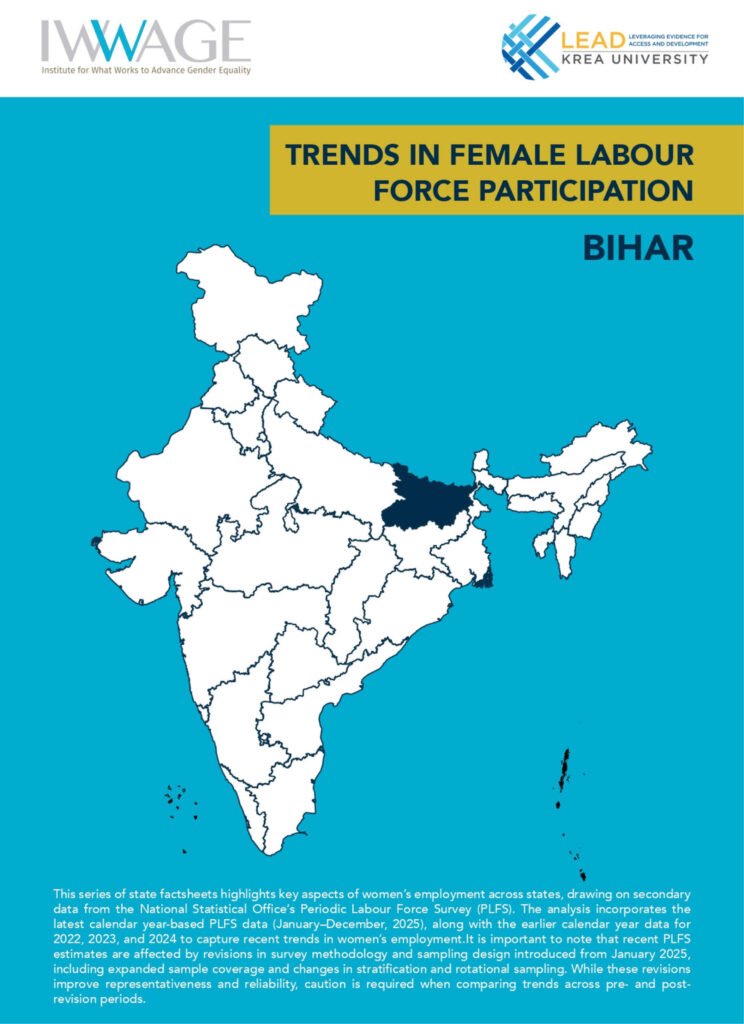
Trends in Female Labour Force Participation in Bihar
- September , 2026
- Vidhi, Bidisha Mondal
Despite economic growth, Bihar continues to face low female labour force participation, reflecting persistent supply-side constraints and limited access to suitable employment opportunities. Young women, in particular, experience low labour force participation amid high youth unemployment, while employment remains concentrated in agriculture and informal work. Sociocultural norms, limited access to education and skills, mobility constraints, inadequate transport, and care responsibilities further restrict women’s access to employment. Against this backdrop, this factsheet examines trends in female labour force participation, workforce composition, sectoral distribution, and working conditions in Bihar.
Despite economic growth, Bihar continues to face low female labour force participation, reflecting persistent supply-side constraints and limited access to suitable employment opportunities. Young women, in particular, experience low labour force participation amid high youth unemployment, while employment remains concentrated in agriculture and informal work. Sociocultural norms, limited access to education and skills, mobility constraints, inadequate transport, and care responsibilities further restrict women’s access to employment. Against this backdrop, this factsheet examines trends in female labour force participation, workforce composition, sectoral distribution, and working conditions in Bihar.
Report
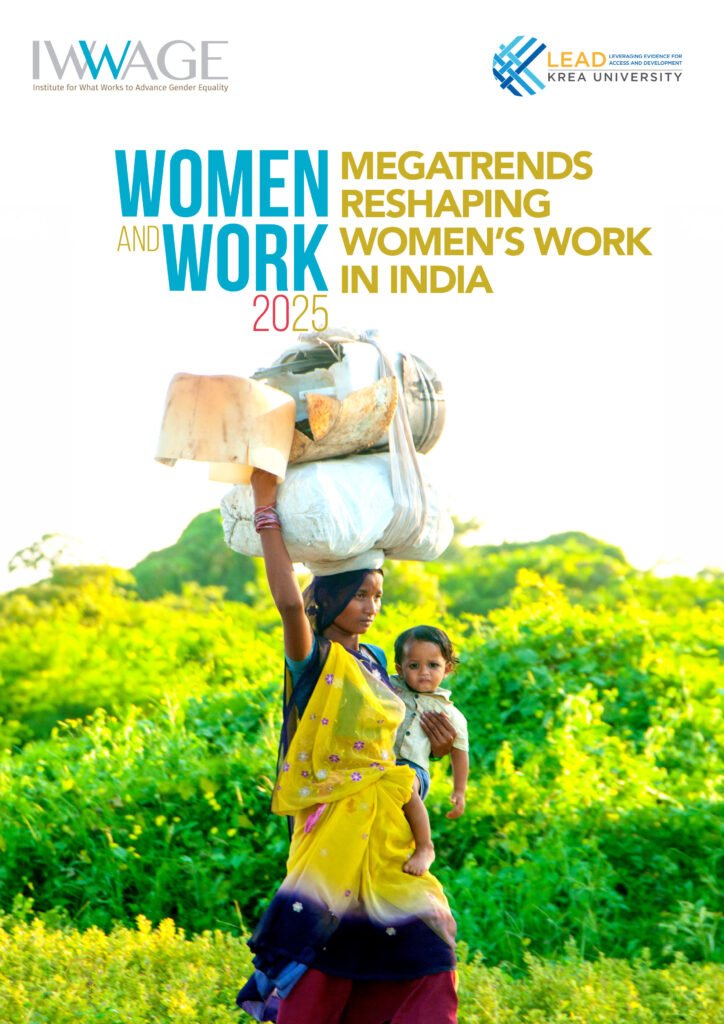
Women and Work 2025: Megatrends Reshaping Women’s Work in India
- September , 2026
- Divya Singh, Prakriti Sharma, Vidhi Singh, Sharati Roy
IWWAGE’s flagship report examines the changing landscape of women’s work in India and the forces shaping its future. Women’s labour force participation has risen significantly in recent years. Yet, the headline numbers tell only part of the story. The nature and experience of women’s work continue to be shaped by the quality and security of employment, unpaid care work, digitalisation, artificial intelligence, climate change, and women’s health at work. The report brings together evidence and emerging policy developments across these interconnected forces to examine where women’s work is headed—and what it will take to translate greater participation into greater economic agency, decent work, and protection.
IWWAGE’s flagship report examines the changing landscape of women’s work in India and the forces shaping its future. Women’s labour force participation has risen significantly in recent years. Yet, the headline numbers tell only part of the story. The nature and experience of women’s work continue to be shaped by the quality and security of employment, unpaid care work, digitalisation, artificial intelligence, climate change, and women’s health at work. The report brings together evidence and emerging policy developments across these interconnected forces to examine where women’s work is headed—and what it will take to translate greater participation into greater economic agency, decent work, and protection.
Factsheet
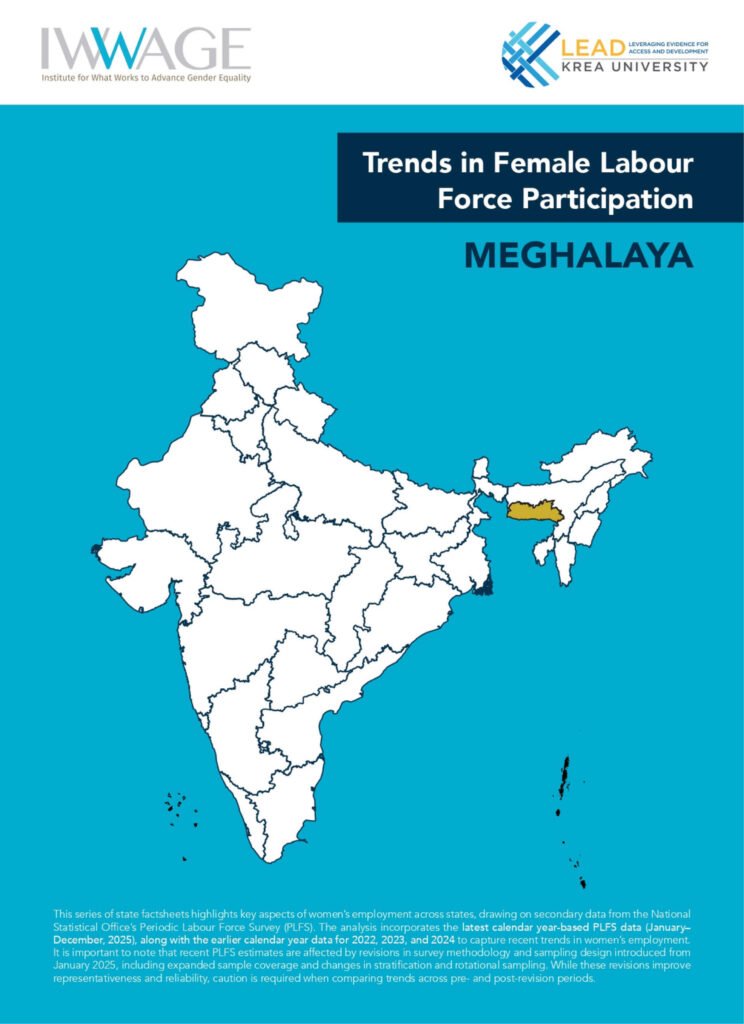
Trends in Female Labour Force Participation in Meghalaya
- August , 2026
- Nabankur Huda, Bidisha Mondal
Meghalaya is a small, hilly state in north-east India with a predominantly rural, agrarian economy and one of the country’s most distinctive social structures. The factsheet explores the trends, opportunities and challenges shaping women’s participation in Meghalaya’s labour market, with a focus on how the state’s social structure and economic transformation influence the nature and quality of women’s work.
Meghalaya is a small, hilly state in north-east India with a predominantly rural, agrarian economy and one of the country’s most distinctive social structures. The factsheet explores the trends, opportunities and challenges shaping women’s participation in Meghalaya’s labour market, with a focus on how the state’s social structure and economic transformation influence the nature and quality of women’s work.
Newsletter (Gender In Focus)
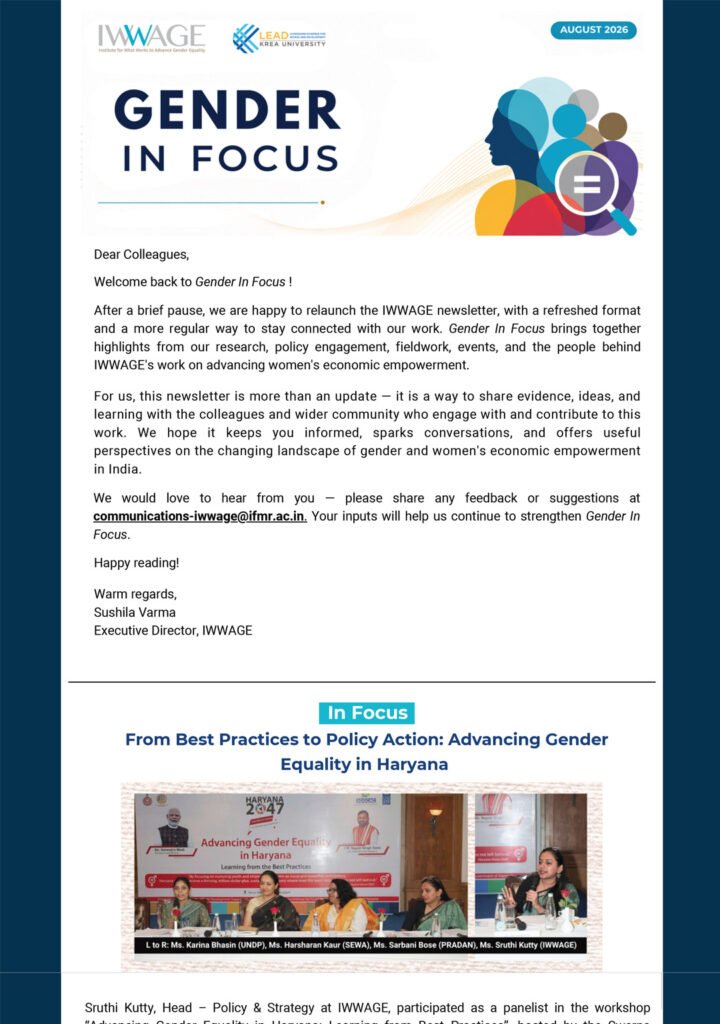
Gender in Focus
- August , 2026
The August 2026 edition features highlights from IWWAGE’s research, policy engagements, fieldwork and knowledge initiatives. It also offers a closer look at emerging trends shaping women’s work and economic participation in India.
The August 2026 edition features highlights from IWWAGE’s research, policy engagements, fieldwork and knowledge initiatives. It also offers a closer look at emerging trends shaping women’s work and economic participation in India.