


Publications
Publications
Category
Year
Learning note
Women’s Workforce Participation In India: Statewise Trends
- April , 2020
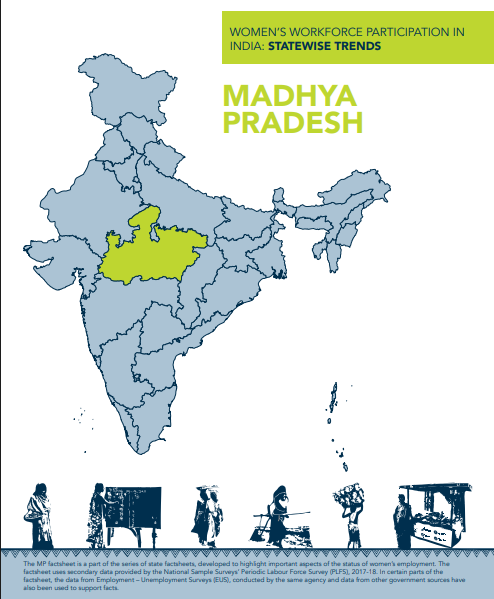
Madhya Pradesh (MP) is the only state in India to have witnessed a rise in workforce participation rates (WPRs) of women in both rural and urban areas between 2011-12 and 2017-18. The increase in women’s WPR in MP was driven largely by increase in self-employment in the rural areas and regular employment in the urban areas. According to the Periodic Labourforce Survey in 2017-18, more than half of the female workforce in the state is self-employed, with a higher incidence of self-employment in rural areas. While approximately 88 percent of the rural self-employed women in MP are engaged in unpaid work, the share of women in own account enterprises is substantially high in urban MP. The distribution of casual women workers suggests very few women engaged under MGNREGA and other public works as 96 percent women in casual employment were engaged in non-public works, with very little security or guarantee of payment
Madhya Pradesh (MP) is the only state in India to have witnessed a rise in workforce participation rates (WPRs) of women in both rural and urban areas between 2011-12 and 2017-18. The increase in women’s WPR in MP was driven largely by increase in self-employment in the rural areas and regular employment in the urban areas. According to the Periodic Labourforce Survey in 2017-18, more than half of the female workforce in the state is self-employed, with a higher incidence of self-employment in rural areas. While approximately 88 percent of the rural self-employed women in MP are engaged in unpaid work, the share of women in own account enterprises is substantially high in urban MP. The distribution of casual women workers suggests very few women engaged under MGNREGA and other public works as 96 percent women in casual employment were engaged in non-public works, with very little security or guarantee of payment

Factsheet
Trends in Female Labour and Workforce Participation – Karnataka
- April , 2020
- Aneek Choudhary , Bidisha Mondal
Karnataka, despite being India’s IT hub, has a lower female labour force participation rate (FLFPR) than the national average. While women’s literacy exceeds 68%, many are engaged in unpaid household work or casual labour. Recent developments, like the ‘Shakti’ scheme, have positively impacted FLFPR by providing safe and affordable transportation, leading to increased workforce participation. However, disparities remain, as highlighted by the PLFS 2023-24 survey. This factsheet explores the trends, challenges, and policy implications affecting women’s participation in Karnataka’s labour market.
Karnataka, despite being India’s IT hub, has a lower female labour force participation rate (FLFPR) than the national average. While women’s literacy exceeds 68%, many are engaged in unpaid household work or casual labour. Recent developments, like the ‘Shakti’ scheme, have positively impacted FLFPR by providing safe and affordable transportation, leading to increased workforce participation. However, disparities remain, as highlighted by the PLFS 2023-24 survey. This factsheet explores the trends, challenges, and policy implications affecting women’s participation in Karnataka’s labour market.
Brief
Accelerating Women’s Access to Entitlements through Digital Solutions
- April , 2020
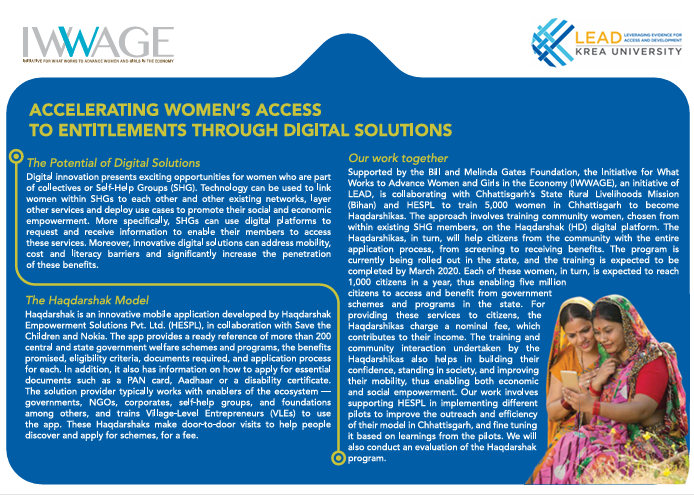
Digital innovation offers strong opportunities for women in collectives and Self-Help Groups (SHGs) by strengthening connections, expanding networks, and enabling access to services. Digital platforms can help SHGs share information, deliver targeted use cases, and improve access to benefits. By addressing barriers related to mobility, cost, and literacy, digital solutions can significantly enhance women’s social and economic empowerment.
Digital innovation offers strong opportunities for women in collectives and Self-Help Groups (SHGs) by strengthening connections, expanding networks, and enabling access to services. Digital platforms can help SHGs share information, deliver targeted use cases, and improve access to benefits. By addressing barriers related to mobility, cost, and literacy, digital solutions can significantly enhance women’s social and economic empowerment.
Report
Generating Female Employment through Public Employment: A Scoping Paper
- February , 2020
- Dipa Sinha, Jayati Ghosh, Mohini Gupta, Varsha Gupta
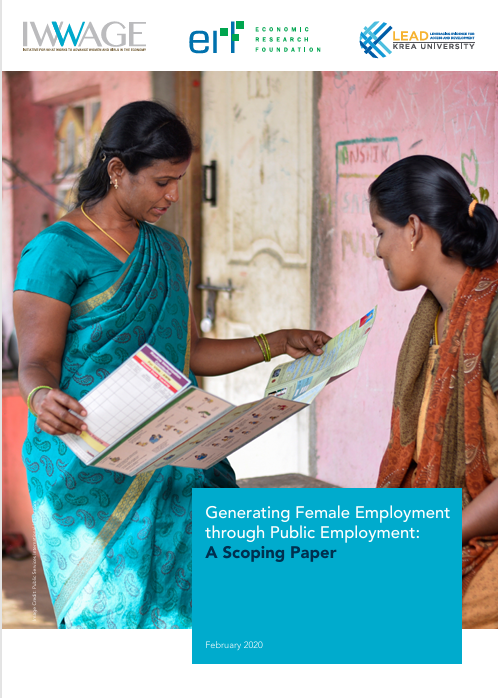
The employment generating potential of growth in India has been on the decline with unemployment and the lack of new job opportunities at their peak. According to the data put together by the State of Working India 2018, the relationship between growth and employment generation in India has weakened over time. A related puzzle is that of declining female workforce participation rates in the country, despite increasing education levels as well as economic growth. A major concern for the direction and pace of economic growth is how work and labour force participation rates of women can be improved. Employment in the government, especially in public services delivery, is a potential area where jobs can be created. An emphasis on creating work opportunities for women in public administration and frontline public services can serve the dual purpose of providing universal access to quality public services and reviving demand in the economy. IWWAGE study, Generating Female Employment through Public Employment aims to estimate the impact of creating and regularising jobs for women within the system of public administration, especially in frontline public services delivery. It considers questions on the activities and working conditions of women workers in frontline public services, assesses the number of such workers, and compares them with international estimates. The study also evaluates whether there is gender stereotyping in certain public sector jobs. Additionally, the study captures women’s perceptions of the benefits and constraints of being employed in such jobs. This scoping paper presents the current status of women employed in various levels by the government, based on data from the National Sample Survey (NSS), analysis of government reports, publications, and responses to queries raised using the Right to Information (RTI).
The employment generating potential of growth in India has been on the decline with unemployment and the lack of new job opportunities at their peak. According to the data put together by the State of Working India 2018, the relationship between growth and employment generation in India has weakened over time. A related puzzle is that of declining female workforce participation rates in the country, despite increasing education levels as well as economic growth. A major concern for the direction and pace of economic growth is how work and labour force participation rates of women can be improved. Employment in the government, especially in public services delivery, is a potential area where jobs can be created. An emphasis on creating work opportunities for women in public administration and frontline public services can serve the dual purpose of providing universal access to quality public services and reviving demand in the economy. IWWAGE study, Generating Female Employment through Public Employment aims to estimate the impact of creating and regularising jobs for women within the system of public administration, especially in frontline public services delivery. It considers questions on the activities and working conditions of women workers in frontline public services, assesses the number of such workers, and compares them with international estimates. The study also evaluates whether there is gender stereotyping in certain public sector jobs. Additionally, the study captures women’s perceptions of the benefits and constraints of being employed in such jobs. This scoping paper presents the current status of women employed in various levels by the government, based on data from the National Sample Survey (NSS), analysis of government reports, publications, and responses to queries raised using the Right to Information (RTI).
Brief
Learnings from Scoping Visit
- February , 2020
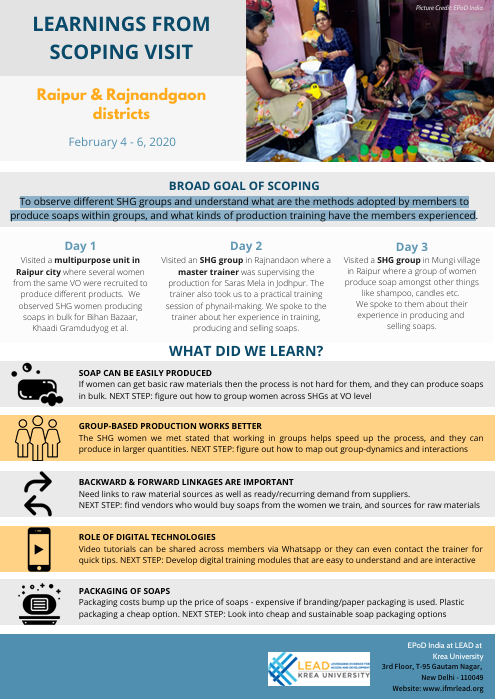
To observe different SHG groups and understand what are the methods adopted by members to produce soaps within groups, and what kinds of production training have the members experienced
To observe different SHG groups and understand what are the methods adopted by members to produce soaps within groups, and what kinds of production training have the members experienced

Learning note
Female Labour Force Participation Rate and Earnings Gap in India
- February , 2020
Despite high economic growth, decline in fertility, and rise in schooling of girls, the Female Labour Force Participation Rate (FLFPR) in India has declined in rural areas and stagnated in urban areas since the late 1980s. This is contrary to the global experience, where similar factors resulted substantial increase in the FLFPR. The recently released Periodic Labour Force Survey 2017-18 confirms the declining trend and shows FLFPR declined in all states with the exception of Madhya Pradesh and Goa. Women’s engagement in unpaid work is high in rural areas and while a majority of women are employed in regular wage work in urban areas, there are substantial wage differentials between men and women, most of the regular work of women is in the informal sector, and non-wage benefits are poor.
Despite high economic growth, decline in fertility, and rise in schooling of girls, the Female Labour Force Participation Rate (FLFPR) in India has declined in rural areas and stagnated in urban areas since the late 1980s. This is contrary to the global experience, where similar factors resulted substantial increase in the FLFPR. The recently released Periodic Labour Force Survey 2017-18 confirms the declining trend and shows FLFPR declined in all states with the exception of Madhya Pradesh and Goa. Women’s engagement in unpaid work is high in rural areas and while a majority of women are employed in regular wage work in urban areas, there are substantial wage differentials between men and women, most of the regular work of women is in the informal sector, and non-wage benefits are poor.
Learning note
Women in Manufacturing
- February , 2020
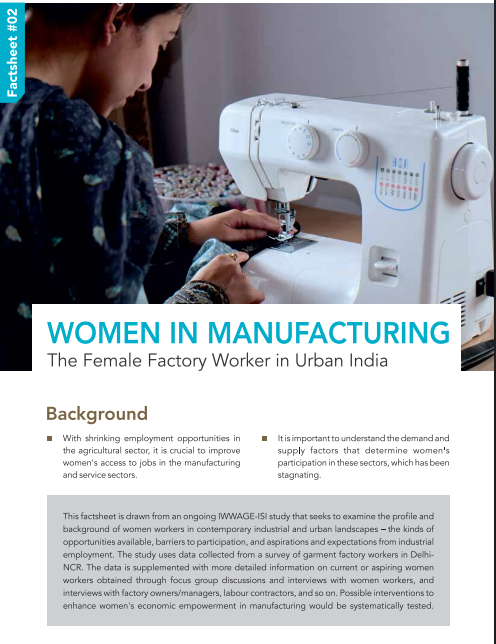
This factsheet is drawn from an IWWAGE-ISI study that seeks to examine the profile and background of women workers in contemporary industrial and urban landscapes – the kinds of opportunities available, barriers to participation, and aspirations and expectations from industrial employment. The study uses data collected from a survey of garment factory workers in Delhi-NCR. The data is supplemented with more detailed information on current or aspiring women workers obtained through focus group discussions and interviews with women workers, and interviews with factory owners/managers, labour contractors, and so on. Possible interventions to enhance women’s economic empowerment in manufacturing would be systematically tested.
This factsheet is drawn from an IWWAGE-ISI study that seeks to examine the profile and background of women workers in contemporary industrial and urban landscapes – the kinds of opportunities available, barriers to participation, and aspirations and expectations from industrial employment. The study uses data collected from a survey of garment factory workers in Delhi-NCR. The data is supplemented with more detailed information on current or aspiring women workers obtained through focus group discussions and interviews with women workers, and interviews with factory owners/managers, labour contractors, and so on. Possible interventions to enhance women’s economic empowerment in manufacturing would be systematically tested.
Learning note
Testing Approaches to Strengthen Gender within NRLM
- January , 2020
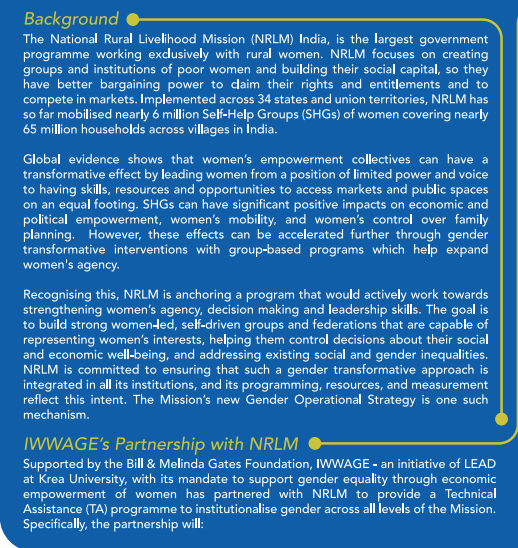
With over 60 million women mobilised to be part of one of India’s largest livelihoods programme, the Deendayal Antayodaya Yojana-National Rural Livelihoods Mission (DAY-NRLM), holds great promise for advancing women’s socio-economic empowerment by organising them into self-help groups (SHGs) and institutions of the rural poor. These platforms are facilitating financial opportunities and livelihood support services for women. The livelihoods programme works exclusively with rural women, and a critical element for its success has been the mission’s commitment towards prioritising women’s perspectives and being responsive to their needs and aspirations. This approach has been embedded across all DAY-NRLM activities with the goal of strengthening women’s agency, identity, well-being, and solidarity, through women’s collectivisation. NRLM believes that gender sensitisation and social action should be mainstreamed in its framework, systems, institutions and processes. To this end, it devised a Gender Operational Strategy in financial year 2019-20 committing actions that recognise women’s heterogeneity and the unique socio-economic barriers faced by them. Through Swayam, IWWAGE is partnering with DAY-NRLM to provide technical assistance to support this strategy and institutionalise gender across all levels of the Mission. The note gives a snapshot on the approaches to strengthen gender interventions by NRLM.
With over 60 million women mobilised to be part of one of India’s largest livelihoods programme, the Deendayal Antayodaya Yojana-National Rural Livelihoods Mission (DAY-NRLM), holds great promise for advancing women’s socio-economic empowerment by organising them into self-help groups (SHGs) and institutions of the rural poor. These platforms are facilitating financial opportunities and livelihood support services for women. The livelihoods programme works exclusively with rural women, and a critical element for its success has been the mission’s commitment towards prioritising women’s perspectives and being responsive to their needs and aspirations. This approach has been embedded across all DAY-NRLM activities with the goal of strengthening women’s agency, identity, well-being, and solidarity, through women’s collectivisation. NRLM believes that gender sensitisation and social action should be mainstreamed in its framework, systems, institutions and processes. To this end, it devised a Gender Operational Strategy in financial year 2019-20 committing actions that recognise women’s heterogeneity and the unique socio-economic barriers faced by them. Through Swayam, IWWAGE is partnering with DAY-NRLM to provide technical assistance to support this strategy and institutionalise gender across all levels of the Mission. The note gives a snapshot on the approaches to strengthen gender interventions by NRLM.
Report
Empowering Women Collectives through Digital Initiatives in Chhattisgarh
- January , 2020
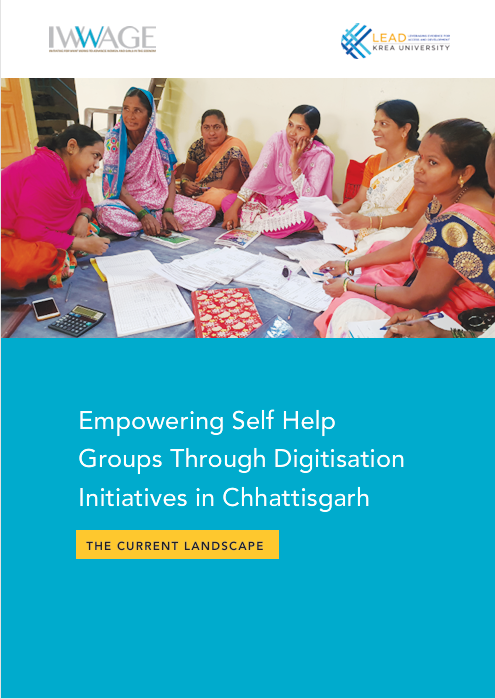
Digital tools offer immense potential for accelerating women’s empowerment, enhancing the impact of ongoing initiatives, and providing women with new avenues to improve knowledge and share information. Over the past year, the Initiative of What Works to Advance Women and Girls in the Economy (IWWAGE), part of LEAD at Krea University, has been collaborating with the Government of Chhattisgarh and other partners to map existing digitisation initiatives aimed at empowering women in the state, evaluate their effectiveness, and explore opportunities for improvement. Many of these initiatives are centred around Self-Help Groups (SHGs), which play a key role in empowering women through social mobilisation and financial inclusion. In Chhattisgarh, the SHG ecosystem is managed by the state chapter of the Deendayal Antyodaya Yojana-National Rural Livelihood Mission (DAY-NRLM), known locally as Bihan. Established in 2012, Bihan serves as a Self-Help Promoting Agency (SHPA), working to strengthen women’s collectives by improving financial and market linkages, promoting access to entitlements, and providing capacity-building support. Additionally, non-governmental SHPAs like PRADAN are active in supporting women’s empowerment in the state. IWWAGE is supporting Bihan’s efforts to enhance the SHG ecosystem by promoting and testing digital solutions that enable women’s collectives to access markets and services more effectively. This initiative focuses on summarising the current digitisation efforts, identifying existing gaps and barriers, and proposing innovative use cases to further drive women’s empowerment in Chhattisgarh.
Digital tools offer immense potential for accelerating women’s empowerment, enhancing the impact of ongoing initiatives, and providing women with new avenues to improve knowledge and share information. Over the past year, the Initiative of What Works to Advance Women and Girls in the Economy (IWWAGE), part of LEAD at Krea University, has been collaborating with the Government of Chhattisgarh and other partners to map existing digitisation initiatives aimed at empowering women in the state, evaluate their effectiveness, and explore opportunities for improvement. Many of these initiatives are centred around Self-Help Groups (SHGs), which play a key role in empowering women through social mobilisation and financial inclusion. In Chhattisgarh, the SHG ecosystem is managed by the state chapter of the Deendayal Antyodaya Yojana-National Rural Livelihood Mission (DAY-NRLM), known locally as Bihan. Established in 2012, Bihan serves as a Self-Help Promoting Agency (SHPA), working to strengthen women’s collectives by improving financial and market linkages, promoting access to entitlements, and providing capacity-building support. Additionally, non-governmental SHPAs like PRADAN are active in supporting women’s empowerment in the state. IWWAGE is supporting Bihan’s efforts to enhance the SHG ecosystem by promoting and testing digital solutions that enable women’s collectives to access markets and services more effectively. This initiative focuses on summarising the current digitisation efforts, identifying existing gaps and barriers, and proposing innovative use cases to further drive women’s empowerment in Chhattisgarh.

Report
Exploring linkages between womens empowerment workforce participation and population dynamics in the Indian context: A comprehensive macro micro analysis
- November , 2025
Gender equality and reproductive autonomy are central to India’s ability to navigate ongoing demographic transitions effectively. The study, a collaboration between the Population Foundation of India and the Institute for What Works to Advance Gender Equality (IWWAGE), presents new evidence on these critical interconnections. By integrating macro-level demographic and human development data with micro-level insights from women’s lived experiences, the study offers one of the most comprehensive analyses of its kind in India, bridging quantitative data with qualitative narratives to illuminate how women’s empowerment shapes the country’s demographic and developmental trajectory.
Gender equality and reproductive autonomy are central to India’s ability to navigate ongoing demographic transitions effectively. The study, a collaboration between the Population Foundation of India and the Institute for What Works to Advance Gender Equality (IWWAGE), presents new evidence on these critical interconnections. By integrating macro-level demographic and human development data with micro-level insights from women’s lived experiences, the study offers one of the most comprehensive analyses of its kind in India, bridging quantitative data with qualitative narratives to illuminate how women’s empowerment shapes the country’s demographic and developmental trajectory.

Factsheet
Trends in Female Labour Force Participation in West Bengal
- October , 2025
- Vidhi and Bidisha Mondal
West Bengal has seen strong economic growth driven by manufacturing, MSMEs and investment, with GSDP projected to grow 12 per cent in 2025–26. However, per capita income remains below the national average. The state has lost around 3 million informal jobs in recent years, disproportionately affecting women, while high outmigration, especially of skilled workers, continues to reshape the labour market. Women remain concentrated in low-productivity informal sectors such as agriculture and domestic work, resulting in low female labour force participation and underscoring the need for targeted employment policies.
West Bengal has seen strong economic growth driven by manufacturing, MSMEs and investment, with GSDP projected to grow 12 per cent in 2025–26. However, per capita income remains below the national average. The state has lost around 3 million informal jobs in recent years, disproportionately affecting women, while high outmigration, especially of skilled workers, continues to reshape the labour market. Women remain concentrated in low-productivity informal sectors such as agriculture and domestic work, resulting in low female labour force participation and underscoring the need for targeted employment policies.
West Bengal has seen strong economic growth driven by manufacturing, MSMEs and investment, with GSDP projected to grow 12 per cent in 2025–26. However, per capita income remains below the national average. The state has lost around 3 million informal jobs in recent years, disproportionately affecting women, while high outmigration, especially of skilled workers, continues to reshape the labour market. Women remain concentrated in low-productivity informal sectors such as agriculture and domestic work, resulting in low female labour force participation and underscoring the need for targeted employment policies.


Working Paper
Working or Not: What Determines Women’s Labour Force Participation in India?
- May , 2021
- Ruchika Chaudhary
This paper delves into the persistent gender gaps in India’s labour market, highlighting the alarming decline in women’s labour force participation despite socio-economic progress. Using data from the Periodic Labour Force Surveys (PLFS) and the National Sample Survey Office (NSSO), it examines the key factors contributing to this trend, including the disproportionate burden of unpaid care work. The paper underscores the need for targeted policies, such as vocational training and gender-responsive initiatives, to empower women and break down barriers to their economic participation.
This paper delves into the persistent gender gaps in India’s labour market, highlighting the alarming decline in women’s labour force participation despite socio-economic progress. Using data from the Periodic Labour Force Surveys (PLFS) and the National Sample Survey Office (NSSO), it examines the key factors contributing to this trend, including the disproportionate burden of unpaid care work. The paper underscores the need for targeted policies, such as vocational training and gender-responsive initiatives, to empower women and break down barriers to their economic participation.
This paper delves into the persistent gender gaps in India’s labour market, highlighting the alarming decline in women’s labour force participation despite socio-economic progress. Using data from the Periodic Labour Force Surveys (PLFS) and the National Sample Survey Office (NSSO), it examines the key factors contributing to this trend, including the disproportionate burden of unpaid care work. The paper underscores the need for targeted policies, such as vocational training and gender-responsive initiatives, to empower women and break down barriers to their economic participation.

Brief
A Crisis in Care India’s Ageing Population and the Need for Strengthened Eldercare – Hindi
- September , 2025
The global population is ageing, presenting complex challenges and new opportunities.The policy brief draws on insights from a roundtable discussion that brought together sectoral experts, practitioners, and academics, along with secondary research.The discussion served as a platform to examine the current state of eldercare in India, identify critical gaps, and explore actionable solutions to increase women’s participation in the formal eldercare workforce.
The global population is ageing, presenting complex challenges and new opportunities.The policy brief draws on insights from a roundtable discussion that brought together sectoral experts, practitioners, and academics, along with secondary research.The discussion served as a platform to examine the current state of eldercare in India, identify critical gaps, and explore actionable solutions to increase women’s participation in the formal eldercare workforce.

Brief
A Crisis in Care India’s Ageing
- September , 2025
- Ananya Sharma, Harshita Kumari
The global population is ageing, presenting complex challenges and new opportunities.The policy brief draws on insights from a roundtable discussion that brought together sectoral experts, practitioners, and academics, along with secondary research.The discussion served as a platform to examine the current state of eldercare in India, identify critical gaps, and explore actionable solutions to increase women’s participation in the formal eldercare workforce.
The global population is ageing, presenting complex challenges and new opportunities.The policy brief draws on insights from a roundtable discussion that brought together sectoral experts, practitioners, and academics, along with secondary research.The discussion served as a platform to examine the current state of eldercare in India, identify critical gaps, and explore actionable solutions to increase women’s participation in the formal eldercare workforce.