


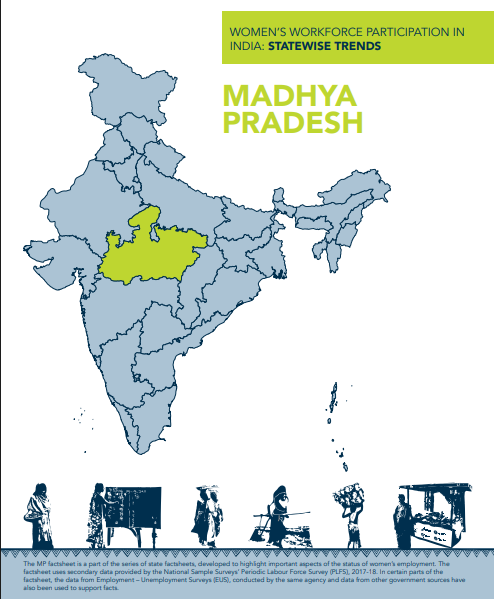
This factsheet explores Madhya Pradesh’s economy, contributing 4% to the national GDP with a GSDP of Rs. 8.1 lakh crores. Despite its natural resources, the state ranks among the bottom ten in per capita GSDP. With nearly 20% of the population being Scheduled Tribes, districts like Barwani, Damoh, and Guna experience higher poverty rates, highlighting the challenges faced by MP’s large tribal population.
Publications
Publications
Category
Year
Learning note
Women’s Workforce Participation In India: Statewise Trends
- November , 2020
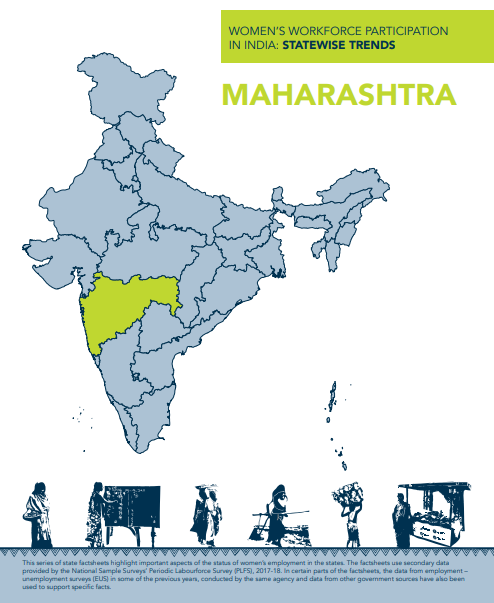
Women’s labourforce participation rates (LFPR) reveals some interesting trends for Maharashtra. As per the figures from the labourforce surveys, the LFPR is significantly higher than the all-India figures, largely driven by higher than average rural employment. The state also shares a decline in self-employment and casual employment and a shift towards regular wage work for both rural and urban women. In Maharashtra the urban areas witnessed a consistent rise in regular wage work of women since 2004-05. More than 60 percent of women are employed as regular workers 70 percent of which is concentrated in the services sector such as education, health and retail. In rural areas, the share of casual workers is considerably higher at around 42 percent, followed by 52 percent in self-employment. The incidence of unpaid family workers among self-employed women exceed 80 percent. While the urban areas show considerable diversity of women workers across occupations and sectors, women in the rural areas remain concentrated as manual workers in agriculture or within construction work.
Women’s labourforce participation rates (LFPR) reveals some interesting trends for Maharashtra. As per the figures from the labourforce surveys, the LFPR is significantly higher than the all-India figures, largely driven by higher than average rural employment. The state also shares a decline in self-employment and casual employment and a shift towards regular wage work for both rural and urban women. In Maharashtra the urban areas witnessed a consistent rise in regular wage work of women since 2004-05. More than 60 percent of women are employed as regular workers 70 percent of which is concentrated in the services sector such as education, health and retail. In rural areas, the share of casual workers is considerably higher at around 42 percent, followed by 52 percent in self-employment. The incidence of unpaid family workers among self-employed women exceed 80 percent. While the urban areas show considerable diversity of women workers across occupations and sectors, women in the rural areas remain concentrated as manual workers in agriculture or within construction work.
Newsletter (Gender In Focus)
Gender in Focus
- November , 2020
- IWWAGE
During COVID-19, women’s Self-Help Groups (SHGs) under DAY-NRLM played a critical role due to their deep rural reach and strong social capital. SHGs emerged as frontline actors in crisis response, leveraging trust and local networks to support communities. To recognise this contribution, IWWAGE’s report documents the good practices, strategies, and innovations led by SHGs in partnership with State Rural Livelihoods Missions during the pandemic.
During COVID-19, women’s Self-Help Groups (SHGs) under DAY-NRLM played a critical role due to their deep rural reach and strong social capital. SHGs emerged as frontline actors in crisis response, leveraging trust and local networks to support communities. To recognise this contribution, IWWAGE’s report documents the good practices, strategies, and innovations led by SHGs in partnership with State Rural Livelihoods Missions during the pandemic.
Learning note
Women’s Workforce Participation in India: Statewise Trends
- November , 2020
- Nidhi Gyan Pandey , Sona Mitra
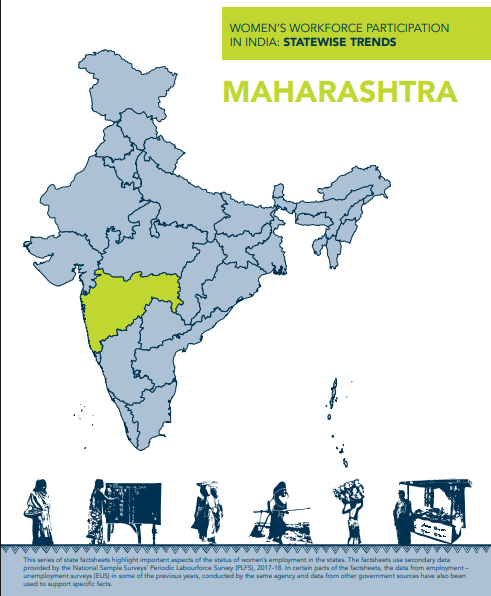
Maharashtra, one of India’s most prosperous and industrially advanced states, has the highest Gross State Domestic Product (GSDP) among all states, amounting to Rs. 19,400 billion in 2017-18. Despite its economic strength, Maharashtra ranks lower on gender indicators, with a sex ratio of 958 females per 1,000 males and a child sex ratio of 894. Female labour force participation (FLFPR) in Maharashtra is significantly higher than the national average at 31%, driven by rural participation. However, urban FLFPR remains low at 16.8%, highlighting gender disparities in urban employment. This factsheet explores key socio-economic and gender trends in the state.
Maharashtra, one of India’s most prosperous and industrially advanced states, has the highest Gross State Domestic Product (GSDP) among all states, amounting to Rs. 19,400 billion in 2017-18. Despite its economic strength, Maharashtra ranks lower on gender indicators, with a sex ratio of 958 females per 1,000 males and a child sex ratio of 894. Female labour force participation (FLFPR) in Maharashtra is significantly higher than the national average at 31%, driven by rural participation. However, urban FLFPR remains low at 16.8%, highlighting gender disparities in urban employment. This factsheet explores key socio-economic and gender trends in the state.
Learning note
Women’s Workforce Participation in India: Statewise Trends
- November , 2020
- Sona Mitra , Hiya Singh Rajput
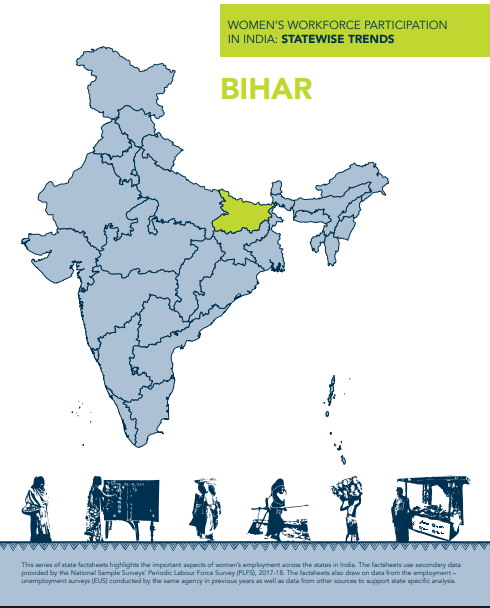
Bihar, one of India’s poorest states, faces significant challenges in development across key areas such as education, health, and nutrition, while also lagging in gender development. With the lowest female workforce participation rate (WPR) in the country at just 2.8%, Bihar’s economic empowerment of women is a critical concern. This factsheet highlights the stark disparities in women’s employment in the state and calls for urgent policy action to address these issues, offering a comparison with national averages.
Bihar, one of India’s poorest states, faces significant challenges in development across key areas such as education, health, and nutrition, while also lagging in gender development. With the lowest female workforce participation rate (WPR) in the country at just 2.8%, Bihar’s economic empowerment of women is a critical concern. This factsheet highlights the stark disparities in women’s employment in the state and calls for urgent policy action to address these issues, offering a comparison with national averages.
Learning note
Women’s Workforce Participation in India: Statewise Trends
- November , 2020
- Nidhi Gyan Pandey , Sona Mitra
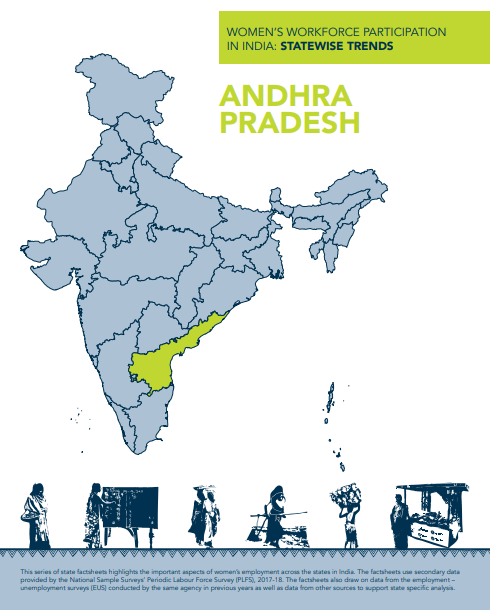
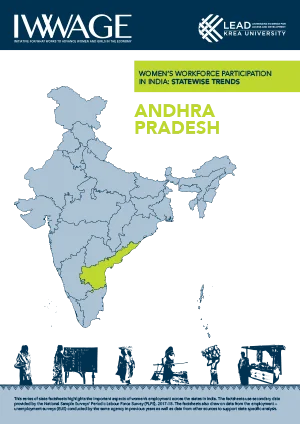
Located on the southeastern coast of India, Andhra Pradesh is the eighth largest state by area, with 23.5% forest cover and 50.5% land under cultivation. While agriculture employs 60% of the population, it contributes only 32% to the state’s GSDP. Andhra Pradesh is a middle-income state with a high growth rate of 11% in 2018-19. The state’s female labour force participation rate (FLFPR) is significantly higher than the national average, with rural FLFPR at 39% and urban FLFPR at 25.1%. The high rural FLFPR is partly attributed to women’s participation in the MGNREGA programme.
Located on the southeastern coast of India, Andhra Pradesh is the eighth largest state by area, with 23.5% forest cover and 50.5% land under cultivation. While agriculture employs 60% of the population, it contributes only 32% to the state’s GSDP. Andhra Pradesh is a middle-income state with a high growth rate of 11% in 2018-19. The state’s female labour force participation rate (FLFPR) is significantly higher than the national average, with rural FLFPR at 39% and urban FLFPR at 25.1%. The high rural FLFPR is partly attributed to women’s participation in the MGNREGA programme.
Learning note
Women’s Workforce Participation in India: Statewise Trends
- November , 2020
- Sona Mitra , Hiya Singh Rajput
Madhya Pradesh, known as the heart of India, is the second-largest state by area and rich in natural resources. With a Gross State Domestic Product (GSDP) of Rs. 8.1 lakh crores, MP contributes around 4% to the national GDP. However, the state faces significant challenges, ranking among the bottom ten states in per capita GSDP. Nearly 20% of MP’s population comprises Scheduled Tribes (STs), and districts like Barwani, Damoh, and Guna are among the poorest in the country, reflecting higher poverty rates among the state’s large tribal population.
Madhya Pradesh, known as the heart of India, is the second-largest state by area and rich in natural resources. With a Gross State Domestic Product (GSDP) of Rs. 8.1 lakh crores, MP contributes around 4% to the national GDP. However, the state faces significant challenges, ranking among the bottom ten states in per capita GSDP. Nearly 20% of MP’s population comprises Scheduled Tribes (STs), and districts like Barwani, Damoh, and Guna are among the poorest in the country, reflecting higher poverty rates among the state’s large tribal population.
Working Paper
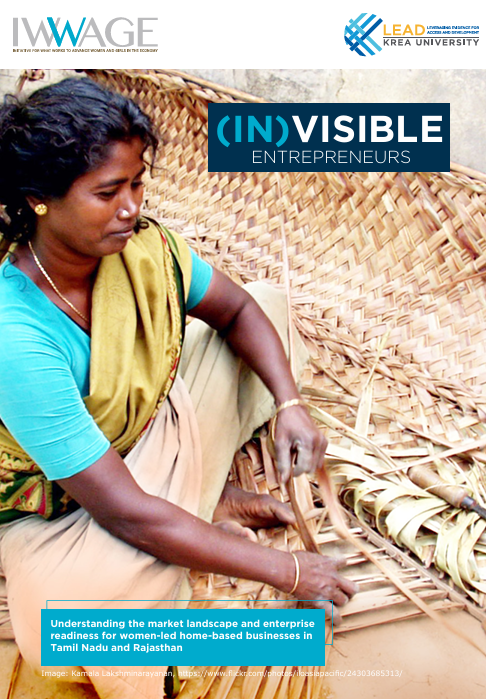
Understanding the Market Landscape and Enterprise Readiness for Women-led Home-based Businesses in Tamil Nadu and Rajasthan
- November , 2020
- RIGZOM WANGCHUK, RIA DUTTA
This document is not a priced publication. Copyright @ 2020 Initiative for What Works to Advance Women and Girls in the Economy (IWWAGE), an initiative of LEAD at Krea University. Reproduction of this publication for educational or other non-commercial purpose is authorised, without prior written permission, provided the source is fully acknowledged. For further information, please write to communications@iwwage. org. This publication was possible with the generous support of the Bill & Melinda Gates Foundation. The findings and conclusions in this publication are those of the authors and do not necessarily represent the views of the Bill & Melinda Gates Foundation
This document is not a priced publication. Copyright @ 2020 Initiative for What Works to Advance Women and Girls in the Economy (IWWAGE), an initiative of LEAD at Krea University. Reproduction of this publication for educational or other non-commercial purpose is authorised, without prior written permission, provided the source is fully acknowledged. For further information, please write to communications@iwwage. org. This publication was possible with the generous support of the Bill & Melinda Gates Foundation. The findings and conclusions in this publication are those of the authors and do not necessarily represent the views of the Bill & Melinda Gates Foundation
Factsheet
Women’s Workforce Participation in India: Statewise Trends
- November , 2020
- Sona Mitra, Hiya Singh Rajput
In urban areas of Madhya Pradesh, while the rise of women in regular wage work appears to be a positive trend, more in-depth analyses is required on the nature of employment contracts for women. On the positive side, the share of women in own account enterprises is substantially high in MP, more so in urban parts of the state
In urban areas of Madhya Pradesh, while the rise of women in regular wage work appears to be a positive trend, more in-depth analyses is required on the nature of employment contracts for women. On the positive side, the share of women in own account enterprises is substantially high in MP, more so in urban parts of the state

Factsheet
Women’s Workforce Participation in India: Statewise Trends
- November , 2020
- Nidhi Gyan Pandey, Sona Mitra
This factsheet examines Maharashtra’s socio-economic landscape, highlighting its strong economic performance with the highest GSDP in India. Despite this, the state faces gender disparities, with a sex ratio of 958 females per 1,000 males and an urban female labour force participation rate (FLFPR) of just 16.8%. Rural FLFPR is higher, driving the state’s overall rate to 31%, but urban gender inequalities in employment persist.
This factsheet examines Maharashtra’s socio-economic landscape, highlighting its strong economic performance with the highest GSDP in India. Despite this, the state faces gender disparities, with a sex ratio of 958 females per 1,000 males and an urban female labour force participation rate (FLFPR) of just 16.8%. Rural FLFPR is higher, driving the state’s overall rate to 31%, but urban gender inequalities in employment persist.
Factsheet
Women’s Workforce Participation in India: Statewise Trends
- November , 2020
- Nidhi Gyan Pandey, Sona Mitra
This factsheet provides an overview of Andhra Pradesh’s economy, where agriculture employs 60% of the population but contributes 32% to the GSDP. The state’s female labour force participation rate (FLFPR) is notably higher than the national average, with rural FLFPR at 39% and urban at 25.1%, driven in part by women’s participation in the MGNREGA programme.
This factsheet provides an overview of Andhra Pradesh’s economy, where agriculture employs 60% of the population but contributes 32% to the GSDP. The state’s female labour force participation rate (FLFPR) is notably higher than the national average, with rural FLFPR at 39% and urban at 25.1%, driven in part by women’s participation in the MGNREGA programme.
SWAYAM
Practice Guide for Gender Integration in Livelihoods under DAY-NRLM
- September , 2025
- Shilpa Vasavada | Seema Bhaskaran
This booklet is intended for the livelihoods vertical and serves as a practical, field-focused Guide for teams on integrating gender into livelihoods interventions. Since these interventions include both farm-based and nonfarm- based activities, the booklet addresses each type separately, following a gender-responsive and progressively gender-transformative approach.
This booklet is intended for the livelihoods vertical and serves as a practical, field-focused Guide for teams on integrating gender into livelihoods interventions. Since these interventions include both farm-based and nonfarm- based activities, the booklet addresses each type separately, following a gender-responsive and progressively gender-transformative approach.

Report
Women and Work: How India fared in 2024
- September , 2025
- Aishwarya Bhuta, Harshita Kumari, Sohinee Thakurta, and Teesta Shukla.
The year 2024 marked a key moment for women and work in India, shaped by economic shifts, policy action, and technological change. Since 2021–22, new challenges and opportunities have influenced women’s workforce participation, alongside renewed efforts to advance women’s economic empowerment. Building on the vision of women-led development highlighted during India’s 2023 G20 presidency, momentum continued across multiple initiatives. This report examines key trends, policy developments, and emerging challenges shaping women’s work in 2024. Drawing on secondary data and research from IWWAGE and LEAD, it maps the evolving landscape of women’s work in India and identifies pathways to greater inclusion and economic agency.
The year 2024 marked a key moment for women and work in India, shaped by economic shifts, policy action, and technological change. Since 2021–22, new challenges and opportunities have influenced women’s workforce participation, alongside renewed efforts to advance women’s economic empowerment. Building on the vision of women-led development highlighted during India’s 2023 G20 presidency, momentum continued across multiple initiatives. This report examines key trends, policy developments, and emerging challenges shaping women’s work in 2024. Drawing on secondary data and research from IWWAGE and LEAD, it maps the evolving landscape of women’s work in India and identifies pathways to greater inclusion and economic agency.

Knowledge series
Migration Climate Change and Gender
- July , 2025
- Divya Singh (IWWAGE), Aiman Akhtar (PDAG)
Climate change is altering everyday life and livelihoods across India, and its impacts are not felt equally. Women, particularly those from marginalised and low-income communities, are often the first to absorb the effects of climate shocks, whether through disrupted livelihoods, migration, or the pressures of extreme weather. These experiences are shaped by long-standing social and economic inequalities, making it essential to look beyond sectoral solutions. One of the least visible but most affected areas is the care economy. As climate risks intensify, women’s unpaid and poorly paid care work expands, especially during displacement, crises, and recovery. Care work plays a critical role in helping families and communities cope with climate stress, yet it remains largely invisible within climate policy and planning. Looking at climate change through the lens of care helps reveal two connected dynamics: how climate risks reshape care responsibilities, and how the way care is organised influences resilience and adaptation. Recognising care, valuing women’s unpaid labour, and strengthening care systems are therefore not add-ons, but central to effective climate responses. This series of policy briefs, jointly developed by IWWAGE and PDAG, explores these connections in detail. It examines how care work is shaped by climate-related vulnerabilities, labour transitions, and forced mobility, with close attention to gendered outcomes. The series is part of a broader climate–gender conversation that includes work, migration, governance, and energy transitions, while centring experiences from India and the Global South. Through this initiative, we aim to deepen understanding, inform policy choices, and contribute meaningfully to ongoing discussions on climate change, care, and gender equality.
Climate change is altering everyday life and livelihoods across India, and its impacts are not felt equally. Women, particularly those from marginalised and low-income communities, are often the first to absorb the effects of climate shocks, whether through disrupted livelihoods, migration, or the pressures of extreme weather. These experiences are shaped by long-standing social and economic inequalities, making it essential to look beyond sectoral solutions. One of the least visible but most affected areas is the care economy. As climate risks intensify, women’s unpaid and poorly paid care work expands, especially during displacement, crises, and recovery. Care work plays a critical role in helping families and communities cope with climate stress, yet it remains largely invisible within climate policy and planning. Looking at climate change through the lens of care helps reveal two connected dynamics: how climate risks reshape care responsibilities, and how the way care is organised influences resilience and adaptation. Recognising care, valuing women’s unpaid labour, and strengthening care systems are therefore not add-ons, but central to effective climate responses. This series of policy briefs, jointly developed by IWWAGE and PDAG, explores these connections in detail. It examines how care work is shaped by climate-related vulnerabilities, labour transitions, and forced mobility, with close attention to gendered outcomes. The series is part of a broader climate–gender conversation that includes work, migration, governance, and energy transitions, while centring experiences from India and the Global South. Through this initiative, we aim to deepen understanding, inform policy choices, and contribute meaningfully to ongoing discussions on climate change, care, and gender equality.

Knowledge series
Migration Climate Change and Gender
- July , 2025
- Divya Singh (IWWAGE), Aiman Akhtar (PDAG)
Climate change is altering everyday life and livelihoods across India, and its impacts are not felt equally. Women, particularly those from marginalised and low-income communities, are often the first to absorb the effects of climate shocks, whether through disrupted livelihoods, migration, or the pressures of extreme weather. These experiences are shaped by long-standing social and economic inequalities, making it essential to look beyond sectoral solutions. One of the least visible but most affected areas is the care economy. As climate risks intensify, women’s unpaid and poorly paid care work expands, especially during displacement, crises, and recovery. Care work plays a critical role in helping families and communities cope with climate stress, yet it remains largely invisible within climate policy and planning. Looking at climate change through the lens of care helps reveal two connected dynamics: how climate risks reshape care responsibilities, and how the way care is organised influences resilience and adaptation. Recognising care, valuing women’s unpaid labour, and strengthening care systems are therefore not add-ons, but central to effective climate responses. This series of policy briefs, jointly developed by IWWAGE and PDAG, explores these connections in detail. It examines how care work is shaped by climate-related vulnerabilities, labour transitions, and forced mobility, with close attention to gendered outcomes. The series is part of a broader climate–gender conversation that includes work, migration, governance, and energy transitions, while centring experiences from India and the Global South. Through this initiative, we aim to deepen understanding, inform policy choices, and contribute meaningfully to ongoing discussions on climate change, care, and gender equality.
Climate change is altering everyday life and livelihoods across India, and its impacts are not felt equally. Women, particularly those from marginalised and low-income communities, are often the first to absorb the effects of climate shocks, whether through disrupted livelihoods, migration, or the pressures of extreme weather. These experiences are shaped by long-standing social and economic inequalities, making it essential to look beyond sectoral solutions. One of the least visible but most affected areas is the care economy. As climate risks intensify, women’s unpaid and poorly paid care work expands, especially during displacement, crises, and recovery. Care work plays a critical role in helping families and communities cope with climate stress, yet it remains largely invisible within climate policy and planning. Looking at climate change through the lens of care helps reveal two connected dynamics: how climate risks reshape care responsibilities, and how the way care is organised influences resilience and adaptation. Recognising care, valuing women’s unpaid labour, and strengthening care systems are therefore not add-ons, but central to effective climate responses. This series of policy briefs, jointly developed by IWWAGE and PDAG, explores these connections in detail. It examines how care work is shaped by climate-related vulnerabilities, labour transitions, and forced mobility, with close attention to gendered outcomes. The series is part of a broader climate–gender conversation that includes work, migration, governance, and energy transitions, while centring experiences from India and the Global South. Through this initiative, we aim to deepen understanding, inform policy choices, and contribute meaningfully to ongoing discussions on climate change, care, and gender equality.

Factsheet
Trends in Female Labour and Workforce Participation – Assam
- July , 2025
- Aneek Choudhary and Vidhi
Assam has seen a sharp rise in female labour force participation since 2021–22, now above the national average (50% vs 42% in PLFS 2023–24). However, the 2022–23 gender gap appears distorted due to an NSSO weighting error in a few villages, which led to underreporting of female participation at district, state, and national levels. In parallel, pro-women initiatives such as Sarothi (interest-subsidised loans) and PMKVY 2.0 (industry-relevant skilling) are believed to have supported this improvement. Future analysis will use corrected PLFS data to better track trends and understand the drivers of rising female employment in Assam.
Assam has seen a sharp rise in female labour force participation since 2021–22, now above the national average (50% vs 42% in PLFS 2023–24). However, the 2022–23 gender gap appears distorted due to an NSSO weighting error in a few villages, which led to underreporting of female participation at district, state, and national levels. In parallel, pro-women initiatives such as Sarothi (interest-subsidised loans) and PMKVY 2.0 (industry-relevant skilling) are believed to have supported this improvement. Future analysis will use corrected PLFS data to better track trends and understand the drivers of rising female employment in Assam.
Assam has seen a sharp rise in female labour force participation since 2021–22, now above the national average (50% vs 42% in PLFS 2023–24). However, the 2022–23 gender gap appears distorted due to an NSSO weighting error in a few villages, which led to underreporting of female participation at district, state, and national levels. In parallel, pro-women initiatives such as Sarothi (interest-subsidised loans) and PMKVY 2.0 (industry-relevant skilling) are believed to have supported this improvement. Future analysis will use corrected PLFS data to better track trends and understand the drivers of rising female employment in Assam.

Report Snapshot
Swayam Process Evaluation: A Year-Long Ethnography Study, Madhya Pradesh & Odisha
- June , 2025
- Anushree Goenka, Lopamudra Nayak, Moumita Mandal, Shaheen Kauser, Sudhir Kumar Kori, Anubha Dixit, Mallika Mitra Biswas, Garvi Dhar, Pratyusha Barua, Surabhi Awasthi, Gayathri Sreedharan
This study assesses the impact of training programmes on community change and empowerment among leaders of Self-Help Groups (SHGs), Village Organisations (VOs), and Cluster-Level Federations (CLFs). It also includes interviews with district- and block-level officials from MPSRLM and OLM to examine how line departments collaborate with community institutions to address and resolve complaints.
This study assesses the impact of training programmes on community change and empowerment among leaders of Self-Help Groups (SHGs), Village Organisations (VOs), and Cluster-Level Federations (CLFs). It also includes interviews with district- and block-level officials from MPSRLM and OLM to examine how line departments collaborate with community institutions to address and resolve complaints.