


Publications
Publications
Category
Year
IWWAGE-ISI-BRIEFS
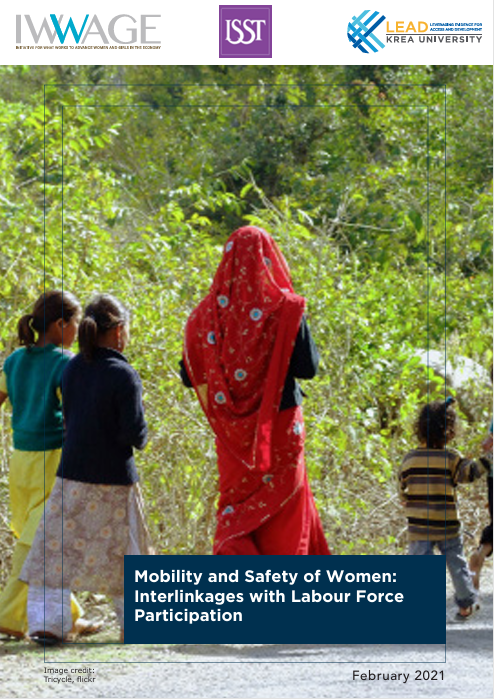
Mobility and Safety of Women
- March , 2021
- Hiya Singh Rajput
India’s economic growth has not translated into equal economic participation for women. Female labour force participation fell to a historic low of **23.3% in 2017–18**, with only a few countries reporting lower levels. A major barrier is **women’s safety**—fear of sexual violence in public spaces, transport, schools, and workplaces—which restricts mobility and reduces access to education, work, services, and public life. This perceived risk reinforces social norms limiting women’s freedom; for instance, many women require family permission even to visit a health centre. Improving **safe and affordable public transport**, **women-friendly urban infrastructure**, and **inclusive workplace safety laws** can meaningfully enable higher female LFPR.
India’s economic growth has not translated into equal economic participation for women. Female labour force participation fell to a historic low of **23.3% in 2017–18**, with only a few countries reporting lower levels. A major barrier is **women’s safety**—fear of sexual violence in public spaces, transport, schools, and workplaces—which restricts mobility and reduces access to education, work, services, and public life. This perceived risk reinforces social norms limiting women’s freedom; for instance, many women require family permission even to visit a health centre. Improving **safe and affordable public transport**, **women-friendly urban infrastructure**, and **inclusive workplace safety laws** can meaningfully enable higher female LFPR.
IWWAGE-ISI-BRIEFS
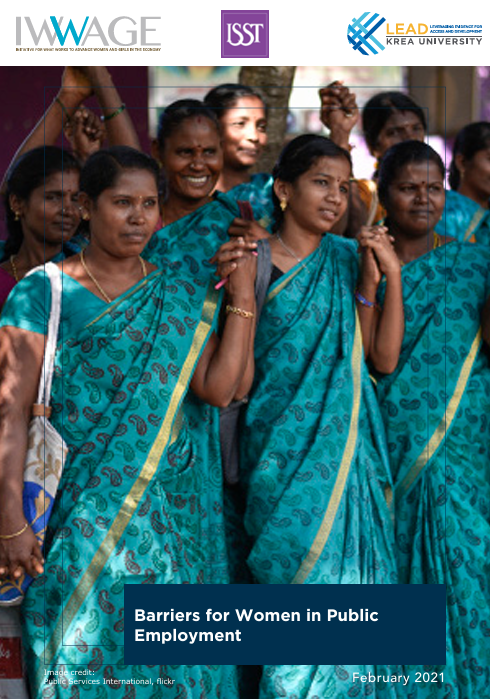
Barriers for Women in Public Employment
- March , 2021
- Steven Walker
Despite strong growth and better health/economic outcomes since the 1990s, women’s labour force participation in India has stagnated or fallen—reaching 17.5% in 2017–18 (PLFS). Even before Covid-19, most working women were in insecure work: 80%+ were self-employed or casual workers, with under 20% in regular salaried jobs. The public sector is the largest source of formal jobs for women—22.6% of female non-agricultural workers are government-employed (about 27% in rural areas). Women also contribute through under-recognised public roles like Anganwadi workers (ICDS) and bank sakhis (NRLM). However, despite more educated young women being ready to work, structural barriers and reduced public hiring are limiting opportunities. With Covid-19 worsening unemployment and recovery needs, removing barriers to women’s public employment is crucial—both for job creation and wider benefits like better service delivery, stronger social protection, and higher household consumption.
Despite strong growth and better health/economic outcomes since the 1990s, women’s labour force participation in India has stagnated or fallen—reaching 17.5% in 2017–18 (PLFS). Even before Covid-19, most working women were in insecure work: 80%+ were self-employed or casual workers, with under 20% in regular salaried jobs. The public sector is the largest source of formal jobs for women—22.6% of female non-agricultural workers are government-employed (about 27% in rural areas). Women also contribute through under-recognised public roles like Anganwadi workers (ICDS) and bank sakhis (NRLM). However, despite more educated young women being ready to work, structural barriers and reduced public hiring are limiting opportunities. With Covid-19 worsening unemployment and recovery needs, removing barriers to women’s public employment is crucial—both for job creation and wider benefits like better service delivery, stronger social protection, and higher household consumption.
Learning note
Women’s Workforce Participation In India: Statewise Trends
- March , 2021
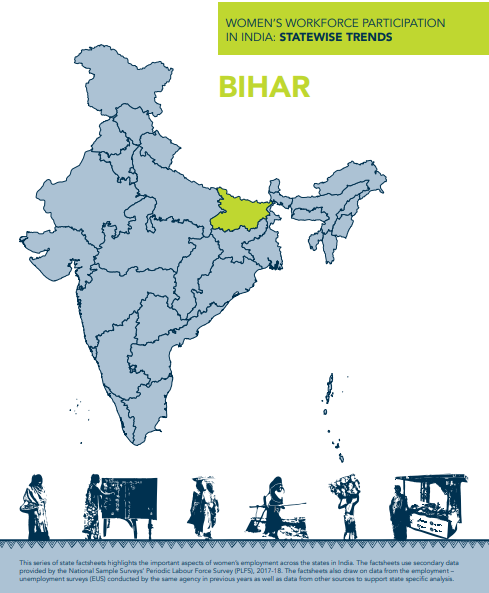
Bihar has the lowest female workforce participation rate (FWPR) among all states at 2.8 percent. The decline in FWPR has been shaper in rural areas as compared to urban areas, pushing a large number of women out of the workforce since 2007-08. With the decline in women workforce, there has been a substantial increase in the share of women in regular employment, in line with the national trend, and a significant decline in the share of self-employed, which is greater than the decline observed at the all India level. Women’s self-employment in Bihar is characterised by high incidence of own account work and low share of unpaid work, in contrast with all India figures.
Bihar has the lowest female workforce participation rate (FWPR) among all states at 2.8 percent. The decline in FWPR has been shaper in rural areas as compared to urban areas, pushing a large number of women out of the workforce since 2007-08. With the decline in women workforce, there has been a substantial increase in the share of women in regular employment, in line with the national trend, and a significant decline in the share of self-employed, which is greater than the decline observed at the all India level. Women’s self-employment in Bihar is characterised by high incidence of own account work and low share of unpaid work, in contrast with all India figures.
Learning note
Women’s Workforce Participation In India: Statewise Trends
- March , 2021
Women’s labourforce participation rates (LFPR) reveals some interesting trends for Maharashtra. As per the figures from the labourforce surveys, the LFPR is significantly higher than the all-India figures, largely driven by higher than average rural employment. The state also shares a decline in self-employment and casual employment and a shift towards regular wage work for both rural and urban women. In Maharashtra the urban areas witnessed a consistent rise in regular wage work of women since 2004-05. More than 60 percent of women are employed as regular workers 70 percent of which is concentrated in the services sector such as education, health and retail. In rural areas, the share of casual workers is considerably higher at around 42 percent, followed by 52 percent in self-employment. The incidence of unpaid family workers among self-employed women exceed 80 percent. While the urban areas show considerable diversity of women workers across occupations and sectors, women in the rural areas remain concentrated as manual workers in agriculture or within construction work.
Women’s labourforce participation rates (LFPR) reveals some interesting trends for Maharashtra. As per the figures from the labourforce surveys, the LFPR is significantly higher than the all-India figures, largely driven by higher than average rural employment. The state also shares a decline in self-employment and casual employment and a shift towards regular wage work for both rural and urban women. In Maharashtra the urban areas witnessed a consistent rise in regular wage work of women since 2004-05. More than 60 percent of women are employed as regular workers 70 percent of which is concentrated in the services sector such as education, health and retail. In rural areas, the share of casual workers is considerably higher at around 42 percent, followed by 52 percent in self-employment. The incidence of unpaid family workers among self-employed women exceed 80 percent. While the urban areas show considerable diversity of women workers across occupations and sectors, women in the rural areas remain concentrated as manual workers in agriculture or within construction work.

Factsheet
Women’s Workforce Participation in India: Statewise Trends
- March , 2021
- Nidhi Gyan Pandey
This factsheet highlights Tamil Nadu’s strong economy, with a GSDP of Rs 18,45,853 crores, and impressive social development. The state ranks third in human development and boasts high female labour force participation rates (rural: 35.1%, urban: 23.6%) along with excellent gender indicators, including a low maternal mortality rate and one of the lowest crime rates against women in India.
This factsheet highlights Tamil Nadu’s strong economy, with a GSDP of Rs 18,45,853 crores, and impressive social development. The state ranks third in human development and boasts high female labour force participation rates (rural: 35.1%, urban: 23.6%) along with excellent gender indicators, including a low maternal mortality rate and one of the lowest crime rates against women in India.
IWWAGE-ISST-BRIEFS
Barriers for Women in Public Employment
- March , 2021
- Steven Walker | Sarojini Ganju Thakur
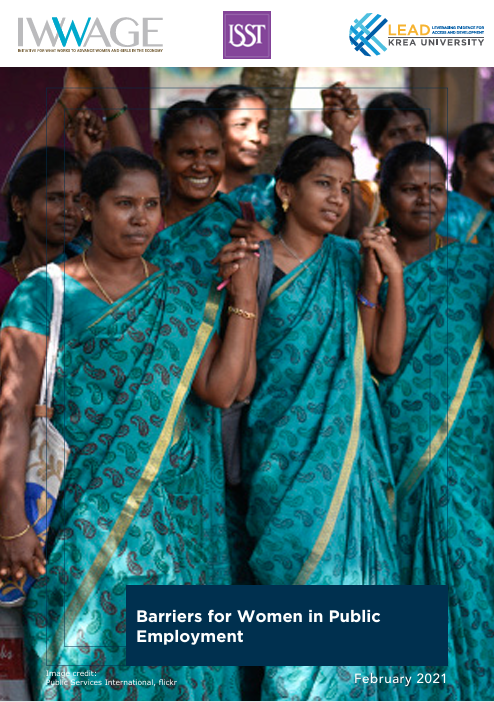
India’s female labour force participation (FLFP) remains among the lowest globally, falling to 17.5% in 2017-18. Despite more women gaining education and work readiness, access to secure jobs-especially in the public sector-remains limited due to structural and social barriers. The public sector is a vital source of formal employment for women, with nearly one in four female non-agricultural workers employed by the government. Yet women still account for just 30% of all government employees and are less likely than men to hold regular salaried roles or access social security benefits. Public employment offers more stability and benefits for women than most sectors, but widening their participation requires targeted reforms. These include: Investing in women’s education and challenging social norms; – Strengthening childcare and basic service infrastructure; – Formalising roles like Anganwadi workers and bank sakhis; – Creating promotion pathways and leadership opportunities; – Filling vacancies with gender-sensitive recruitment practices; – And investing in evidence to inform policy action. Expanding access to public sector jobs can drive economic recovery, reduce gender gaps, and build a more inclusive and resilient workforce.
India’s female labour force participation (FLFP) remains among the lowest globally, falling to 17.5% in 2017-18. Despite more women gaining education and work readiness, access to secure jobs-especially in the public sector-remains limited due to structural and social barriers. The public sector is a vital source of formal employment for women, with nearly one in four female non-agricultural workers employed by the government. Yet women still account for just 30% of all government employees and are less likely than men to hold regular salaried roles or access social security benefits. Public employment offers more stability and benefits for women than most sectors, but widening their participation requires targeted reforms. These include: Investing in women’s education and challenging social norms; – Strengthening childcare and basic service infrastructure; – Formalising roles like Anganwadi workers and bank sakhis; – Creating promotion pathways and leadership opportunities; – Filling vacancies with gender-sensitive recruitment practices; – And investing in evidence to inform policy action. Expanding access to public sector jobs can drive economic recovery, reduce gender gaps, and build a more inclusive and resilient workforce.
Newsletter (Gender In Focus)
Gender in Focus
- March , 2021
- IWWAGE
IWWAGE has partnered with the University of Bath on WorkFREE to test how unconditional cash transfers affect workers in exploitative jobs like waste picking, supported through research over the next 2.5 years. It has also expanded work on gender budgeting and policy solutions—covering gender-responsive financing, urban employment guarantees, post-COVID childcare, and women’s collective responses—while scaling gender resource centres in Madhya Pradesh with Anandi and the State Rural Livelihoods Mission.
IWWAGE has partnered with the University of Bath on WorkFREE to test how unconditional cash transfers affect workers in exploitative jobs like waste picking, supported through research over the next 2.5 years. It has also expanded work on gender budgeting and policy solutions—covering gender-responsive financing, urban employment guarantees, post-COVID childcare, and women’s collective responses—while scaling gender resource centres in Madhya Pradesh with Anandi and the State Rural Livelihoods Mission.
Learning note
Women’s Workforce Participation in India: Statewise Trends
- March , 2021
- Nidhi Gyan Pandey
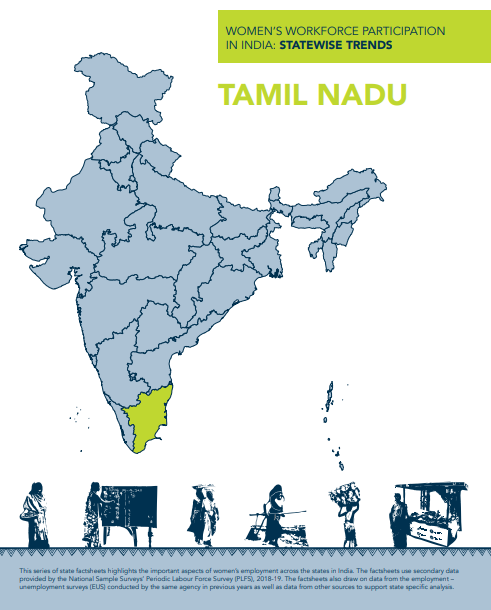
Tamil Nadu, the second-largest economy in India with a GSDP of Rs 18,45,853 crores, is known for combining rapid economic growth with high social development. The state boasts strong public services, ranking third in human development and literacy (96.8%) among all states. Tamil Nadu’s female labour force participation rates (FLFPR) are significantly higher than the national average, with rural FLFPR at 35.1% and urban FLFPR at 23.6%. The state also excels in gender indicators, with a low maternal mortality rate of 66 and the third lowest crime rate against women in the country.
Tamil Nadu, the second-largest economy in India with a GSDP of Rs 18,45,853 crores, is known for combining rapid economic growth with high social development. The state boasts strong public services, ranking third in human development and literacy (96.8%) among all states. Tamil Nadu’s female labour force participation rates (FLFPR) are significantly higher than the national average, with rural FLFPR at 35.1% and urban FLFPR at 23.6%. The state also excels in gender indicators, with a low maternal mortality rate of 66 and the third lowest crime rate against women in the country.
IWWAGE-ISST-BRIEFS
Women’s Entrepreneurship in India: Harnessing the Gender Dividend
- March , 2021
- Sanjana Vijay , Mridulya Narasimhan
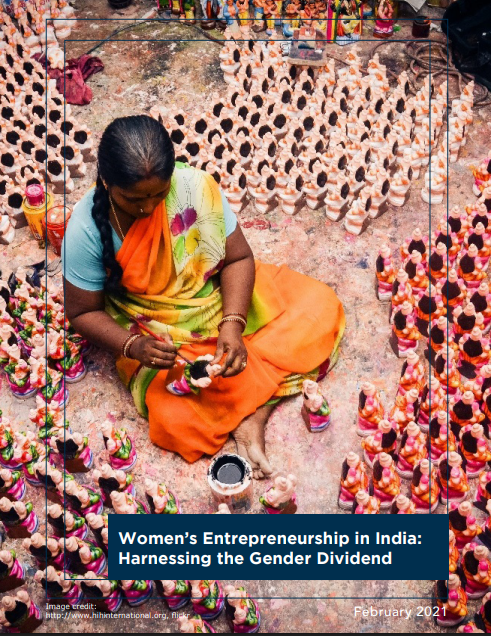
India’s economic growth has largely bypassed its smallest enterprises-particularly those led by women. Despite an increase in the number of micro, small, and medium enterprises (MSMEs), only 21.5% were owned by women as of 2018-19. Even more concerning is the stagnation in growth: between 2010 and 2015, the share of women-led enterprises and their gross value added (GVA) remained static, while the share of workers in these enterprises declined. Women entrepreneurs face layered barriers-from deep-rooted social norms and gender biases to unequal access to education, credit, and networks. For many women, entrepreneurship is not a path to scale but a survivalist response to limited employment opportunities, wage inequality, and inflexible work conditions. India ranked 49th out of 57 countries in the 2020 Mastercard Index of Women Entrepreneurs-a stark reflection of the odds stacked against women in the entrepreneurial landscape. To enable women to thrive as entrepreneurs, we must address structural and cultural challenges. Key recommendations include: – Challenging restrictive gender norms and stereotypes; – Ensuring better access to education and digital literacy; – Expanding affordable and inclusive financing mechanisms; – Creating women-friendly business networks and incubators; – Leveraging technology to connect women to markets, mentorship, and information. Enabling women to realise their entrepreneurial ambitions is not only a matter of equity-it is essential for India’s inclusive and sustainable economic growth.
India’s economic growth has largely bypassed its smallest enterprises-particularly those led by women. Despite an increase in the number of micro, small, and medium enterprises (MSMEs), only 21.5% were owned by women as of 2018-19. Even more concerning is the stagnation in growth: between 2010 and 2015, the share of women-led enterprises and their gross value added (GVA) remained static, while the share of workers in these enterprises declined. Women entrepreneurs face layered barriers-from deep-rooted social norms and gender biases to unequal access to education, credit, and networks. For many women, entrepreneurship is not a path to scale but a survivalist response to limited employment opportunities, wage inequality, and inflexible work conditions. India ranked 49th out of 57 countries in the 2020 Mastercard Index of Women Entrepreneurs-a stark reflection of the odds stacked against women in the entrepreneurial landscape. To enable women to thrive as entrepreneurs, we must address structural and cultural challenges. Key recommendations include: – Challenging restrictive gender norms and stereotypes; – Ensuring better access to education and digital literacy; – Expanding affordable and inclusive financing mechanisms; – Creating women-friendly business networks and incubators; – Leveraging technology to connect women to markets, mentorship, and information. Enabling women to realise their entrepreneurial ambitions is not only a matter of equity-it is essential for India’s inclusive and sustainable economic growth.

IWWAGE-ISST-BRIEFS
Women and Unpaid Work
- March , 2021
- Monika Banerjee , Ahana Chakrabarti
Women’s workforce participation in India has been consistently low-and steadily declining over the last 15 years, as recorded by official surveys like those conducted by the National Sample Survey Office (NSSO) and the Periodic Labour Force Survey (PLFS). However, these numbers fail to capture the full extent of women’s economic contributions, largely because they exclude unpaid work-domestic chores, caregiving, and community roles-that women perform on a daily basis. Feminist scholars have long advocated for the recognition, reduction, and redistribution of unpaid work as essential steps toward achieving gender equality. If the definition of work is expanded to include these invisible activities, it becomes evident that many more women are contributing to the economy than current statistics suggest. The COVID-19 pandemic further exacerbated these inequalities. As homes transformed into sites of both work and survival, women’s unpaid workload increased significantly. A Rapid Assessment Survey conducted by the Institute of Social Studies Trust (ISST) in Delhi found that women in urban informal sectors-such as domestic work, waste picking, street vending, and construction-reported a significant rise in unpaid responsibilities, including childcare, eldercare, and food provisioning. Despite other family members being at home, women continued to shoulder the majority of domestic work, often with little or no help. To build a more inclusive and equitable economy, it is critical to recognise and value unpaid labour and ensure that data and policy frameworks reflect the full spectrum of women’s work.
Women’s workforce participation in India has been consistently low-and steadily declining over the last 15 years, as recorded by official surveys like those conducted by the National Sample Survey Office (NSSO) and the Periodic Labour Force Survey (PLFS). However, these numbers fail to capture the full extent of women’s economic contributions, largely because they exclude unpaid work-domestic chores, caregiving, and community roles-that women perform on a daily basis. Feminist scholars have long advocated for the recognition, reduction, and redistribution of unpaid work as essential steps toward achieving gender equality. If the definition of work is expanded to include these invisible activities, it becomes evident that many more women are contributing to the economy than current statistics suggest. The COVID-19 pandemic further exacerbated these inequalities. As homes transformed into sites of both work and survival, women’s unpaid workload increased significantly. A Rapid Assessment Survey conducted by the Institute of Social Studies Trust (ISST) in Delhi found that women in urban informal sectors-such as domestic work, waste picking, street vending, and construction-reported a significant rise in unpaid responsibilities, including childcare, eldercare, and food provisioning. Despite other family members being at home, women continued to shoulder the majority of domestic work, often with little or no help. To build a more inclusive and equitable economy, it is critical to recognise and value unpaid labour and ensure that data and policy frameworks reflect the full spectrum of women’s work.
SWAYAM
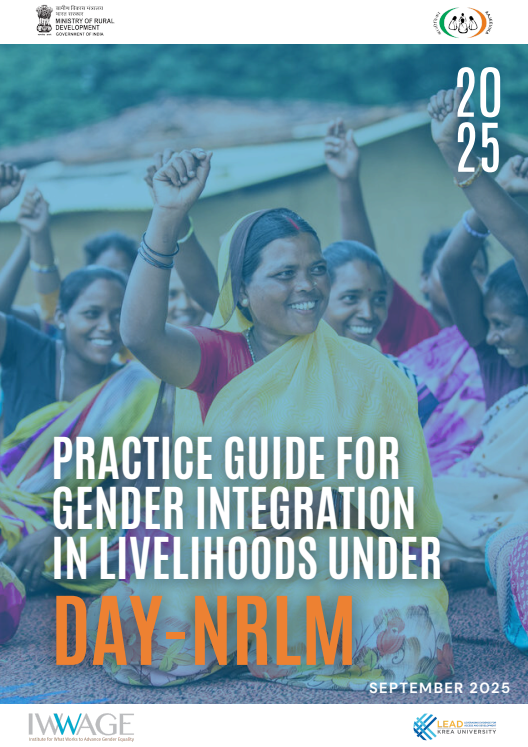
Practice Guide for Gender Integration in Livelihoods under DAY-NRLM
- September , 2025
- Shilpa Vasavada | Seema Bhaskaran
This booklet is intended for the livelihoods vertical and serves as a practical, field-focused Guide for teams on integrating gender into livelihoods interventions. Since these interventions include both farm-based and nonfarm- based activities, the booklet addresses each type separately, following a gender-responsive and progressively gender-transformative approach.
This booklet is intended for the livelihoods vertical and serves as a practical, field-focused Guide for teams on integrating gender into livelihoods interventions. Since these interventions include both farm-based and nonfarm- based activities, the booklet addresses each type separately, following a gender-responsive and progressively gender-transformative approach.

Report
Women and Work: How India fared in 2024
- September , 2025
- Aishwarya Bhuta, Harshita Kumari, Sohinee Thakurta, and Teesta Shukla.
The year 2024 marked a key moment for women and work in India, shaped by economic shifts, policy action, and technological change. Since 2021–22, new challenges and opportunities have influenced women’s workforce participation, alongside renewed efforts to advance women’s economic empowerment. Building on the vision of women-led development highlighted during India’s 2023 G20 presidency, momentum continued across multiple initiatives. This report examines key trends, policy developments, and emerging challenges shaping women’s work in 2024. Drawing on secondary data and research from IWWAGE and LEAD, it maps the evolving landscape of women’s work in India and identifies pathways to greater inclusion and economic agency.
The year 2024 marked a key moment for women and work in India, shaped by economic shifts, policy action, and technological change. Since 2021–22, new challenges and opportunities have influenced women’s workforce participation, alongside renewed efforts to advance women’s economic empowerment. Building on the vision of women-led development highlighted during India’s 2023 G20 presidency, momentum continued across multiple initiatives. This report examines key trends, policy developments, and emerging challenges shaping women’s work in 2024. Drawing on secondary data and research from IWWAGE and LEAD, it maps the evolving landscape of women’s work in India and identifies pathways to greater inclusion and economic agency.

Knowledge series
Migration Climate Change and Gender
- July , 2025
- Divya Singh (IWWAGE), Aiman Akhtar (PDAG)
Climate change is altering everyday life and livelihoods across India, and its impacts are not felt equally. Women, particularly those from marginalised and low-income communities, are often the first to absorb the effects of climate shocks, whether through disrupted livelihoods, migration, or the pressures of extreme weather. These experiences are shaped by long-standing social and economic inequalities, making it essential to look beyond sectoral solutions. One of the least visible but most affected areas is the care economy. As climate risks intensify, women’s unpaid and poorly paid care work expands, especially during displacement, crises, and recovery. Care work plays a critical role in helping families and communities cope with climate stress, yet it remains largely invisible within climate policy and planning. Looking at climate change through the lens of care helps reveal two connected dynamics: how climate risks reshape care responsibilities, and how the way care is organised influences resilience and adaptation. Recognising care, valuing women’s unpaid labour, and strengthening care systems are therefore not add-ons, but central to effective climate responses. This series of policy briefs, jointly developed by IWWAGE and PDAG, explores these connections in detail. It examines how care work is shaped by climate-related vulnerabilities, labour transitions, and forced mobility, with close attention to gendered outcomes. The series is part of a broader climate–gender conversation that includes work, migration, governance, and energy transitions, while centring experiences from India and the Global South. Through this initiative, we aim to deepen understanding, inform policy choices, and contribute meaningfully to ongoing discussions on climate change, care, and gender equality.
Climate change is altering everyday life and livelihoods across India, and its impacts are not felt equally. Women, particularly those from marginalised and low-income communities, are often the first to absorb the effects of climate shocks, whether through disrupted livelihoods, migration, or the pressures of extreme weather. These experiences are shaped by long-standing social and economic inequalities, making it essential to look beyond sectoral solutions. One of the least visible but most affected areas is the care economy. As climate risks intensify, women’s unpaid and poorly paid care work expands, especially during displacement, crises, and recovery. Care work plays a critical role in helping families and communities cope with climate stress, yet it remains largely invisible within climate policy and planning. Looking at climate change through the lens of care helps reveal two connected dynamics: how climate risks reshape care responsibilities, and how the way care is organised influences resilience and adaptation. Recognising care, valuing women’s unpaid labour, and strengthening care systems are therefore not add-ons, but central to effective climate responses. This series of policy briefs, jointly developed by IWWAGE and PDAG, explores these connections in detail. It examines how care work is shaped by climate-related vulnerabilities, labour transitions, and forced mobility, with close attention to gendered outcomes. The series is part of a broader climate–gender conversation that includes work, migration, governance, and energy transitions, while centring experiences from India and the Global South. Through this initiative, we aim to deepen understanding, inform policy choices, and contribute meaningfully to ongoing discussions on climate change, care, and gender equality.

Knowledge series
Migration Climate Change and Gender
- July , 2025
- Divya Singh (IWWAGE), Aiman Akhtar (PDAG)
Climate change is altering everyday life and livelihoods across India, and its impacts are not felt equally. Women, particularly those from marginalised and low-income communities, are often the first to absorb the effects of climate shocks, whether through disrupted livelihoods, migration, or the pressures of extreme weather. These experiences are shaped by long-standing social and economic inequalities, making it essential to look beyond sectoral solutions. One of the least visible but most affected areas is the care economy. As climate risks intensify, women’s unpaid and poorly paid care work expands, especially during displacement, crises, and recovery. Care work plays a critical role in helping families and communities cope with climate stress, yet it remains largely invisible within climate policy and planning. Looking at climate change through the lens of care helps reveal two connected dynamics: how climate risks reshape care responsibilities, and how the way care is organised influences resilience and adaptation. Recognising care, valuing women’s unpaid labour, and strengthening care systems are therefore not add-ons, but central to effective climate responses. This series of policy briefs, jointly developed by IWWAGE and PDAG, explores these connections in detail. It examines how care work is shaped by climate-related vulnerabilities, labour transitions, and forced mobility, with close attention to gendered outcomes. The series is part of a broader climate–gender conversation that includes work, migration, governance, and energy transitions, while centring experiences from India and the Global South. Through this initiative, we aim to deepen understanding, inform policy choices, and contribute meaningfully to ongoing discussions on climate change, care, and gender equality.
Climate change is altering everyday life and livelihoods across India, and its impacts are not felt equally. Women, particularly those from marginalised and low-income communities, are often the first to absorb the effects of climate shocks, whether through disrupted livelihoods, migration, or the pressures of extreme weather. These experiences are shaped by long-standing social and economic inequalities, making it essential to look beyond sectoral solutions. One of the least visible but most affected areas is the care economy. As climate risks intensify, women’s unpaid and poorly paid care work expands, especially during displacement, crises, and recovery. Care work plays a critical role in helping families and communities cope with climate stress, yet it remains largely invisible within climate policy and planning. Looking at climate change through the lens of care helps reveal two connected dynamics: how climate risks reshape care responsibilities, and how the way care is organised influences resilience and adaptation. Recognising care, valuing women’s unpaid labour, and strengthening care systems are therefore not add-ons, but central to effective climate responses. This series of policy briefs, jointly developed by IWWAGE and PDAG, explores these connections in detail. It examines how care work is shaped by climate-related vulnerabilities, labour transitions, and forced mobility, with close attention to gendered outcomes. The series is part of a broader climate–gender conversation that includes work, migration, governance, and energy transitions, while centring experiences from India and the Global South. Through this initiative, we aim to deepen understanding, inform policy choices, and contribute meaningfully to ongoing discussions on climate change, care, and gender equality.

Factsheet
Trends in Female Labour and Workforce Participation – Assam
- July , 2025
- Aneek Choudhary and Vidhi
Assam has seen a sharp rise in female labour force participation since 2021–22, now above the national average (50% vs 42% in PLFS 2023–24). However, the 2022–23 gender gap appears distorted due to an NSSO weighting error in a few villages, which led to underreporting of female participation at district, state, and national levels. In parallel, pro-women initiatives such as Sarothi (interest-subsidised loans) and PMKVY 2.0 (industry-relevant skilling) are believed to have supported this improvement. Future analysis will use corrected PLFS data to better track trends and understand the drivers of rising female employment in Assam.
Assam has seen a sharp rise in female labour force participation since 2021–22, now above the national average (50% vs 42% in PLFS 2023–24). However, the 2022–23 gender gap appears distorted due to an NSSO weighting error in a few villages, which led to underreporting of female participation at district, state, and national levels. In parallel, pro-women initiatives such as Sarothi (interest-subsidised loans) and PMKVY 2.0 (industry-relevant skilling) are believed to have supported this improvement. Future analysis will use corrected PLFS data to better track trends and understand the drivers of rising female employment in Assam.
Assam has seen a sharp rise in female labour force participation since 2021–22, now above the national average (50% vs 42% in PLFS 2023–24). However, the 2022–23 gender gap appears distorted due to an NSSO weighting error in a few villages, which led to underreporting of female participation at district, state, and national levels. In parallel, pro-women initiatives such as Sarothi (interest-subsidised loans) and PMKVY 2.0 (industry-relevant skilling) are believed to have supported this improvement. Future analysis will use corrected PLFS data to better track trends and understand the drivers of rising female employment in Assam.

Report Snapshot
Swayam Process Evaluation: A Year-Long Ethnography Study, Madhya Pradesh & Odisha
- June , 2025
- Anushree Goenka, Lopamudra Nayak, Moumita Mandal, Shaheen Kauser, Sudhir Kumar Kori, Anubha Dixit, Mallika Mitra Biswas, Garvi Dhar, Pratyusha Barua, Surabhi Awasthi, Gayathri Sreedharan
This study assesses the impact of training programmes on community change and empowerment among leaders of Self-Help Groups (SHGs), Village Organisations (VOs), and Cluster-Level Federations (CLFs). It also includes interviews with district- and block-level officials from MPSRLM and OLM to examine how line departments collaborate with community institutions to address and resolve complaints.
This study assesses the impact of training programmes on community change and empowerment among leaders of Self-Help Groups (SHGs), Village Organisations (VOs), and Cluster-Level Federations (CLFs). It also includes interviews with district- and block-level officials from MPSRLM and OLM to examine how line departments collaborate with community institutions to address and resolve complaints.