


Publications
Publications
Category
Year

Compendium of best practices
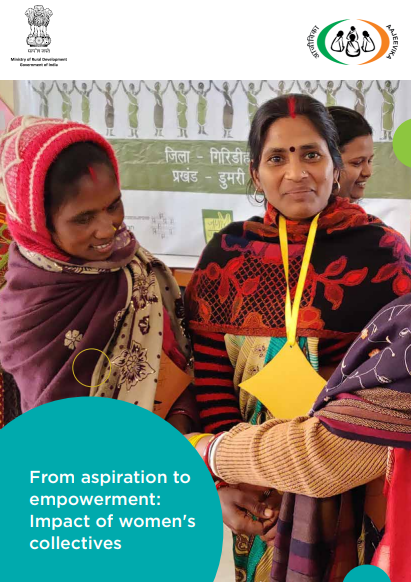
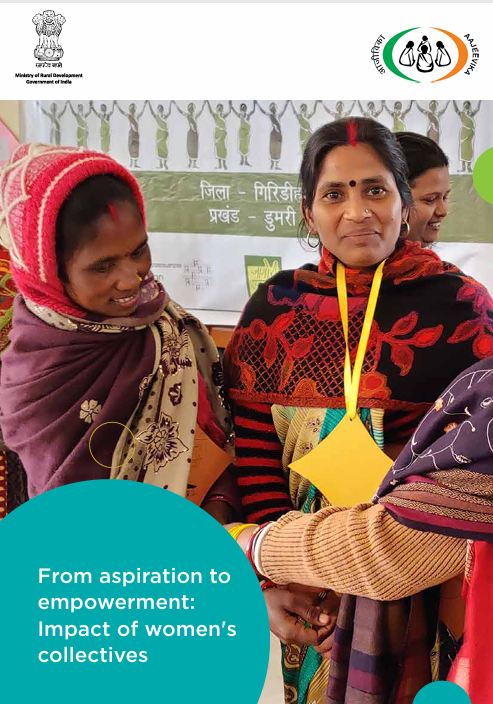
From aspiration to empowerment: Impact of women’s collectives
- July , 2021
- Moumita Sarkar | Kanika Jha Kingra | Seema Bhaskaran
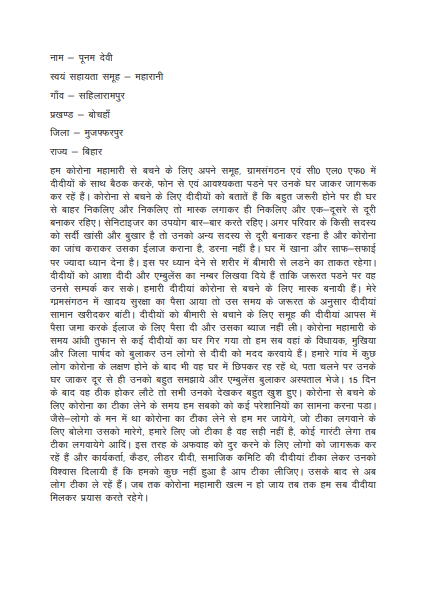
The Deendayal Antyodaya Yojana- National Rural Livelihoods Mission (DAY NRLM) has adopted a focussed approach towards gender mainstreaming in its programme architecture. This includes establishing institutional mechanisms like Social Action Committees at the village organisation (VO SAC) and cluster federation levels to serve as response mechanisms to various issues that women and girls face, and that continue to act as barriers for them in accessing their rights and entitlements to lead a decent living. These Social Action Committees have shown exemplary leadership in strengthening the gender responsiveness of the programme at the grassroots level, especially during COVID-19. The compendium on best practices titled, From aspiration to empowerment: Impact of women’s collectives, was launched in the presence of Sadhvi Niranjan Jyoti, Minister of State, Rural Development, officials from the Ministry of Rural Development and all State Governments through an online event, national webinar on sharing of best practices adopted for addressing gender issues by VO SACs held on June 29, 2021. The compendium of case studies from 23 States highlights the processes, mechanisms, strategies and plans for replicating and scaling gender interventions to advance gender equality and end all forms of discrimination against women and girls. This volume contains inspiring stories of VO-SACs in increasing women’s access to rights and entitlements, and other economic issues like addressing wage disparities between men and women in the village through collective action; addressing issues of drudgery; the labour rights of migrants, prevention of child marriage, increasing girls retention in schools, preventing child abuse, alcoholism, domestic violence, witch hunting, human trafficking, and COVID-related gender issues. Broadly, the case studies highlight how VO-SACs have used multiple strategies including restorative justice, collective action, offering support to women (including psycho-social support) and sometimes even engaging with men to address issues that matter to women.
The Deendayal Antyodaya Yojana- National Rural Livelihoods Mission (DAY NRLM) has adopted a focussed approach towards gender mainstreaming in its programme architecture. This includes establishing institutional mechanisms like Social Action Committees at the village organisation (VO SAC) and cluster federation levels to serve as response mechanisms to various issues that women and girls face, and that continue to act as barriers for them in accessing their rights and entitlements to lead a decent living. These Social Action Committees have shown exemplary leadership in strengthening the gender responsiveness of the programme at the grassroots level, especially during COVID-19. The compendium on best practices titled, From aspiration to empowerment: Impact of women’s collectives, was launched in the presence of Sadhvi Niranjan Jyoti, Minister of State, Rural Development, officials from the Ministry of Rural Development and all State Governments through an online event, national webinar on sharing of best practices adopted for addressing gender issues by VO SACs held on June 29, 2021. The compendium of case studies from 23 States highlights the processes, mechanisms, strategies and plans for replicating and scaling gender interventions to advance gender equality and end all forms of discrimination against women and girls. This volume contains inspiring stories of VO-SACs in increasing women’s access to rights and entitlements, and other economic issues like addressing wage disparities between men and women in the village through collective action; addressing issues of drudgery; the labour rights of migrants, prevention of child marriage, increasing girls retention in schools, preventing child abuse, alcoholism, domestic violence, witch hunting, human trafficking, and COVID-related gender issues. Broadly, the case studies highlight how VO-SACs have used multiple strategies including restorative justice, collective action, offering support to women (including psycho-social support) and sometimes even engaging with men to address issues that matter to women.
Newsletter (Gender In Focus)
Gender in Focus
- July , 2021
- IWWAGE
Over 90% of India’s workforce is employed informally, comprising 400+ million workers across multiple forms of non-standard work. This informal economy is marked by low earnings, precarious conditions, insecure jobs, and minimal social protection—covering domestic workers, contributing family workers, own-account workers, and contract or temporary workers. COVID-19 has worsened inequalities within this system, with women hit differently and often harder, as they are more concentrated in the most vulnerable and lowest-paid segments of informal work.
Over 90% of India’s workforce is employed informally, comprising 400+ million workers across multiple forms of non-standard work. This informal economy is marked by low earnings, precarious conditions, insecure jobs, and minimal social protection—covering domestic workers, contributing family workers, own-account workers, and contract or temporary workers. COVID-19 has worsened inequalities within this system, with women hit differently and often harder, as they are more concentrated in the most vulnerable and lowest-paid segments of informal work.
Report
From Aspiration to Empowerment: Impact of Women’s Collectives
- June , 2021
- Aasha Ramesh, Kalamani Arumugam, P. Prashanthi
This volume presents case studies of Village Organisation–Social Action Committees (VO-SACs) across states, highlighting their role in addressing complex gender issues at the village level. The stories showcase efforts to improve women’s access to rights, entitlements, property, land ownership, and common resources through collective action. They also cover initiatives on wage parity, reducing drudgery, migrant labour rights, COVID-related gender challenges, and advancing the rights of the girl child, including preventing child marriage, improving school retention, and preventing child abuse.
This volume presents case studies of Village Organisation–Social Action Committees (VO-SACs) across states, highlighting their role in addressing complex gender issues at the village level. The stories showcase efforts to improve women’s access to rights, entitlements, property, land ownership, and common resources through collective action. They also cover initiatives on wage parity, reducing drudgery, migrant labour rights, COVID-related gender challenges, and advancing the rights of the girl child, including preventing child marriage, improving school retention, and preventing child abuse.
Working Paper
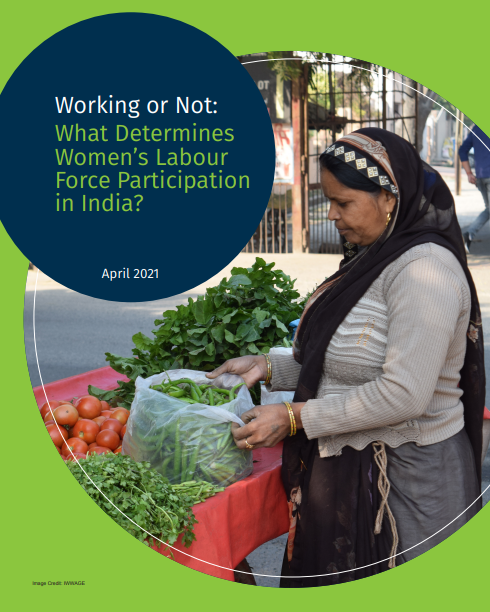
Working or Not: What Determines Women’s Labour Force Participation in India?
- May , 2021
- Ruchika Chaudhary
Women’s labour force participation is abysmally low, and persistent gender gaps characterise the Indian labour market. It is alarming to note that women have been continuously dropping out of the labour market since the mid-2000s. Their participation has been declining despite rising GDP, increasing educational attainment, rising household incomes, and declining fertility. Utilising household-level data of Periodic Labour Force Surveys (PLFS) (covering the years 2017-18 and 2018-19), and NSSO’s Employment-Unemployment Surveys (EUS) (various rounds completed in 1993-94, 1999-00, 2004-5, 2009-10, 2011-12), this paper provides systematic evidence on the country’s gender gaps in employment and labour market outcomes. This paper tries to unpack the critical aspects of low female labour force participation in rural and urban India. Findings suggest that women have notably lower employment rates than men, even though their enrolment in schools and colleges have risen. U-shaped relationship between education and women’s labour force participation is seen, which is strongly evident in the case of urban women. Women perform a disproportionate amount of unpaid care work and domestic work and face multiple constraints in society, limiting their mobility and labour market choice, forcing them to take non-wage employment or remain out of the labour force. Our findings suggest that policies supporting women’s entry into the labour market, such as vocational and technical skills, can significantly impact increasing their participation and mitigating persistent inequalities in India’s labour market outcomes. The paper underscores the importance of a comprehensive and integrated approach and suggests investing in gender-responsive policies to break down women’s economic engagement barriers.
Women’s labour force participation is abysmally low, and persistent gender gaps characterise the Indian labour market. It is alarming to note that women have been continuously dropping out of the labour market since the mid-2000s. Their participation has been declining despite rising GDP, increasing educational attainment, rising household incomes, and declining fertility. Utilising household-level data of Periodic Labour Force Surveys (PLFS) (covering the years 2017-18 and 2018-19), and NSSO’s Employment-Unemployment Surveys (EUS) (various rounds completed in 1993-94, 1999-00, 2004-5, 2009-10, 2011-12), this paper provides systematic evidence on the country’s gender gaps in employment and labour market outcomes. This paper tries to unpack the critical aspects of low female labour force participation in rural and urban India. Findings suggest that women have notably lower employment rates than men, even though their enrolment in schools and colleges have risen. U-shaped relationship between education and women’s labour force participation is seen, which is strongly evident in the case of urban women. Women perform a disproportionate amount of unpaid care work and domestic work and face multiple constraints in society, limiting their mobility and labour market choice, forcing them to take non-wage employment or remain out of the labour force. Our findings suggest that policies supporting women’s entry into the labour market, such as vocational and technical skills, can significantly impact increasing their participation and mitigating persistent inequalities in India’s labour market outcomes. The paper underscores the importance of a comprehensive and integrated approach and suggests investing in gender-responsive policies to break down women’s economic engagement barriers.
Learning note
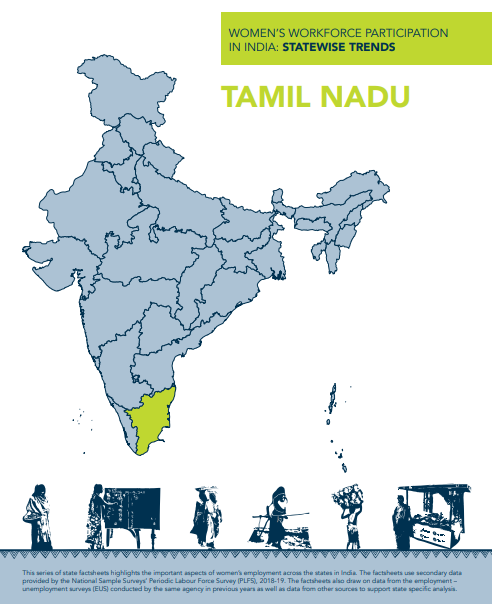
Women’s Workforce Participation State wise Trends in India
- May , 2021
Madhya Pradesh (MP) is the only state in India to have witnessed a rise in workforce participation rates (WPRs) of women in both rural and urban areas between 2011-12 and 2017-18. The increase in women’s WPR in MP was driven largely by increase in self-employment in the rural areas and regular employment in the urban areas. According to the Periodic Labourforce Survey in 2017-18, more than half of the female workforce in the state is self-employed, with a higher incidence of self-employment in rural areas. While approximately 88 percent of the rural self-employed women in MP are engaged in unpaid work, the share of women in own account enterprises is substantially high in urban MP. The distribution of casual women workers suggests very few women engaged under MGNREGA and other public works as 96 percent women in casual employment were engaged in non-public works, with very little security or guarantee of payment
Madhya Pradesh (MP) is the only state in India to have witnessed a rise in workforce participation rates (WPRs) of women in both rural and urban areas between 2011-12 and 2017-18. The increase in women’s WPR in MP was driven largely by increase in self-employment in the rural areas and regular employment in the urban areas. According to the Periodic Labourforce Survey in 2017-18, more than half of the female workforce in the state is self-employed, with a higher incidence of self-employment in rural areas. While approximately 88 percent of the rural self-employed women in MP are engaged in unpaid work, the share of women in own account enterprises is substantially high in urban MP. The distribution of casual women workers suggests very few women engaged under MGNREGA and other public works as 96 percent women in casual employment were engaged in non-public works, with very little security or guarantee of payment

Working Paper
Intersecting Identities, Livelihoods and Affirmative Action: How Social Identity Affects Economic Opportunity for Women in India
- April , 2021
- Ashwini Deshpande
This paper presents a landscape assessment of the current state of gender inequality in the economic sphere in India, which is a key facet of overall inequality. The assessment comprises the latest empirical evidence based both on demographic survey data, as well as key results from cutting-edge scholarly literature. Male “female gaps are significant in many dimensions, but the contours of these gaps are shaped by the overlap of gender with other social identities, such as caste, religion or tribal identities. Thus, women from stigmatised and marginalised groups are disadvantaged along two dimensions and have to battle the double stigma of this intersectionality. The paper outlines the trends in overall gender gaps in the areas of labour force participation, self-employment and education over the last couple of decades, but highlights the role of intersectionality that goes into producing structures of advantage and disadvantage. The paper discusses policies such as the National Rural Livelihood Mission designed to encourage self-employment, which have had several other positive impacts, such as increase in empowerment and autonomy, but their record in terms of enhancing livelihoods is mixed at best. Evidence shows that policies such as employment guarantee schemes or transport infrastructure could end up having positive gendered effects, despite their gender-blind design. The paper argues that in order to tackle inequality fundamentally, we need to mainstream evidence-based research on intersectionality, which should be the basic lens informing policy.
This paper presents a landscape assessment of the current state of gender inequality in the economic sphere in India, which is a key facet of overall inequality. The assessment comprises the latest empirical evidence based both on demographic survey data, as well as key results from cutting-edge scholarly literature. Male “female gaps are significant in many dimensions, but the contours of these gaps are shaped by the overlap of gender with other social identities, such as caste, religion or tribal identities. Thus, women from stigmatised and marginalised groups are disadvantaged along two dimensions and have to battle the double stigma of this intersectionality. The paper outlines the trends in overall gender gaps in the areas of labour force participation, self-employment and education over the last couple of decades, but highlights the role of intersectionality that goes into producing structures of advantage and disadvantage. The paper discusses policies such as the National Rural Livelihood Mission designed to encourage self-employment, which have had several other positive impacts, such as increase in empowerment and autonomy, but their record in terms of enhancing livelihoods is mixed at best. Evidence shows that policies such as employment guarantee schemes or transport infrastructure could end up having positive gendered effects, despite their gender-blind design. The paper argues that in order to tackle inequality fundamentally, we need to mainstream evidence-based research on intersectionality, which should be the basic lens informing policy.
Brief
Care and Climate Change
- January , 2026
The brief focuses on bridging feminist economics and climate policy, highlighting gendered care burdens, structural undervaluation of reproductive labour, and the need for transformative interventions like care-responsive adaptation and finance.
The brief focuses on bridging feminist economics and climate policy, highlighting gendered care burdens, structural undervaluation of reproductive labour, and the need for transformative interventions like care-responsive adaptation and finance.
Brief
Measuring Women’s Work: Innovations and Obstacles in the Global South
- January , 2026
The brief examined challenges and innovations in capturing women’s paid and unpaid work in labour statistics. Drawing on experiences from India, South Africa, Latin America, and global systems, panelists highlighted how survey design, classifications, and institutional limits determine what is counted, and what remains invisible
The brief examined challenges and innovations in capturing women’s paid and unpaid work in labour statistics. Drawing on experiences from India, South Africa, Latin America, and global systems, panelists highlighted how survey design, classifications, and institutional limits determine what is counted, and what remains invisible

Report Snapshot
The Changing World of Women’s Work
- December , 2025
- Bidisha Mondal, Prakriti Sharma, Aneek Chowdhury, Anjali S
This study examines women’s participation in India’s platform economy using a mixed-methods approach, combining a survey of 598 platform workers (440 women) across care, domestic, beauty, ride-sharing, and delivery services with qualitative interviews. While platform work offers new entry points and flexibility, it often mirrors and deepens the precarity of informal work, limiting its potential for women’s empowerment. Persistent challenges include income instability, high entry and platform costs, limited social protection, unsafe conditions, and reinforced gender inequalities. Meaningful progress requires coordinated action by policymakers, platforms, and worker collectives to ensure fair earnings, social security, gender-sensitive systems, and effective grievance redressal
This study examines women’s participation in India’s platform economy using a mixed-methods approach, combining a survey of 598 platform workers (440 women) across care, domestic, beauty, ride-sharing, and delivery services with qualitative interviews. While platform work offers new entry points and flexibility, it often mirrors and deepens the precarity of informal work, limiting its potential for women’s empowerment. Persistent challenges include income instability, high entry and platform costs, limited social protection, unsafe conditions, and reinforced gender inequalities. Meaningful progress requires coordinated action by policymakers, platforms, and worker collectives to ensure fair earnings, social security, gender-sensitive systems, and effective grievance redressal

Brief
Women’s Work and AI-Unlocking Potential, Bridging the Divide
- December , 2025
- Sharati Roy, Dr. Mahima Taneja
AI is not neutral in how it’s designed or deployed. It is reshaping labour markets, with the biggest gains when it complements human skills rather than replaces them (ILO, 2025). While AI can improve efficiency and decision-making in sectors like healthcare, finance, and education, it also risks job losses and deeper inequalities. Outcomes will depend on whether AI drives automation or augmentation. In India—where Digital Public Infrastructure, data expansion, and the gig economy are growing rapidly—this brief explores women’s opportunities in AI/data value-chain work and AI-augmented livelihoods to support economic empowerment.
AI is not neutral in how it’s designed or deployed. It is reshaping labour markets, with the biggest gains when it complements human skills rather than replaces them (ILO, 2025). While AI can improve efficiency and decision-making in sectors like healthcare, finance, and education, it also risks job losses and deeper inequalities. Outcomes will depend on whether AI drives automation or augmentation. In India—where Digital Public Infrastructure, data expansion, and the gig economy are growing rapidly—this brief explores women’s opportunities in AI/data value-chain work and AI-augmented livelihoods to support economic empowerment.
Report
The Changing World of Women’s Work
- December , 2025
- Bidisha Mondal, Prakriti Sharma, Aneek Chowdhury, Anjali S
This study examines women’s participation in India’s platform economy using a mixed-methods approach, combining a survey of 598 platform workers (440 women) across care, domestic, beauty, ride-sharing, and delivery services with qualitative interviews. While platform work offers new entry points and flexibility, it often mirrors and deepens the precarity of informal work, limiting its potential for women’s empowerment. Persistent challenges include income instability, high entry and platform costs, limited social protection, unsafe conditions, and reinforced gender inequalities. Meaningful progress requires coordinated action by policymakers, platforms, and worker collectives to ensure fair earnings, social security, gender-sensitive systems, and effective grievance redressal
This study examines women’s participation in India’s platform economy using a mixed-methods approach, combining a survey of 598 platform workers (440 women) across care, domestic, beauty, ride-sharing, and delivery services with qualitative interviews. While platform work offers new entry points and flexibility, it often mirrors and deepens the precarity of informal work, limiting its potential for women’s empowerment. Persistent challenges include income instability, high entry and platform costs, limited social protection, unsafe conditions, and reinforced gender inequalities. Meaningful progress requires coordinated action by policymakers, platforms, and worker collectives to ensure fair earnings, social security, gender-sensitive systems, and effective grievance redressal

Brief
Impact of Social Norms on Women’s Economic Empowerment in India
- November , 2025
- Mridusmita Bordoloi, Surabhi Awasthi, Sharati Roy
Women’s Economic Empowerment (WEE) refers to women’s access to economic opportunities, resources, decent work, and the ability to make independent economic choices. It is both a process and an outcome that strengthens individual agency and supports inclusive growth. In countries like India, WEE is constrained not only by structural gaps—such as inadequate care infrastructure, poor connectivity, and limited skills access—but also by deeply rooted gender norms that shape women’s roles in society.
Women’s Economic Empowerment (WEE) refers to women’s access to economic opportunities, resources, decent work, and the ability to make independent economic choices. It is both a process and an outcome that strengthens individual agency and supports inclusive growth. In countries like India, WEE is constrained not only by structural gaps—such as inadequate care infrastructure, poor connectivity, and limited skills access—but also by deeply rooted gender norms that shape women’s roles in society.