


This paper delves into the persistent gender gaps in India’s labour market, highlighting the alarming decline in women’s labour force participation despite socio-economic progress. Using data from the Periodic Labour Force Surveys (PLFS) and the National Sample Survey Office (NSSO), it examines the key factors contributing to this trend, including the disproportionate burden of unpaid care work. The paper underscores the need for targeted policies, such as vocational training and gender-responsive initiatives, to empower women and break down barriers to their economic participation.
Care Economy
Care Economy
Women’s low labour force participation in India is closely linked to the unequal burden of unpaid care and domestic work. Evidence from India’s Time Use Survey shows that women and girls spend significantly more time on unpaid household and caregiving responsibilities than men and boys, while paid care work remains largely feminised, undervalued, and characterised by low wages and limited social protection. Addressing the care economy is therefore critical to advancing women’s economic participation and building inclusive labour markets.
IWWAGE’s work on the care economy focuses on:
Building evidence through collaboration
Generating and co-creating policy-relevant evidence in partnership with research institutions, governments, and civil society to highlight the scale, value, and distribution of care work.
Strengthening care and social infrastructure
Advocating investments in care services and enabling infrastructure such as childcare, elder care, piped water, clean energy, and reliable electricity to reduce women’s unpaid care burden.
Improving measurement and visibility of care work
Advancing better tools and methods to measure unpaid and paid care work, ensuring women’s contributions are visible in data, policy, and planning processes.
Advancing rights and protections for care workers
Supporting policy dialogue on fair wages, social protection, and access to entitlements for paid care workers.
Influencing policy and advocacy
Using evidence to inform policy across national and sub-national levels through sustained engagement with key institutions, including NITI Aayog, the Ministry of Women and Child Development, and the Ministry of Rural Development.
This body of work has strengthened national and international attention to care workers’ needs, including during India’s G20 Presidency in 2023, and contributed to IWWAGE being recognised by UNESCAP and UN Women (Regional Office) as a Care Champion in the region for 2024.

Working Paper
Understanding violence & female labour supply
- November , 2021
- Neelanjana Gupta
The paper, What is keeping women from going to work: Understanding violence and female labour supply is an output of the research vertical of the Initiative for What Works to Advance Women and Girls in the Economy (IWWAGE), an initiative of LEAD at Krea University. This document is not a priced publication
The paper, What is keeping women from going to work: Understanding violence and female labour supply is an output of the research vertical of the Initiative for What Works to Advance Women and Girls in the Economy (IWWAGE), an initiative of LEAD at Krea University. This document is not a priced publication

Working Paper
Working or Not: What Determines Women’s Labour Force Participation in India?
- May , 2021
- Ruchika Chaudhary
This paper delves into the persistent gender gaps in India’s labour market, highlighting the alarming decline in women’s labour force participation despite socio-economic progress. Using data from the Periodic Labour Force Surveys (PLFS) and the National Sample Survey Office (NSSO), it examines the key factors contributing to this trend, including the disproportionate burden of unpaid care work. The paper underscores the need for targeted policies, such as vocational training and gender-responsive initiatives, to empower women and break down barriers to their economic participation.
This paper delves into the persistent gender gaps in India’s labour market, highlighting the alarming decline in women’s labour force participation despite socio-economic progress. Using data from the Periodic Labour Force Surveys (PLFS) and the National Sample Survey Office (NSSO), it examines the key factors contributing to this trend, including the disproportionate burden of unpaid care work. The paper underscores the need for targeted policies, such as vocational training and gender-responsive initiatives, to empower women and break down barriers to their economic participation.

Brief
COVID-19 and Women’s Labour Crisis
- April , 2021
- Sona Mitra, Dipa Sinha
A pandemic that translates itself into an economic crisis has the potential to push women out of the labour force through several mechanisms. An economic crisis creates pressure on governments to cut down on social sector expenditures which potentially increases the burden of unpaid care and household work for women. As a result, women’s time for engaging in productive work gets reduced, having a negative impact on their labour force participation. The COVID-19 pandemic in India has had an unequal impact on women in a number of ways. In terms of economic opportunity, it has been seen that more women lost jobs compared to men and fewer have been able to rejoin labour force. This is in the context of gendered labour markets where female labour force participation has been low and declining. This paper presents an analysis of the situation of women’s employment pre-lockdown and some indications on what the impact of COVID-19 could be, based on microstudies and other literature available. Further, the adequacy of the social protection and employment generation programmes of the government that are specifically aimed at improving female labour force participation is assessed.
A pandemic that translates itself into an economic crisis has the potential to push women out of the labour force through several mechanisms. An economic crisis creates pressure on governments to cut down on social sector expenditures which potentially increases the burden of unpaid care and household work for women. As a result, women’s time for engaging in productive work gets reduced, having a negative impact on their labour force participation. The COVID-19 pandemic in India has had an unequal impact on women in a number of ways. In terms of economic opportunity, it has been seen that more women lost jobs compared to men and fewer have been able to rejoin labour force. This is in the context of gendered labour markets where female labour force participation has been low and declining. This paper presents an analysis of the situation of women’s employment pre-lockdown and some indications on what the impact of COVID-19 could be, based on microstudies and other literature available. Further, the adequacy of the social protection and employment generation programmes of the government that are specifically aimed at improving female labour force participation is assessed.

Working Paper
Women’s Awareness of Sexual Harassment and Labour Market Preferences
- April , 2021
- Karmini Sharma
The paper, Women’s Awareness of Sexual Harassment and Labour Market Preferences, is a part of the working paper series and has been produced with the help of IWWAGE research fellowship to young researchers in 2019.
The paper, Women’s Awareness of Sexual Harassment and Labour Market Preferences, is a part of the working paper series and has been produced with the help of IWWAGE research fellowship to young researchers in 2019.

IWWAGE-ISST-BRIEFS
Women and Unpaid Work
- March , 2021
- Monika Banerjee , Ahana Chakrabarti
Women’s workforce participation in India has been consistently low-and steadily declining over the last 15 years, as recorded by official surveys like those conducted by the National Sample Survey Office (NSSO) and the Periodic Labour Force Survey (PLFS). However, these numbers fail to capture the full extent of women’s economic contributions, largely because they exclude unpaid work-domestic chores, caregiving, and community roles-that women perform on a daily basis. Feminist scholars have long advocated for the recognition, reduction, and redistribution of unpaid work as essential steps toward achieving gender equality. If the definition of work is expanded to include these invisible activities, it becomes evident that many more women are contributing to the economy than current statistics suggest. The COVID-19 pandemic further exacerbated these inequalities. As homes transformed into sites of both work and survival, women’s unpaid workload increased significantly. A Rapid Assessment Survey conducted by the Institute of Social Studies Trust (ISST) in Delhi found that women in urban informal sectors-such as domestic work, waste picking, street vending, and construction-reported a significant rise in unpaid responsibilities, including childcare, eldercare, and food provisioning. Despite other family members being at home, women continued to shoulder the majority of domestic work, often with little or no help. To build a more inclusive and equitable economy, it is critical to recognise and value unpaid labour and ensure that data and policy frameworks reflect the full spectrum of women’s work.
Women’s workforce participation in India has been consistently low-and steadily declining over the last 15 years, as recorded by official surveys like those conducted by the National Sample Survey Office (NSSO) and the Periodic Labour Force Survey (PLFS). However, these numbers fail to capture the full extent of women’s economic contributions, largely because they exclude unpaid work-domestic chores, caregiving, and community roles-that women perform on a daily basis. Feminist scholars have long advocated for the recognition, reduction, and redistribution of unpaid work as essential steps toward achieving gender equality. If the definition of work is expanded to include these invisible activities, it becomes evident that many more women are contributing to the economy than current statistics suggest. The COVID-19 pandemic further exacerbated these inequalities. As homes transformed into sites of both work and survival, women’s unpaid workload increased significantly. A Rapid Assessment Survey conducted by the Institute of Social Studies Trust (ISST) in Delhi found that women in urban informal sectors-such as domestic work, waste picking, street vending, and construction-reported a significant rise in unpaid responsibilities, including childcare, eldercare, and food provisioning. Despite other family members being at home, women continued to shoulder the majority of domestic work, often with little or no help. To build a more inclusive and equitable economy, it is critical to recognise and value unpaid labour and ensure that data and policy frameworks reflect the full spectrum of women’s work.
IWWAGE-ISST-BRIEFS
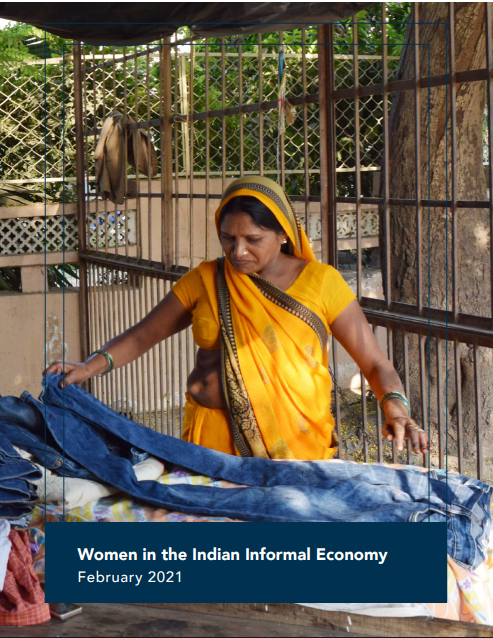
Women in the Indian Informal Economy
- March , 2021
- Shiney Chakraborty
Globally, the informal economy employs over two billion people aged 15 and above-accounting for 61.2 per cent of total employment. In India, a slightly higher proportion of women than men are engaged in informal employment, despite the absolute numbers being lower. Informality often reflects a lack of socio-economic development and education, with workers possessing limited or no formal qualifications being more vulnerable to informal work. In India, women are extensively engaged in productive and reproductive activities, yet much of this labour remains invisible. They are concentrated in low-skilled, low-paid informal jobs with minimal or no social protection-working as domestic workers, self-employed home-based workers, or in other precarious roles. These challenges are further compounded by caste- and religion-based discrimination, revealing the layered nature of women’s marginalisation. The COVID-19 pandemic exacerbated existing gender inequalities within the informal sector. With the collapse of livelihoods during the lockdown, women bore a disproportionate burden of job losses and increased household responsibilities. The economic shock reinforced pre-existing gaps in employment, wages, and access to social security. To address these inequities, the following policy recommendations are key: – Expand employment opportunities through direct public investment and job generation, including reservation for women in these initiatives. – Improve working conditions in the informal sector by recognising all types of work (including home-based), enforcing minimum wages, and reducing gender wage gaps. – Strengthen access to social protection, especially old-age pensions and healthcare, including occupational health services for women in often-overlooked sectors. – Invest in gender-sensitive infrastructure, such as safe public transport, crèche facilities, and accessible toilets. – Support collective organising among informal women workers to strengthen their bargaining power and representation. Addressing informality through a gendered lens is crucial for building an inclusive and equitable economy.
Globally, the informal economy employs over two billion people aged 15 and above-accounting for 61.2 per cent of total employment. In India, a slightly higher proportion of women than men are engaged in informal employment, despite the absolute numbers being lower. Informality often reflects a lack of socio-economic development and education, with workers possessing limited or no formal qualifications being more vulnerable to informal work. In India, women are extensively engaged in productive and reproductive activities, yet much of this labour remains invisible. They are concentrated in low-skilled, low-paid informal jobs with minimal or no social protection-working as domestic workers, self-employed home-based workers, or in other precarious roles. These challenges are further compounded by caste- and religion-based discrimination, revealing the layered nature of women’s marginalisation. The COVID-19 pandemic exacerbated existing gender inequalities within the informal sector. With the collapse of livelihoods during the lockdown, women bore a disproportionate burden of job losses and increased household responsibilities. The economic shock reinforced pre-existing gaps in employment, wages, and access to social security. To address these inequities, the following policy recommendations are key: – Expand employment opportunities through direct public investment and job generation, including reservation for women in these initiatives. – Improve working conditions in the informal sector by recognising all types of work (including home-based), enforcing minimum wages, and reducing gender wage gaps. – Strengthen access to social protection, especially old-age pensions and healthcare, including occupational health services for women in often-overlooked sectors. – Invest in gender-sensitive infrastructure, such as safe public transport, crèche facilities, and accessible toilets. – Support collective organising among informal women workers to strengthen their bargaining power and representation. Addressing informality through a gendered lens is crucial for building an inclusive and equitable economy.