Care Economy

Care Economy

Women’s low labour force participation in India is closely linked to the unequal burden of unpaid care and domestic work. Evidence from India’s Time Use Survey shows that women and girls spend significantly more time on unpaid household and caregiving responsibilities than men and boys, while paid care work remains largely feminised, undervalued, and characterised by low wages and limited social protection. Addressing the care economy is therefore critical to advancing women’s economic participation and building inclusive labour markets.

IWWAGE’s work on the care economy focuses on:

Building evidence through collaboration

Generating and co-creating policy-relevant evidence in partnership with research institutions, governments, and civil society to highlight the scale, value, and distribution of care work.

Strengthening care and social infrastructure

Advocating investments in care services and enabling infrastructure such as childcare, elder care, piped water, clean energy, and reliable electricity to reduce women’s unpaid care burden.

Improving measurement and visibility of care work

Advancing better tools and methods to measure unpaid and paid care work, ensuring women’s contributions are visible in data, policy, and planning processes.

Advancing rights and protections for care workers

Supporting policy dialogue on fair wages, social protection, and access to entitlements for paid care workers.

Influencing policy and advocacy

Using evidence to inform policy across national and sub-national levels through sustained engagement with key institutions, including NITI Aayog, the Ministry of Women and Child Development, and the Ministry of Rural Development.

This body of work has strengthened national and international attention to care workers’ needs, including during India’s G20 Presidency in 2023, and contributed to IWWAGE being recognised by UNESCAP and UN Women (Regional Office) as a Care Champion in the region for 2024.
Learning note

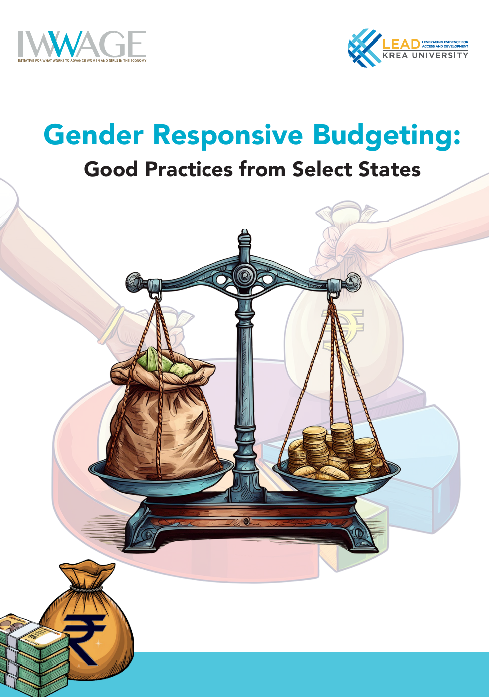
Gender Responsive Budgeting: Good Practices from Select States

Mainstreaming gender into development financing has gained global momentum, with the Addis Ababa Action Agenda reinforcing the need for gender-sensitive approaches in financial, economic, and social policies. In India, the journey towards Gender Responsive Budgeting (GRB) began with efforts in the Sixth Five Year Plan and was institutionalised at the central level in 2004-05. GRB aims to integrate gender considerations across development planning, programme formulation, and budgeting processes. India’s GRB mechanism functions through Gender Budget Cells and the Gender Budget Statement (GBS), covering 57 ministries as of 2022. While the framework provides an avenue for monitoring fund allocations and their impact on gender equality, significant gaps remain in its implementation. State governments, such as Odisha and Kerala, have shown greater success in embedding gender concerns into policy-making, with Odisha allocating over 40% of its budget towards gender priorities. However, at the national level, gender budgeting remains low, accounting for less than 5% of the Union Budget. This brief highlights the divrse approaches to GRB across states like Odisha, Karnataka, Kerala, and Andhra Pradesh, showcasing experiences, lessons learnt, and good practices in advancing gender equality through fiscal policy.
Report

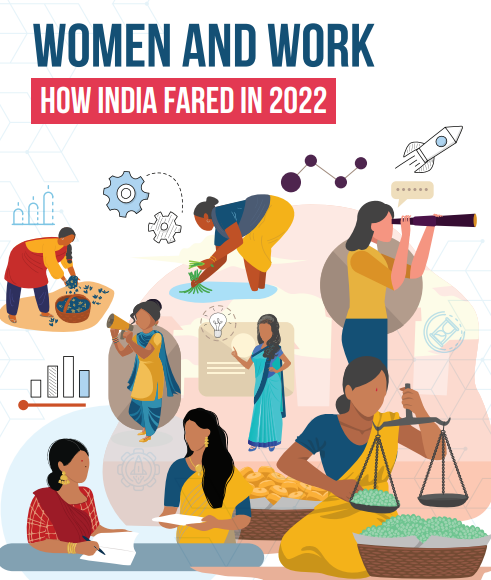
Women and Work, How India Fared in 2022

2022 presented a landscape of change as the world aimed for greater resilience, recovery and growth as things began to open up post the COVID-19 pandemic. Spurred by changes in the overall outlook on work, women’s participation in the workforce also reflected a shift, with remote and hybrid work emerging strongly in certain sectors, in continuation of trends set during the height of the pandemic. Similarly, even in work that cannot be performed remotely, there has been a deepening in positive trends. As lockdowns lifted, women persondays in certain employment schemes also climbed. Against this backdrop, India has assumed the G20 presidency for 2023, and the year provides the nation with the opportunity to not only proactively set the agenda for women-led development, but also plan for the next phase of growth. There is thus a need to provide a roadmap for enablers of women-led development, whether through participation in leadership, reflection in policy mandates, or even addressing barriers to work. From the macro-political economic scenario to the specific challenges faced by women, this report situates women’s work against the challenges and opportunities that lie ahead, particularly in light of India’s G20 presidency. Threaded through with insights from IWWAGE and LEAD’s research on the subject, the report covers trends across available data sources on scheme performances, policy changes, and political announcements, mapping the contours of women’s work in India and looking ahead to 2023.
Report

Women’s Work in Select States in India: Opportunities and Challenges

Women comprise nearly half of the world’s working population and therefore potentially half of its labour force. Female labour force participation (FLFP) represent a women decision to be the part of labour force or part of economically inactive population. At present in nearly every country female labor force participation is lower than that of male labour force participation. Female labour force participation in South Asia is among the lowest of any developing region in the world. As per PLFS, FLFPR in rural and urban area are 27.7% and 18.6% respectively. India’s low female labour force participation excludes almost half of the potential working age population, leading to gross underutilisation of women’s talents and capabilities and remains a roadblock in reaping and distributing its demographic advantage. Women participation in labour force varies across different region. The variation is determined by an array of economic and social factors including income growth, educational attainment, marital status and other prevailing local social norms.
Report Snapshot

Women’s Work in Select States in India: Opportunities and Challenges

Women comprise nearly half of the world’s working population and therefore potentially half of its labour force. Female labour force participation (FLFP) represent a women decision to be the part of labour force or part of economically inactive population. At present in nearly every country female labor force participation is lower than that of male labour force participation. Female labour force participation in South Asia is among the lowest of any developing region in the world. As per PLFS, FLFPR in rural and urban area are 27.7% and 18.6% respectively. India’s low female labour force participation excludes almost half of the potential working age population, leading to gross underutilisation of women’s talents and capabilities and remains a roadblock in reaping and distributing its demographic advantage. Women participation in labour force varies across different region. The variation is determined by an array of economic and social factors including income growth, educational attainment, marital status and other prevailing local social norms.
Report

Women and Work: How India Fared in 2021

The year 2021 continued to challenge global recovery efforts, with the second wave of COVID-19 presenting new hurdles. Women and girls were disproportionately impacted, with structural barriers exacerbating the health crisis. As this report is compiled, the Omicron variant remains a threat, highlighting the need for a gender-responsive and equitable recovery. To achieve this, we must design inclusive social safety nets, bridge the gender gap in access to technology, create hybrid work solutions, reduce and redistribute care work, and invest in the care economy. Collecting robust, sex-disaggregated data is crucial to ensure effective, scalable policies and solutions. This report maps the ongoing efforts to bring women back into the workforce and prepare them for the future of work. It highlights key policy and programmatic developments that shaped women’s work in India in 2021. Additionally, the report looks ahead, emphasising new-age skills, entrepreneurship, and non-traditional livelihoods for a self-reliant India. It also sheds light on social indicators influencing women’s workforce participation, including access to resources, health, well-being, and security.
Learning note

Towards a Gender-Responsive and Inclusive Economic Recovery for India in the COVID-19 Context

The COVID-19 pandemic disproportionately impacted India’s most vulnerable populations, with women and girls bearing the brunt of job losses, heightened unpaid care responsibilities, and reduced economic participation. At the peak of the first lockdown in April–June 2020, India’s female labour force participation rate plummeted to just 16%, and nearly half of all working women faced permanent job losses-compared to just 7% of men. Women-owned and women-led micro-enterprises also experienced severe income declines and closures. Despite government relief measures, many failed to reach the most marginalised women and girls. As India moves toward economic recovery, there is an urgent need for a just, equitable, and gender-responsive recovery plan that puts women at the centre. This brief by IWWAGE outlines key short-, medium-, and long-term macroeconomic strategies-across monetary, fiscal, and innovative financing domains-to ensure women and girls are not left behind. It calls for investments in the care economy, the creation of equitable jobs and livelihoods, and the adoption of sustainable, climate-just, and rights-based economic models that support long-term resilience.
Scroll to Top