


Publications
Publications
Category
Year
Report Snapshot
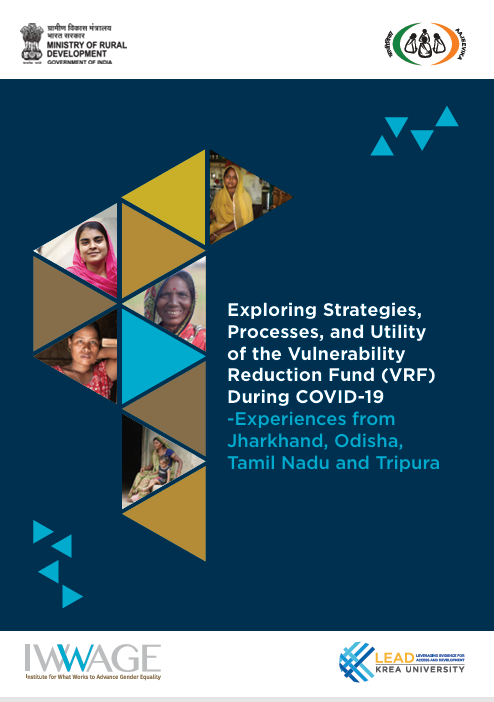
Exploring Strategies, Processes, and Utility of the Vulnerability Reduction Fund (VRF) During COVID-19
- December , 2024
- Surabhi Awasthi, Sharmishtha Nanda, Arpita Paul
The Deendayal Antyodaya Yojana – National Rural Livelihoods Mission (DAY-NRLM) is a Government of India scheme aimed at reducing poverty by empowering women through Self-Help Groups (SHGs), Village Organisations (VOs), and Cluster-Level Federations (CLFs). These platforms provide access to rights, financial services, and livelihood opportunities, promoting collective action and leadership among women. To address vulnerability, the Vulnerability Reduction Fund (VRF) was introduced in 2016 as part of DAY-NRLM’s social inclusion strategy. The VRF focuses on reducing risk and supporting vulnerable communities, especially during crises like the COVID-19 pandemic. In 2022, IWWAGE conducted a study in Jharkhand, Odisha, Tamil Nadu, and Tripura to assess the implementation and impact of the VRF during COVID-19. The research involved interviews with beneficiaries and officials and focused on the allocation, disbursement, and effectiveness of the fund in reaching vulnerable households. The study highlights the VRF’s role in building resilience and aiding marginalised communities.
The Deendayal Antyodaya Yojana – National Rural Livelihoods Mission (DAY-NRLM) is a Government of India scheme aimed at reducing poverty by empowering women through Self-Help Groups (SHGs), Village Organisations (VOs), and Cluster-Level Federations (CLFs). These platforms provide access to rights, financial services, and livelihood opportunities, promoting collective action and leadership among women. To address vulnerability, the Vulnerability Reduction Fund (VRF) was introduced in 2016 as part of DAY-NRLM’s social inclusion strategy. The VRF focuses on reducing risk and supporting vulnerable communities, especially during crises like the COVID-19 pandemic. In 2022, IWWAGE conducted a study in Jharkhand, Odisha, Tamil Nadu, and Tripura to assess the implementation and impact of the VRF during COVID-19. The research involved interviews with beneficiaries and officials and focused on the allocation, disbursement, and effectiveness of the fund in reaching vulnerable households. The study highlights the VRF’s role in building resilience and aiding marginalised communities.

Report
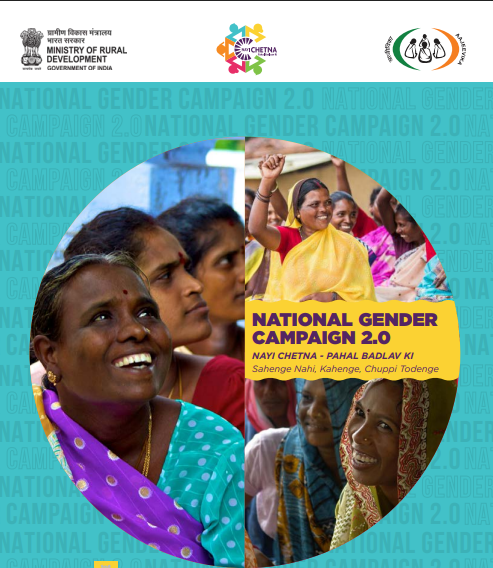
National Gender Campaign 2.0 Assessment Report – English
- November , 2024
- Aayesha Saxena , Gaurav Kumar Sinha , Arpita Paul
Launched by the Ministry of Rural Development (MoRD) in 2022, Nayi Chetna – Pahal Badlaav Ki is a national gender campaign under the Deendayal Antyodaya Yojana-National Rural Livelihoods Mission (DAY-NRLM). The campaign aims to raise awareness about Gender-Based Violence (GBV) across various life stages of women and girls, promote reporting, and enhance collaboration among stakeholders for safe redress mechanisms. The first edition of the campaign was introduced on November 25, 2022, with the theme of equity and ending GBV. Building on its inaugural success, the second edition was launched on November 25, 2023. This phase focused on deepening awareness of the different forms of violence and strengthening access to safe redress mechanisms through convergence with stakeholders, including State Rural Livelihood Missions (SRLMs), DAY-NRLM community institutions, Panchayati Raj Institutions (PRIs), and 14 Line Ministries. IWWAGE, in collaboration with LEAD at Krea University, conducted a comprehensive qualitative and quantitative assessment of the Nayi Chetna 2.0 campaign. The study aimed to evaluate the campaign’s reach, relevance, and effectiveness, particularly in raising awareness of GBV, enhancing reporting mechanisms, and improving institutional support. The assessment employed a mixed-methods approach, incorporating qualitative interviews and focus group discussions across ten states, alongside quantitative data collection through an online platform. Key findings revealed the strength of women’s Self-Help Groups (SHGs) as central to the campaign’s impact. However, engaging men and adolescents in future iterations is crucial for broader societal change. Additionally, active involvement of PRI functionaries in grassroots dialogues on gender discrimination emerged as a successful strategy. The assessment also highlighted the importance of fostering cross-departmental convergence to improve GBV reporting, and recommended further budget allocations, access to localised training materials, and greater use of media platforms to amplify the campaign’s reach and engagement.
Launched by the Ministry of Rural Development (MoRD) in 2022, Nayi Chetna – Pahal Badlaav Ki is a national gender campaign under the Deendayal Antyodaya Yojana-National Rural Livelihoods Mission (DAY-NRLM). The campaign aims to raise awareness about Gender-Based Violence (GBV) across various life stages of women and girls, promote reporting, and enhance collaboration among stakeholders for safe redress mechanisms. The first edition of the campaign was introduced on November 25, 2022, with the theme of equity and ending GBV. Building on its inaugural success, the second edition was launched on November 25, 2023. This phase focused on deepening awareness of the different forms of violence and strengthening access to safe redress mechanisms through convergence with stakeholders, including State Rural Livelihood Missions (SRLMs), DAY-NRLM community institutions, Panchayati Raj Institutions (PRIs), and 14 Line Ministries. IWWAGE, in collaboration with LEAD at Krea University, conducted a comprehensive qualitative and quantitative assessment of the Nayi Chetna 2.0 campaign. The study aimed to evaluate the campaign’s reach, relevance, and effectiveness, particularly in raising awareness of GBV, enhancing reporting mechanisms, and improving institutional support. The assessment employed a mixed-methods approach, incorporating qualitative interviews and focus group discussions across ten states, alongside quantitative data collection through an online platform. Key findings revealed the strength of women’s Self-Help Groups (SHGs) as central to the campaign’s impact. However, engaging men and adolescents in future iterations is crucial for broader societal change. Additionally, active involvement of PRI functionaries in grassroots dialogues on gender discrimination emerged as a successful strategy. The assessment also highlighted the importance of fostering cross-departmental convergence to improve GBV reporting, and recommended further budget allocations, access to localised training materials, and greater use of media platforms to amplify the campaign’s reach and engagement.

Working Paper
Improving Women’s Employment Possibilities: A Sectoral Analysis
- September , 2024
- Sona Mitra | Bidisha Mondal
This research paper explores the intersection of sectoral growth and gendered employment in India, analysing how economic changes impact women’s participation in the workforce. Using time-series data from CPHS, CMIE CAPEX, PLFS, and NAS, the study forecasts employment trends across key sectors from 2024 to 2027, with a particular lens on sectors employing large numbers of women. It highlights an overall projected decline in women’s employment, especially in agriculture, education, ICT, and several manufacturing industries due to mechanisation and automation. However, it also identifies potential growth in sectors such as wholesale and retail trade, and selected manufacturing sub-sectors like footwear and detergents, driven by women’s increasing entrepreneurial presence in e-commerce. The paper calls for urgent upskilling and targeted investments in sectors with high potential to absorb women workers.
This research paper explores the intersection of sectoral growth and gendered employment in India, analysing how economic changes impact women’s participation in the workforce. Using time-series data from CPHS, CMIE CAPEX, PLFS, and NAS, the study forecasts employment trends across key sectors from 2024 to 2027, with a particular lens on sectors employing large numbers of women. It highlights an overall projected decline in women’s employment, especially in agriculture, education, ICT, and several manufacturing industries due to mechanisation and automation. However, it also identifies potential growth in sectors such as wholesale and retail trade, and selected manufacturing sub-sectors like footwear and detergents, driven by women’s increasing entrepreneurial presence in e-commerce. The paper calls for urgent upskilling and targeted investments in sectors with high potential to absorb women workers.

Report
Financing Quality Childcare Facilities in India by IWWAGE and Mobile Creches
- September , 2024
- Divya Singh, Sruthi Kutty, Suchika Gupta
The increasing nuclearisation of families in urban and peri-urban areas is driving demand for quality childcare, especially for working women.This study explores the current landscape of childcare services in India, focusing on government and non-governmental efforts to improve access and support women’s economic empowerment.
The increasing nuclearisation of families in urban and peri-urban areas is driving demand for quality childcare, especially for working women.This study explores the current landscape of childcare services in India, focusing on government and non-governmental efforts to improve access and support women’s economic empowerment.
Report Snapshot
Financing Quality Childcare Facilities in India by IWWAGE and Mobile Creches
- September , 2024
- Divya Singh, Sruthi Kutty, Suchika Gupta
The increasing nuclearisation of families in urban and peri-urban areas is driving demand for quality childcare, especially for working women.This study explores the current landscape of childcare services in India, focusing on government and non-governmental efforts to improve access and support women’s economic empowerment.
The increasing nuclearisation of families in urban and peri-urban areas is driving demand for quality childcare, especially for working women.This study explores the current landscape of childcare services in India, focusing on government and non-governmental efforts to improve access and support women’s economic empowerment.
Report Snapshot
Capturing Women’s Work To Measure Better
- September , 2024
- Sona Mitra, Prakriti Sharma, Aneek Choudhary
Women’s work is often underestimated in labour force surveys due to its complex nature, which includes economic, non-economic, and unpaid work such as domestic tasks and caregiving. Additionally, biases in respondents and enumerators, along with survey designs lacking gender sensitivity, contribute to data gaps and the undercounting of women’s contributions, keeping them invisible in statistics and policy discussions. Research highlights how oversimplified methodologies in mainstream surveys lead to the misclassification of economically active women as inactive. This study aims to address these gaps by testing innovative survey techniques that provide more accurate estimates of women’s participation in the workforce. It also examines perception bias in proxy-reporting. The study was conducted in Karnataka and Jharkhand, surveying 4,000 women and 800 men. Findings show that these innovations were effective in capturing more women in employment compared to conventional surveys, offering deeper insights into their time-use patterns and highlighting the impact of perception bias in proxy reporting.
Women’s work is often underestimated in labour force surveys due to its complex nature, which includes economic, non-economic, and unpaid work such as domestic tasks and caregiving. Additionally, biases in respondents and enumerators, along with survey designs lacking gender sensitivity, contribute to data gaps and the undercounting of women’s contributions, keeping them invisible in statistics and policy discussions. Research highlights how oversimplified methodologies in mainstream surveys lead to the misclassification of economically active women as inactive. This study aims to address these gaps by testing innovative survey techniques that provide more accurate estimates of women’s participation in the workforce. It also examines perception bias in proxy-reporting. The study was conducted in Karnataka and Jharkhand, surveying 4,000 women and 800 men. Findings show that these innovations were effective in capturing more women in employment compared to conventional surveys, offering deeper insights into their time-use patterns and highlighting the impact of perception bias in proxy reporting.

Learning note
Capturing Women’s Work To Measure Better
- August , 2024
- Sona Mitra | Bidisha Mondal | Prakriti Sharma
Women’s work is often more diverse and complex due to the significant amount of unpaid labour they perform, including domestic chores and caregiving responsibilities. Conventional labour force surveys tend to overlook these contributions, leading to an undercounting of women’s work and their exclusion from policy discussions. As a result, women are often not recognised as ‘workers,’ keeping them invisible in statistical estimates. IWWAGE seeks to address this gap by developing better mechanisms for collecting data on women’s work. Through innovative probing techniques and sampling frames, our research aims to capture a more accurate picture of women’s labour force participation. Additionally, we propose a framework for women-centric surveys that can be aligned with national Labour Force Surveys (LFS) to provide more accurate estimates. Our study also highlights the bias that occurs when respondents other than women themselves report on their work, further underestimating women’s contributions to the economy. By engendering labour force surveys, IWWAGE hopes to bring greater visibility to women’s work and ensure their inclusion in policy discussions that drive economic empowerment.
Women’s work is often more diverse and complex due to the significant amount of unpaid labour they perform, including domestic chores and caregiving responsibilities. Conventional labour force surveys tend to overlook these contributions, leading to an undercounting of women’s work and their exclusion from policy discussions. As a result, women are often not recognised as ‘workers,’ keeping them invisible in statistical estimates. IWWAGE seeks to address this gap by developing better mechanisms for collecting data on women’s work. Through innovative probing techniques and sampling frames, our research aims to capture a more accurate picture of women’s labour force participation. Additionally, we propose a framework for women-centric surveys that can be aligned with national Labour Force Surveys (LFS) to provide more accurate estimates. Our study also highlights the bias that occurs when respondents other than women themselves report on their work, further underestimating women’s contributions to the economy. By engendering labour force surveys, IWWAGE hopes to bring greater visibility to women’s work and ensure their inclusion in policy discussions that drive economic empowerment.
Report
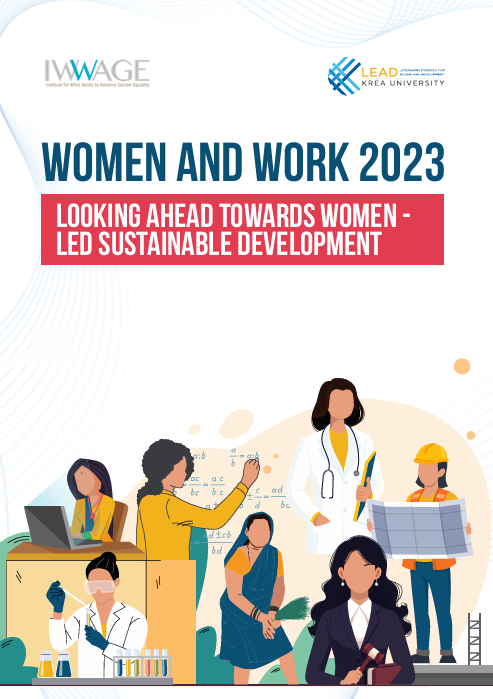
IWWAGE Women And Work Trends Report 2023
- July , 2024
- Devika Oberai | Suhani Pandey | Manas Pathak
In 2023, India emerged as the fastest-growing major economy globally, driven by robust employment generation, productivity gains, and sustained economic growth. Alongside this remarkable economic performance, the year brought women-led development and Nari Shakti into focus, reaffirming India’s commitment to gender equality and sustainable development. However, despite these advancements, the issue of female labour force participation remains critical. India has long struggled with lower female labour force participation compared to global standards, with socio-economic and cultural factors limiting the full utilisation of women’s potential. Yet, recent trends offer promising signs of progress. According to the latest Periodic Labour Force Survey (2022-2023), female participation in the labour force for those aged 15 and above rose to 37%, with rural areas seeing an increase from 36.6% to 41.5%, and urban areas from 23.8% to 25.4%. More women are engaging in family-owned or self-employed work, including agriculture, contributing positively to this shift. Additionally, 2023 witnessed significant strides towards women-led development, with a renewed push for women’s representation in Parliament and proactive policy discussions during India’s G-20 presidency. However, the journey towards true gender equality remains ongoing. Women continue to be under-represented in key sectors, particularly in science and technology, with workplaces reflecting broader economic and social inequalities. India’s G-20 presidency adopted a gender-focused approach, aiming to reposition women not just as beneficiaries but as economic agents driving development. By embracing women-led development, India sought to shift the narrative and demonstrate the transformative potential of women in spearheading key sectors and promoting inclusive growth. This report contextualises women’s participation in various fields within the broader political and economic landscape of 2023. It highlights the challenges and opportunities that emerged during the year and offers a forward-looking perspective on potential growth areas in 2024, recognising women as a formidable force in driving progress and prosperity.
In 2023, India emerged as the fastest-growing major economy globally, driven by robust employment generation, productivity gains, and sustained economic growth. Alongside this remarkable economic performance, the year brought women-led development and Nari Shakti into focus, reaffirming India’s commitment to gender equality and sustainable development. However, despite these advancements, the issue of female labour force participation remains critical. India has long struggled with lower female labour force participation compared to global standards, with socio-economic and cultural factors limiting the full utilisation of women’s potential. Yet, recent trends offer promising signs of progress. According to the latest Periodic Labour Force Survey (2022-2023), female participation in the labour force for those aged 15 and above rose to 37%, with rural areas seeing an increase from 36.6% to 41.5%, and urban areas from 23.8% to 25.4%. More women are engaging in family-owned or self-employed work, including agriculture, contributing positively to this shift. Additionally, 2023 witnessed significant strides towards women-led development, with a renewed push for women’s representation in Parliament and proactive policy discussions during India’s G-20 presidency. However, the journey towards true gender equality remains ongoing. Women continue to be under-represented in key sectors, particularly in science and technology, with workplaces reflecting broader economic and social inequalities. India’s G-20 presidency adopted a gender-focused approach, aiming to reposition women not just as beneficiaries but as economic agents driving development. By embracing women-led development, India sought to shift the narrative and demonstrate the transformative potential of women in spearheading key sectors and promoting inclusive growth. This report contextualises women’s participation in various fields within the broader political and economic landscape of 2023. It highlights the challenges and opportunities that emerged during the year and offers a forward-looking perspective on potential growth areas in 2024, recognising women as a formidable force in driving progress and prosperity.
Newsletter (Gender In Focus)
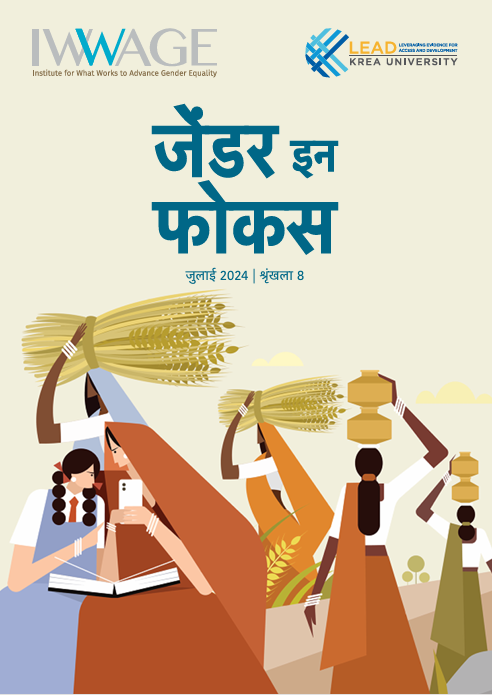
Gender in Focus- Hindi
- July , 2024
- IWWAGE
This edition of “Gender in Focus” explores key topics such as gender-based violence, empowering women in STEM and the care sector’s emerging priorities. It also feature updates from our networks and coalitions. Each article reflects our collective effort to drive meaningful change and inspire action towards a more equitable society.
This edition of “Gender in Focus” explores key topics such as gender-based violence, empowering women in STEM and the care sector’s emerging priorities. It also feature updates from our networks and coalitions. Each article reflects our collective effort to drive meaningful change and inspire action towards a more equitable society.
Brief
Care and Climate Change
- January , 2026
The brief focuses on bridging feminist economics and climate policy, highlighting gendered care burdens, structural undervaluation of reproductive labour, and the need for transformative interventions like care-responsive adaptation and finance.
The brief focuses on bridging feminist economics and climate policy, highlighting gendered care burdens, structural undervaluation of reproductive labour, and the need for transformative interventions like care-responsive adaptation and finance.
Brief
Measuring Women’s Work: Innovations and Obstacles in the Global South
- January , 2026
The brief examined challenges and innovations in capturing women’s paid and unpaid work in labour statistics. Drawing on experiences from India, South Africa, Latin America, and global systems, panelists highlighted how survey design, classifications, and institutional limits determine what is counted, and what remains invisible
The brief examined challenges and innovations in capturing women’s paid and unpaid work in labour statistics. Drawing on experiences from India, South Africa, Latin America, and global systems, panelists highlighted how survey design, classifications, and institutional limits determine what is counted, and what remains invisible

Report Snapshot
The Changing World of Women’s Work
- December , 2025
- Bidisha Mondal, Prakriti Sharma, Aneek Chowdhury, Anjali S
This study examines women’s participation in India’s platform economy using a mixed-methods approach, combining a survey of 598 platform workers (440 women) across care, domestic, beauty, ride-sharing, and delivery services with qualitative interviews. While platform work offers new entry points and flexibility, it often mirrors and deepens the precarity of informal work, limiting its potential for women’s empowerment. Persistent challenges include income instability, high entry and platform costs, limited social protection, unsafe conditions, and reinforced gender inequalities. Meaningful progress requires coordinated action by policymakers, platforms, and worker collectives to ensure fair earnings, social security, gender-sensitive systems, and effective grievance redressal
This study examines women’s participation in India’s platform economy using a mixed-methods approach, combining a survey of 598 platform workers (440 women) across care, domestic, beauty, ride-sharing, and delivery services with qualitative interviews. While platform work offers new entry points and flexibility, it often mirrors and deepens the precarity of informal work, limiting its potential for women’s empowerment. Persistent challenges include income instability, high entry and platform costs, limited social protection, unsafe conditions, and reinforced gender inequalities. Meaningful progress requires coordinated action by policymakers, platforms, and worker collectives to ensure fair earnings, social security, gender-sensitive systems, and effective grievance redressal

Brief
Women’s Work and AI-Unlocking Potential, Bridging the Divide
- December , 2025
- Sharati Roy, Dr. Mahima Taneja
AI is not neutral in how it’s designed or deployed. It is reshaping labour markets, with the biggest gains when it complements human skills rather than replaces them (ILO, 2025). While AI can improve efficiency and decision-making in sectors like healthcare, finance, and education, it also risks job losses and deeper inequalities. Outcomes will depend on whether AI drives automation or augmentation. In India—where Digital Public Infrastructure, data expansion, and the gig economy are growing rapidly—this brief explores women’s opportunities in AI/data value-chain work and AI-augmented livelihoods to support economic empowerment.
AI is not neutral in how it’s designed or deployed. It is reshaping labour markets, with the biggest gains when it complements human skills rather than replaces them (ILO, 2025). While AI can improve efficiency and decision-making in sectors like healthcare, finance, and education, it also risks job losses and deeper inequalities. Outcomes will depend on whether AI drives automation or augmentation. In India—where Digital Public Infrastructure, data expansion, and the gig economy are growing rapidly—this brief explores women’s opportunities in AI/data value-chain work and AI-augmented livelihoods to support economic empowerment.
Report
The Changing World of Women’s Work
- December , 2025
- Bidisha Mondal, Prakriti Sharma, Aneek Chowdhury, Anjali S
This study examines women’s participation in India’s platform economy using a mixed-methods approach, combining a survey of 598 platform workers (440 women) across care, domestic, beauty, ride-sharing, and delivery services with qualitative interviews. While platform work offers new entry points and flexibility, it often mirrors and deepens the precarity of informal work, limiting its potential for women’s empowerment. Persistent challenges include income instability, high entry and platform costs, limited social protection, unsafe conditions, and reinforced gender inequalities. Meaningful progress requires coordinated action by policymakers, platforms, and worker collectives to ensure fair earnings, social security, gender-sensitive systems, and effective grievance redressal
This study examines women’s participation in India’s platform economy using a mixed-methods approach, combining a survey of 598 platform workers (440 women) across care, domestic, beauty, ride-sharing, and delivery services with qualitative interviews. While platform work offers new entry points and flexibility, it often mirrors and deepens the precarity of informal work, limiting its potential for women’s empowerment. Persistent challenges include income instability, high entry and platform costs, limited social protection, unsafe conditions, and reinforced gender inequalities. Meaningful progress requires coordinated action by policymakers, platforms, and worker collectives to ensure fair earnings, social security, gender-sensitive systems, and effective grievance redressal

Brief
Impact of Social Norms on Women’s Economic Empowerment in India
- November , 2025
- Mridusmita Bordoloi, Surabhi Awasthi, Sharati Roy
Women’s Economic Empowerment (WEE) refers to women’s access to economic opportunities, resources, decent work, and the ability to make independent economic choices. It is both a process and an outcome that strengthens individual agency and supports inclusive growth. In countries like India, WEE is constrained not only by structural gaps—such as inadequate care infrastructure, poor connectivity, and limited skills access—but also by deeply rooted gender norms that shape women’s roles in society.
Women’s Economic Empowerment (WEE) refers to women’s access to economic opportunities, resources, decent work, and the ability to make independent economic choices. It is both a process and an outcome that strengthens individual agency and supports inclusive growth. In countries like India, WEE is constrained not only by structural gaps—such as inadequate care infrastructure, poor connectivity, and limited skills access—but also by deeply rooted gender norms that shape women’s roles in society.