


Publications
Publications
Category
Year
Brief
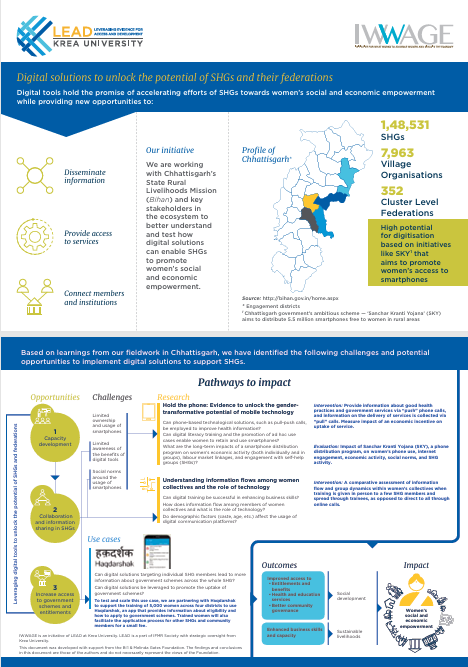
Digital Solutions to Unlock the Potential of SHGs and their Federations
- January , 2020
IWWAGE – an initiative of LEAD at Krea University– in partnership with the State Rural Livelihoods Mission (SRLM) Chhattisgarh and Haqdarshak Empowerment Solutions, is implementing a project that trains women self-help group (SHG) members as Haqdarshikas to provide doorstep access to government welfare schemes using a mobile app, Haqdarshak. A survey of 411 Haqdarshikas conducted in late 2020 revealed that while many continued to support their communities, a large number had stopped using the app, citing issues such as smartphone access, digital literacy, and low demand for services. Despite challenges, 97% of respondents reported earning income through paid work, and most remained engaged in the program, motivated by community recognition, learning, and income opportunities. The study highlights both the potential and challenges of leveraging SHG women as digital agents for last-mile delivery of entitlements and offers insights for improving retention, support, and impact of such models.
IWWAGE – an initiative of LEAD at Krea University– in partnership with the State Rural Livelihoods Mission (SRLM) Chhattisgarh and Haqdarshak Empowerment Solutions, is implementing a project that trains women self-help group (SHG) members as Haqdarshikas to provide doorstep access to government welfare schemes using a mobile app, Haqdarshak. A survey of 411 Haqdarshikas conducted in late 2020 revealed that while many continued to support their communities, a large number had stopped using the app, citing issues such as smartphone access, digital literacy, and low demand for services. Despite challenges, 97% of respondents reported earning income through paid work, and most remained engaged in the program, motivated by community recognition, learning, and income opportunities. The study highlights both the potential and challenges of leveraging SHG women as digital agents for last-mile delivery of entitlements and offers insights for improving retention, support, and impact of such models.

Learning note
Women and Unpaid Work
- November , 2019
The methodology involves assessing the causal effect of switching to LPG on women’s outcomes by construction of a comparison group of households that are not eligible for or did not participate in PMUY. The study uses self-reported health status, and a time-use survey of women to measure the effect of LPG usage on time released for other activities. The results from this exercise would be used to design an experiment wherein information on long-term health benefits of LPG usage and the financial incentive under PMUY would be disseminated in randomly selected villages. This would be conducted by Accredited Social Health Activist (ASHA) workers by visiting randomly sampled households in treatment villages on a monthly basis, and responses of women in targeted villages would be compared with those of other women at the end of a year. The study is being conducted in Indore region of Madhya Pradesh.
The methodology involves assessing the causal effect of switching to LPG on women’s outcomes by construction of a comparison group of households that are not eligible for or did not participate in PMUY. The study uses self-reported health status, and a time-use survey of women to measure the effect of LPG usage on time released for other activities. The results from this exercise would be used to design an experiment wherein information on long-term health benefits of LPG usage and the financial incentive under PMUY would be disseminated in randomly selected villages. This would be conducted by Accredited Social Health Activist (ASHA) workers by visiting randomly sampled households in treatment villages on a monthly basis, and responses of women in targeted villages would be compared with those of other women at the end of a year. The study is being conducted in Indore region of Madhya Pradesh.

Learning note
Women in Agriculture
- November , 2019
This factsheet presents insights from an IWWAGE and Indian Statistical Institute (ISI) study exploring the impact of structural transformation in agriculture on female employment, with a focus on women farm managers. Using data from the India Human Development Survey (2004-05, 2011-12), the study examines the rise in female farm management, its demographic variations, and key differences between households managed by men and those managed by women. The findings aim to shed light on the evolving role of women in agriculture and its implications for employment.
This factsheet presents insights from an IWWAGE and Indian Statistical Institute (ISI) study exploring the impact of structural transformation in agriculture on female employment, with a focus on women farm managers. Using data from the India Human Development Survey (2004-05, 2011-12), the study examines the rise in female farm management, its demographic variations, and key differences between households managed by men and those managed by women. The findings aim to shed light on the evolving role of women in agriculture and its implications for employment.

Report
Digitisation of Self-Help Groups in India
- August , 2019
- Sharon Buteau | Jithin Jose | Kriti Chouhan
Self Help Groups (SHGs) have become essential for empowering women in India. Digitisation of SHG processes can streamline operations, addressing challenges like inefficient monitoring, data fragmentation, and capacity-building gaps. The Deendayal Antyodaya Yojana-National Rural Livelihoods Mission (DAY-NRLM) and its state chapters have made significant progress in this area. This report provides an assessment and roadmap for State Rural Livelihoods Missions (SRLMs) to digitise SHG processes effectively. It highlights current initiatives, identifies gaps, and suggests ways to address them. While Management Information Systems (MIS) have been digitised to some extent, many SRLMs face challenges such as resource shortages and limited IT capabilities, which hinder progress. Additionally, SHGs often lack clarity on the benefits of digitisation, leading to low community ownership. Most programmes rely on manual data entry, with few using digital tools at the ground level. SHG members and stakeholders beyond SRLMs and banks have limited access to the data. Improved data quality and use are essential for better financial outcomes for SHGs. Digital linkages for livelihoods and markets are underdeveloped, with innovations remaining small and context-dependent. Additionally, digital platforms for learning are underutilised due to limited smartphone and internet access in rural areas. The success of digitisation initiatives depends on partnerships between implementing agencies and Technology Service Providers (TSPs). Flexible models, like those seen in Andhra Pradesh and Jharkhand, offer promising examples for the future. Addressing these challenges will be crucial for the long-term success and sustainability of SHG digitisation efforts.
Self Help Groups (SHGs) have become essential for empowering women in India. Digitisation of SHG processes can streamline operations, addressing challenges like inefficient monitoring, data fragmentation, and capacity-building gaps. The Deendayal Antyodaya Yojana-National Rural Livelihoods Mission (DAY-NRLM) and its state chapters have made significant progress in this area. This report provides an assessment and roadmap for State Rural Livelihoods Missions (SRLMs) to digitise SHG processes effectively. It highlights current initiatives, identifies gaps, and suggests ways to address them. While Management Information Systems (MIS) have been digitised to some extent, many SRLMs face challenges such as resource shortages and limited IT capabilities, which hinder progress. Additionally, SHGs often lack clarity on the benefits of digitisation, leading to low community ownership. Most programmes rely on manual data entry, with few using digital tools at the ground level. SHG members and stakeholders beyond SRLMs and banks have limited access to the data. Improved data quality and use are essential for better financial outcomes for SHGs. Digital linkages for livelihoods and markets are underdeveloped, with innovations remaining small and context-dependent. Additionally, digital platforms for learning are underutilised due to limited smartphone and internet access in rural areas. The success of digitisation initiatives depends on partnerships between implementing agencies and Technology Service Providers (TSPs). Flexible models, like those seen in Andhra Pradesh and Jharkhand, offer promising examples for the future. Addressing these challenges will be crucial for the long-term success and sustainability of SHG digitisation efforts.

Working Paper
Identifying Gaps in Gender Statistics In India
- June , 2019
- Shiney Chakraborthy, Ruchika Chaudhary
Women are key agents of change, and a move towards gender equality translates into increased economic empowerment for women; it also brings greater benefits for the society at large. As pointed out by McKinsey Global Institute, the economic impact of achieving gender equality in India is estimated to be US$700 billion of added Gross Domestic Product (GDP) by 2025. But achieving gender equality necessitates measures to correct for existing disadvantages that prevent women from accessing productive opportunities. Gender data play an important role in this regard. This study is an attempt to outline the existing gaps in available official data sources in India. The study has identified data gaps in key domains of women’s empowerment, namely, employment and wages, ownership of assets, access to basic amenities, financial inclusion, health, education, access to digital platforms, participation in decision making, and crime and violence, etc. The study highlights the need for more regular surveys on employment and wages, and time use surveys to better capture women’s paid and unpaid work, and also time spent on different unpaid activities. A multi-causal approach to data collection on migration, on earnings of the self-employed as well as on ownership and management of assets and businesses, at the individual level, is also recommended. Besides, a cohort study of young women, behavioural aspects, norms and opinions around women’s work, as well as data on mental health, learning outcomes, violence and individual access to digital resources, would provide a range of measures to investigate the issue of women’s empowerment.
Women are key agents of change, and a move towards gender equality translates into increased economic empowerment for women; it also brings greater benefits for the society at large. As pointed out by McKinsey Global Institute, the economic impact of achieving gender equality in India is estimated to be US$700 billion of added Gross Domestic Product (GDP) by 2025. But achieving gender equality necessitates measures to correct for existing disadvantages that prevent women from accessing productive opportunities. Gender data play an important role in this regard. This study is an attempt to outline the existing gaps in available official data sources in India. The study has identified data gaps in key domains of women’s empowerment, namely, employment and wages, ownership of assets, access to basic amenities, financial inclusion, health, education, access to digital platforms, participation in decision making, and crime and violence, etc. The study highlights the need for more regular surveys on employment and wages, and time use surveys to better capture women’s paid and unpaid work, and also time spent on different unpaid activities. A multi-causal approach to data collection on migration, on earnings of the self-employed as well as on ownership and management of assets and businesses, at the individual level, is also recommended. Besides, a cohort study of young women, behavioural aspects, norms and opinions around women’s work, as well as data on mental health, learning outcomes, violence and individual access to digital resources, would provide a range of measures to investigate the issue of women’s empowerment.
Working Paper
Impact of Centre-based Quality Childcare on Maternal Employment & Early Childhood Development Outcomes
- April , 2019
- Surabhi Chaturvedi
India has low Female Labour Force Participation (FLFP) and this has ramifications on women’s economic empowerment and India’s Gross Domestic Product (GDP). The issue is compounded by time-poverty endured by women, masking the burden of unpaid work, a part of which is unpaid care for the children and the elderly. Often, social protection and child development programmes in India, and globally, target a certain population in isolation, ignoring unintended consequences for example, child nutrition programmes often prescribe interventions without considering the demands these impose on a woman’s time. At a household level, this translates into exacerbating time poverty for women and deprives children of direct care in early childhood. At the state level, this results in disjointed or siloed social protection policies and diluted programmes for women’s empowerment and child development. Centre-based Quality Childcare: A Case for Public Investment for Improved Maternal Employment and Early Childhood Development is a three-part series of papers. The series is a commentary that emphasises the inter-connectedness of labour, women’s empowerment, and child development policies and programmes. It elaborates on this inter-connectedness’s criticality in planning and implementation to actualise the additive effects (positive feedback loops) and alleviate exposure to risk factors and unintended consequences (negative feedback loops), especially at the critical points in the life cycle of a woman (childhood to adulthood). More specifically, this first paper in the series maps the pathway on how accessible, affordable and quality centre-based childcare can support women by reducing and redistributing the unpaid care work, thereby alleviating time poverty to a certain extent and improving the quality of care for children. It brings together evidence of how public provision of centre-based childcare has had positive impact on the two outcomes of interest maternal employment as well as various aspects of early childhood development for children under six years of age.
India has low Female Labour Force Participation (FLFP) and this has ramifications on women’s economic empowerment and India’s Gross Domestic Product (GDP). The issue is compounded by time-poverty endured by women, masking the burden of unpaid work, a part of which is unpaid care for the children and the elderly. Often, social protection and child development programmes in India, and globally, target a certain population in isolation, ignoring unintended consequences for example, child nutrition programmes often prescribe interventions without considering the demands these impose on a woman’s time. At a household level, this translates into exacerbating time poverty for women and deprives children of direct care in early childhood. At the state level, this results in disjointed or siloed social protection policies and diluted programmes for women’s empowerment and child development. Centre-based Quality Childcare: A Case for Public Investment for Improved Maternal Employment and Early Childhood Development is a three-part series of papers. The series is a commentary that emphasises the inter-connectedness of labour, women’s empowerment, and child development policies and programmes. It elaborates on this inter-connectedness’s criticality in planning and implementation to actualise the additive effects (positive feedback loops) and alleviate exposure to risk factors and unintended consequences (negative feedback loops), especially at the critical points in the life cycle of a woman (childhood to adulthood). More specifically, this first paper in the series maps the pathway on how accessible, affordable and quality centre-based childcare can support women by reducing and redistributing the unpaid care work, thereby alleviating time poverty to a certain extent and improving the quality of care for children. It brings together evidence of how public provision of centre-based childcare has had positive impact on the two outcomes of interest maternal employment as well as various aspects of early childhood development for children under six years of age.

Working Paper
Social Safety Net for Maternity Protection and Early Childhood Development in India
- April , 2019
- Surabhi Chaturvedi
This paper analyses the Integrated Child Development Services (ICDS) system (its historical evolution and current form) and other policies that are intended to provide maternity support and early childhood development. In light of the learnings from the second paper, this paper attempts a gap analysis of the ICDS system capacity and design to reach the intended beneficiary. It highlights the fact that in an effort to provide integrated services, vertical programmes attempt to deliver their interventions using the common platform of ICDS, without accurately assessing the capacity or design of these platforms. Often the layering of additional inputs onto these platforms causes the system to overload, resulting in diminishing returns or exacerbating the negative feedback loops. Moreover, human resources for childcare is one of the key features that influences the quality of the childcare centres. This paper includes findings from a qualitative field study on insights on human resources motivations and non-monetary incentives that influence their performance and productivity. This is accompanied by articulation of potential research questions and some next steps to further the agenda of early childhood development and maternity support.
This paper analyses the Integrated Child Development Services (ICDS) system (its historical evolution and current form) and other policies that are intended to provide maternity support and early childhood development. In light of the learnings from the second paper, this paper attempts a gap analysis of the ICDS system capacity and design to reach the intended beneficiary. It highlights the fact that in an effort to provide integrated services, vertical programmes attempt to deliver their interventions using the common platform of ICDS, without accurately assessing the capacity or design of these platforms. Often the layering of additional inputs onto these platforms causes the system to overload, resulting in diminishing returns or exacerbating the negative feedback loops. Moreover, human resources for childcare is one of the key features that influences the quality of the childcare centres. This paper includes findings from a qualitative field study on insights on human resources motivations and non-monetary incentives that influence their performance and productivity. This is accompanied by articulation of potential research questions and some next steps to further the agenda of early childhood development and maternity support.

Working Paper
Public Provision of Centre-based Childcare in High, Middle & Low-Income Countries
- April , 2019
- Surabhi Chaturvedi
This paper “Public provision of centre-based childcare in high-, middle- and low-income countries: What are the systemic features that aided the effective scale up of these programmes? highlights that the provision of public childcare sits in a large complex adaptive system made of building blocks, such as governance/accountability, financing, scope of the programme, human resources for childcare, data systems, evaluation, costing and impact, and social norms, that need to work in cohesion to ensure a positive impact on two outcomes: maternal employment and early childhood development in large-scale programmes. The main contribution of this paper is to focus, in a comparative study format, on the systemic features that have allowed low- and middle-income countries to implement and iteratively scale up centre-based childcare programmes. This is supported by examples from countries which were cognizant of this complex adaptive systemic thinking, and iteratively scaled up programmes, achieving a positive impact on the two outcomes mentioned above. This paper also documents examples of small-scale, alternate/non-government models of affordable, quality centre-based childcare in India that support working mothers. The intention is to show the feasibility of adoption of the systemic thinking to deliver quality service in India.
This paper “Public provision of centre-based childcare in high-, middle- and low-income countries: What are the systemic features that aided the effective scale up of these programmes? highlights that the provision of public childcare sits in a large complex adaptive system made of building blocks, such as governance/accountability, financing, scope of the programme, human resources for childcare, data systems, evaluation, costing and impact, and social norms, that need to work in cohesion to ensure a positive impact on two outcomes: maternal employment and early childhood development in large-scale programmes. The main contribution of this paper is to focus, in a comparative study format, on the systemic features that have allowed low- and middle-income countries to implement and iteratively scale up centre-based childcare programmes. This is supported by examples from countries which were cognizant of this complex adaptive systemic thinking, and iteratively scaled up programmes, achieving a positive impact on the two outcomes mentioned above. This paper also documents examples of small-scale, alternate/non-government models of affordable, quality centre-based childcare in India that support working mothers. The intention is to show the feasibility of adoption of the systemic thinking to deliver quality service in India.

Brief
Women’s Employment Within an Entrepreneurship Model
- April , 2019
To advance conversations around women’s employment and entrepreneurship, IWWAGE and the Institute of Social Studies Trust (ISST) co-hosted a roundtable on January 21, 2019 at the India Habitat Centre, New Delhi. The dialogue was set against the backdrop of the NITI Aayog’s strategy document ‘Strategy for New India @75′, which identifies low female labour force participation as a key barrier to economic growth and proposes promoting entrepreneurship among women as a strategic solution. The roundtable brought together academics, practitioners, researchers, and corporate representatives to deliberate on how entrepreneurship models can be better aligned with women’s employment needs. Discussions underscored the need for capacity building of women’s collectives, access to affordable credit, and improved market linkages. Participants highlighted that entrepreneurship is often viewed as a coping mechanism rather than a career path, especially among younger women who aspire to formal employment. Key barriers-such as limited access to institutional finance, absence of adequate support services, and disconnects between skills training and employment aspirations-were explored. The importance of unpaid care work, safety at workplaces, and the heterogeneity of women’s needs were also emphasised in shaping inclusive entrepreneurship strategies. The event concluded with a call to develop a broad position paper on women’s entrepreneurship, and to foster partnerships with states and private sector players. There was consensus on the need for holistic macroeconomic strategies that position entrepreneurship within the larger context of women’s employment in India.
To advance conversations around women’s employment and entrepreneurship, IWWAGE and the Institute of Social Studies Trust (ISST) co-hosted a roundtable on January 21, 2019 at the India Habitat Centre, New Delhi. The dialogue was set against the backdrop of the NITI Aayog’s strategy document ‘Strategy for New India @75′, which identifies low female labour force participation as a key barrier to economic growth and proposes promoting entrepreneurship among women as a strategic solution. The roundtable brought together academics, practitioners, researchers, and corporate representatives to deliberate on how entrepreneurship models can be better aligned with women’s employment needs. Discussions underscored the need for capacity building of women’s collectives, access to affordable credit, and improved market linkages. Participants highlighted that entrepreneurship is often viewed as a coping mechanism rather than a career path, especially among younger women who aspire to formal employment. Key barriers-such as limited access to institutional finance, absence of adequate support services, and disconnects between skills training and employment aspirations-were explored. The importance of unpaid care work, safety at workplaces, and the heterogeneity of women’s needs were also emphasised in shaping inclusive entrepreneurship strategies. The event concluded with a call to develop a broad position paper on women’s entrepreneurship, and to foster partnerships with states and private sector players. There was consensus on the need for holistic macroeconomic strategies that position entrepreneurship within the larger context of women’s employment in India.

Working Paper
Impact of Centre-based Quality Childcare on Maternal Employment & Early Childhood Development Outcomes
- April , 2019
- Surabhi Chaturvedi
This document is for private circulation and is not a priced publication. Suggested citation: Chaturvedi, S. (2019). Global evidence on the impact of centre-based quality childcare on maternal employment and early childhood development outcomes, IWWAGE Working Paper Series. New Delhi: Initiative for What Works to Advance Women and Girls in the Economy (IWWAGE)
This document is for private circulation and is not a priced publication. Suggested citation: Chaturvedi, S. (2019). Global evidence on the impact of centre-based quality childcare on maternal employment and early childhood development outcomes, IWWAGE Working Paper Series. New Delhi: Initiative for What Works to Advance Women and Girls in the Economy (IWWAGE)
Brief
Care and Climate Change
- January , 2026
The brief focuses on bridging feminist economics and climate policy, highlighting gendered care burdens, structural undervaluation of reproductive labour, and the need for transformative interventions like care-responsive adaptation and finance.
The brief focuses on bridging feminist economics and climate policy, highlighting gendered care burdens, structural undervaluation of reproductive labour, and the need for transformative interventions like care-responsive adaptation and finance.
Brief
Measuring Women’s Work: Innovations and Obstacles in the Global South
- January , 2026
The brief examined challenges and innovations in capturing women’s paid and unpaid work in labour statistics. Drawing on experiences from India, South Africa, Latin America, and global systems, panelists highlighted how survey design, classifications, and institutional limits determine what is counted, and what remains invisible
The brief examined challenges and innovations in capturing women’s paid and unpaid work in labour statistics. Drawing on experiences from India, South Africa, Latin America, and global systems, panelists highlighted how survey design, classifications, and institutional limits determine what is counted, and what remains invisible

Report Snapshot
The Changing World of Women’s Work
- December , 2025
- Bidisha Mondal, Prakriti Sharma, Aneek Chowdhury, Anjali S
This study examines women’s participation in India’s platform economy using a mixed-methods approach, combining a survey of 598 platform workers (440 women) across care, domestic, beauty, ride-sharing, and delivery services with qualitative interviews. While platform work offers new entry points and flexibility, it often mirrors and deepens the precarity of informal work, limiting its potential for women’s empowerment. Persistent challenges include income instability, high entry and platform costs, limited social protection, unsafe conditions, and reinforced gender inequalities. Meaningful progress requires coordinated action by policymakers, platforms, and worker collectives to ensure fair earnings, social security, gender-sensitive systems, and effective grievance redressal
This study examines women’s participation in India’s platform economy using a mixed-methods approach, combining a survey of 598 platform workers (440 women) across care, domestic, beauty, ride-sharing, and delivery services with qualitative interviews. While platform work offers new entry points and flexibility, it often mirrors and deepens the precarity of informal work, limiting its potential for women’s empowerment. Persistent challenges include income instability, high entry and platform costs, limited social protection, unsafe conditions, and reinforced gender inequalities. Meaningful progress requires coordinated action by policymakers, platforms, and worker collectives to ensure fair earnings, social security, gender-sensitive systems, and effective grievance redressal

Brief
Women’s Work and AI-Unlocking Potential, Bridging the Divide
- December , 2025
- Sharati Roy, Dr. Mahima Taneja
AI is not neutral in how it’s designed or deployed. It is reshaping labour markets, with the biggest gains when it complements human skills rather than replaces them (ILO, 2025). While AI can improve efficiency and decision-making in sectors like healthcare, finance, and education, it also risks job losses and deeper inequalities. Outcomes will depend on whether AI drives automation or augmentation. In India—where Digital Public Infrastructure, data expansion, and the gig economy are growing rapidly—this brief explores women’s opportunities in AI/data value-chain work and AI-augmented livelihoods to support economic empowerment.
AI is not neutral in how it’s designed or deployed. It is reshaping labour markets, with the biggest gains when it complements human skills rather than replaces them (ILO, 2025). While AI can improve efficiency and decision-making in sectors like healthcare, finance, and education, it also risks job losses and deeper inequalities. Outcomes will depend on whether AI drives automation or augmentation. In India—where Digital Public Infrastructure, data expansion, and the gig economy are growing rapidly—this brief explores women’s opportunities in AI/data value-chain work and AI-augmented livelihoods to support economic empowerment.
Report
The Changing World of Women’s Work
- December , 2025
- Bidisha Mondal, Prakriti Sharma, Aneek Chowdhury, Anjali S
This study examines women’s participation in India’s platform economy using a mixed-methods approach, combining a survey of 598 platform workers (440 women) across care, domestic, beauty, ride-sharing, and delivery services with qualitative interviews. While platform work offers new entry points and flexibility, it often mirrors and deepens the precarity of informal work, limiting its potential for women’s empowerment. Persistent challenges include income instability, high entry and platform costs, limited social protection, unsafe conditions, and reinforced gender inequalities. Meaningful progress requires coordinated action by policymakers, platforms, and worker collectives to ensure fair earnings, social security, gender-sensitive systems, and effective grievance redressal
This study examines women’s participation in India’s platform economy using a mixed-methods approach, combining a survey of 598 platform workers (440 women) across care, domestic, beauty, ride-sharing, and delivery services with qualitative interviews. While platform work offers new entry points and flexibility, it often mirrors and deepens the precarity of informal work, limiting its potential for women’s empowerment. Persistent challenges include income instability, high entry and platform costs, limited social protection, unsafe conditions, and reinforced gender inequalities. Meaningful progress requires coordinated action by policymakers, platforms, and worker collectives to ensure fair earnings, social security, gender-sensitive systems, and effective grievance redressal

Brief
Impact of Social Norms on Women’s Economic Empowerment in India
- November , 2025
- Mridusmita Bordoloi, Surabhi Awasthi, Sharati Roy
Women’s Economic Empowerment (WEE) refers to women’s access to economic opportunities, resources, decent work, and the ability to make independent economic choices. It is both a process and an outcome that strengthens individual agency and supports inclusive growth. In countries like India, WEE is constrained not only by structural gaps—such as inadequate care infrastructure, poor connectivity, and limited skills access—but also by deeply rooted gender norms that shape women’s roles in society.
Women’s Economic Empowerment (WEE) refers to women’s access to economic opportunities, resources, decent work, and the ability to make independent economic choices. It is both a process and an outcome that strengthens individual agency and supports inclusive growth. In countries like India, WEE is constrained not only by structural gaps—such as inadequate care infrastructure, poor connectivity, and limited skills access—but also by deeply rooted gender norms that shape women’s roles in society.