


Assam has seen a sharp rise in female labour force participation since 2021–22, now above the national average (50% vs 42% in PLFS 2023–24). However, the 2022–23 gender gap appears distorted due to an NSSO weighting error in a few villages, which led to underreporting of female participation at district, state, and national levels. In parallel, pro-women initiatives such as Sarothi (interest-subsidised loans) and PMKVY 2.0 (industry-relevant skilling) are believed to have supported this improvement. Future analysis will use corrected PLFS data to better track trends and understand the drivers of rising female employment in Assam.
Publications
Publications
Category
Year
Report
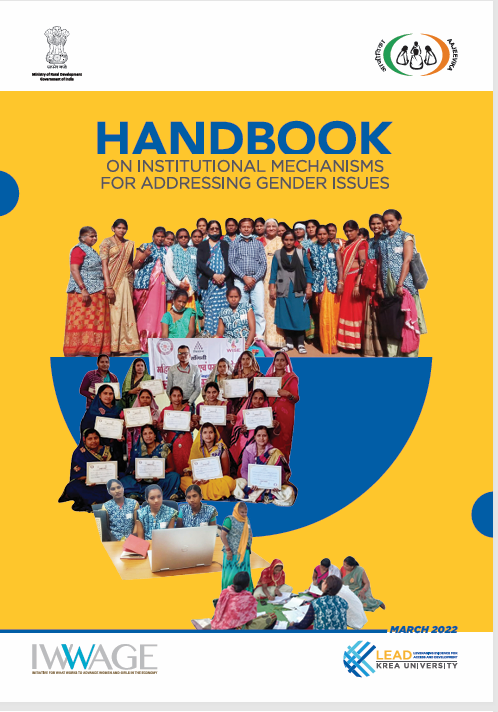
Handbook on institutional mechanisms for addressing gender issues
- March , 2022
- Moumita Sarkar | Soya Thomas | Alpaxee Kashyap
The Deendayal Antyodaya Yojana-National Rural Livelihoods Mission (DAY-NRLM) recognises poverty as multidimensional and addresses the intersectional vulnerabilities women face due to gender, caste, class, and ethnicity. Believing in empowering women through specialised institutions, DAY-NRLM has developed a gender architecture to tackle these challenges. This structure includes platforms such as Gender Forums (GF), Social Action Committees (SAC), Village Organisations (VO), and Cluster-Level Federations (CLF), which raise awareness about women’s rights and connect them to public institutions. Gender Point Persons (GPP) help raise gender issues within Self-Help Groups (SHGs). While progress varies across states, many have successfully used these platforms to secure rights and entitlements for women. This handbook offers guidance on establishing and maintaining these institutions at all levels. It highlights their transformative role in addressing gender inequality, improving access to rights, and fostering stronger state-citizen relationships. The handbook aims to motivate state partners to invest in these models, demonstrating the positive impact they can have on women’s lives.
The Deendayal Antyodaya Yojana-National Rural Livelihoods Mission (DAY-NRLM) recognises poverty as multidimensional and addresses the intersectional vulnerabilities women face due to gender, caste, class, and ethnicity. Believing in empowering women through specialised institutions, DAY-NRLM has developed a gender architecture to tackle these challenges. This structure includes platforms such as Gender Forums (GF), Social Action Committees (SAC), Village Organisations (VO), and Cluster-Level Federations (CLF), which raise awareness about women’s rights and connect them to public institutions. Gender Point Persons (GPP) help raise gender issues within Self-Help Groups (SHGs). While progress varies across states, many have successfully used these platforms to secure rights and entitlements for women. This handbook offers guidance on establishing and maintaining these institutions at all levels. It highlights their transformative role in addressing gender inequality, improving access to rights, and fostering stronger state-citizen relationships. The handbook aims to motivate state partners to invest in these models, demonstrating the positive impact they can have on women’s lives.

Report
Women and Work: How India Fared in 2021
- January , 2022
- IWWAGE , TQH
The year 2021 continued to challenge global recovery efforts, with the second wave of COVID-19 presenting new hurdles. Women and girls were disproportionately impacted, with structural barriers exacerbating the health crisis. As this report is compiled, the Omicron variant remains a threat, highlighting the need for a gender-responsive and equitable recovery. To achieve this, we must design inclusive social safety nets, bridge the gender gap in access to technology, create hybrid work solutions, reduce and redistribute care work, and invest in the care economy. Collecting robust, sex-disaggregated data is crucial to ensure effective, scalable policies and solutions. This report maps the ongoing efforts to bring women back into the workforce and prepare them for the future of work. It highlights key policy and programmatic developments that shaped women’s work in India in 2021. Additionally, the report looks ahead, emphasising new-age skills, entrepreneurship, and non-traditional livelihoods for a self-reliant India. It also sheds light on social indicators influencing women’s workforce participation, including access to resources, health, well-being, and security.
The year 2021 continued to challenge global recovery efforts, with the second wave of COVID-19 presenting new hurdles. Women and girls were disproportionately impacted, with structural barriers exacerbating the health crisis. As this report is compiled, the Omicron variant remains a threat, highlighting the need for a gender-responsive and equitable recovery. To achieve this, we must design inclusive social safety nets, bridge the gender gap in access to technology, create hybrid work solutions, reduce and redistribute care work, and invest in the care economy. Collecting robust, sex-disaggregated data is crucial to ensure effective, scalable policies and solutions. This report maps the ongoing efforts to bring women back into the workforce and prepare them for the future of work. It highlights key policy and programmatic developments that shaped women’s work in India in 2021. Additionally, the report looks ahead, emphasising new-age skills, entrepreneurship, and non-traditional livelihoods for a self-reliant India. It also sheds light on social indicators influencing women’s workforce participation, including access to resources, health, well-being, and security.

Learning note
Innovations for Women’s Empowerment Collectives in Chhattisgarh
- December , 2021
IWWAGE and LEAD at Krea University, in partnership with Bihan and with support from the Gates Foundation, are testing digital and assisted models to strengthen Women’s Empowerment Collectives (WECs) in Chhattisgarh. These pilots include: Haqdarshak: Training SHG women as digital agents (Haqdarshikas) to help communities access government entitlements, with over 2.9 lakh applications processed and income generated for agents. Mor Awaaz: Encouraging mobile phone use among women in SKY villages through weekly information calls, aiming to shift gender norms and improve digital engagement. Information Sharing in SHGs: Exploring how digital tools and social networks influence knowledge sharing and economic resilience, with planned training on soap-making and business skills for SHG women. These initiatives aim to build digital capacity, promote economic inclusion, and strengthen community-based support systems for rural women.
IWWAGE and LEAD at Krea University, in partnership with Bihan and with support from the Gates Foundation, are testing digital and assisted models to strengthen Women’s Empowerment Collectives (WECs) in Chhattisgarh. These pilots include: Haqdarshak: Training SHG women as digital agents (Haqdarshikas) to help communities access government entitlements, with over 2.9 lakh applications processed and income generated for agents. Mor Awaaz: Encouraging mobile phone use among women in SKY villages through weekly information calls, aiming to shift gender norms and improve digital engagement. Information Sharing in SHGs: Exploring how digital tools and social networks influence knowledge sharing and economic resilience, with planned training on soap-making and business skills for SHG women. These initiatives aim to build digital capacity, promote economic inclusion, and strengthen community-based support systems for rural women.

Working Paper
Understanding the barriers to women’s career advancement in the manufacturing sector
- December , 2021
- Swati Sharma
This paper, Understanding the barriers to women’s career advancement in manufacturing sector: diagnostic study of Indian garment factories, is part of the working paper series and has been produced with the help of IWWAGE research fellowship to young researchers in 2019
This paper, Understanding the barriers to women’s career advancement in manufacturing sector: diagnostic study of Indian garment factories, is part of the working paper series and has been produced with the help of IWWAGE research fellowship to young researchers in 2019

IWWAGE-ISI-BRIEFS
Land Access, Productivity and Female Labour Force Participation
- December , 2021
- Ayushi Gupta
Authored by Ayushi Gupta (Research Associate, IWWAGE). ISST is a New Delhi–registered public charitable trust (Reg. No. 923; 25 Feb 1980), based at India Habitat Centre, permitted to receive foreign contributions (FCRA: 231650070); donations are eligible for 80G tax exemption. IWWAGE is an initiative of LEAD (IFMR Society), with strategic oversight and brand support from Krea University, and is supported by the Bill & Melinda Gates Foundation; the views in this brief are the authors’ own and do not necessarily reflect the Foundation’s.
Authored by Ayushi Gupta (Research Associate, IWWAGE). ISST is a New Delhi–registered public charitable trust (Reg. No. 923; 25 Feb 1980), based at India Habitat Centre, permitted to receive foreign contributions (FCRA: 231650070); donations are eligible for 80G tax exemption. IWWAGE is an initiative of LEAD (IFMR Society), with strategic oversight and brand support from Krea University, and is supported by the Bill & Melinda Gates Foundation; the views in this brief are the authors’ own and do not necessarily reflect the Foundation’s.

Learning note
Towards a Gender-Responsive and Inclusive Economic Recovery for India in the COVID-19 Context
- November , 2021
- Kanika Jha Kingra , Soumya Kapoor Mehta
The COVID-19 pandemic disproportionately impacted India’s most vulnerable populations, with women and girls bearing the brunt of job losses, heightened unpaid care responsibilities, and reduced economic participation. At the peak of the first lockdown in April–June 2020, India’s female labour force participation rate plummeted to just 16%, and nearly half of all working women faced permanent job losses-compared to just 7% of men. Women-owned and women-led micro-enterprises also experienced severe income declines and closures. Despite government relief measures, many failed to reach the most marginalised women and girls. As India moves toward economic recovery, there is an urgent need for a just, equitable, and gender-responsive recovery plan that puts women at the centre. This brief by IWWAGE outlines key short-, medium-, and long-term macroeconomic strategies-across monetary, fiscal, and innovative financing domains-to ensure women and girls are not left behind. It calls for investments in the care economy, the creation of equitable jobs and livelihoods, and the adoption of sustainable, climate-just, and rights-based economic models that support long-term resilience.
The COVID-19 pandemic disproportionately impacted India’s most vulnerable populations, with women and girls bearing the brunt of job losses, heightened unpaid care responsibilities, and reduced economic participation. At the peak of the first lockdown in April–June 2020, India’s female labour force participation rate plummeted to just 16%, and nearly half of all working women faced permanent job losses-compared to just 7% of men. Women-owned and women-led micro-enterprises also experienced severe income declines and closures. Despite government relief measures, many failed to reach the most marginalised women and girls. As India moves toward economic recovery, there is an urgent need for a just, equitable, and gender-responsive recovery plan that puts women at the centre. This brief by IWWAGE outlines key short-, medium-, and long-term macroeconomic strategies-across monetary, fiscal, and innovative financing domains-to ensure women and girls are not left behind. It calls for investments in the care economy, the creation of equitable jobs and livelihoods, and the adoption of sustainable, climate-just, and rights-based economic models that support long-term resilience.
Newsletter (Gender In Focus)
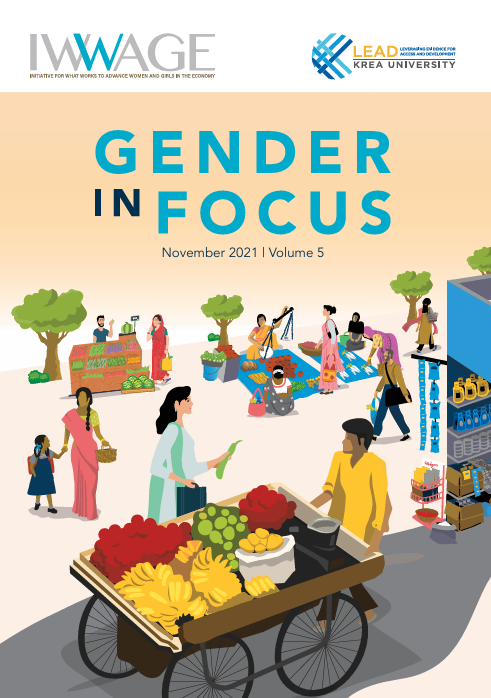
Gender in Focus
- November , 2021
- IWWAGE
The current edition focuses on our latest study on how the lack of safety, attributed to increasing rate of crime against women and girls, acts as a barrier to women’s participation in the workforce. This edition also showcases recommendations for a macroeconomic recovery for India in a COVID and post COVID context with a specific focus on women as a key constituent of this recovery; the impact of sexual harassment on labour market outcomes; and the impact of the COVID crisis on the gendered dimensions of employment and mental health among urban informal-sector workers.
The current edition focuses on our latest study on how the lack of safety, attributed to increasing rate of crime against women and girls, acts as a barrier to women’s participation in the workforce. This edition also showcases recommendations for a macroeconomic recovery for India in a COVID and post COVID context with a specific focus on women as a key constituent of this recovery; the impact of sexual harassment on labour market outcomes; and the impact of the COVID crisis on the gendered dimensions of employment and mental health among urban informal-sector workers.

Working Paper
Understanding violence & female labour supply
- November , 2021
- Neelanjana Gupta
The paper, What is keeping women from going to work: Understanding violence and female labour supply is an output of the research vertical of the Initiative for What Works to Advance Women and Girls in the Economy (IWWAGE), an initiative of LEAD at Krea University. This document is not a priced publication
The paper, What is keeping women from going to work: Understanding violence and female labour supply is an output of the research vertical of the Initiative for What Works to Advance Women and Girls in the Economy (IWWAGE), an initiative of LEAD at Krea University. This document is not a priced publication

IWWAGE-ISI-BRIEFS
Social Identities and Female Labour Force Participation in India
- November , 2021
- Rhitabrita Mukherjee
This brief compiles evidence and data to assess whether caste-based discrimination in India reinforces women’s already disadvantaged position in the labour force. It examines trends in women’s labour force participation by caste, using the official administrative definitions of Scheduled Castes (SCs) and Scheduled Tribes (STs) from major government datasets.
This brief compiles evidence and data to assess whether caste-based discrimination in India reinforces women’s already disadvantaged position in the labour force. It examines trends in women’s labour force participation by caste, using the official administrative definitions of Scheduled Castes (SCs) and Scheduled Tribes (STs) from major government datasets.
SWAYAM
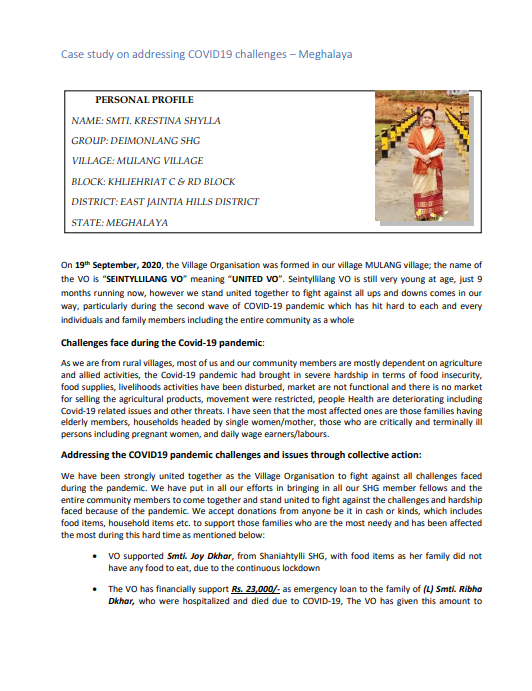
Case study on addressing COVID-19 challenges_Meghalaya
- September , 2021
- Krestina Shylla
SWAYAM
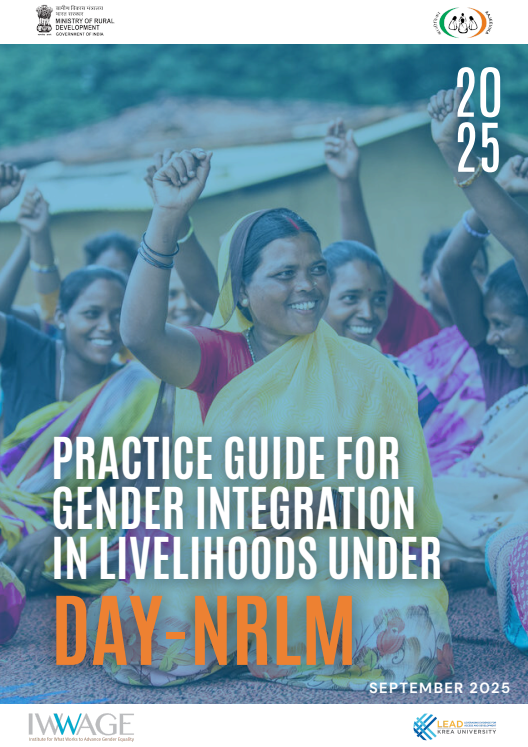
Practice Guide for Gender Integration in Livelihoods under DAY-NRLM
- September , 2025
- Shilpa Vasavada | Seema Bhaskaran
This booklet is intended for the livelihoods vertical and serves as a practical, field-focused Guide for teams on integrating gender into livelihoods interventions. Since these interventions include both farm-based and nonfarm- based activities, the booklet addresses each type separately, following a gender-responsive and progressively gender-transformative approach.
This booklet is intended for the livelihoods vertical and serves as a practical, field-focused Guide for teams on integrating gender into livelihoods interventions. Since these interventions include both farm-based and nonfarm- based activities, the booklet addresses each type separately, following a gender-responsive and progressively gender-transformative approach.

Report
Women and Work: How India fared in 2024
- September , 2025
- Aishwarya Bhuta, Harshita Kumari, Sohinee Thakurta, and Teesta Shukla.
The year 2024 marked a key moment for women and work in India, shaped by economic shifts, policy action, and technological change. Since 2021–22, new challenges and opportunities have influenced women’s workforce participation, alongside renewed efforts to advance women’s economic empowerment. Building on the vision of women-led development highlighted during India’s 2023 G20 presidency, momentum continued across multiple initiatives. This report examines key trends, policy developments, and emerging challenges shaping women’s work in 2024. Drawing on secondary data and research from IWWAGE and LEAD, it maps the evolving landscape of women’s work in India and identifies pathways to greater inclusion and economic agency.
The year 2024 marked a key moment for women and work in India, shaped by economic shifts, policy action, and technological change. Since 2021–22, new challenges and opportunities have influenced women’s workforce participation, alongside renewed efforts to advance women’s economic empowerment. Building on the vision of women-led development highlighted during India’s 2023 G20 presidency, momentum continued across multiple initiatives. This report examines key trends, policy developments, and emerging challenges shaping women’s work in 2024. Drawing on secondary data and research from IWWAGE and LEAD, it maps the evolving landscape of women’s work in India and identifies pathways to greater inclusion and economic agency.

Knowledge series
Migration Climate Change and Gender
- July , 2025
- Divya Singh (IWWAGE), Aiman Akhtar (PDAG)
Climate change is altering everyday life and livelihoods across India, and its impacts are not felt equally. Women, particularly those from marginalised and low-income communities, are often the first to absorb the effects of climate shocks, whether through disrupted livelihoods, migration, or the pressures of extreme weather. These experiences are shaped by long-standing social and economic inequalities, making it essential to look beyond sectoral solutions. One of the least visible but most affected areas is the care economy. As climate risks intensify, women’s unpaid and poorly paid care work expands, especially during displacement, crises, and recovery. Care work plays a critical role in helping families and communities cope with climate stress, yet it remains largely invisible within climate policy and planning. Looking at climate change through the lens of care helps reveal two connected dynamics: how climate risks reshape care responsibilities, and how the way care is organised influences resilience and adaptation. Recognising care, valuing women’s unpaid labour, and strengthening care systems are therefore not add-ons, but central to effective climate responses. This series of policy briefs, jointly developed by IWWAGE and PDAG, explores these connections in detail. It examines how care work is shaped by climate-related vulnerabilities, labour transitions, and forced mobility, with close attention to gendered outcomes. The series is part of a broader climate–gender conversation that includes work, migration, governance, and energy transitions, while centring experiences from India and the Global South. Through this initiative, we aim to deepen understanding, inform policy choices, and contribute meaningfully to ongoing discussions on climate change, care, and gender equality.
Climate change is altering everyday life and livelihoods across India, and its impacts are not felt equally. Women, particularly those from marginalised and low-income communities, are often the first to absorb the effects of climate shocks, whether through disrupted livelihoods, migration, or the pressures of extreme weather. These experiences are shaped by long-standing social and economic inequalities, making it essential to look beyond sectoral solutions. One of the least visible but most affected areas is the care economy. As climate risks intensify, women’s unpaid and poorly paid care work expands, especially during displacement, crises, and recovery. Care work plays a critical role in helping families and communities cope with climate stress, yet it remains largely invisible within climate policy and planning. Looking at climate change through the lens of care helps reveal two connected dynamics: how climate risks reshape care responsibilities, and how the way care is organised influences resilience and adaptation. Recognising care, valuing women’s unpaid labour, and strengthening care systems are therefore not add-ons, but central to effective climate responses. This series of policy briefs, jointly developed by IWWAGE and PDAG, explores these connections in detail. It examines how care work is shaped by climate-related vulnerabilities, labour transitions, and forced mobility, with close attention to gendered outcomes. The series is part of a broader climate–gender conversation that includes work, migration, governance, and energy transitions, while centring experiences from India and the Global South. Through this initiative, we aim to deepen understanding, inform policy choices, and contribute meaningfully to ongoing discussions on climate change, care, and gender equality.

Knowledge series
Migration Climate Change and Gender
- July , 2025
- Divya Singh (IWWAGE), Aiman Akhtar (PDAG)
Climate change is altering everyday life and livelihoods across India, and its impacts are not felt equally. Women, particularly those from marginalised and low-income communities, are often the first to absorb the effects of climate shocks, whether through disrupted livelihoods, migration, or the pressures of extreme weather. These experiences are shaped by long-standing social and economic inequalities, making it essential to look beyond sectoral solutions. One of the least visible but most affected areas is the care economy. As climate risks intensify, women’s unpaid and poorly paid care work expands, especially during displacement, crises, and recovery. Care work plays a critical role in helping families and communities cope with climate stress, yet it remains largely invisible within climate policy and planning. Looking at climate change through the lens of care helps reveal two connected dynamics: how climate risks reshape care responsibilities, and how the way care is organised influences resilience and adaptation. Recognising care, valuing women’s unpaid labour, and strengthening care systems are therefore not add-ons, but central to effective climate responses. This series of policy briefs, jointly developed by IWWAGE and PDAG, explores these connections in detail. It examines how care work is shaped by climate-related vulnerabilities, labour transitions, and forced mobility, with close attention to gendered outcomes. The series is part of a broader climate–gender conversation that includes work, migration, governance, and energy transitions, while centring experiences from India and the Global South. Through this initiative, we aim to deepen understanding, inform policy choices, and contribute meaningfully to ongoing discussions on climate change, care, and gender equality.
Climate change is altering everyday life and livelihoods across India, and its impacts are not felt equally. Women, particularly those from marginalised and low-income communities, are often the first to absorb the effects of climate shocks, whether through disrupted livelihoods, migration, or the pressures of extreme weather. These experiences are shaped by long-standing social and economic inequalities, making it essential to look beyond sectoral solutions. One of the least visible but most affected areas is the care economy. As climate risks intensify, women’s unpaid and poorly paid care work expands, especially during displacement, crises, and recovery. Care work plays a critical role in helping families and communities cope with climate stress, yet it remains largely invisible within climate policy and planning. Looking at climate change through the lens of care helps reveal two connected dynamics: how climate risks reshape care responsibilities, and how the way care is organised influences resilience and adaptation. Recognising care, valuing women’s unpaid labour, and strengthening care systems are therefore not add-ons, but central to effective climate responses. This series of policy briefs, jointly developed by IWWAGE and PDAG, explores these connections in detail. It examines how care work is shaped by climate-related vulnerabilities, labour transitions, and forced mobility, with close attention to gendered outcomes. The series is part of a broader climate–gender conversation that includes work, migration, governance, and energy transitions, while centring experiences from India and the Global South. Through this initiative, we aim to deepen understanding, inform policy choices, and contribute meaningfully to ongoing discussions on climate change, care, and gender equality.

Factsheet
Trends in Female Labour and Workforce Participation – Assam
- July , 2025
- Aneek Choudhary and Vidhi
Assam has seen a sharp rise in female labour force participation since 2021–22, now above the national average (50% vs 42% in PLFS 2023–24). However, the 2022–23 gender gap appears distorted due to an NSSO weighting error in a few villages, which led to underreporting of female participation at district, state, and national levels. In parallel, pro-women initiatives such as Sarothi (interest-subsidised loans) and PMKVY 2.0 (industry-relevant skilling) are believed to have supported this improvement. Future analysis will use corrected PLFS data to better track trends and understand the drivers of rising female employment in Assam.
Assam has seen a sharp rise in female labour force participation since 2021–22, now above the national average (50% vs 42% in PLFS 2023–24). However, the 2022–23 gender gap appears distorted due to an NSSO weighting error in a few villages, which led to underreporting of female participation at district, state, and national levels. In parallel, pro-women initiatives such as Sarothi (interest-subsidised loans) and PMKVY 2.0 (industry-relevant skilling) are believed to have supported this improvement. Future analysis will use corrected PLFS data to better track trends and understand the drivers of rising female employment in Assam.

Report Snapshot
Swayam Process Evaluation: A Year-Long Ethnography Study, Madhya Pradesh & Odisha
- June , 2025
- Anushree Goenka, Lopamudra Nayak, Moumita Mandal, Shaheen Kauser, Sudhir Kumar Kori, Anubha Dixit, Mallika Mitra Biswas, Garvi Dhar, Pratyusha Barua, Surabhi Awasthi, Gayathri Sreedharan
This study assesses the impact of training programmes on community change and empowerment among leaders of Self-Help Groups (SHGs), Village Organisations (VOs), and Cluster-Level Federations (CLFs). It also includes interviews with district- and block-level officials from MPSRLM and OLM to examine how line departments collaborate with community institutions to address and resolve complaints.
This study assesses the impact of training programmes on community change and empowerment among leaders of Self-Help Groups (SHGs), Village Organisations (VOs), and Cluster-Level Federations (CLFs). It also includes interviews with district- and block-level officials from MPSRLM and OLM to examine how line departments collaborate with community institutions to address and resolve complaints.