


This rapid assessment explores how hybrid work models are reshaping opportunities for women in India post-pandemic. It examines the benefits and challenges of hybrid work, with data from 400 working women across various sectors. Featuring a case study of a rural BPO in Uttarakhand, the study highlights the potential of hybrid work for women in both urban and rural areas, offering insights into its impact on productivity, autonomy, and work-life balance.
Publications
Publications
Category
Year

Report
Financing Quality Childcare Facilities in India by IWWAGE and Mobile Creches
- September , 2024
- Divya Singh, Sruthi Kutty, Suchika Gupta
The increasing nuclearisation of families in urban and peri-urban areas is driving demand for quality childcare, especially for working women.This study explores the current landscape of childcare services in India, focusing on government and non-governmental efforts to improve access and support women’s economic empowerment.
The increasing nuclearisation of families in urban and peri-urban areas is driving demand for quality childcare, especially for working women.This study explores the current landscape of childcare services in India, focusing on government and non-governmental efforts to improve access and support women’s economic empowerment.
Report
IWWAGE Women And Work Trends Report 2023
- July , 2024
- Devika Oberai | Suhani Pandey | Manas Pathak
In 2023, India emerged as the fastest-growing major economy globally, driven by robust employment generation, productivity gains, and sustained economic growth. Alongside this remarkable economic performance, the year brought women-led development and Nari Shakti into focus, reaffirming India’s commitment to gender equality and sustainable development. However, despite these advancements, the issue of female labour force participation remains critical. India has long struggled with lower female labour force participation compared to global standards, with socio-economic and cultural factors limiting the full utilisation of women’s potential. Yet, recent trends offer promising signs of progress. According to the latest Periodic Labour Force Survey (2022-2023), female participation in the labour force for those aged 15 and above rose to 37%, with rural areas seeing an increase from 36.6% to 41.5%, and urban areas from 23.8% to 25.4%. More women are engaging in family-owned or self-employed work, including agriculture, contributing positively to this shift. Additionally, 2023 witnessed significant strides towards women-led development, with a renewed push for women’s representation in Parliament and proactive policy discussions during India’s G-20 presidency. However, the journey towards true gender equality remains ongoing. Women continue to be under-represented in key sectors, particularly in science and technology, with workplaces reflecting broader economic and social inequalities. India’s G-20 presidency adopted a gender-focused approach, aiming to reposition women not just as beneficiaries but as economic agents driving development. By embracing women-led development, India sought to shift the narrative and demonstrate the transformative potential of women in spearheading key sectors and promoting inclusive growth. This report contextualises women’s participation in various fields within the broader political and economic landscape of 2023. It highlights the challenges and opportunities that emerged during the year and offers a forward-looking perspective on potential growth areas in 2024, recognising women as a formidable force in driving progress and prosperity.
In 2023, India emerged as the fastest-growing major economy globally, driven by robust employment generation, productivity gains, and sustained economic growth. Alongside this remarkable economic performance, the year brought women-led development and Nari Shakti into focus, reaffirming India’s commitment to gender equality and sustainable development. However, despite these advancements, the issue of female labour force participation remains critical. India has long struggled with lower female labour force participation compared to global standards, with socio-economic and cultural factors limiting the full utilisation of women’s potential. Yet, recent trends offer promising signs of progress. According to the latest Periodic Labour Force Survey (2022-2023), female participation in the labour force for those aged 15 and above rose to 37%, with rural areas seeing an increase from 36.6% to 41.5%, and urban areas from 23.8% to 25.4%. More women are engaging in family-owned or self-employed work, including agriculture, contributing positively to this shift. Additionally, 2023 witnessed significant strides towards women-led development, with a renewed push for women’s representation in Parliament and proactive policy discussions during India’s G-20 presidency. However, the journey towards true gender equality remains ongoing. Women continue to be under-represented in key sectors, particularly in science and technology, with workplaces reflecting broader economic and social inequalities. India’s G-20 presidency adopted a gender-focused approach, aiming to reposition women not just as beneficiaries but as economic agents driving development. By embracing women-led development, India sought to shift the narrative and demonstrate the transformative potential of women in spearheading key sectors and promoting inclusive growth. This report contextualises women’s participation in various fields within the broader political and economic landscape of 2023. It highlights the challenges and opportunities that emerged during the year and offers a forward-looking perspective on potential growth areas in 2024, recognising women as a formidable force in driving progress and prosperity.

Report
Barriers & Opportunities For Aspirational Women Entrepreneurs
- April , 2024
- Neelanjana Gupta | Preethi Rao
This study, conducted in partnership with the Delhi Skill and Entrepreneurship University (DSEU) and the Government of NCT of Delhi, assesses the enterprise readiness of women across five Anganwadi Hubs (AWHs) in the city under the Saheli Samanvay Kendra (SSK) Scheme. Drawing from both quantitative and qualitative data, it explores the demographic profile, motivations, aspirations, and challenges of women’s particularly housewives, unemployed individuals, and informal worker’s seeking to engage in entrepreneurial activities. The findings highlight the critical need for targeted support, especially around access to finance, confidence building, and balancing domestic responsibilities with business pursuits. The study also captures a strong appetite for skill development, with women expressing interest in both technical and soft skills training, particularly if offered at familiar, community-based locations like Anganwadi Centres. These insights directly inform the design of training programmes and the structure of a dedicated fellowship module under the SSK Scheme, which aims to mobilise and mentor women entrepreneurs. The report offers practical recommendations for policymakers and training institutions, underscoring the potential of structured, accessible interventions to advance women’s economic empowerment at the grassroots level.
This study, conducted in partnership with the Delhi Skill and Entrepreneurship University (DSEU) and the Government of NCT of Delhi, assesses the enterprise readiness of women across five Anganwadi Hubs (AWHs) in the city under the Saheli Samanvay Kendra (SSK) Scheme. Drawing from both quantitative and qualitative data, it explores the demographic profile, motivations, aspirations, and challenges of women’s particularly housewives, unemployed individuals, and informal worker’s seeking to engage in entrepreneurial activities. The findings highlight the critical need for targeted support, especially around access to finance, confidence building, and balancing domestic responsibilities with business pursuits. The study also captures a strong appetite for skill development, with women expressing interest in both technical and soft skills training, particularly if offered at familiar, community-based locations like Anganwadi Centres. These insights directly inform the design of training programmes and the structure of a dedicated fellowship module under the SSK Scheme, which aims to mobilise and mentor women entrepreneurs. The report offers practical recommendations for policymakers and training institutions, underscoring the potential of structured, accessible interventions to advance women’s economic empowerment at the grassroots level.
Report
An Assessment Of The National Gender Campaign For DAY-NRLM
- December , 2023
- Moumita Sarkar | Arpita Paul
The Deendayal Antyodaya Yojana-National Rural Livelihoods Mission (DAY-NRLM) is committed to addressing gender equality through its gender interventions, with a focus on eliminating gender-based violence (GBV). GBV, particularly violence against women and girls, remains one of the most significant barriers to personal growth, well-being, and living a life of dignity. Recognising this issue as a major obstacle to individual and societal development, DAY-NRLM has undertaken strategic efforts to combat GBV. To empower marginalised communities, especially women, in recognising and addressing the different forms of violence they face, DAY-NRLM launched the Nayi Chetna Pahal Badlav Ki campaign from 25th November to 23rd December 2022. This month-long initiative, aligned with the International Day for the Elimination of Violence Against Women, was inaugurated by the Honourable Union Minister for Rural Development, Shri Giriraj Singh. The campaign marks the beginning of an annual event focused on gender equity, with each year addressing a specific theme. The theme for Year 1 was Equity and Ending Gender-Based Violence. An assessment was conducted to evaluate the campaign’s reach, relevance, and effectiveness, highlighting the factors that enabled or constrained its success. The findings, drawn from both qualitative and quantitative data, offer valuable insights for improving future campaigns. The report incorporates information from DAY-NRLM’s Management Information System (MIS) and feedback from stakeholders across various administrative level’s state, district, block, Cluster-Level Federations (CLFs), and Village Organisations (VOs). Additionally, a national online survey, with over 20,000 Self-Help Group (SHG) members participating from nearly 5,000 CLFs across 24 states, contributed to the comprehensive assessment.
The Deendayal Antyodaya Yojana-National Rural Livelihoods Mission (DAY-NRLM) is committed to addressing gender equality through its gender interventions, with a focus on eliminating gender-based violence (GBV). GBV, particularly violence against women and girls, remains one of the most significant barriers to personal growth, well-being, and living a life of dignity. Recognising this issue as a major obstacle to individual and societal development, DAY-NRLM has undertaken strategic efforts to combat GBV. To empower marginalised communities, especially women, in recognising and addressing the different forms of violence they face, DAY-NRLM launched the Nayi Chetna Pahal Badlav Ki campaign from 25th November to 23rd December 2022. This month-long initiative, aligned with the International Day for the Elimination of Violence Against Women, was inaugurated by the Honourable Union Minister for Rural Development, Shri Giriraj Singh. The campaign marks the beginning of an annual event focused on gender equity, with each year addressing a specific theme. The theme for Year 1 was Equity and Ending Gender-Based Violence. An assessment was conducted to evaluate the campaign’s reach, relevance, and effectiveness, highlighting the factors that enabled or constrained its success. The findings, drawn from both qualitative and quantitative data, offer valuable insights for improving future campaigns. The report incorporates information from DAY-NRLM’s Management Information System (MIS) and feedback from stakeholders across various administrative level’s state, district, block, Cluster-Level Federations (CLFs), and Village Organisations (VOs). Additionally, a national online survey, with over 20,000 Self-Help Group (SHG) members participating from nearly 5,000 CLFs across 24 states, contributed to the comprehensive assessment.
Report
SWAYAM Process Evaluation
- July , 2023
- Valentina Brailovskaya , Bhavya Khare , Debendra Nag
The Strengthening Women’s Institutions for Agency and Empowerment (SWAYAM) programme is being implemented in Chhattisgarh, Jharkhand, Madhya Pradesh, and Odisha, aimed at empowering women by strengthening collectives. IWWAGE, an initiative of LEAD at Krea University, provides technical assistance to the Deendayal Antyodaya Yojana-National Rural Livelihoods Mission (DAY-NRLM), with IDinsight conducting the evaluation. This report presents IDinsight’s final evaluation findings, offering insights and recommendations for future rollout. The evaluation assessed whether SWAYAM’s activities were implemented as intended based on the Theory of Change (TOC). Two rounds of phone surveys (2021 and 2022) measured key indicators related to women’s empowerment, with the second round including qualitative surveys with stakeholders to understand the role of Gender Resource Centres (GRCs). Key activities in Round 2 included updating the TOC, defining indicators, and revising survey instruments. Topics covered included SWAYAM training, gender-based violence, and economic and political empowerment. This report provides insights to improve SWAYAM’s implementation and increase its impact on women’s empowerment.
The Strengthening Women’s Institutions for Agency and Empowerment (SWAYAM) programme is being implemented in Chhattisgarh, Jharkhand, Madhya Pradesh, and Odisha, aimed at empowering women by strengthening collectives. IWWAGE, an initiative of LEAD at Krea University, provides technical assistance to the Deendayal Antyodaya Yojana-National Rural Livelihoods Mission (DAY-NRLM), with IDinsight conducting the evaluation. This report presents IDinsight’s final evaluation findings, offering insights and recommendations for future rollout. The evaluation assessed whether SWAYAM’s activities were implemented as intended based on the Theory of Change (TOC). Two rounds of phone surveys (2021 and 2022) measured key indicators related to women’s empowerment, with the second round including qualitative surveys with stakeholders to understand the role of Gender Resource Centres (GRCs). Key activities in Round 2 included updating the TOC, defining indicators, and revising survey instruments. Topics covered included SWAYAM training, gender-based violence, and economic and political empowerment. This report provides insights to improve SWAYAM’s implementation and increase its impact on women’s empowerment.
Report
Hybrid Models and Women’s Work in India, Emerging Insights
- March , 2023
- Sona Mitra, Aishwarya Joshi, Mahima Chaki

Report
Evidence Review of the Global Childcare Crisis
- March , 2023
- Kate Grantham , Leva Rouhani, Neelanjana Gupta
The COVID-19 pandemic reversed gains in women’s equality by intensifying unpaid care work and triggering a global childcare crisis. School and childcare closures sharply increased care demands, disproportionately affecting women—especially those in low-paid, informal, and vulnerable jobs—leading to job losses, income insecurity, and limited social protection. Despite its economic importance, childcare remains underfunded and unpaid care work undervalued. Expanding access to affordable, quality childcare is essential to support women’s employment, reduce poverty, create jobs, and enable an inclusive and sustainable post-COVID recovery.
The COVID-19 pandemic reversed gains in women’s equality by intensifying unpaid care work and triggering a global childcare crisis. School and childcare closures sharply increased care demands, disproportionately affecting women—especially those in low-paid, informal, and vulnerable jobs—leading to job losses, income insecurity, and limited social protection. Despite its economic importance, childcare remains underfunded and unpaid care work undervalued. Expanding access to affordable, quality childcare is essential to support women’s employment, reduce poverty, create jobs, and enable an inclusive and sustainable post-COVID recovery.
Report
Gender Modules
- February , 2023
- Moumita Sarkar | Soya Thomas | Seema Bhaskaran
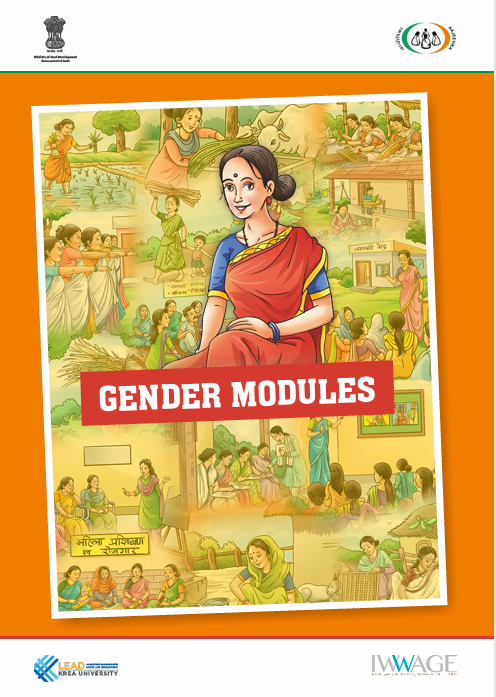
The Deendayal Antyodaya Yojana-National Rural Livelihoods Mission (DAY-NRLM) is a key initiative of the Government of India, led by the Ministry of Rural Development. It aims to collectivise women into institutions that empower them by addressing their needs and concerns, while ensuring their active participation in the development planning process. To advance gender equality, DAY-NRLM follows a two-pronged strategy: establishing functional institutional mechanisms that link communities to governance system and integrating gender-responsive approaches across all program areas. The goal is to foster an environment where women can actively participate in traditional and non-traditional livelihoods and overcome barriers in both public and private spheres. As part of this effort, DAY-NRLM has developed a comprehensive set of 17 training modules. These modules are designed to enhance understanding of key gender concepts and human behaviour, using experiential learning methods such as real-life stories, games, and participatory sessions. They will be used to train National Resource Persons, staff, and community cadres, with the aim of building a demand-driven system that recognises the intersectional challenges faced by women and girls. Developed in collaboration with IWWAGE, these modules cover a wide range of topics, including gender division of labour, asset ownership, and other core concepts, with additional content shaped by state-level needs and the gender operational strategy. This resource is instrumental in supporting DAY-NRLM’s mission to promote gender equality and ensure women’s visibility and empowerment in rural communities.
The Deendayal Antyodaya Yojana-National Rural Livelihoods Mission (DAY-NRLM) is a key initiative of the Government of India, led by the Ministry of Rural Development. It aims to collectivise women into institutions that empower them by addressing their needs and concerns, while ensuring their active participation in the development planning process. To advance gender equality, DAY-NRLM follows a two-pronged strategy: establishing functional institutional mechanisms that link communities to governance system and integrating gender-responsive approaches across all program areas. The goal is to foster an environment where women can actively participate in traditional and non-traditional livelihoods and overcome barriers in both public and private spheres. As part of this effort, DAY-NRLM has developed a comprehensive set of 17 training modules. These modules are designed to enhance understanding of key gender concepts and human behaviour, using experiential learning methods such as real-life stories, games, and participatory sessions. They will be used to train National Resource Persons, staff, and community cadres, with the aim of building a demand-driven system that recognises the intersectional challenges faced by women and girls. Developed in collaboration with IWWAGE, these modules cover a wide range of topics, including gender division of labour, asset ownership, and other core concepts, with additional content shaped by state-level needs and the gender operational strategy. This resource is instrumental in supporting DAY-NRLM’s mission to promote gender equality and ensure women’s visibility and empowerment in rural communities.
Report
Women and Work, How India Fared in 2022
- February , 2023
- IWWAGE , TQH
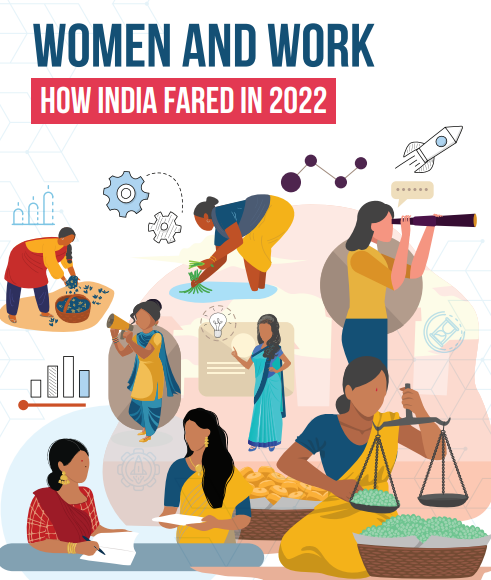
2022 presented a landscape of change as the world aimed for greater resilience, recovery and growth as things began to open up post the COVID-19 pandemic. Spurred by changes in the overall outlook on work, women’s participation in the workforce also reflected a shift, with remote and hybrid work emerging strongly in certain sectors, in continuation of trends set during the height of the pandemic. Similarly, even in work that cannot be performed remotely, there has been a deepening in positive trends. As lockdowns lifted, women persondays in certain employment schemes also climbed. Against this backdrop, India has assumed the G20 presidency for 2023, and the year provides the nation with the opportunity to not only proactively set the agenda for women-led development, but also plan for the next phase of growth. There is thus a need to provide a roadmap for enablers of women-led development, whether through participation in leadership, reflection in policy mandates, or even addressing barriers to work. From the macro-political economic scenario to the specific challenges faced by women, this report situates women’s work against the challenges and opportunities that lie ahead, particularly in light of India’s G20 presidency. Threaded through with insights from IWWAGE and LEAD’s research on the subject, the report covers trends across available data sources on scheme performances, policy changes, and political announcements, mapping the contours of women’s work in India and looking ahead to 2023.
2022 presented a landscape of change as the world aimed for greater resilience, recovery and growth as things began to open up post the COVID-19 pandemic. Spurred by changes in the overall outlook on work, women’s participation in the workforce also reflected a shift, with remote and hybrid work emerging strongly in certain sectors, in continuation of trends set during the height of the pandemic. Similarly, even in work that cannot be performed remotely, there has been a deepening in positive trends. As lockdowns lifted, women persondays in certain employment schemes also climbed. Against this backdrop, India has assumed the G20 presidency for 2023, and the year provides the nation with the opportunity to not only proactively set the agenda for women-led development, but also plan for the next phase of growth. There is thus a need to provide a roadmap for enablers of women-led development, whether through participation in leadership, reflection in policy mandates, or even addressing barriers to work. From the macro-political economic scenario to the specific challenges faced by women, this report situates women’s work against the challenges and opportunities that lie ahead, particularly in light of India’s G20 presidency. Threaded through with insights from IWWAGE and LEAD’s research on the subject, the report covers trends across available data sources on scheme performances, policy changes, and political announcements, mapping the contours of women’s work in India and looking ahead to 2023.

Report
Women’s Work in Select States in India: Opportunities and Challenges
- December , 2022
- Sona Mitra
Women comprise nearly half of the world’s working population and therefore potentially half of its labour force. Female labour force participation (FLFP) represent a women decision to be the part of labour force or part of economically inactive population. At present in nearly every country female labor force participation is lower than that of male labour force participation. Female labour force participation in South Asia is among the lowest of any developing region in the world. As per PLFS, FLFPR in rural and urban area are 27.7% and 18.6% respectively. India’s low female labour force participation excludes almost half of the potential working age population, leading to gross underutilisation of women’s talents and capabilities and remains a roadblock in reaping and distributing its demographic advantage. Women participation in labour force varies across different region. The variation is determined by an array of economic and social factors including income growth, educational attainment, marital status and other prevailing local social norms.
Women comprise nearly half of the world’s working population and therefore potentially half of its labour force. Female labour force participation (FLFP) represent a women decision to be the part of labour force or part of economically inactive population. At present in nearly every country female labor force participation is lower than that of male labour force participation. Female labour force participation in South Asia is among the lowest of any developing region in the world. As per PLFS, FLFPR in rural and urban area are 27.7% and 18.6% respectively. India’s low female labour force participation excludes almost half of the potential working age population, leading to gross underutilisation of women’s talents and capabilities and remains a roadblock in reaping and distributing its demographic advantage. Women participation in labour force varies across different region. The variation is determined by an array of economic and social factors including income growth, educational attainment, marital status and other prevailing local social norms.
Factsheet
Trends in Female Labour Force Participation in Karnataka
- October , 2026
- Vidhi, Bidisha Mondal
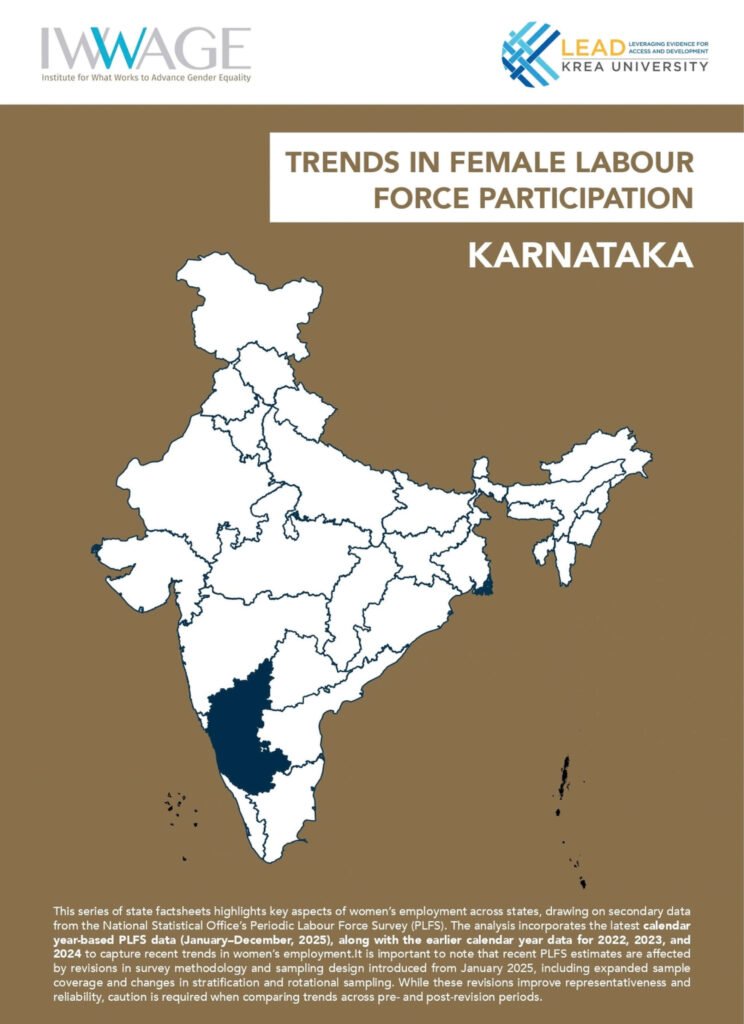
Karnataka occupies a distinctive position in India’s economic landscape, driven by rapid growth in services, technology, and manufacturing sectors.This factsheet examines key trends in women’s labour force participation in Karnataka using PLFS data, with a focus on employment composition, sectoral and occupational distribution, quality of work, and barriers to women’s participation in the labour market.
Karnataka occupies a distinctive position in India’s economic landscape, driven by rapid growth in services, technology, and manufacturing sectors.This factsheet examines key trends in women’s labour force participation in Karnataka using PLFS data, with a focus on employment composition, sectoral and occupational distribution, quality of work, and barriers to women’s participation in the labour market.
Brief
Deconstructing the Care Economy: Measurement, Gendered Outcomes, and Macroeconomic Policy
- September , 2026
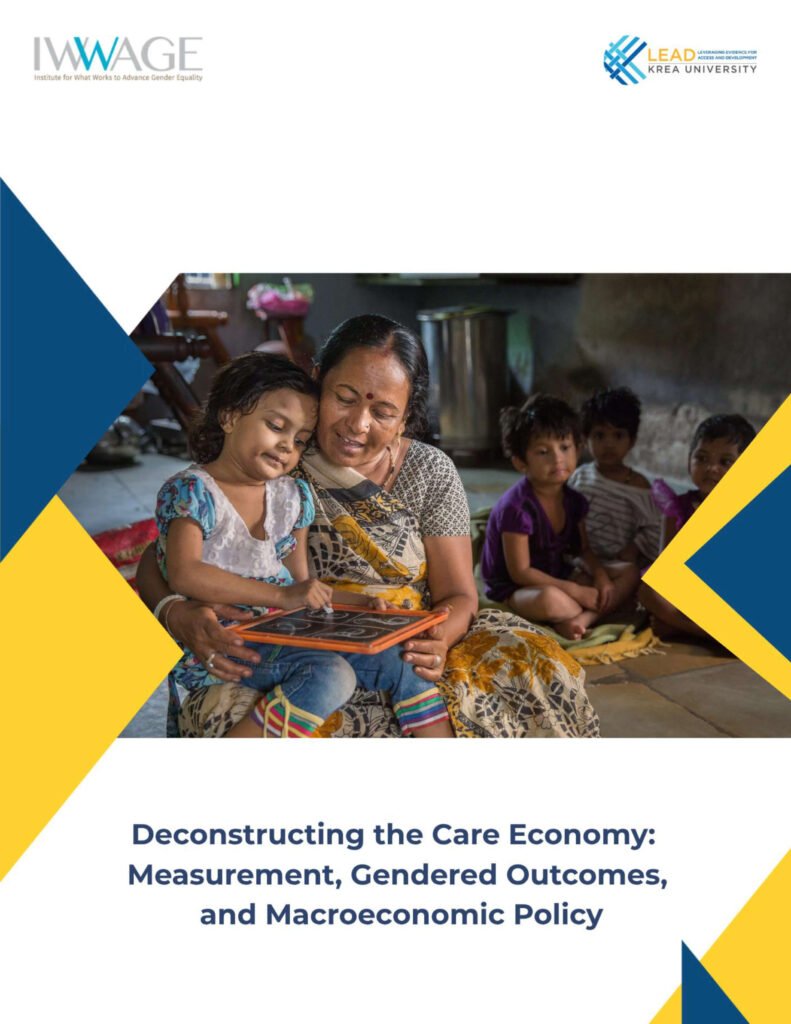
The policy brief examines how unpaid care and domestic work largely undertaken by women remains invisible in conventional economic and labour statistics, while significantly shaping women’s participation and outcomes in the labour market. It highlights how care responsibilities contribute to women’s underemployment, lower-paid and precarious work, and inequalities in platform and hybrid work.
The policy brief examines how unpaid care and domestic work largely undertaken by women remains invisible in conventional economic and labour statistics, while significantly shaping women’s participation and outcomes in the labour market. It highlights how care responsibilities contribute to women’s underemployment, lower-paid and precarious work, and inequalities in platform and hybrid work.
Factsheet
Trends in Female Labour Force Participation in Bihar
- September , 2026
- Vidhi, Bidisha Mondal
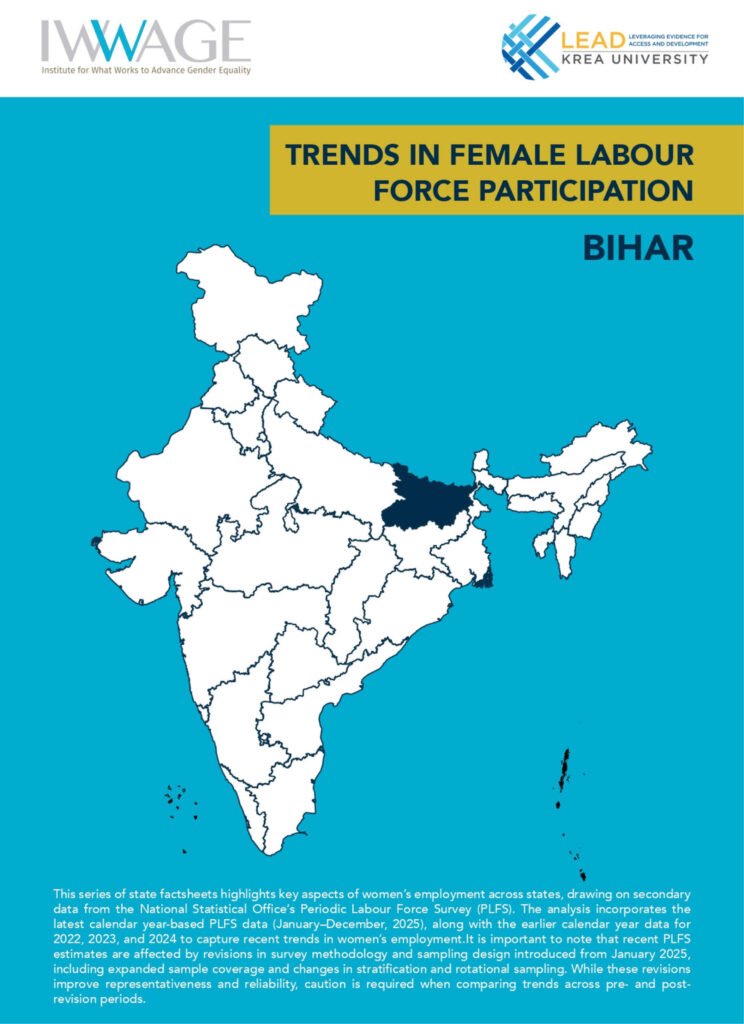
Despite economic growth, Bihar continues to face low female labour force participation, reflecting persistent supply-side constraints and limited access to suitable employment opportunities. Young women, in particular, experience low labour force participation amid high youth unemployment, while employment remains concentrated in agriculture and informal work. Sociocultural norms, limited access to education and skills, mobility constraints, inadequate transport, and care responsibilities further restrict women’s access to employment. Against this backdrop, this factsheet examines trends in female labour force participation, workforce composition, sectoral distribution, and working conditions in Bihar.
Despite economic growth, Bihar continues to face low female labour force participation, reflecting persistent supply-side constraints and limited access to suitable employment opportunities. Young women, in particular, experience low labour force participation amid high youth unemployment, while employment remains concentrated in agriculture and informal work. Sociocultural norms, limited access to education and skills, mobility constraints, inadequate transport, and care responsibilities further restrict women’s access to employment. Against this backdrop, this factsheet examines trends in female labour force participation, workforce composition, sectoral distribution, and working conditions in Bihar.
Report
Women and Work 2025: Megatrends Reshaping Women’s Work in India
- September , 2026
- Divya Singh, Prakriti Sharma, Vidhi Singh, Sharati Roy
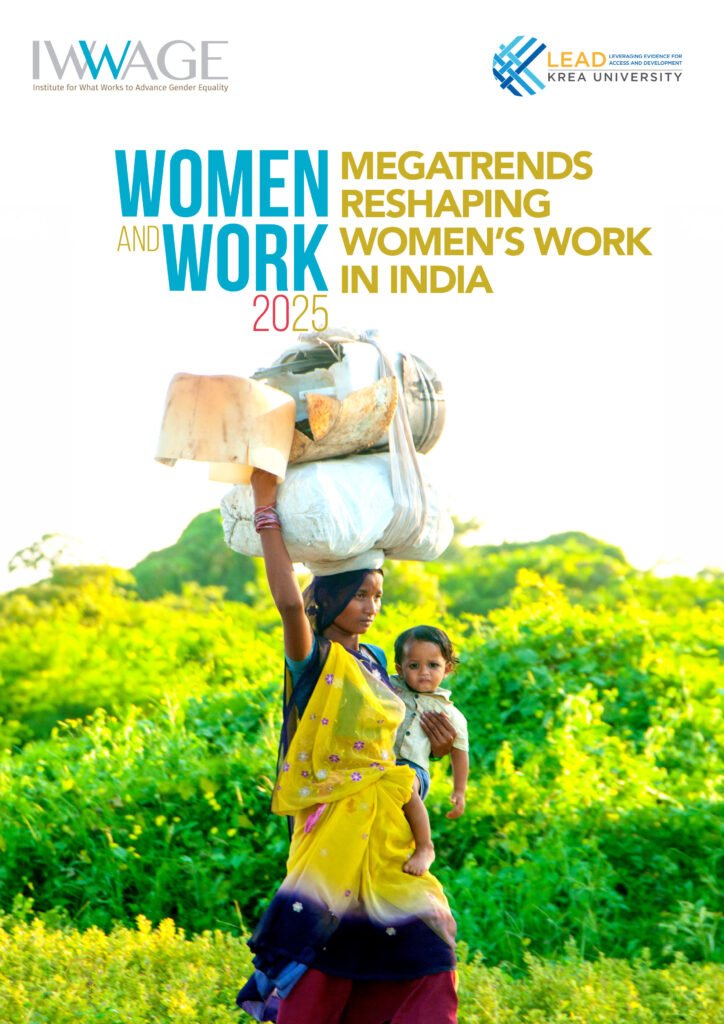
IWWAGE’s flagship report examines the changing landscape of women’s work in India and the forces shaping its future. Women’s labour force participation has risen significantly in recent years. Yet, the headline numbers tell only part of the story. The nature and experience of women’s work continue to be shaped by the quality and security of employment, unpaid care work, digitalisation, artificial intelligence, climate change, and women’s health at work. The report brings together evidence and emerging policy developments across these interconnected forces to examine where women’s work is headed—and what it will take to translate greater participation into greater economic agency, decent work, and protection.
IWWAGE’s flagship report examines the changing landscape of women’s work in India and the forces shaping its future. Women’s labour force participation has risen significantly in recent years. Yet, the headline numbers tell only part of the story. The nature and experience of women’s work continue to be shaped by the quality and security of employment, unpaid care work, digitalisation, artificial intelligence, climate change, and women’s health at work. The report brings together evidence and emerging policy developments across these interconnected forces to examine where women’s work is headed—and what it will take to translate greater participation into greater economic agency, decent work, and protection.
Factsheet
Trends in Female Labour Force Participation in Meghalaya
- August , 2026
- Nabankur Huda, Bidisha Mondal
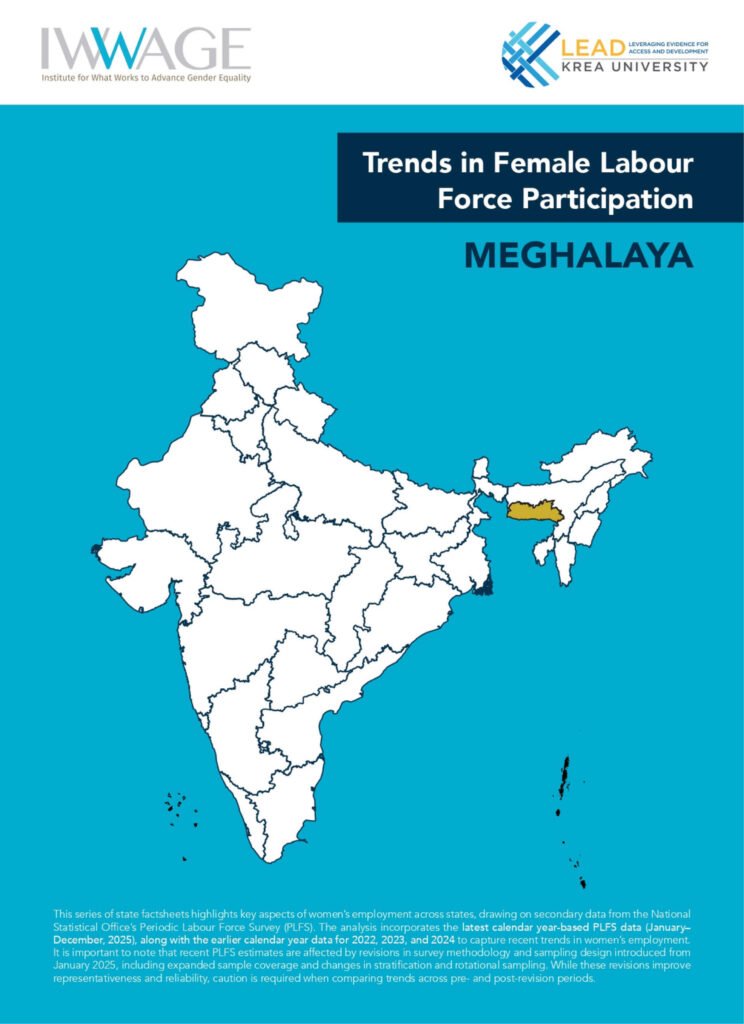
Meghalaya is a small, hilly state in north-east India with a predominantly rural, agrarian economy and one of the country’s most distinctive social structures. The factsheet explores the trends, opportunities and challenges shaping women’s participation in Meghalaya’s labour market, with a focus on how the state’s social structure and economic transformation influence the nature and quality of women’s work.
Meghalaya is a small, hilly state in north-east India with a predominantly rural, agrarian economy and one of the country’s most distinctive social structures. The factsheet explores the trends, opportunities and challenges shaping women’s participation in Meghalaya’s labour market, with a focus on how the state’s social structure and economic transformation influence the nature and quality of women’s work.
Newsletter (Gender In Focus)
Gender in Focus
- August , 2026
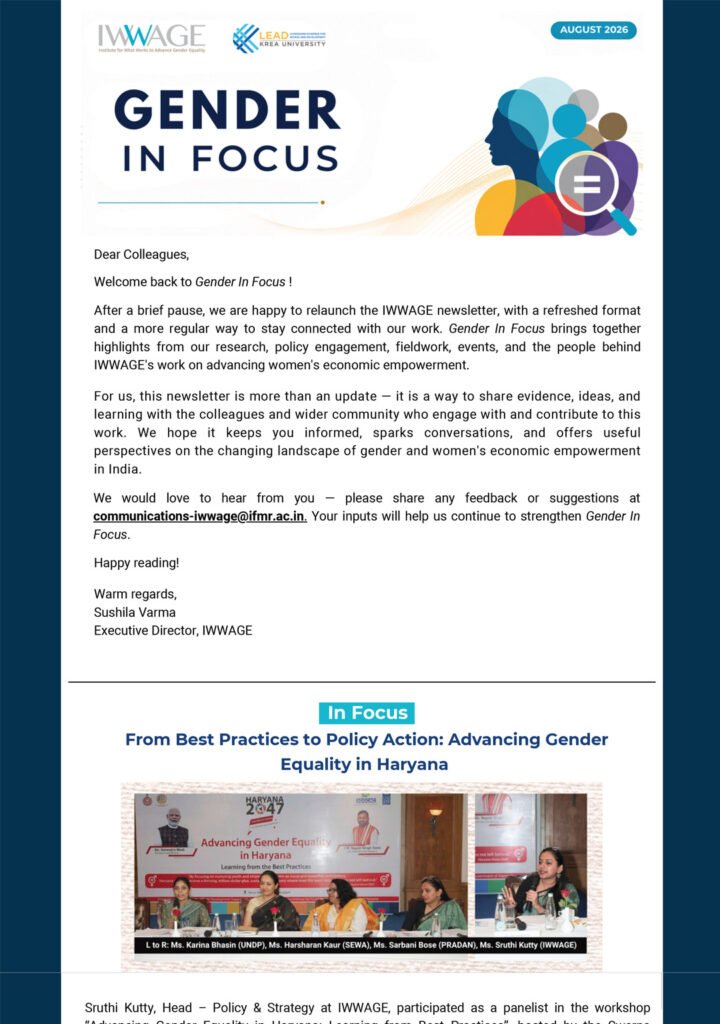
The August 2026 edition features highlights from IWWAGE’s research, policy engagements, fieldwork and knowledge initiatives. It also offers a closer look at emerging trends shaping women’s work and economic participation in India.
The August 2026 edition features highlights from IWWAGE’s research, policy engagements, fieldwork and knowledge initiatives. It also offers a closer look at emerging trends shaping women’s work and economic participation in India.