


Publications
Publications
Category
Year
Factsheet
Trends in Female Labour Force Participation in Chhattisgarh
- November , 2026
- Nabankur Huda, Bidisha Mondal
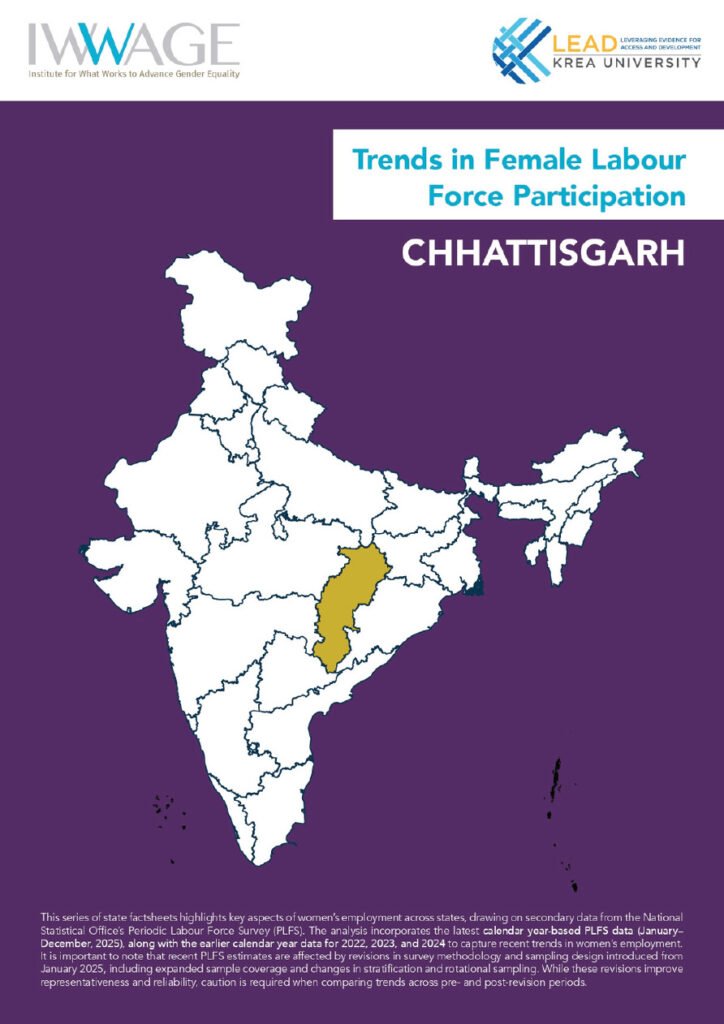
Chhattisgarh is a state that stands out nationally for its high female labour force participation, especially in rural areas, where women’s work is concentrated in family cultivation, much of it is informal or unpaid. The factsheet examines trends in women’s labour force participation and employment in Chhattisgarh between 2022 and 2025, highlighting the state’s high rural participation alongside declining urban participation.
Chhattisgarh is a state that stands out nationally for its high female labour force participation, especially in rural areas, where women’s work is concentrated in family cultivation, much of it is informal or unpaid. The factsheet examines trends in women’s labour force participation and employment in Chhattisgarh between 2022 and 2025, highlighting the state’s high rural participation alongside declining urban participation.

SWAYAM
The National Gender Campaign – Nayi Chetna 4.0
- November , 2026
- Arpita Paul, Chandan Sharma
The National Gender Campaign – Nayi Chetna 4.0, implemented under the Deendayal Antyodaya Yojana–National Rural Livelihood Mission (DAY-NRLM), represents effort to institutionalise gender equality and address gender-based violence (GBV) through a community-driven, convergent approach. This report records the perspective of women on the identified barriers to achieving women’s empowerment such as access to and control over assets, safe mobility and safety, non-recognition of women as economic contributors and unrecognised unpaid care work, along with the activities organised at different levels and the reach of the campaign in terms of participation during the campaign period.
The National Gender Campaign – Nayi Chetna 4.0, implemented under the Deendayal Antyodaya Yojana–National Rural Livelihood Mission (DAY-NRLM), represents effort to institutionalise gender equality and address gender-based violence (GBV) through a community-driven, convergent approach. This report records the perspective of women on the identified barriers to achieving women’s empowerment such as access to and control over assets, safe mobility and safety, non-recognition of women as economic contributors and unrecognised unpaid care work, along with the activities organised at different levels and the reach of the campaign in terms of participation during the campaign period.
Factsheet
Trends in Female Labour Force Participation in Gujarat
- November , 2026
- Nabankur Huda, Bidisha Mondal
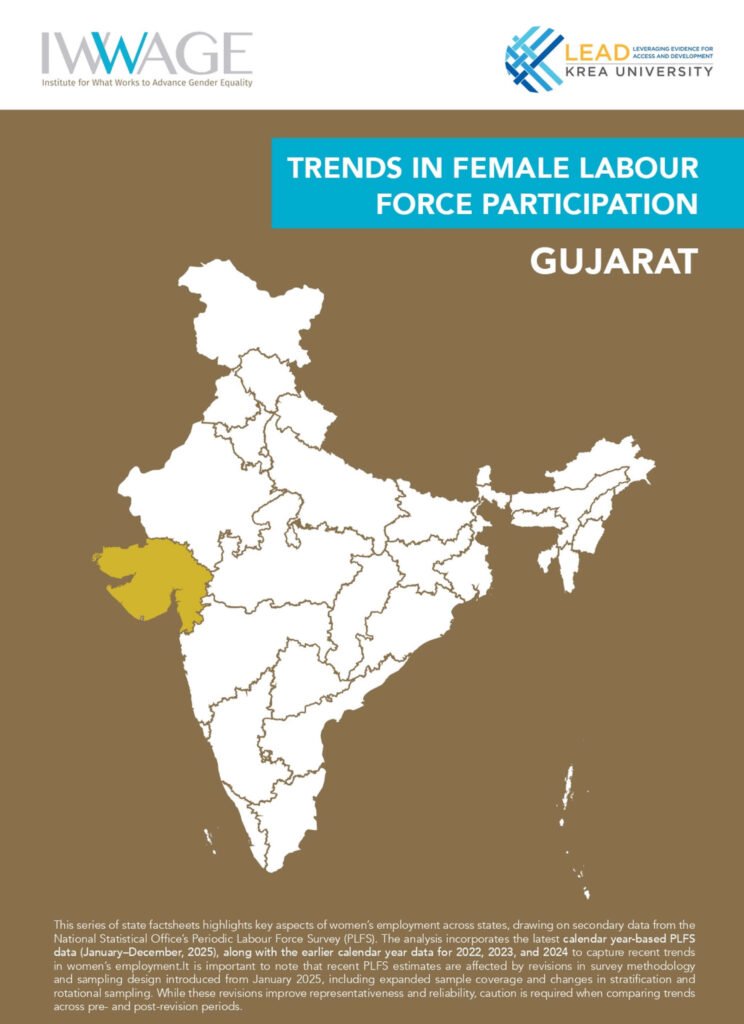
Gujarat is one of India’s most industrialised and urbanised states, generating a large share of national manufacturing output and exports.This factsheet analyses patterns of female labour force participation in Gujarat from 2022 to 2025 using PLFS calendar year data. It highlights trends in participation rates, sectoral distribution and occupational distribution, quality of work, employment types, and barriers to women’s workforce entry.
Gujarat is one of India’s most industrialised and urbanised states, generating a large share of national manufacturing output and exports.This factsheet analyses patterns of female labour force participation in Gujarat from 2022 to 2025 using PLFS calendar year data. It highlights trends in participation rates, sectoral distribution and occupational distribution, quality of work, employment types, and barriers to women’s workforce entry.
Factsheet
Trends in Female Labour Force Participation in West Bengal
- October , 2026
- Arpita Paul, Bidisha Mondal
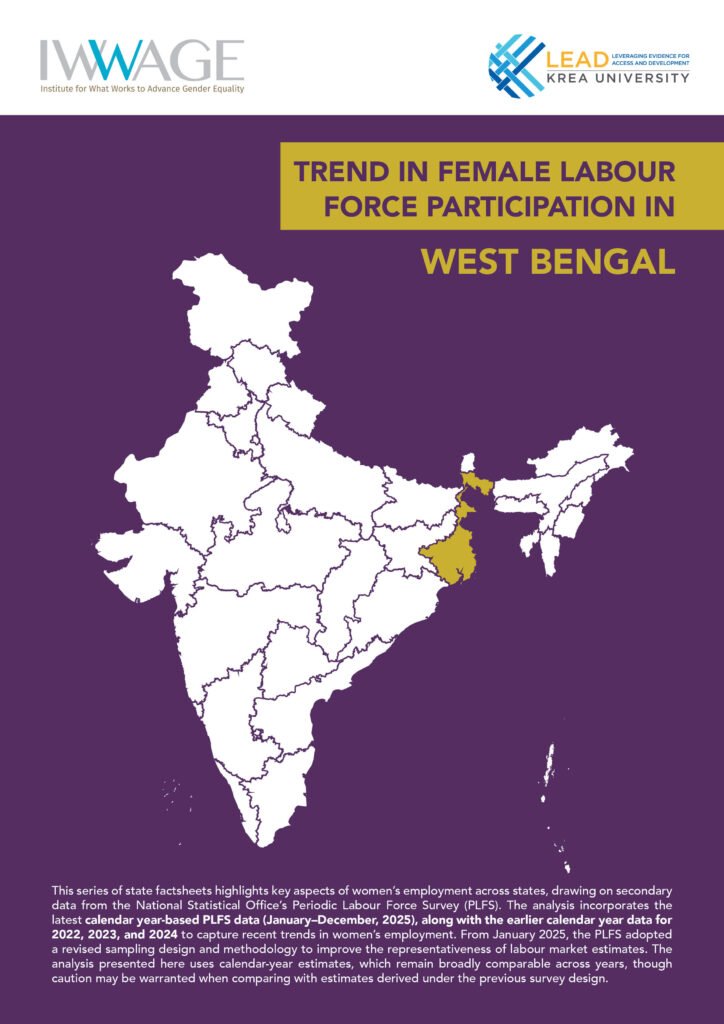
West Bengal, located in eastern India, is one of the most densely populated states with a diverse economic ranging from agriculture, manufacturing (jute, textiles, chemicals), trade, services,forest and fisheries, and construction sector. This factsheet analyses patterns of female labour force participation in West Bengal from 2022 to 2025 using PLFS calendar year data. It highlights trends in participation rates, sectoral distribution, occupational composition, employment types, and barriers to women’s workforce entry.
West Bengal, located in eastern India, is one of the most densely populated states with a diverse economic ranging from agriculture, manufacturing (jute, textiles, chemicals), trade, services,forest and fisheries, and construction sector. This factsheet analyses patterns of female labour force participation in West Bengal from 2022 to 2025 using PLFS calendar year data. It highlights trends in participation rates, sectoral distribution, occupational composition, employment types, and barriers to women’s workforce entry.
Factsheet
Trends in Female Labour Force Participation in Karnataka
- October , 2026
- Vidhi, Bidisha Mondal
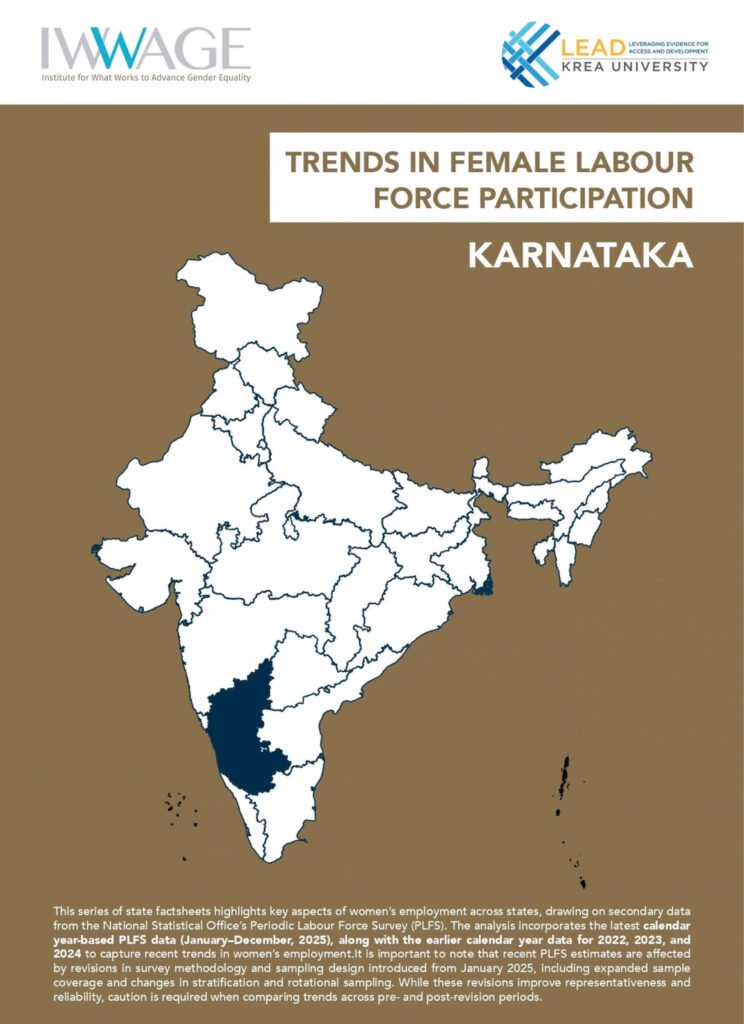
Karnataka occupies a distinctive position in India’s economic landscape, driven by rapid growth in services, technology, and manufacturing sectors.This factsheet examines key trends in women’s labour force participation in Karnataka using PLFS data, with a focus on employment composition, sectoral and occupational distribution, quality of work, and barriers to women’s participation in the labour market.
Karnataka occupies a distinctive position in India’s economic landscape, driven by rapid growth in services, technology, and manufacturing sectors.This factsheet examines key trends in women’s labour force participation in Karnataka using PLFS data, with a focus on employment composition, sectoral and occupational distribution, quality of work, and barriers to women’s participation in the labour market.
Brief
Deconstructing the Care Economy: Measurement, Gendered Outcomes, and Macroeconomic Policy
- September , 2026
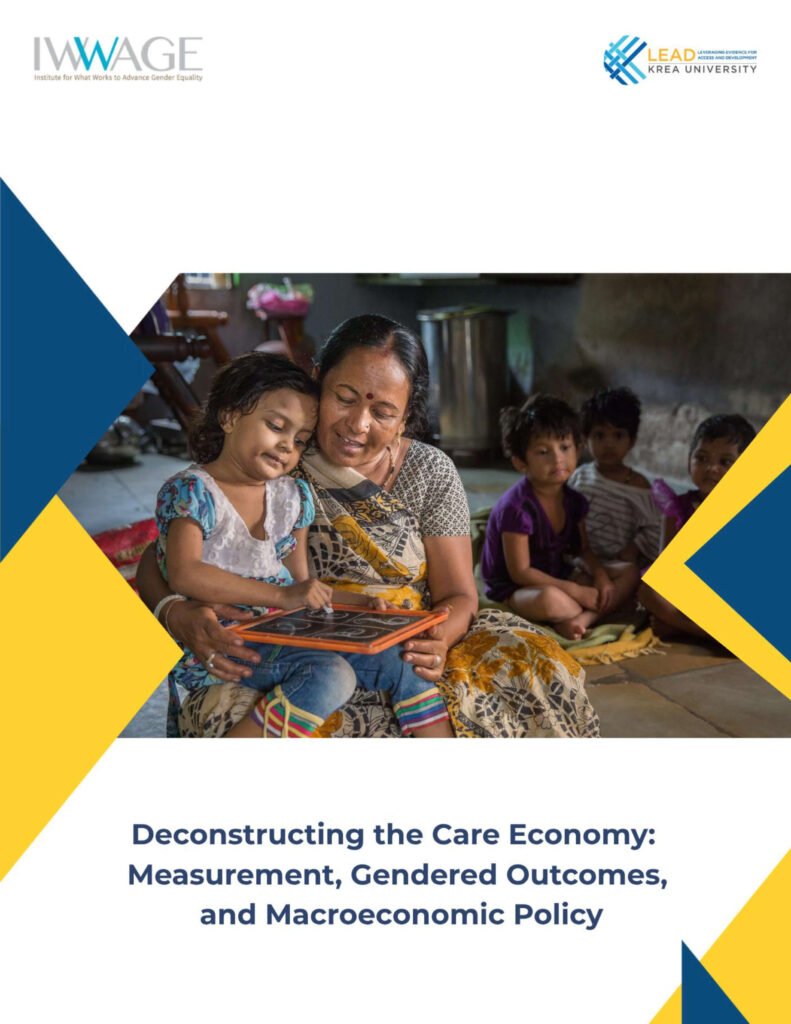
The policy brief examines how unpaid care and domestic work largely undertaken by women remains invisible in conventional economic and labour statistics, while significantly shaping women’s participation and outcomes in the labour market. It highlights how care responsibilities contribute to women’s underemployment, lower-paid and precarious work, and inequalities in platform and hybrid work.
The policy brief examines how unpaid care and domestic work largely undertaken by women remains invisible in conventional economic and labour statistics, while significantly shaping women’s participation and outcomes in the labour market. It highlights how care responsibilities contribute to women’s underemployment, lower-paid and precarious work, and inequalities in platform and hybrid work.
Factsheet
Trends in Female Labour Force Participation in Bihar
- September , 2026
- Vidhi, Bidisha Mondal
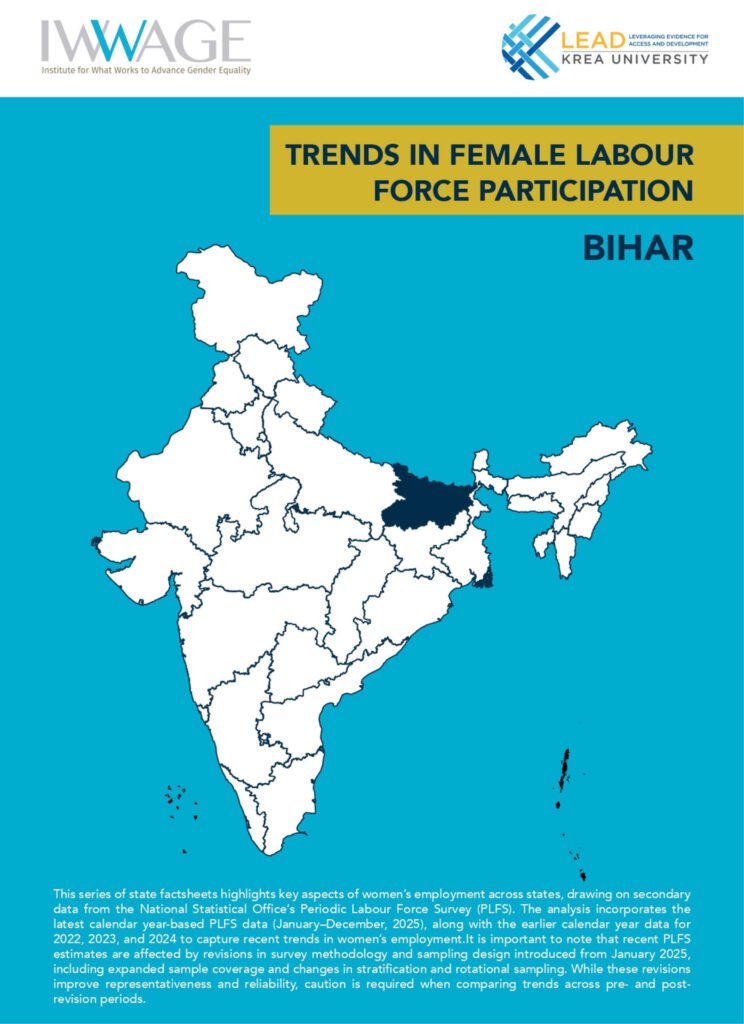
Despite economic growth, Bihar continues to face low female labour force participation, reflecting persistent supply-side constraints and limited access to suitable employment opportunities. Young women, in particular, experience low labour force participation amid high youth unemployment, while employment remains concentrated in agriculture and informal work. Sociocultural norms, limited access to education and skills, mobility constraints, inadequate transport, and care responsibilities further restrict women’s access to employment. Against this backdrop, this factsheet examines trends in female labour force participation, workforce composition, sectoral distribution, and working conditions in Bihar.
Despite economic growth, Bihar continues to face low female labour force participation, reflecting persistent supply-side constraints and limited access to suitable employment opportunities. Young women, in particular, experience low labour force participation amid high youth unemployment, while employment remains concentrated in agriculture and informal work. Sociocultural norms, limited access to education and skills, mobility constraints, inadequate transport, and care responsibilities further restrict women’s access to employment. Against this backdrop, this factsheet examines trends in female labour force participation, workforce composition, sectoral distribution, and working conditions in Bihar.
Report
Women and Work 2025: Megatrends Reshaping Women’s Work in India
- September , 2026
- Divya Singh, Prakriti Sharma, Vidhi Singh, Sharati Roy
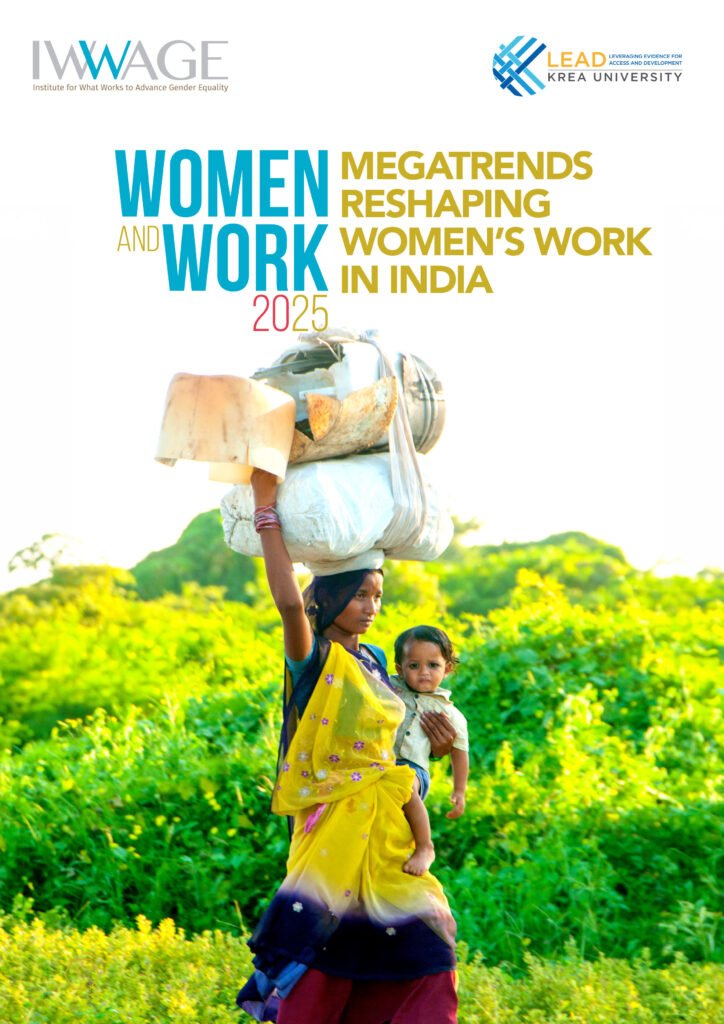
IWWAGE’s flagship report examines the changing landscape of women’s work in India and the forces shaping its future. Women’s labour force participation has risen significantly in recent years. Yet, the headline numbers tell only part of the story. The nature and experience of women’s work continue to be shaped by the quality and security of employment, unpaid care work, digitalisation, artificial intelligence, climate change, and women’s health at work. The report brings together evidence and emerging policy developments across these interconnected forces to examine where women’s work is headed—and what it will take to translate greater participation into greater economic agency, decent work, and protection.
IWWAGE’s flagship report examines the changing landscape of women’s work in India and the forces shaping its future. Women’s labour force participation has risen significantly in recent years. Yet, the headline numbers tell only part of the story. The nature and experience of women’s work continue to be shaped by the quality and security of employment, unpaid care work, digitalisation, artificial intelligence, climate change, and women’s health at work. The report brings together evidence and emerging policy developments across these interconnected forces to examine where women’s work is headed—and what it will take to translate greater participation into greater economic agency, decent work, and protection.
Factsheet
Trends in Female Labour Force Participation in Meghalaya
- August , 2026
- Nabankur Huda, Bidisha Mondal
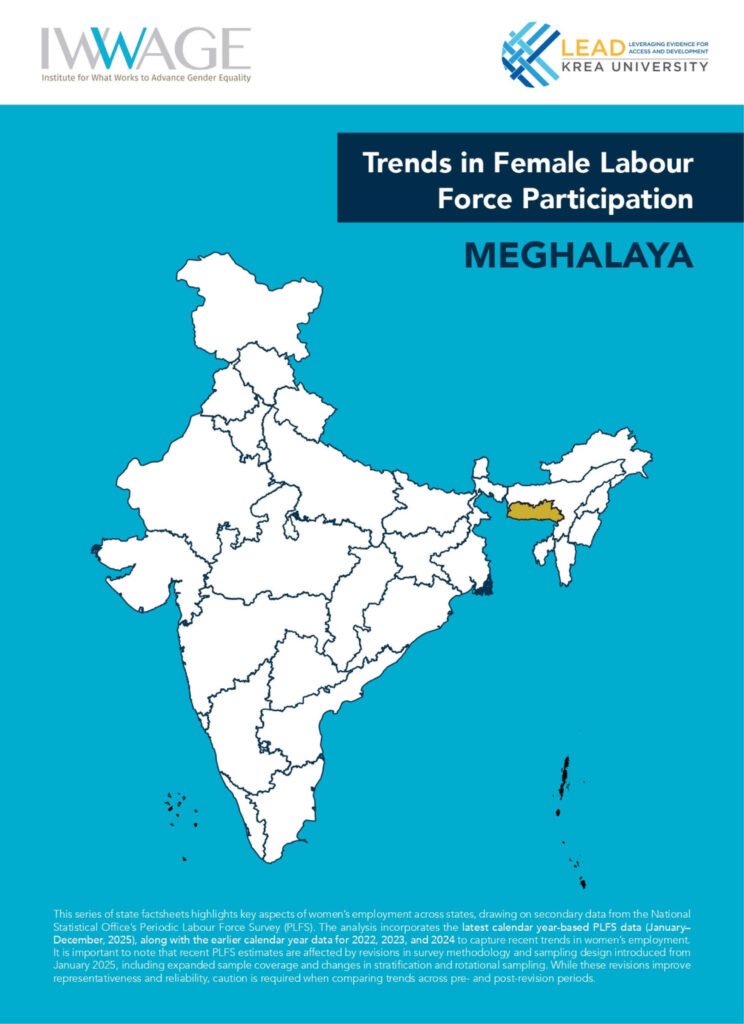
Meghalaya is a small, hilly state in north-east India with a predominantly rural, agrarian economy and one of the country’s most distinctive social structures. The factsheet explores the trends, opportunities and challenges shaping women’s participation in Meghalaya’s labour market, with a focus on how the state’s social structure and economic transformation influence the nature and quality of women’s work.
Meghalaya is a small, hilly state in north-east India with a predominantly rural, agrarian economy and one of the country’s most distinctive social structures. The factsheet explores the trends, opportunities and challenges shaping women’s participation in Meghalaya’s labour market, with a focus on how the state’s social structure and economic transformation influence the nature and quality of women’s work.
Newsletter (Gender In Focus)
Gender in Focus
- August , 2026
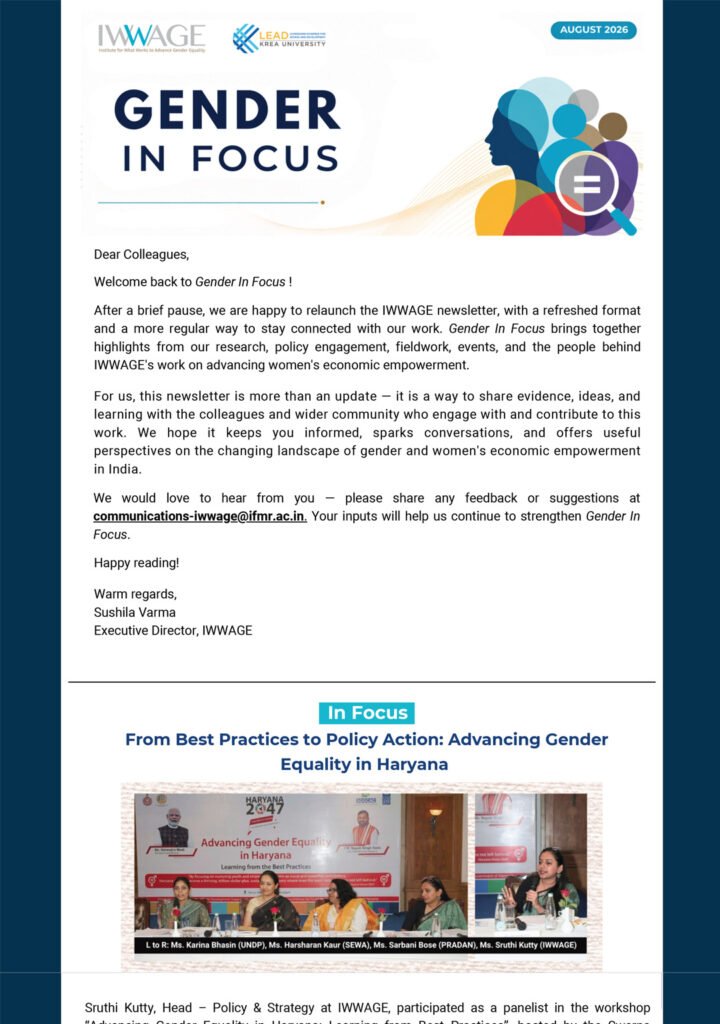
The August 2026 edition features highlights from IWWAGE’s research, policy engagements, fieldwork and knowledge initiatives. It also offers a closer look at emerging trends shaping women’s work and economic participation in India.
The August 2026 edition features highlights from IWWAGE’s research, policy engagements, fieldwork and knowledge initiatives. It also offers a closer look at emerging trends shaping women’s work and economic participation in India.
Factsheet
Trends in Female Labour Force Participation in Chhattisgarh
- November , 2026
- Nabankur Huda, Bidisha Mondal
Chhattisgarh is a state that stands out nationally for its high female labour force participation, especially in rural areas, where women’s work is concentrated in family cultivation, much of it is informal or unpaid. The factsheet examines trends in women’s labour force participation and employment in Chhattisgarh between 2022 and 2025, highlighting the state’s high rural participation alongside declining urban participation.
Chhattisgarh is a state that stands out nationally for its high female labour force participation, especially in rural areas, where women’s work is concentrated in family cultivation, much of it is informal or unpaid. The factsheet examines trends in women’s labour force participation and employment in Chhattisgarh between 2022 and 2025, highlighting the state’s high rural participation alongside declining urban participation.
SWAYAM
The National Gender Campaign – Nayi Chetna 4.0
- November , 2026
- Arpita Paul, Chandan Sharma
The National Gender Campaign – Nayi Chetna 4.0, implemented under the Deendayal Antyodaya Yojana–National Rural Livelihood Mission (DAY-NRLM), represents effort to institutionalise gender equality and address gender-based violence (GBV) through a community-driven, convergent approach. This report records the perspective of women on the identified barriers to achieving women’s empowerment such as access to and control over assets, safe mobility and safety, non-recognition of women as economic contributors and unrecognised unpaid care work, along with the activities organised at different levels and the reach of the campaign in terms of participation during the campaign period.
The National Gender Campaign – Nayi Chetna 4.0, implemented under the Deendayal Antyodaya Yojana–National Rural Livelihood Mission (DAY-NRLM), represents effort to institutionalise gender equality and address gender-based violence (GBV) through a community-driven, convergent approach. This report records the perspective of women on the identified barriers to achieving women’s empowerment such as access to and control over assets, safe mobility and safety, non-recognition of women as economic contributors and unrecognised unpaid care work, along with the activities organised at different levels and the reach of the campaign in terms of participation during the campaign period.
Factsheet
Trends in Female Labour Force Participation in Gujarat
- November , 2026
- Nabankur Huda, Bidisha Mondal
Gujarat is one of India’s most industrialised and urbanised states, generating a large share of national manufacturing output and exports.This factsheet analyses patterns of female labour force participation in Gujarat from 2022 to 2025 using PLFS calendar year data. It highlights trends in participation rates, sectoral distribution and occupational distribution, quality of work, employment types, and barriers to women’s workforce entry.
Gujarat is one of India’s most industrialised and urbanised states, generating a large share of national manufacturing output and exports.This factsheet analyses patterns of female labour force participation in Gujarat from 2022 to 2025 using PLFS calendar year data. It highlights trends in participation rates, sectoral distribution and occupational distribution, quality of work, employment types, and barriers to women’s workforce entry.
Factsheet
Trends in Female Labour Force Participation in West Bengal
- October , 2026
- Arpita Paul, Bidisha Mondal
West Bengal, located in eastern India, is one of the most densely populated states with a diverse economic ranging from agriculture, manufacturing (jute, textiles, chemicals), trade, services,forest and fisheries, and construction sector. This factsheet analyses patterns of female labour force participation in West Bengal from 2022 to 2025 using PLFS calendar year data. It highlights trends in participation rates, sectoral distribution, occupational composition, employment types, and barriers to women’s workforce entry.
West Bengal, located in eastern India, is one of the most densely populated states with a diverse economic ranging from agriculture, manufacturing (jute, textiles, chemicals), trade, services,forest and fisheries, and construction sector. This factsheet analyses patterns of female labour force participation in West Bengal from 2022 to 2025 using PLFS calendar year data. It highlights trends in participation rates, sectoral distribution, occupational composition, employment types, and barriers to women’s workforce entry.
Factsheet
Trends in Female Labour Force Participation in Karnataka
- October , 2026
- Vidhi, Bidisha Mondal
Karnataka occupies a distinctive position in India’s economic landscape, driven by rapid growth in services, technology, and manufacturing sectors.This factsheet examines key trends in women’s labour force participation in Karnataka using PLFS data, with a focus on employment composition, sectoral and occupational distribution, quality of work, and barriers to women’s participation in the labour market.
Karnataka occupies a distinctive position in India’s economic landscape, driven by rapid growth in services, technology, and manufacturing sectors.This factsheet examines key trends in women’s labour force participation in Karnataka using PLFS data, with a focus on employment composition, sectoral and occupational distribution, quality of work, and barriers to women’s participation in the labour market.
Brief
Deconstructing the Care Economy: Measurement, Gendered Outcomes, and Macroeconomic Policy
- September , 2026
The policy brief examines how unpaid care and domestic work largely undertaken by women remains invisible in conventional economic and labour statistics, while significantly shaping women’s participation and outcomes in the labour market. It highlights how care responsibilities contribute to women’s underemployment, lower-paid and precarious work, and inequalities in platform and hybrid work.
The policy brief examines how unpaid care and domestic work largely undertaken by women remains invisible in conventional economic and labour statistics, while significantly shaping women’s participation and outcomes in the labour market. It highlights how care responsibilities contribute to women’s underemployment, lower-paid and precarious work, and inequalities in platform and hybrid work.