


This factsheet highlights Odisha’s economy, which is largely agro-based, with agriculture, forestry, and fishing providing 50% of employment. Despite natural disasters, the state’s service, industrial, and mining sectors contribute significantly to its GSDP. Tribal women play a vital role in forest produce collection and handicrafts, yet female labor force participation remains low, with rural and urban FLFPRs at 15.2% and 13.4%, respectively.
Women's Economic
Empowerment
Women's Economic
Empowerment
IWWAGE’s work on women’s economic empowerment focuses on understanding and addressing the structural barriers that shape women’s participation in India’s labour market. At the centre of this agenda is the persistently low Female Labour Force Participation Rate (FLFPR), which reflects deep-rooted challenges related to access to decent work, social norms, and labour market institutions.
IWWAGE’s work in this area focuses on:
Evidence generation for policy action
Analysing national and state-level data to understand women’s employment patterns, sectoral and occupational distribution, and barriers to labour market entry and continuity.
Improving measurement and visibility of women’s work
Improved definitions and measurement of work, with a strong emphasis on recognising unpaid, home-based, and care work that remains undercounted in conventional labour statistics.
Shaping the future of women’s work
Examining women’s participation in a rapidly digitising economy, including platform and hybrid work models, to assess emerging opportunities, risks, and forms of precarity.
Strengthening agency and protection
Exploring women’s access to digital skills, agency, bargaining power, and social protection within evolving labour market arrangements.
Together, this body of work highlights that meaningful women’s economic empowerment requires better data, recognition of all forms of work, and the proactive shaping of labour market institutions so that women’s work is visible, valued, and protected.
Learning note
Women’s Workforce Participation in India: Statewise Trends
- November , 2020
- Nidhi Gyan Pandey , Sona Mitra
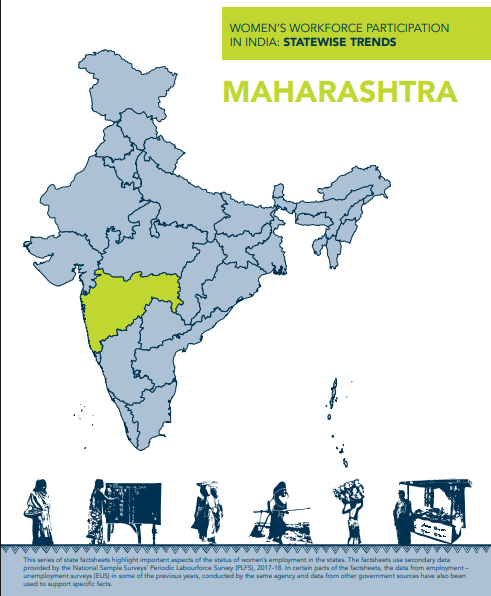
Maharashtra, one of India’s most prosperous and industrially advanced states, has the highest Gross State Domestic Product (GSDP) among all states, amounting to Rs. 19,400 billion in 2017-18. Despite its economic strength, Maharashtra ranks lower on gender indicators, with a sex ratio of 958 females per 1,000 males and a child sex ratio of 894. Female labour force participation (FLFPR) in Maharashtra is significantly higher than the national average at 31%, driven by rural participation. However, urban FLFPR remains low at 16.8%, highlighting gender disparities in urban employment. This factsheet explores key socio-economic and gender trends in the state.
Maharashtra, one of India’s most prosperous and industrially advanced states, has the highest Gross State Domestic Product (GSDP) among all states, amounting to Rs. 19,400 billion in 2017-18. Despite its economic strength, Maharashtra ranks lower on gender indicators, with a sex ratio of 958 females per 1,000 males and a child sex ratio of 894. Female labour force participation (FLFPR) in Maharashtra is significantly higher than the national average at 31%, driven by rural participation. However, urban FLFPR remains low at 16.8%, highlighting gender disparities in urban employment. This factsheet explores key socio-economic and gender trends in the state.
Factsheet
Women’s Workforce Participation in India: Statewise Trends
- October , 2020
- Nidhi Gyan Pandey
While the share of women workers in regular wage work has been increasing all across India, Odisha has shown exceptional growth in this regard, particularly in urban areas. But as in other states, this has not translated into improved working conditions for women.
While the share of women workers in regular wage work has been increasing all across India, Odisha has shown exceptional growth in this regard, particularly in urban areas. But as in other states, this has not translated into improved working conditions for women.
Learning note
Women’s Workforce Participation in India: Statewise Trends
- October , 2020
- Nidhi Gyan Pandey , Sona Mitra
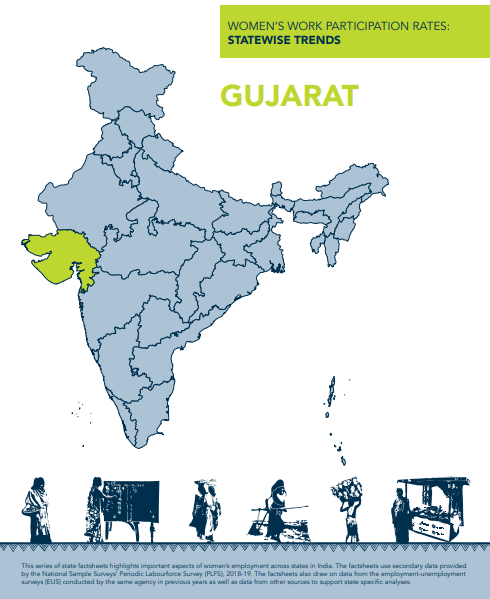
Gujarat, one of India’s most industrially advanced states, is a hub for textile manufacturing and diamond trade with a high GSDP per capita of Rs 1,65,414. Despite its economic strengths, Gujarat faces significant challenges in social development. The state has a low sex ratio (866 females per 1,000 males) and high rates of under-nutrition, with 55% of women aged 15-49 being anaemic. Education indicators also lag behind national averages, and gender inequality in the labour market is prevalent. The female labour force participation rate (FLFPR) stands at 16.9%, below the national average, with large gender disparities in both rural and urban areas. This factsheet explores key economic and social indicators for Gujarat in 2020.
Gujarat, one of India’s most industrially advanced states, is a hub for textile manufacturing and diamond trade with a high GSDP per capita of Rs 1,65,414. Despite its economic strengths, Gujarat faces significant challenges in social development. The state has a low sex ratio (866 females per 1,000 males) and high rates of under-nutrition, with 55% of women aged 15-49 being anaemic. Education indicators also lag behind national averages, and gender inequality in the labour market is prevalent. The female labour force participation rate (FLFPR) stands at 16.9%, below the national average, with large gender disparities in both rural and urban areas. This factsheet explores key economic and social indicators for Gujarat in 2020.
Learning note
Women’s Workforce Participation in India: Statewise Trends
- October , 2020
- Nidhi Gyan Pandey
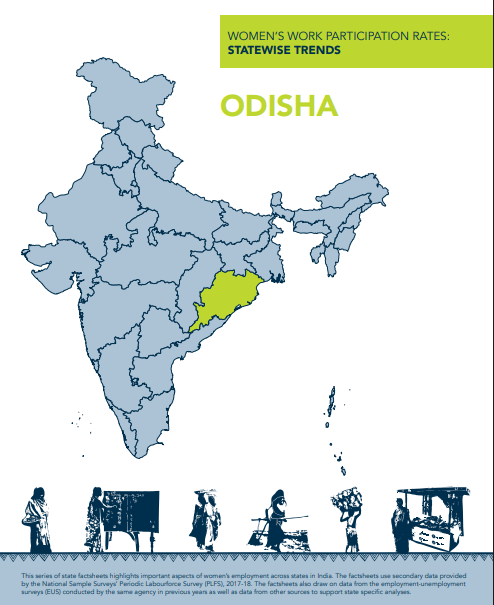
Odisha, located on India’s eastern coastline, is rich in natural resources with forests covering 33.2% of its area. The state’s economy is largely agro-based, with agriculture, forestry, and fishing sectors providing around 50% of employment. Despite frequent cyclones and floods that impact livelihoods, Odisha’s service, industrial, and mining sectors contribute significantly to its GSDP. With a large tribal population, tribal women play a key role in forest produce collection and handicraft industries. Female labour force participation in Odisha remains low, with rural and urban FLFPRs below the national average at 15.2% and 13.4%, respectively.
Odisha, located on India’s eastern coastline, is rich in natural resources with forests covering 33.2% of its area. The state’s economy is largely agro-based, with agriculture, forestry, and fishing sectors providing around 50% of employment. Despite frequent cyclones and floods that impact livelihoods, Odisha’s service, industrial, and mining sectors contribute significantly to its GSDP. With a large tribal population, tribal women play a key role in forest produce collection and handicraft industries. Female labour force participation in Odisha remains low, with rural and urban FLFPRs below the national average at 15.2% and 13.4%, respectively.

Learning note
Business Readiness Scorecard for Women
- August , 2020
- Rigzom Wangchuk | Ria Dutta | M P Karthick
Women dominate India’s informal economy, especially in the handloom and handicrafts sectors, where they often operate as home-based entrepreneurs. Yet, they remain underrepresented in the formal business space. To better support these women-led enterprises, IWWAGE developed the Women’s Business Readiness Scorecard for Handloom and Handicrafts Sector (WBRS-HHS). This data-driven diagnostic tool was developed through surveys with 800 women entrepreneurs across Rajasthan and Tamil Nadu’s two states with distinct public and private sector dynamics. The scorecard evaluates business readiness across four dimensions: 1.Agency (decision-making, financial control, risk-taking) 2. Market Readiness (product portfolio, advance orders) 3. Production Readiness (worksite, inventory, personnel) 4. Legal and Regulatory Readiness (registration, scheme awareness) By measuring these indicators, the WBRS-HHS helps identify strengths, gaps, and policy opportunities to scale and sustain women’s enterprises. The tool also offers a replicable framework for stakeholders to design targeted interventions across sectors.
Women dominate India’s informal economy, especially in the handloom and handicrafts sectors, where they often operate as home-based entrepreneurs. Yet, they remain underrepresented in the formal business space. To better support these women-led enterprises, IWWAGE developed the Women’s Business Readiness Scorecard for Handloom and Handicrafts Sector (WBRS-HHS). This data-driven diagnostic tool was developed through surveys with 800 women entrepreneurs across Rajasthan and Tamil Nadu’s two states with distinct public and private sector dynamics. The scorecard evaluates business readiness across four dimensions: 1.Agency (decision-making, financial control, risk-taking) 2. Market Readiness (product portfolio, advance orders) 3. Production Readiness (worksite, inventory, personnel) 4. Legal and Regulatory Readiness (registration, scheme awareness) By measuring these indicators, the WBRS-HHS helps identify strengths, gaps, and policy opportunities to scale and sustain women’s enterprises. The tool also offers a replicable framework for stakeholders to design targeted interventions across sectors.
Report
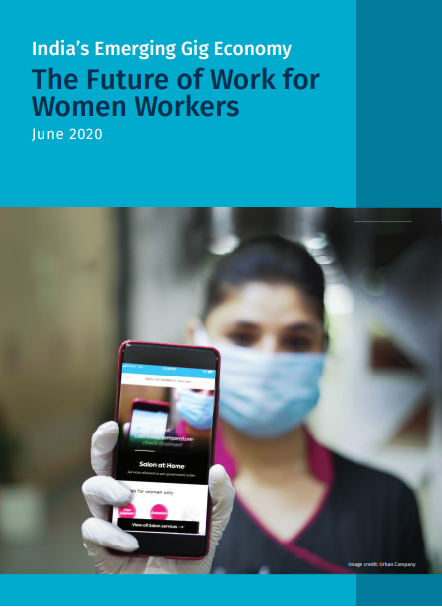
The Future of Work for Women Workers
- August , 2020
- Ruchika Chaudhary , Sona Mitra , Soumya Kapoor Mehta
World over, the technology-driven gig economy has been expanding rapidly over the past decade, in which digital platforms connect workers with requesters to facilitate on demand work. While the gig economy has also become a buzzword in India, particularly in the last couple of years, and is attracting millennials by offering alternative employment opportunities. However, literature is scanty when it comes to measuring its impacts on the gendered experiences of gig work or on gig workers. This report aims to provide a comprehensive analytical overview of women’s engagement in platform work, and presents findings from an in-depth study of women’s work in one of India’s leading platform companies. It aims to understand the emerging forms of labour practices and the impact of platform engagement on workers experiences, challenges, and impact on women’s empowerment and agency. The findings are based on interviews with workers, platform managers, and other key informants, and comprehensive literature review. The study presents an in-depth and specialised analysis of the gig economy to explain some of the unique features of the labour practices and consequences of such practices on the overall labour relations. The study also makes specific recommendations and argue that policy makers and platforms have a key role in ensuring access to decent work and social protection for these workers.
World over, the technology-driven gig economy has been expanding rapidly over the past decade, in which digital platforms connect workers with requesters to facilitate on demand work. While the gig economy has also become a buzzword in India, particularly in the last couple of years, and is attracting millennials by offering alternative employment opportunities. However, literature is scanty when it comes to measuring its impacts on the gendered experiences of gig work or on gig workers. This report aims to provide a comprehensive analytical overview of women’s engagement in platform work, and presents findings from an in-depth study of women’s work in one of India’s leading platform companies. It aims to understand the emerging forms of labour practices and the impact of platform engagement on workers experiences, challenges, and impact on women’s empowerment and agency. The findings are based on interviews with workers, platform managers, and other key informants, and comprehensive literature review. The study presents an in-depth and specialised analysis of the gig economy to explain some of the unique features of the labour practices and consequences of such practices on the overall labour relations. The study also makes specific recommendations and argue that policy makers and platforms have a key role in ensuring access to decent work and social protection for these workers.