Women's Economic
Empowerment

Women's Economic
Empowerment

IWWAGE’s work on women’s economic empowerment focuses on understanding and addressing the structural barriers that shape women’s participation in India’s labour market. At the centre of this agenda is the persistently low Female Labour Force Participation Rate (FLFPR), which reflects deep-rooted challenges related to access to decent work, social norms, and labour market institutions.

IWWAGE’s work in this area focuses on:

Evidence generation for policy action

Analysing national and state-level data to understand women’s employment patterns, sectoral and occupational distribution, and barriers to labour market entry and continuity.

Improving measurement and visibility of women’s work

Improved definitions and measurement of work, with a strong emphasis on recognising unpaid, home-based, and care work that remains undercounted in conventional labour statistics.

Shaping the future of women’s work

Examining women’s participation in a rapidly digitising economy, including platform and hybrid work models, to assess emerging opportunities, risks, and forms of precarity.

Strengthening agency and protection

Exploring women’s access to digital skills, agency, bargaining power, and social protection within evolving labour market arrangements.

Together, this body of work highlights that meaningful women’s economic empowerment requires better data, recognition of all forms of work, and the proactive shaping of labour market institutions so that women’s work is visible, valued, and protected.

Brief

COVID-19 and Women’s Labour Crisis

A pandemic that translates itself into an economic crisis has the potential to push women out of the labour force through several mechanisms. An economic crisis creates pressure on governments to cut down on social sector expenditures which potentially increases the burden of unpaid care and household work for women. As a result, women’s time for engaging in productive work gets reduced, having a negative impact on their labour force participation. The COVID-19 pandemic in India has had an unequal impact on women in a number of ways. In terms of economic opportunity, it has been seen that more women lost jobs compared to men and fewer have been able to rejoin labour force. This is in the context of gendered labour markets where female labour force participation has been low and declining. This paper presents an analysis of the situation of women’s employment pre-lockdown and some indications on what the impact of COVID-19 could be, based on microstudies and other literature available. Further, the adequacy of the social protection and employment generation programmes of the government that are specifically aimed at improving female labour force participation is assessed.
Learning note

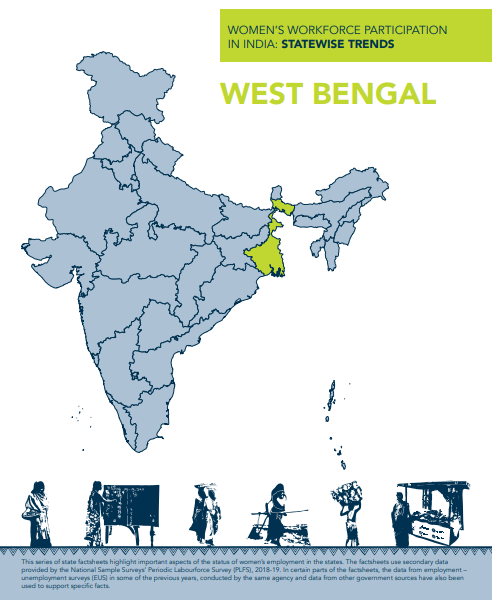
Women’s Workforce Participation in India: Statewise Trends

West Bengal, home to 99 million people, is the fourth most populous state in India. With a primarily rural population and agriculture as the main source of employment, women’s work participation rates remain low. Many women in rural areas engage in unpaid agricultural labor, particularly in paddy fields, leading to underreporting of their contributions. The state’s female labour force participation rate (FLFPR) is 17.5%, below the national average. Despite challenges, West Bengal shows strong performance in indicators like maternal mortality and sex ratio, though issues like gender inequality in the labour market and high rates of under-nutrition persist.
Factsheet

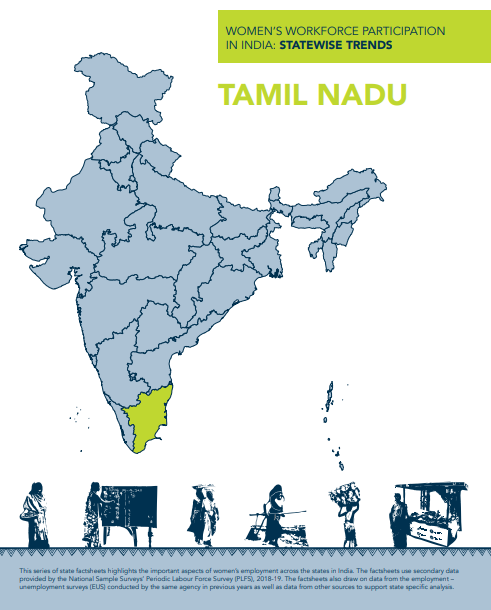
Women’s Workforce Participation in India: Statewise Trends

This factsheet highlights Tamil Nadu’s strong economy, with a GSDP of Rs 18,45,853 crores, and impressive social development. The state ranks third in human development and boasts high female labour force participation rates (rural: 35.1%, urban: 23.6%) along with excellent gender indicators, including a low maternal mortality rate and one of the lowest crime rates against women in India.
IWWAGE-ISST-BRIEFS

Women and Unpaid Work

Women’s workforce participation in India has been consistently low-and steadily declining over the last 15 years, as recorded by official surveys like those conducted by the National Sample Survey Office (NSSO) and the Periodic Labour Force Survey (PLFS). However, these numbers fail to capture the full extent of women’s economic contributions, largely because they exclude unpaid work-domestic chores, caregiving, and community roles-that women perform on a daily basis. Feminist scholars have long advocated for the recognition, reduction, and redistribution of unpaid work as essential steps toward achieving gender equality. If the definition of work is expanded to include these invisible activities, it becomes evident that many more women are contributing to the economy than current statistics suggest. The COVID-19 pandemic further exacerbated these inequalities. As homes transformed into sites of both work and survival, women’s unpaid workload increased significantly. A Rapid Assessment Survey conducted by the Institute of Social Studies Trust (ISST) in Delhi found that women in urban informal sectors-such as domestic work, waste picking, street vending, and construction-reported a significant rise in unpaid responsibilities, including childcare, eldercare, and food provisioning. Despite other family members being at home, women continued to shoulder the majority of domestic work, often with little or no help. To build a more inclusive and equitable economy, it is critical to recognise and value unpaid labour and ensure that data and policy frameworks reflect the full spectrum of women’s work.
IWWAGE-ISST-BRIEFS

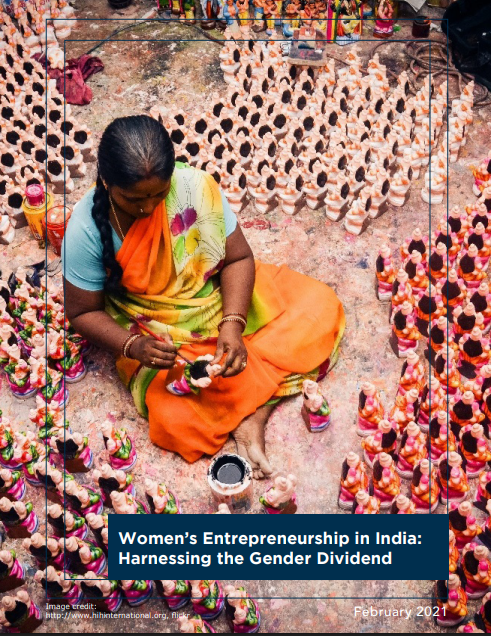
Women’s Entrepreneurship in India: Harnessing the Gender Dividend

India’s economic growth has largely bypassed its smallest enterprises-particularly those led by women. Despite an increase in the number of micro, small, and medium enterprises (MSMEs), only 21.5% were owned by women as of 2018-19. Even more concerning is the stagnation in growth: between 2010 and 2015, the share of women-led enterprises and their gross value added (GVA) remained static, while the share of workers in these enterprises declined. Women entrepreneurs face layered barriers-from deep-rooted social norms and gender biases to unequal access to education, credit, and networks. For many women, entrepreneurship is not a path to scale but a survivalist response to limited employment opportunities, wage inequality, and inflexible work conditions. India ranked 49th out of 57 countries in the 2020 Mastercard Index of Women Entrepreneurs-a stark reflection of the odds stacked against women in the entrepreneurial landscape. To enable women to thrive as entrepreneurs, we must address structural and cultural challenges. Key recommendations include: – Challenging restrictive gender norms and stereotypes; – Ensuring better access to education and digital literacy; – Expanding affordable and inclusive financing mechanisms; – Creating women-friendly business networks and incubators; – Leveraging technology to connect women to markets, mentorship, and information. Enabling women to realise their entrepreneurial ambitions is not only a matter of equity-it is essential for India’s inclusive and sustainable economic growth.
Learning note

Women’s Workforce Participation in India: Statewise Trends

Tamil Nadu, the second-largest economy in India with a GSDP of Rs 18,45,853 crores, is known for combining rapid economic growth with high social development. The state boasts strong public services, ranking third in human development and literacy (96.8%) among all states. Tamil Nadu’s female labour force participation rates (FLFPR) are significantly higher than the national average, with rural FLFPR at 35.1% and urban FLFPR at 23.6%. The state also excels in gender indicators, with a low maternal mortality rate of 66 and the third lowest crime rate against women in the country.
Scroll to Top