Publications

Publications

Category

Year
Report

Exploring linkages between womens empowerment workforce participation and population dynamics in the Indian context: A comprehensive macro micro analysis

Gender equality and reproductive autonomy are central to India’s ability to navigate ongoing demographic transitions effectively. The study, a collaboration between the Population Foundation of India and the Institute for What Works to Advance Gender Equality (IWWAGE), presents new evidence on these critical interconnections. By integrating macro-level demographic and human development data with micro-level insights from women’s lived experiences, the study offers one of the most comprehensive analyses of its kind in India, bridging quantitative data with qualitative narratives to illuminate how women’s empowerment shapes the country’s demographic and developmental trajectory.
Factsheet

Trends in Female Labour Force Participation in West Bengal

West Bengal has seen strong economic growth driven by manufacturing, MSMEs and investment, with GSDP projected to grow 12 per cent in 2025–26. However, per capita income remains below the national average. The state has lost around 3 million informal jobs in recent years, disproportionately affecting women, while high outmigration, especially of skilled workers, continues to reshape the labour market. Women remain concentrated in low-productivity informal sectors such as agriculture and domestic work, resulting in low female labour force participation and underscoring the need for targeted employment policies.
West Bengal has seen strong economic growth driven by manufacturing, MSMEs and investment, with GSDP projected to grow 12 per cent in 2025–26. However, per capita income remains below the national average. The state has lost around 3 million informal jobs in recent years, disproportionately affecting women, while high outmigration, especially of skilled workers, continues to reshape the labour market. Women remain concentrated in low-productivity informal sectors such as agriculture and domestic work, resulting in low female labour force participation and underscoring the need for targeted employment policies.
Annual Report (IFMR)

Innovating Empowering Advancing

Working Paper

Working or Not: What Determines Women’s Labour Force Participation in India?

This paper delves into the persistent gender gaps in India’s labour market, highlighting the alarming decline in women’s labour force participation despite socio-economic progress. Using data from the Periodic Labour Force Surveys (PLFS) and the National Sample Survey Office (NSSO), it examines the key factors contributing to this trend, including the disproportionate burden of unpaid care work. The paper underscores the need for targeted policies, such as vocational training and gender-responsive initiatives, to empower women and break down barriers to their economic participation.

This paper delves into the persistent gender gaps in India’s labour market, highlighting the alarming decline in women’s labour force participation despite socio-economic progress. Using data from the Periodic Labour Force Surveys (PLFS) and the National Sample Survey Office (NSSO), it examines the key factors contributing to this trend, including the disproportionate burden of unpaid care work. The paper underscores the need for targeted policies, such as vocational training and gender-responsive initiatives, to empower women and break down barriers to their economic participation.
Brief

A Crisis in Care India’s Ageing Population and the Need for Strengthened Eldercare – Hindi

The global population is ageing, presenting complex challenges and new opportunities.The policy brief draws on insights from a roundtable discussion that brought together sectoral experts, practitioners, and academics, along with secondary research.The discussion served as a platform to examine the current state of eldercare in India, identify critical gaps, and explore actionable solutions to increase women’s participation in the formal eldercare workforce.
Brief

A Crisis in Care India’s Ageing

The global population is ageing, presenting complex challenges and new opportunities.The policy brief draws on insights from a roundtable discussion that brought together sectoral experts, practitioners, and academics, along with secondary research.The discussion served as a platform to examine the current state of eldercare in India, identify critical gaps, and explore actionable solutions to increase women’s participation in the formal eldercare workforce.
SWAYAM

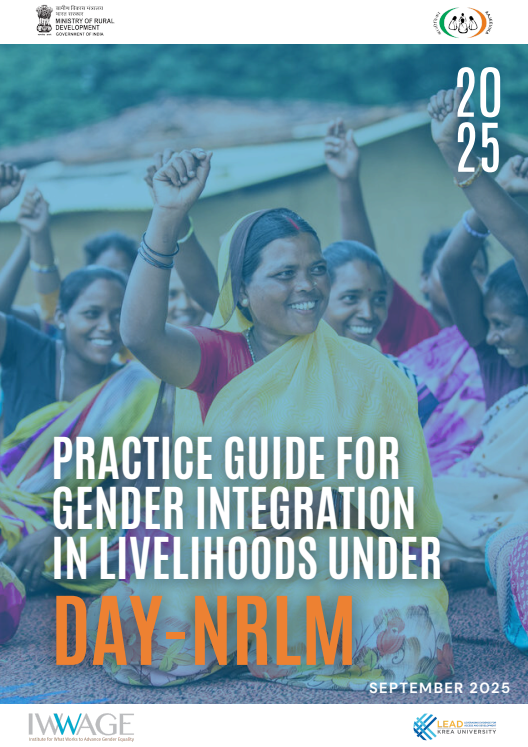
Practice Guide for Gender Integration in Livelihoods under DAY-NRLM

This booklet is intended for the livelihoods vertical and serves as a practical, field-focused Guide for teams on integrating gender into livelihoods interventions. Since these interventions include both farm-based and nonfarm- based activities, the booklet addresses each type separately, following a gender-responsive and progressively gender-transformative approach.
Knowledge series

Migration Climate Change and Gender

Climate change is altering everyday life and livelihoods across India, and its impacts are not felt equally. Women, particularly those from marginalised and low-income communities, are often the first to absorb the effects of climate shocks, whether through disrupted livelihoods, migration, or the pressures of extreme weather. These experiences are shaped by long-standing social and economic inequalities, making it essential to look beyond sectoral solutions. One of the least visible but most affected areas is the care economy. As climate risks intensify, women’s unpaid and poorly paid care work expands, especially during displacement, crises, and recovery. Care work plays a critical role in helping families and communities cope with climate stress, yet it remains largely invisible within climate policy and planning. Looking at climate change through the lens of care helps reveal two connected dynamics: how climate risks reshape care responsibilities, and how the way care is organised influences resilience and adaptation. Recognising care, valuing women’s unpaid labour, and strengthening care systems are therefore not add-ons, but central to effective climate responses. This series of policy briefs, jointly developed by IWWAGE and PDAG, explores these connections in detail. It examines how care work is shaped by climate-related vulnerabilities, labour transitions, and forced mobility, with close attention to gendered outcomes. The series is part of a broader climate–gender conversation that includes work, migration, governance, and energy transitions, while centring experiences from India and the Global South. Through this initiative, we aim to deepen understanding, inform policy choices, and contribute meaningfully to ongoing discussions on climate change, care, and gender equality.
Knowledge series

Migration Climate Change and Gender

Climate change is altering everyday life and livelihoods across India, and its impacts are not felt equally. Women, particularly those from marginalised and low-income communities, are often the first to absorb the effects of climate shocks, whether through disrupted livelihoods, migration, or the pressures of extreme weather. These experiences are shaped by long-standing social and economic inequalities, making it essential to look beyond sectoral solutions. One of the least visible but most affected areas is the care economy. As climate risks intensify, women’s unpaid and poorly paid care work expands, especially during displacement, crises, and recovery. Care work plays a critical role in helping families and communities cope with climate stress, yet it remains largely invisible within climate policy and planning. Looking at climate change through the lens of care helps reveal two connected dynamics: how climate risks reshape care responsibilities, and how the way care is organised influences resilience and adaptation. Recognising care, valuing women’s unpaid labour, and strengthening care systems are therefore not add-ons, but central to effective climate responses. This series of policy briefs, jointly developed by IWWAGE and PDAG, explores these connections in detail. It examines how care work is shaped by climate-related vulnerabilities, labour transitions, and forced mobility, with close attention to gendered outcomes. The series is part of a broader climate–gender conversation that includes work, migration, governance, and energy transitions, while centring experiences from India and the Global South. Through this initiative, we aim to deepen understanding, inform policy choices, and contribute meaningfully to ongoing discussions on climate change, care, and gender equality.
Factsheet

Trends in Female Labour and Workforce Participation – Assam

Assam has seen a sharp rise in female labour force participation since 2021–22, now above the national average (50% vs 42% in PLFS 2023–24). However, the 2022–23 gender gap appears distorted due to an NSSO weighting error in a few villages, which led to underreporting of female participation at district, state, and national levels. In parallel, pro-women initiatives such as Sarothi (interest-subsidised loans) and PMKVY 2.0 (industry-relevant skilling) are believed to have supported this improvement. Future analysis will use corrected PLFS data to better track trends and understand the drivers of rising female employment in Assam.

Assam has seen a sharp rise in female labour force participation since 2021–22, now above the national average (50% vs 42% in PLFS 2023–24). However, the 2022–23 gender gap appears distorted due to an NSSO weighting error in a few villages, which led to underreporting of female participation at district, state, and national levels. In parallel, pro-women initiatives such as Sarothi (interest-subsidised loans) and PMKVY 2.0 (industry-relevant skilling) are believed to have supported this improvement. Future analysis will use corrected PLFS data to better track trends and understand the drivers of rising female employment in Assam.
Factsheet

Trends in Female Labour Force Participation in Gujrat

Gujarat records a female labour force participation rate above the national average, supported by government policies promoting women’s economic empowerment. Schemes such as Mukhyamantri Mahila Utkars Yojana and Mahila Swavalamban Scheme strengthen financial inclusion, self-help groups, and access to credit for women, especially those below the poverty line. The state also promotes women’s entrepreneurship through targeted training and awareness programmes. Using PLFS 2023–24 data, this factsheet examines women’s employment in Gujarat, focusing on job types, sectoral distribution, and key indicators shaping female workforce participation.

Gujarat records a female labour force participation rate above the national average, supported by government policies promoting women’s economic empowerment. Schemes such as Mukhyamantri Mahila Utkars Yojana and Mahila Swavalamban Scheme strengthen financial inclusion, self-help groups, and access to credit for women, especially those below the poverty line. The state also promotes women’s entrepreneurship through targeted training and awareness programmes. Using PLFS 2023–24 data, this factsheet examines women’s employment in Gujarat, focusing on job types, sectoral distribution, and key indicators shaping female workforce participation.
Factsheet

Trend in Female Labour Force Participation in Chhattisgarh

Chhattisgarh records a significantly higher female labour force participation rate than the national average, particularly in rural areas, with rising women’s participation evident since before 2016. Tribal women participate in the labour market at much higher rates than non-tribal women, but most are engaged in self-employment, with a large share working as unpaid family workers. While schemes such as Mahila Kosh and the National Rural Livelihoods Mission aim to promote women’s financial independence, the dominance of unpaid work highlights the need for a deeper examination of labour market conditions and opportunities for women in the state.

Chhattisgarh records a significantly higher female labour force participation rate than the national average, particularly in rural areas, with rising women’s participation evident since before 2016. Tribal women participate in the labour market at much higher rates than non-tribal women, but most are engaged in self-employment, with a large share working as unpaid family workers. While schemes such as Mahila Kosh and the National Rural Livelihoods Mission aim to promote women’s financial independence, the dominance of unpaid work highlights the need for a deeper examination of labour market conditions and opportunities for women in the state.
Factsheet

Trends in Female Labour Force Participation in Assam

Assam has seen a notable rise in female labour force participation since 2021–22, exceeding the national average. However, data for 2022–23 shows an unusually wide gender gap and the lowest recorded female participation, largely due to an NSSO enumeration error that led to underreporting. In recent years, the state has introduced several pro-women initiatives focused on self-employment, skill development, and access to credit, which are expected to support higher female participation. Updated PLFS data will provide a clearer picture of emerging trends in women’s employment in Assam.

Assam has seen a notable rise in female labour force participation since 2021–22, exceeding the national average. However, data for 2022–23 shows an unusually wide gender gap and the lowest recorded female participation, largely due to an NSSO enumeration error that led to underreporting. In recent years, the state has introduced several pro-women initiatives focused on self-employment, skill development, and access to credit, which are expected to support higher female participation. Updated PLFS data will provide a clearer picture of emerging trends in women’s employment in Assam.
Factsheet

Trend In Female Labour Force and Workforce Participation- Telangana

Telangana has emerged as a major industrial and services-led economy, with GSDP growing nearly 197% between 2014–15 and 2023–24. Services contribute about two-thirds of GSVA, while industry has achieved near gender parity in employment due to targeted policy interventions. Agriculture remains a key employer, engaging 45.8% of the population but contributing a smaller share to GSDP. Women are largely concentrated in agriculture, while men dominate services. This factsheet examines trends in female labour force participation in Telangana from 2017–18 to 2023–24, focusing on sectoral distribution, occupational segregation, and workforce barriers.

Telangana has emerged as a major industrial and services-led economy, with GSDP growing nearly 197% between 2014–15 and 2023–24. Services contribute about two-thirds of GSVA, while industry has achieved near gender parity in employment due to targeted policy interventions. Agriculture remains a key employer, engaging 45.8% of the population but contributing a smaller share to GSDP. Women are largely concentrated in agriculture, while men dominate services. This factsheet examines trends in female labour force participation in Telangana from 2017–18 to 2023–24, focusing on sectoral distribution, occupational segregation, and workforce barriers.
Factsheet

Trends in Female Labour and Workforce Participation- Meghalaya

Meghalaya’s FLFPR is significantly higher than the average for India and many other states. Although the proportion of self-employed women has risen in both rural and urban areas, the overwhelming majority (over 75 per cent) are own-account workers. The report highlights the Female Labour Force Participation Rate (FLFPR) in Meghalaya compared to other states in the country and delve into the specific data and factors influencing this FLFPR.
Factsheet

Trends in Female Labour and Workforce Participation – Chhattisgarh

Chhattisgarh records significantly higher female labour force participation than the national average (60% vs 42% in PLFS 2023–24), driven mainly by increased involvement of women in agriculture and allied activities since 2016. However, much of this work remains informal, with high shares of self-employment and unpaid family labour (91% in PLFS 2023–24). While schemes like the Mahila Cash and National Rural Livelihoods Mission have expanded women’s self-help groups, these patterns point to the need for deeper analysis of job quality, labour conditions, and meaningful economic opportunities for women in the state.

Chhattisgarh records significantly higher female labour force participation than the national average (60% vs 42% in PLFS 2023–24), driven mainly by increased involvement of women in agriculture and allied activities since 2016. However, much of this work remains informal, with high shares of self-employment and unpaid family labour (91% in PLFS 2023–24). While schemes like the Mahila Cash and National Rural Livelihoods Mission have expanded women’s self-help groups, these patterns point to the need for deeper analysis of job quality, labour conditions, and meaningful economic opportunities for women in the state.
Scroll to Top