


Care Economy
Care Economy
Women’s low labour force participation in India is closely linked to the unequal burden of unpaid care and domestic work. Evidence from India’s Time Use Survey shows that women and girls spend significantly more time on unpaid household and caregiving responsibilities than men and boys, while paid care work remains largely feminised, undervalued, and characterised by low wages and limited social protection. Addressing the care economy is therefore critical to advancing women’s economic participation and building inclusive labour markets.
IWWAGE’s work on the care economy focuses on:
Building evidence through collaboration
Generating and co-creating policy-relevant evidence in partnership with research institutions, governments, and civil society to highlight the scale, value, and distribution of care work.
Strengthening care and social infrastructure
Advocating investments in care services and enabling infrastructure such as childcare, elder care, piped water, clean energy, and reliable electricity to reduce women’s unpaid care burden.
Improving measurement and visibility of care work
Advancing better tools and methods to measure unpaid and paid care work, ensuring women’s contributions are visible in data, policy, and planning processes.
Advancing rights and protections for care workers
Supporting policy dialogue on fair wages, social protection, and access to entitlements for paid care workers.
Influencing policy and advocacy
Using evidence to inform policy across national and sub-national levels through sustained engagement with key institutions, including NITI Aayog, the Ministry of Women and Child Development, and the Ministry of Rural Development.
This body of work has strengthened national and international attention to care workers’ needs, including during India’s G20 Presidency in 2023, and contributed to IWWAGE being recognised by UNESCAP and UN Women (Regional Office) as a Care Champion in the region for 2024.
Report
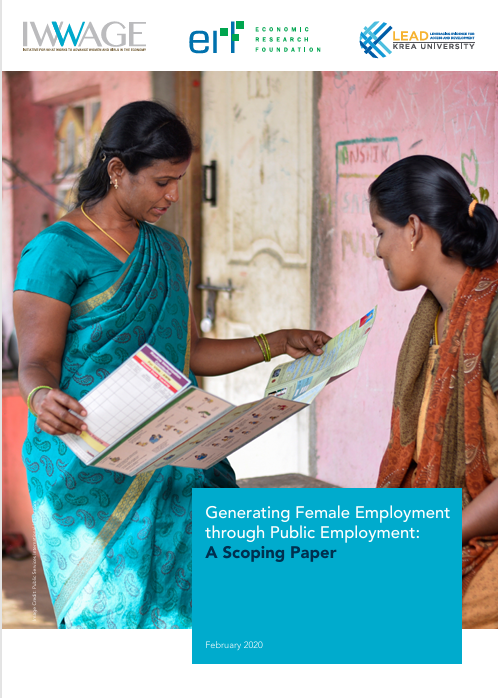
Generating Female Employment through Public Employment: A Scoping Paper
- February , 2020
- Dipa Sinha, Jayati Ghosh, Mohini Gupta, Varsha Gupta
The employment generating potential of growth in India has been on the decline with unemployment and the lack of new job opportunities at their peak. According to the data put together by the State of Working India 2018, the relationship between growth and employment generation in India has weakened over time. A related puzzle is that of declining female workforce participation rates in the country, despite increasing education levels as well as economic growth. A major concern for the direction and pace of economic growth is how work and labour force participation rates of women can be improved. Employment in the government, especially in public services delivery, is a potential area where jobs can be created. An emphasis on creating work opportunities for women in public administration and frontline public services can serve the dual purpose of providing universal access to quality public services and reviving demand in the economy. IWWAGE study, Generating Female Employment through Public Employment aims to estimate the impact of creating and regularising jobs for women within the system of public administration, especially in frontline public services delivery. It considers questions on the activities and working conditions of women workers in frontline public services, assesses the number of such workers, and compares them with international estimates. The study also evaluates whether there is gender stereotyping in certain public sector jobs. Additionally, the study captures women’s perceptions of the benefits and constraints of being employed in such jobs. This scoping paper presents the current status of women employed in various levels by the government, based on data from the National Sample Survey (NSS), analysis of government reports, publications, and responses to queries raised using the Right to Information (RTI).
The employment generating potential of growth in India has been on the decline with unemployment and the lack of new job opportunities at their peak. According to the data put together by the State of Working India 2018, the relationship between growth and employment generation in India has weakened over time. A related puzzle is that of declining female workforce participation rates in the country, despite increasing education levels as well as economic growth. A major concern for the direction and pace of economic growth is how work and labour force participation rates of women can be improved. Employment in the government, especially in public services delivery, is a potential area where jobs can be created. An emphasis on creating work opportunities for women in public administration and frontline public services can serve the dual purpose of providing universal access to quality public services and reviving demand in the economy. IWWAGE study, Generating Female Employment through Public Employment aims to estimate the impact of creating and regularising jobs for women within the system of public administration, especially in frontline public services delivery. It considers questions on the activities and working conditions of women workers in frontline public services, assesses the number of such workers, and compares them with international estimates. The study also evaluates whether there is gender stereotyping in certain public sector jobs. Additionally, the study captures women’s perceptions of the benefits and constraints of being employed in such jobs. This scoping paper presents the current status of women employed in various levels by the government, based on data from the National Sample Survey (NSS), analysis of government reports, publications, and responses to queries raised using the Right to Information (RTI).
Brief
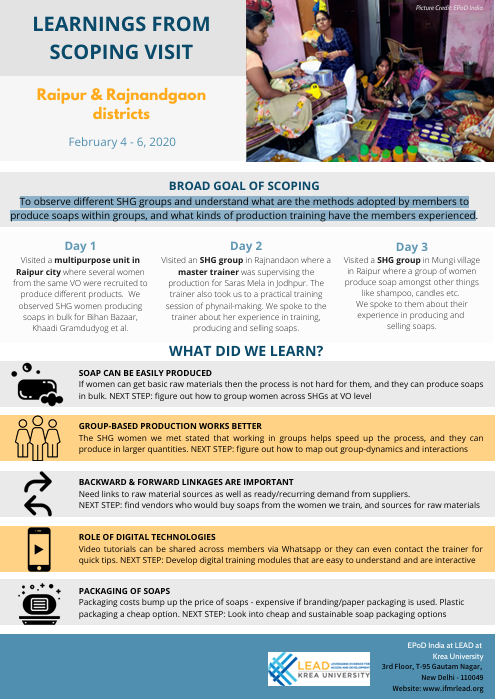
Learnings from Scoping Visit
- February , 2020
To observe different SHG groups and understand what are the methods adopted by members to produce soaps within groups, and what kinds of production training have the members experienced
To observe different SHG groups and understand what are the methods adopted by members to produce soaps within groups, and what kinds of production training have the members experienced

Learning note
Female Labour Force Participation Rate and Earnings Gap in India
- February , 2020
Despite high economic growth, decline in fertility, and rise in schooling of girls, the Female Labour Force Participation Rate (FLFPR) in India has declined in rural areas and stagnated in urban areas since the late 1980s. This is contrary to the global experience, where similar factors resulted substantial increase in the FLFPR. The recently released Periodic Labour Force Survey 2017-18 confirms the declining trend and shows FLFPR declined in all states with the exception of Madhya Pradesh and Goa. Women’s engagement in unpaid work is high in rural areas and while a majority of women are employed in regular wage work in urban areas, there are substantial wage differentials between men and women, most of the regular work of women is in the informal sector, and non-wage benefits are poor.
Despite high economic growth, decline in fertility, and rise in schooling of girls, the Female Labour Force Participation Rate (FLFPR) in India has declined in rural areas and stagnated in urban areas since the late 1980s. This is contrary to the global experience, where similar factors resulted substantial increase in the FLFPR. The recently released Periodic Labour Force Survey 2017-18 confirms the declining trend and shows FLFPR declined in all states with the exception of Madhya Pradesh and Goa. Women’s engagement in unpaid work is high in rural areas and while a majority of women are employed in regular wage work in urban areas, there are substantial wage differentials between men and women, most of the regular work of women is in the informal sector, and non-wage benefits are poor.